
Pierce v. Society of Sisters: The 100th Anniversary – Was Pierce a mistake?
PANEL 6
Concluding the discussions, this panel will focus on the question of whether Pierce was a mistake. Did the Court strike the appropriate balance between the interests of the state and families, children and parents, the secular and religious spheres, and liberty and equality? Considering both the opinion and its legacy, where has it failed and where has it succeeded? Where should we go from here?
Moderator: James A. Sonne, Stanford Law School
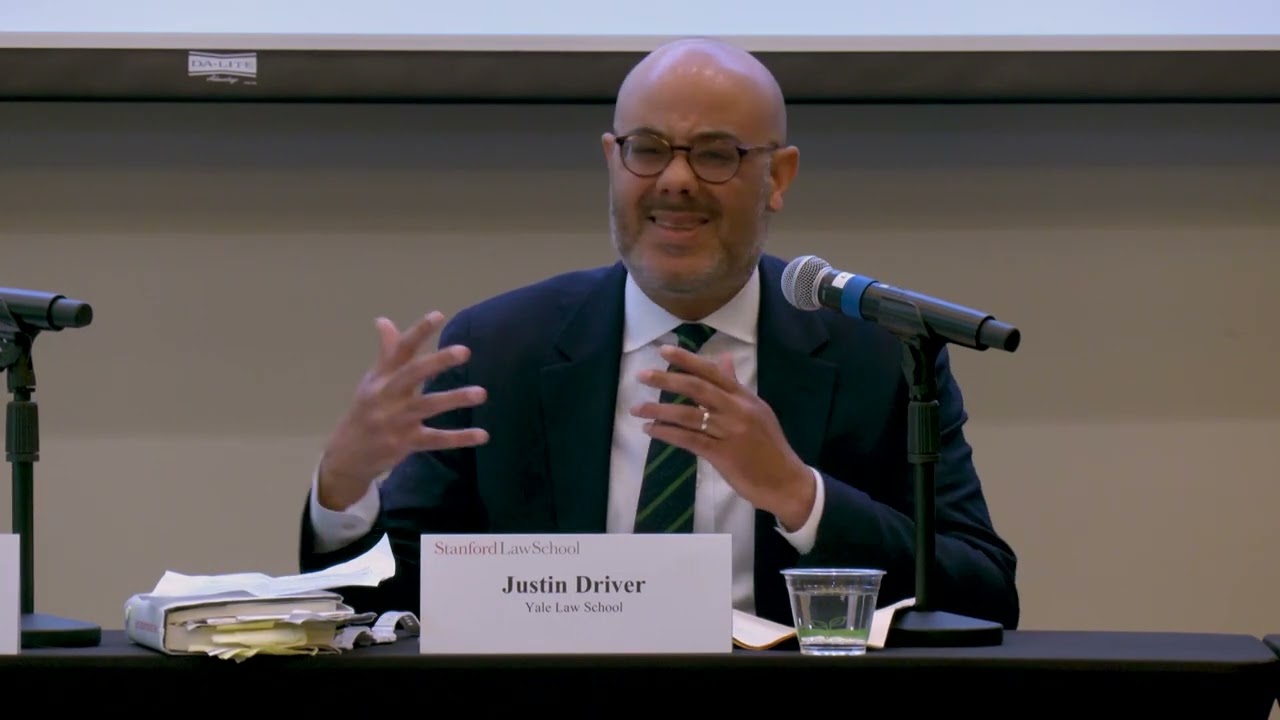
Welcome everyone to our afternoon panel. I’m Jim Sonne. I direct the Religious Liberty Clinic here at Stanford. And it’s a joy to have all of you here. So this afternoon I have three distinct honors. The first is to welcome you all again to Stanford. We have a special thing going in the law and religion space as I think you can see most importantly profoundly with Michael’s leadership.
And it’s been my joy to be part of this community, the last 12 or so years, and by extension part of the larger law and religion community that I think this conference speaks so, so well too. I can’t imagine a more star-studded group of panelists, moderators and and participants and audience members, right?
That was the point that Questioner was making. My second honor, of course, is to join all of you in commemorating, celebrating, and yes, criticizing Pierce the rates and robust discussion. We’ve been having so far, speaks to how compelling, enduring, and endlessly fascinating pierce and its range of dynamics and implications are.
My third and final and most immediate honor, of course is to moderate this afternoon’s esteemed panel. And we are charged with the question, was Pierce a mistake? And although that might seem a straightforward inquiry, it raises a host of sub-questions, A mistake, how methodologically, doctrinally, philosophically, politically, culturally.
Fortunately, we have the ideal panel to lead us through this, these many facets of the question. With that, allow me to briefly introduce each of our panelists, who will then share their thoughts and we can have a conversation with q and a, which I suspect will be robust despite hours being the closing panel after lunch.
So no pressure. In the, in alphabetical order on which the panelists will speak, allow me first to introduce Professor Justin. Driver. Justin is the Robert r Slaughter professor of law at Yale Law School. He’s a graduate of Brown Oxford, Harvard Law School, and notably also earned a Master’s in Public Education at Duke.
Professor Driver also clerked for Judge Merrick Garland and Justices O’Connor and Breyer. Professor Driver teaches and writes in the area of constitutional law. And notably for our purposes is the author of the award-winning book and titles, the Schoolhouse Gate Public Education, the Supreme Court, and The Battle for the American Mind.
I think I see it right here, schoolhouse Gate. So from this book, title Alone and Justice background, you can tell we’re in for a treat. Next it’s my joy to welcome to the panel my friend and proud Stanford graduate Professor Nicole Garnett. Nicole is the John P. Murphy Foundation Professor of Law at Notre Dame Law School, where she also serves as the Associate Dean for external engagement and directs the Notre Dame Education Law Project.
She’s also, I must add a core part of Notre Dame’s Religious Liberty Clinic an honors graduate of Stanford and Yale Law School as well as a former law court to Judge Arnold on eighth Circuit and Justice Thomas. Professor Garnett is a prolific scholar and leader in the school choice movement.
Notably for our purposes, she’s written groundbreaking works on law, religion, and education. One of her most recent accomplishments was co-editing the book, the Case for Parental Choice God, family and Educational Liberty. Again, enough said. Last but not least, it’s my privilege to welcome our third panelist, professor Steven Smith.
Steven is the Warren Distinguished Professor of law at the University of San Diego School of Law, as well as the co-executive director of both its Institutes for Law and Religion and Law and Philosophy. A proud honors graduate of Brigham Young University and Yale Law School, as well as a former law clerk to late night circuit Judge Joseph Snead of the power and range of Professor Smith’s scholarship, including on the deeper implications of Pierce itself.
Makes him an ideal closing, closing panelist. So without further ado, Justin. Okay, thanks so much. I’m really delighted to be with you all today, and thank you to Professor McConnell for assembling this wonderful group. I’ve learned a lot over the last day and a half I’m really just honored to be here.
When we’re thinking about whether Pierce versus Society of Sisters was mistaken, you could view the mistake, the potential mistake in a couple of different ways. Of course, one would be mistaken with respect to outcome, and another would be mistaken with respect to rationale. It seems to me that the outcome, the idea that it was a mistaken outcome is the more.
Rich and unusual position. And that there are some liberals who have taken that position that Pierce versus Society of Sisters, the measure at issue in Oregon should have been upheld rather than invalidated. I’m gonna speak about some of these luminaries including justice Frankfurter, then Professor Frank Ferter and also Dean Erwin Chasky from just down the road.
But before I do that I wanna mention a couple of things, setting the scene. I do think that the, the rationale, as Nathan Chapman said yesterday has been for Pierce versus Society of Sisters, has been widely ridiculed. And this makes me think that we often overvalue the content of the opinions themselves.
I’m working on a piece that’s forthcoming in the California Law Review called the Insignificance of Judicial Opinions. That. What these opinions actually say is often although of deep interest to law professors and our law students, neither here nor there, not only with respect to the larger public, but even the esteem with which opinions are held in legal academia itself and in the legal profession.
I think about Brown versus Board of Education in this way. And Pierce versus Society of Sisters also belongs here. Pierce may not be quite brown with respect to pledging allegiance to that view being a requirement to be in good standing in our constitutional order, but it’s right just below brown.
I think. It seems to me that the real action is finding the appropriate rationale or textual sort of hook for the outcome rather than questioning the outcome itself. I also am grateful to Zalmon on the last panel for mentioning the Farrington v Tge case from 1927. We’ve basically spoken about Meyer and Pierce as a duo, but I think it’s actually right to think of it as a trio of opinions.
And Farrington versus Akhi is 1927, so only two years after Pierce. And there we are thinking about language schools out of Hawaii. And I think that this is one instance where the order of operations may matter quite a lot. After there was this law that said that it’s he heavily regulating schools that teach Japanese in Hawaii many of these language schools just lay down and thought the fight was over, but the existence of Meyer.
And Pierce being on the books made a tremendous difference. And I should also say that the Farrington v Tge case was widely unpopular at the time. The racial element of the Farrington v Tge case was a significant thing. The New York Times said that it was a mistake that this was going to make Hawaii a very difficult place to be part of the United States a territory at the time.
And so that was not an unusual view. I am grateful to this trilogy of opinions. I believe that Pierce versus Society Sisters was correctly decided along with Meyer in Farrington v Tge because those opinions serve as a gateway for thinking about. Judges getting involved in the regulation of the nation’s public schools as a whole.
These are cases all involve private educational entities. But for a long time the view was that education is the singular province of states and localities and that it would be impermissible for federal judges to have anything to say about that whatsoever. You find that in the coming to, in the coming versus Richmond County School Board case from 1899, this is a case out of Georgia where there was a black high school and a white high school.
The locality closes the black high school leaving only the white high school. And the question is, does this violate the constitution? This is sometimes referred to as separate and unequal. Three years after Plessy v Ferguson and Justice Harlan, the Revere, justice Harlan writes an opinion for the court saying that this is a local matter.
We have nothing to do about this whatsoever. Meyer checked. Measures that were found in 33 states at the time. Obviously there’s a tremendous amount of concern about German. That’s it was mentioned yesterday. There was an effort to purge English of sort of roots. I. Of words with German roots, including sauerkraut was meant to be re christened, liberty, cabbage.
There was an effort to say we shouldn’t use kindergarten anymore, we should say preschool. So this was, deeply felt and I. It was found not only in three, three states, but many luminaries thought that of course, these laws were permissible. The mighty tr Teddy Roosevelt said that we have room for but one language here, and that is the English language.
And if we don’t have these sorts of laws that we’re going to no longer be an American people, and instead we will be dwellers of a polyglot boarding house. He said it’s a tribute to how deeply felt this was. Robert Post yesterday mentioned Elwood Covery. I haven’t forgotten. Elwood Covery the Stanford law professor, the finest education professor maybe in the first half of the 20th century, and his master work.
Public education in the United States. He said that these laws were essential. Otherwise. He says, we’re going to lose our national character. And he felt so strongly that even after Meyer was handed down, he said that this is in effect. He says it’s almost incomprehensible that the federal judiciary would think that it has anything to say about the educational realm whatsoever.
He again used this incredibly evocative language. He says that the existence of the non-English languages in the United States is a problem because our national digestive organs have broken down. He said. So this is a huge decision and it is emblematic of the Supreme Court’s ability to protect minority rights, resisting a dominant view.
Some have attempted to paint Pierce in a very different way and say, whereas in Meyer there were 33 states that had these language provisions. It was only Oregon that had a law that required people to attend public school. And so we should view this as a constitutional outlier. This is in effect just a mopping up.
Operation. And this was just something that those yahoos up in Oregon were attracted to, and this was idiosyncratic. I don’t think that’s the right way to view the situation. There were many Catholic leaders at the time who were deeply concerned that if this law was upheld, that it would spread like wildfire throughout the country.
And the great state of California and Washington, among about a dozen other states had efforts underway to say that students must attend public schools. The Los Angeles Times in 1922 wrote that many people regard the measure as the first step in a campaign to close all private elementary schools over the entire country.
Thus, they invest the movement with a national significance. And so I think that the outlier idea is a helpful one, but it’s also an umbrella term and that we would do well to distinguish. What I would refer to as outliers on the one hand from upstarts on the other. Sorry. Holdouts on the one hand versus upstarts on the other.
Holdouts and upstarts. A holdout is a measure that would be found in many places once upon a time. And then it has retreated to be found in only a tiny number of jurisdictions. You might think of Griswold versus Connecticut as falling into that holdout measure where states on their own have repealed this, but an upstart measure as in Pierce could become quite prevalent.
You also see this phenomenon in the Plyler versus Doe decision, another decision that constitutional law scholars say, oh, it’s just those, crazy people down in Texas that were attracted to this. That strikes me as wrongheaded. And I believe that the Pierce decision stepped in and in effect in turd a measure that would have had potentially quite widespread appeal.
Let me talk a little bit now about Dean Rinky, who I respect greatly. And he wrote a remarkable piece in 2003, making the case that Pierce was in effect, wrongly decided. His principle concern in this essay was the paucity of racial integration in the country. He says, we have lots of school districts in the country.
I. That have very few white students, and there’s an existence of what some scholars today would refer to as apartheid schools, nearly all black and all Latino schools. And it is the escape valve of private education. Rinky would say that makes this a possibility. He also was concerned about the Rodriguez decision and school funding, and the basic idea was that if everyone were attending public school then people would use their voice use their voices to have more equitable approaches to school financing.
I share many of Dean Shamsky’s concerns about the. The lack of racial integration decades after Brown versus Board of Education. Nevertheless I am not on board with this idea that he acknowledges is a radical one and in no danger of being adopted of Pierce being wrongly decided.
And I also believe that there are a number of unstated assumptions embedded in this idea that if everyone attended public school, then there would be meaningful amounts of racial integration. Would it also require the complete abandonment? I wonder of the neighborhood school as a phenomenon. Schools are not of infinite size.
And given the persistence of residential segregation in the nation, if you have the neighborhood school there is going to be issues along those lines. It’s also true that just because people attend the same school. Does not mean that they’re going to be in the same classroom together.
There is a phenomenon called tracking where people are placed theoretically, at least according to different skill levels. And I have it on good authority that there are many gifted and talented classrooms in schools with large black populations, but the gif, gifted and talented classrooms have no black students or ah, black student.
So we shouldn’t regard that as being necessarily leading to the type of integration that rinky would prioritize. It’s also true that people would speak about, white flight and whether that would could be a more widespread phenomenon. Certainly in the age of people working remotely from home, it seems to me that you could imagine people moving further and further away from urban areas in order to maximize schooling outcomes for their children.
But that, that would have the negative effect, I believe, on racial integration. The core issue here and the lack of racial integration in our public schools is not due to, I think our legal regime. It is a failure of political will to realize the ambition of Brown versus Board of Education.
I was a law clerk when the parents involved Case from Louisville and Seattle was decided in 2007. And unfortunately, the sorts of pro integration programs that Louisville and Seattle had were very unusual. There are mechanisms that schools could take if they were truly invested in promoting racial integration.
But they have not done so. Dean Shamsky, in his essay, his provocative essay, noted that one objection would be that wealthy parents would still have access to camps. And enrichment programs and things of that nature. And I, that’s an important objection. Rinky doesn’t go here, but you could imagine other people saying, and therefore we should get rid of these enrichment programs and camps as well.
And my response would be with Justice McReynolds the child is not the mere creature of the state. Let me talk briefly. Actually one, one more item on an underappreciated legacy of Pierce Versus Society of Sisters, which appears in the Southern Manifesto, which I’ve written about.
This is a document from 1956 that says, in effect, brown versus Board of Education was wrongly decided. And the framers of the Southern Manifesto seem to me to, they don’t cite Pierce, but they use the language of Pierce to say that the regime of Plessy versus Ferguson here I’m quoting, is founded on elemental humanity.
And common sense for parents should not be deprived by government of the right to direct the lives and education of their own children. That is almost. Parroting the language that appears in Pierce itself. And of course the right to control one’s children is not absolute. And the Court and Brown versus Board of Education refused to recognize this, although this was a common view at the time, including one floated by Senator Sam Irvin of North Carolina who was very invested in this project.
Let me briefly turn to the old Professor Frankfurter wrote a remarkable essay in the New Republic in 1925, published the same month as Pierce Versus Society of Sisters. It was titled, can the Supreme Court Guarantee Toleration? His answer to that question ranged between No and hell no.
It seems to me and he’s concerned, of course, about the Lochner era. I. And the Supreme Court of the United States invalidating legislation and we afford too much authority to the Supreme Court of the United States. It’s an ode to judicial restraint in many ways. He shares the view that the Oregon legislation was wrongheaded, but thinks that this was not the right way to address this matter.
He says Frankfurt or us in rejoicing over the Nebraska and the Oregon cases sorry. We must not forget that a heavy price has to be paid for these occasional services to liberalism. He goes on to say, anticipating something that is very much Koran in some of our fine law schools today.
He says, here is ample warning to the liberal forces that the real battles of liberalism are not won in the Supreme Court. I. To a large extent, the Supreme Court is the reflector of the general drift of public opinion. Only a persistent positive translation of the liberal faith into the thoughts and acts of the community is the real reliance against the un unabated temptation to straightjacket the human mind, we have to win over the hearts and minds of our fellow citizens.
Rather than only worrying about the judges is the claim that Frankfurter makes. And again, here I think that this is wrongheaded and that there are instances where the Supreme Court can issue a decision that checks majority impulses and defends minority rights. The, it’s true that Pierce was widely celebrated, though not universally celebrated.
There was an article in the Virginia Law Register, the forerunner to the Virginia Law Review that as all things in Charlottesville turned to, they think about the sage of Monticello. It says, we wonder whether the soul of Thomas Jefferson would’ve wept aloud if it could see the interference of the federal government through its courts, with his pet school system.
So there was an idea that this was a contested idea. And I am grateful that the court interred this idea. And so in, in closing, I would only add that I’m grateful for this conference today given that just as in the 1920s, it seems to me that we are in a renewed era of xenophobia and even neo nativism, and that the courts will have an important role to play in protecting minority rights as they did a century ago.
Thanks. Thank you, professor Driver. Thank you, professor Garnett. Okay. Thanks. So I, we’ve been asked to, to talk about whether Pierce is a mistake, and I think a lot of what I would had planned to say has been anticipated over the last couple days, but I think I’m gonna, I’ll take of this in two ways.
The first is the methodological question. It seems like everybody agrees that it was a methodological mistake. But if we think it wasn’t a mistake and substance, then what are the possible alternatives to. What I take to be substantive due process. And the second, which I find really interesting and challenging is whether the scope of it was a mistake.
That is to say what with the pierce rights too broad or too narrow. Before I do that though, I do wanna just say something that Eric mentioned this in his talk, but I wanna make an observation about in terms of parental choice and parental rights, how different the world is that we are living in than the one we lived in five years ago, let alone in 1925 a hundred years ago.
So if we think about p Pierces about parental choice and parental rights and parental choice, just keep this in mind. At the time there were no real choices for parents except paper, private schools and or send your kid to a public school. And now law tried to take away the first and that was the case all throughout.
The 20th century, well into the time when I graduated from public school in the, in 1988. And there, that has completely changed. And not because of parental lights litigation, but because of legislative victories. As of two hours ago, 35 states have at least one private school choice program.
And with Texas joining the roster two hours ago, about 50% of American kids qualified to participate in them. Currently, about 1.25 million kids and counting use public funds to attend a private school. 3.7 million kids go to charter schools. And this just to point out that much of what Pierce, the fight in Pierce about parental choice is being achieved, but it’s being achieved in politically, not in the courts.
And I, and that informs the way I think about the other questions. Doctrinally, is it a mistake? So I’m an originalist. And so I am I’m I. Judy Bounds, I believe. Of course it was. I don’t believe in substitute process. I agree with Justice Scalia that substitute process is an oxymoron. And I agree with Justice Leader that it has caused no end of mischief in the law.
That doesn’t mean that I don’t believe in unen enumerated rights. I clerk for Justice Thomas, and it may not surprise you to know that the question that un enumerated rights is the one that most deeply divides our tribe. I am on team un enumerated rights. I have four kids and I think parental rights are among them.
I have four kids. All of them went to Catholic schools their entire lives, several of them for 16 years. And I’ve been in a par at Saint Jude Grade school for longer than I could possibly even remember. And I will be for 21 consecutive years ’cause God really loves me anyway. So if they’re not found at the front rights aren’t found at the due process clause, where might they be found?
And I can think of a few, and they all have implications for the second part of the question, which is whether it was the scope of Pierce was wrong. Of course the first, which is already even mentioned many times, is the privileges or amenities clause of the 14th Amendment. This is appealing to me as a number for a number of reasons not least of which is that I’m a Justice Thomas clerk at an Institute for Lawyer justice this Institute for Justice alum.
So one of the, we might view this in terms like David Smolin did of think about Justice. Thomas’s opinion in a McDonald is as why what rights. Partially granted in the idea that the rights protected by the 14th Amendment were rights denied to slaves. I would summarize that per portion of justice Thomas’s opinion in McDonald as black people need to pack heat.
I think it’s clear that PA slaves were denied parental rights. That was one of the cruelest aspects of slavery. So it’d be reasonable to conclude that the people who ratified the 14th Amendment understood and sought to ensign that freedom, that liberty, that the autonomy in the 14th Amendment. But then this raises all kinds of questions that I don’t have a good answer to.
For example, as Justice Barrett ask and Broin, if we were to interpret the privileges or immunities clauses protecting these rights. We to interpret it against the founding a La Bushrod Washington, or the time of the ratification of the 14th Amendment. Which I think I favor. Even though it might mean that rights protected against state incursions are different than rights protected against the federal government.
If there are rights protected in the 14th amendment’s privileges or immunities clause, they might be relatively limited. I haven’t done the work. I agree that David, that there is a need for it. Second option, which has also been mentioned today and yesterday is parental rights are religious liberty rights.
I think Pierce could be interpreted as having been decided as a religious liberty case. One of the plaintiffs was a religious congregation, and it’s clear that the anti-Catholic, history motivating this law and motivating the movement. It wasn’t just, obviously it wasn’t just in Oregon. There was a general movement.
It had roots in anti Catholicism. And this maybe as Eric Beck points out, is what’s happening on the ground in federal courts, but it has some significant drawbacks. Chief among them is that parental rights rooted in the religion clause or free exercise clause. Don’t give parental rights claims to people who are making them for reasons unrelated to religion.
I think that’s problematic. What about non-religious parents who object to curriculum in public schools? Say it in Mahmud they won’t get opt outs in Mahmud. It’s not the question before the court, but perhaps they should. I is another personal, example is my brother is adopting his or seeking to adopt his stepchildren.
My brother is not religious. His wife is not religious. The biological father is not religious. They’re in a nasty termination battle, and I certainly wouldn’t want it to be that only religious parents can complain, about, I think the guy should lose, and he is not been it.
Particularly heroic figure in these children’s lives, but I do think he gets entitled to due process. So we should be cautious if we try to make the religion clause the hook, even if that’s what the courts feel more comfortable with on doctrinal grounds. The third option is suggested by the. The great Jack Koons and more recently by Philip Hamburger yesterday and today by Eugene, is that parental rights are free speech rights.
So Jack, if you don’t know Jack, you should read my, my, the book of that Rick and I, my husband and I, edited of his essays that that Jim was kind enough to mention. He argues that parents speak through their children, that the formation of their children is a way of parents expressing themselves to the world.
I commend to you a short essay that he wrote called School Choice as Simple Justice that makes this argument and it’s very beautiful. I really, this seems intuitively appealing to me as a parent, although I’ve learned as my children age that the ability to control my children through. Speech is quite limited.
So Philip Hamburger has more recently argued that public schools are unconstitutional on free speech grounds. He says education consists mostly in speech to and with children. Parents enjoy freedom of speech and educating their children, whether at home or through private schooling. And he goes on to make this case that means public schools are unconstitutional.
The problem with that argument is no court is ever going to endorse it as a theory of parental rights as originalist. I think that’s correct, although I will point out, as Eugene did, is that some private school regulations might violate the free speech clause. This is being tested right now in the first circuit in the post Carson litigation.
Okay, so that’s, so with those musings about methodology and doctrinal grounding, I wanna turn to the second part of my answer to the question was Pearson mistake. And that’s a question about the scope of its rights. So I teach property law, so I tend to teach, think in terms of property law, terms about rights.
So I tell my, I ask my students, what is the scope of your property, right? What is the scope? How big is it? How little is it? What it’s, how are the law restricted? And if it restricts it too far, is that taking it away from you? So I think if we ask the scope question we would ask whether Pierce was a mistake, either because it is too big, too broad, or too narrow.
And Justin talked a little bit about the, some of the consequences of its breadth. I actually think it can’t really be said that it was too broad. It’s pretty narrow. I take Pierce to mean that parents have a right to send their kids to non-public religious schools, not to be taken away without due process.
And you can’t make your parents parents share their kids with their grandparents. There’s some people who object to the opt-outs in Pierce. I mean that because of the consequences for for desegregation or maybe just Amy Guttman who would say that it, we really would all be better off as a society if we had this common experience of going to public schools.
I’m not one of them. I’ve given my whole life to the case for parental choice and education. But what else is there? So there’s a great Steve and I participated about a year ago in a conference on Pierce as a, at a hundred Pearson Meyer and Chip Lupu had a good paper in that conference, which I commend to you.
It’s actually goes through what the lower courts have done with Pierce and it’s pretty thin rule, so it’s not clear that you have the right to homeschool, although homeschoolers have achieved that. Legislatively constitutional challenges to homeschool regulations even bans were not successful.
No parent no. Typically demands for parental opt-outs of public school curriculum on parental rights grounds have failed. I do think after Mahmud, there may be a limited religious liberty right to do but I expect it to be relative. Pretty limited. No. To have your state fund, your exit options.
More on that in a moment. I would point out there were parental rights claims in Retti. I think Eric’s here in Mahmud. Yes. Were there parental rights claims in Mahmud? I, yeah, so I, I actually think that’s instructive. The court didn’t grant the parental rights claims in those cases for a reason. I don’t think it wanted to get into that thicket.
I think it didn’t wanna have to rule on those claims. It might have made them articulate more clearly the scope of parental rights and under Pierce and perhaps even narrow them. And that’s just something the court’s not attracted to doing? Yes.
Okay. So it was there never made it up. Okay. But there were parental rights claims in Sremm and there are parental rights claims. IJ and others have made demanding op-eds for certain things like mandatory service. Okay. Those are just musings. So what about too narrow? As an originalist, my actual answer to that question would turn on the answer to the doctrinal question.
Parents’ rights ought to be as broad or as narrow as the people who ratified the 14th Amendment privileges or immunities clause understood them to be I haven’t done this work. It’s possible that the scope of that right is narrow than I would like them to be. I really do think this is work that needs to be done, especially if the court is more interested in the privileges or immunities clause.
Just to give one example, I just read a paper about this. Parents writes challenges to seeking curricular opt-outs in the 19th century uniformly failed. There were usually Catholics that demanded opt-outs from reading the Bible, king James Bible, and these were ridiculed by courts in opinion saying things like, the Bible is obviously the foundation of American democracy, so have we possibly it, it’s like they’re called lu ludicrous.
So I don’t know that they’re as broad as I would want them to be. But what might a broader pierce rights look like? No one will tell me this, and I find that quite frustrating, except that in an individual case, it looks like A, B, or C. So do you, if you have the right to opt out of public school curriculum on non-religious grounds wolf from what?
Just the LGBT storybooks or what about if your evolution math. English. I just so you know, I think that becomes quite difficult. It becomes quite difficult to run a public school system where you have pervasive opt-outs. What do you, so I give example, I said this morning, what about your kids socially transitioning at school?
Do you have the right to no. Do you have the right to access medical treatments for gender transition? Do you have the right to say no to vaccines? Do you have the right to homeschool, the right to fund kids for public funding, for your peers rights? All of these arguments have been and to some extent are being advanced by advocates and they each take us back to the question of scope.
And I think for example, just to give a couple examples, what about homeschooling? Does that exempt me from being regulated as a homeschool parent? If I have the right, the fierce constitutional right altogether, sometimes when. This is actually being tested right now in Illinois, which is seeking to make homeschooling parents submit to the supervision of local school districts.
If I have a right to public funding as a peer to public funding of my opt out rights, which is not going to happen in this court or any, but we could muse about it. So how much money under what circumstances do we really want a constitutional rights of public funding? Dur all? There isn’t a constitutional right to education.
I think that’s been fight about whether that’s been good or bad. But if we look at what has happened in the public in litigation, the funding equity litigation, state courts over public education funding, it’s completely a morass. Do we want our battles over parental choice to be stuck in that morass? Do we really want court ordered and structured parental choice programs?
Would we get less or more than we just got in Texas today, which is a $10,000 education savings account for every kid in the state up to a billion dollars. It’s a lot of choice. The same thing might be said about homeschoolers who’ve secured maximal freedom from government intervention, which I think is far more than when they have what they would’ve gotten from courts.
So I don’t know what I think about the scope of the right. This, the pierce. I just want closing, just thought about analogizing it to free exercise. So a lot of people think, including many people in this room, Michael McConnell, chief among them is that Smith was terrible and that we should overturn Smith and bring back strict scrutiny.
I sometimes wonder though whether or not that might lead to. Fewer victories than we’re getting as religious institutions are getting now under most favored nation status. For example whether or not it might, as Justice Scalia was concerned, lead to a watering down of strict scrutiny.
Those are prudential questions unrelated to the question of whether Smith was correct doctrinally or as a matter of original public meaning. So in the end, all of these questions just leave me frustrated that nobody will tell me or no, or articulate what stronger Pierce rights would mean on the ground, and also just a little bit anxious that we might be advised to be careful what we wish for and asked for.
So thank you. Thank you, professor Green.
Professor Smith. It occurred to me that being the last speaker in the last session of a conference that’s been as I, I think, informative and rich as this one has been, is a disadvantage and an advantage depending how you look on it. Look at it, it’s a disadvantage because probably almost any point I might wanna make has already been made more eloquently by previous speakers.
But it might be an advantage because almost any point I wanna make has already been made more eloquently by earlier speakers. And so I have the luxury of just incorporating by reference a lot of what’s occurred. And I’ll probably do a fair amount of that in this little presentation. Nicole mentioned that she and I were both at a conference on almost the same topic on the opposite coast, just over a year ago.
And for that conference I wrote a paper called. Meyer Pierce in the Formation of Persons. And I could use that as the title for my remarks here too, because turns out I haven’t really had any brilliant insights in the intervening year about Pierce and new insights. And I and I think it’s safe to say that I.
Probably hardly anyone, if anyone in the room has read that article. And so I’m gonna give a distilled you I was obligated to. Yeah, okay. Anyone who wasn’t forced to read it probably has read it. So I’m gonna give a distilled version of that and I wanna do it under four headings or four sections.
So the first section is the conundrum, the second is the explanation. The third is the very imperfect liberal answer. And the last section is the unease legitimacy of Pierce, which is the hopefully dealing with the was Pearson mistake. So first of all, the conundrum I want to explain this in terms of two points and because there’ll be recurring points, I thought it might be good to give them labels.
So I’m gonna say one point, I’m gonna call it the A four Shire point, and the second one is the constitutional silence point. So the A four. Force Gii point basically says that if government restrictions on the expression or the manifestation of personhood, present potential threats to human liberty and therefore have to be guarded against and ought to follow a force gii the government control over the formation of persons presents potential threats to the to human liberty and human autonomy.
And should it’s even more important than to those be guarded against if the government, places restrictions on the exercise or manifestation of personhood that may limit what I can do or what I can say. But if government controls the formation of persons that determines who I am, that would seem to be a more serious threat to personal liberty or personal autonomy, and therefore more, more urgently to be guarded against.
But the second point is that the Constitution has a lot of provisions that deal with potential threats to the exercise or manifestation of personhood. Free speech, free exercise to bear arms, et cetera, et cetera. But it has really nothing. I think that bears on directly on the formation of persons.
Now one of my favorite quotes is one from one of my law school professors SFC Millen, the legal historian who had a quote saying the life of the common law has been in the unceasing abuse of its elementary ideas. And I take it that’s true for constitutional law too. So if we need to find provisions from the Constitution to address the problem of formation, we can find them.
But as Mark Storslee pointed out yesterday, they aren’t really designed for that. There, there’s not the Constitution is pretty much silent on that point. I tried to illustrate this conundrum with a sort of futuristic hypothetical, imagine that in a state polarization has intensified so that the state is on the verge of civil war, there’s increasing political violence.
I. Even assassinations, and it seems that the government has to do something about this problem, but what can it do? Let’s suppose it passes a law prohibiting the expression of potentially inflammatory or divisive opinions. That would clearly go against the free speech clause, and it would go well beyond what the Brandenburg Doctrine allows and so forth, so it would likely violate the First Amendment.
Suppose that instead a minister says. Let’s do this. We could put a pacifying chemical in the water, that would just occur. And I take it, this is scientifically possible in the drinking water, it was curve violent tendencies, or to be a little more futuristic. Let’s just insert the Gandhi nanobot into, our flu vaccinations and so forth.
It will migrate into everybody’s brains and the government will be able to control to some degree their thoughts and their emotions and so forth. And now the beauty of this approach is that every, there will be no violations of free speech. Everybody will be perfectly free to express any opinions that they want.
It’s just that nobody will want to express any, any antisocial or violent opinions because we will have ensured that they don’t have those kinds of thoughts or emotions. Everybody will be the sort of docile cooperative people that we want to have a healthy functioning society. Is there any constitutional problem in this?
You might think that there ought to be, but it’s not obvious what constitutional provisions address this. There’s nothing really on the formation of persons. Now, if we go from this kind of bizarres scenario to a more normal one. And just going back, go back to education, I take it that it’s already true that our public schools, our schools generally are trying to mold children into peaceful law abiding human beings who are tolerant and respectful of others and so forth.
And it’s also true that most of us have to take mandatory online training every year with respect to things like sexual harassment or campus violence or things of that sort. In this way, our personalities are being molded, but do we see these as serious threats to human freedom?
And maybe we don’t, and why not? And perhaps the answer is ’cause they’re not really very effective and we understand, that they’re not really going to shape us. And in fact, they might even be counterproductive. But what if we imagined that the science of pedagogy improved to the point, or they could be 99% effective.
We could be sure that children who go through the school system will be molded into sociable, peaceful yeah, again, docile, good citizens, or that the mandatory online training would shape us all into the kind of people that our universities want us to be. Would there be a problem then? And it would seem odd to say, no the government has power to do this because it won’t succeed anyway.
But if it got very effective at doing what it’s already trying to do, then there’d be a serious problem of formation. It seems again that there should be a constitutional problem here, but there’s nothing in the constitution to address it. Second section, the explanation here, I’m gonna quickly make three points.
One is it’s not surprising that the Constitution doesn’t contain provisions on formation because at the time the Constitution was being adopted, governments really didn’t have any, there wasn’t really a concern about government formation or person. It was more schools, parents, families, and so forth that were in the business and there were no Gandy, non Gandhi, nanobots available at the time anyway, and so forth.
So this was not surprising that the Constitution doesn’t address this problem. But secondly, liberal theory, generally, I think. Tends to steer away from this kind of problem. Liberal theory usually operates on the assumption of a universe of adults who are freely formed, who know what they believe, who know what their interests are and so forth.
And it tries to avoid, I think, generally dealing with questions of the formation of children. John Stewart Mill was quite explicit on this point in his classic on Liberty. He says very clearly that his discussion applies, quote only to human beings in the maturity of their faculties. We are not speaking of children or of young people be below the age, which the law may fix as that of manhood or womanhood.
But third, it’s not just liberal theory that tries to avoid this problem. In general, let’s just say this is a very hard problem. The problem of the formation of persons. It gets into questions like, what even is a person, how does a person get formed? It’s not as if you leave the state out of it, then people will be themselves, their true selves, they’re gonna be formed in one way or another by lots of other kinds of influences.
And how that ought to work and how it does work is a very difficult problem. So what to do? And now we come to what I’m calling the very imperfect liberal answer. And I, my suggestion is that liberalism tries to deal with this problem by adopting basically an anti-monopoly principle. Which in essence acknowledges that there are no very good or satisfying answers to these questions of personal formation.
But that various entities and so forth have a role. Parents, schools, teachers, the government here, I’m gonna incorporate by reference Nomi’s discussion of this sort of pluralistic reading and so forth. Maybe the church, all these things, all these institutions may have a legitimate role, but none should have a monopoly over the formation of persons.
Why not? I’ll just say two things. One is this is more conducive to freedom and that I think is actually a really complicated quite, I’m not gonna try and go into that much now, but the second one I think is maybe more intuitively accessible, which is, I think this is driven a lot by a concern about a avoidance of a sort of formation dystopia, the sort of 1984 world or the brave new world fear where one institution and maybe the state has complete control over the formation of persons so it can form them into to suit its own needs and preferences.
People become more or less creatures or puppets of the state, and the situation can’t be easily corrected because it’s the state that’s forming people, so you know, it can form them so as not to challenge it. The liberal, I think anti-monopoly principle is strongly motivated by a concern, I think, to avoid that kind of formation dystopia.
So finally getting around to the uneasy legitimacy of Pierce and Meyer and was Pierce a mistake. Now Pierce is usually understood I think as something that stands for the right of parents to direct the upbringing of children. And there’s been a lot of discussion of this of this sort of thing.
During the course of this conference. I think that, interpretation isn’t wrong exactly, but it isn’t quite right either. It’s at the very least very incomplete in a couple of ways. First, it’s not so much a rights decision, I think, as a limited power decision, saying that the state has no legitimate power to standardize children.
And Michael McConnell talked a lot about this yesterday, so I wanna incorporate his discussion here. Second, and once again, nomi’s discussion will be relevant here. It isn’t just about parents. It acknowledges that the state has a legitimate role. So do schools, so do teachers, so do parents. The Constitution is offended only when the state becomes too domineering.
It’s more in the nature of an anti-monopoly principle. I think you could think about Pierce as a kind of Sherman act relative to the formation of persons. The Sherman Act doesn’t tell businesses how to operate. It just said, they work that out for themselves. I. And up to the point where they managed to dominate the market and restraint trade.
And then the law will step in to stop that. But otherwise, it kinda leaves them to work things out themselves in the same way, I think Pierce doesn’t try to tell us how much or exactly what role parents have or the state has or the schools have, but it does suggest the state can’t have a monopoly over this, then the Constitution is offended. The state has no power to standardize people, and Meyer even gives, I think, the dystopian explanation that I’ve mentioned. It talks about Plato’s Republic and Sparta and so forth and says, it says men of genius have favored those things, but that’s not our constitution.
We’re opposed to that. Now, all this in the end is pretty imprecise and unsatisfying, but it may well be, I think, the best that liberal theory and law can do this sort of anti-monopoly principle. So if we ask, is this constitutionally legitimate? Or was Pearson mistake. And I think that depends a lot on your theory of the constitution, your view of the constitution of Constitutional interpretation.
And as we’ve heard here of law generally. ’cause I thought that what the Post said about that yesterday was really fascinating and very insightful and David Small and repeated some of that today I think. So it depends on things like that. Which of course can’t be worked out in a couple of minutes here by me.
I think everything that we’ve heard about substantive due process and uner un enumerated rights and so forth is all relevant to Pierce because the connection we do pierce in the constitutional text is admittedly quite tenuous. So all those discussions I think, become relevant here. But I do think, and this gets back to my first two points with respect to the conundrum, there is something distinctive about Pierce that I think may contribute to its legitimacy.
And so the first has to do again with the the A four CRI point. That if controls government control over the formation of persons seems to be a more serious threat to personal autonomy or personal liberty than restrictions on expression or manifestation of personhood, then it does seem to be urgently necessary that there be some kind of limits on formation.
And the second with respect to the constitutional silence point is this I think Pierce in some ways is in a different position than say, Lochner or Griswold or Roe or Obergefell, which were all decisions about the exercise of personhood. Again, Pierce is about the formation of personhood. So those other decisions all have at least a potential kind of expresso onus problem.
You might say, look, the framers and, later and actors did address the problem of expression of personhood lots of times over and over. They put a lot of thought into it and and the rights. Recognizing those decisions didn’t make the list. Now of course, constitutional the will find ways, to get around that and so forth.
But it is a strike against those kinds of decisions. With Pierce, on the other hand, I think you say, we don’t have that problem here. They didn’t think about that problem. They didn’t try to build any answers into the Constitution. So the fact that the Constitution is more or less silent with respect to formation rights doesn’t really count as an expresso type of objection to it.
And that in the end doesn’t mean that Pierce was necessarily correct or or that it was legitimate. But I think that they at least bear on our thinking about whether Pierce in relation to some of these other un enumerated rights or, the term we use now, I acknowledge it might not have been the term appropriate that some other time, whether that’s legitimate or not.
I think those two points, and again, most fundamentally the idea that this is about formation of persons, not about what most of our constitutional rights about is relevant to our thinking about that. Thanks.
Okay. I have a a brief question for each of our panelists, and then we’ll turn it over to q and a. Justin you distinguished rationale and outcome in talking about peers and I think generally stressing the latter. With that though, and your book title in mind, schoolhouse Gate Tinker public Education Supreme Court, and the battle for the American Mind speaks of a battle.
So how does the outcome of Pierce speak to the battle? So I would say that the outcome in Pierce is attributable to the way that there was a real divide in American society about the role that schools play in society. And so the clan was motivated by anti-Catholic animus and also by the idea that if people rub shoulders with real Americans then this will be beneficial for the American project.
And this is a clash or a battle that the Supreme Court saw a fit to resolve. And I think that one can see a similar battle for the American mind in the Mahmud decision for that matter, which is, which has come up. I this has come up a few times and so I do think it’s worth noting the prevalence of, these sorts of objections that are religious in nature.
There was some commentary yesterday that this isn’t going to open up the floodgates of religious objections to curricular decisions. And I think that’s exactly wrong. And I think that history is on my side here. I think it’s helpful to ground the decision in the, in some of these religious objections.
And here I’m drawing on the Moser decision, which objected to the Holt basic textbook series. And so the the offending text for Mr. Moser himself, Robert Moses, Robert Moser was, pat has a big book. Pat reads the big book. Jim reads the big book, pat Reads to Jim Cooks and this is troublesome.
Because Pat is a girl and Jim is a boy. And this gives a voice to the idea that it’s permissible for women to work outside of the home and to not adhere to traditional gender roles. And this is therefore a violation of my religious views. There have been objections also in that Moser case to a story called A Visit to Mars because this required people to imagine themselves on a planet.
And this is drawing on the occult. So I understand that some of the books in Mahmud people found deeply troubling and religiously troublesome, but that was the same true in Moser. It’s also worth noting that there were other books, obviously. One of the books in Mahmud, which has been mentioned was Uncle Bobby’s Wedding.
Where there are two men getting married to each other. And this was meant to be very troublesome from a religious perspective. There’s another book children’s book that was objected to in the 1950s called The Rabbit’s Wedding. This is a book that’s published in 1958. It featured a black bunny and a white bunny getting married.
And this was religiously objected because of it suggests that interracial intimacy is permissible. And so as people know, 1958 is some nine years before loving versus Virginia an incredibly hot topic. And the district court decision in loving versus Virginia gave voice to the religious objections to to interracial marriage.
So I do think that there’s a direct line from the rabbit’s wedding to Uncle Bobby’s wedding. And we are now a decade after the Obergefell decision itself. The last thing I’ll say is I was quite struck by one of the questions that Justice Jackson asked during oral argument in Mahmud, which was what are the boundaries of this?
Is this only a decision involving curriculum and the sort of clash of ideas there? She says, what about a male teacher who is married to another man? And there’s a photo in the classroom of that we, wedding day is, I have a photo of my wedding day in my office. Is that permissible for a religious objection to get a transfer to a different classroom?
And I think that’s a very difficult question. The lawyer said, no, that wouldn’t require that, but I’m not sure why. Because when you think about the one picture book in the form of, say, uncle Bobby’s wedding. And that being read or another book of, maybe the hundreds of books that are read in, in kindergarten during the course of a year that is a relatively small intervention compared to having a gay teacher on a daily basis who would talk about what he and his husband did over the weekend.
So it seems to me that the religious objection is even stronger to the teacher than to the existence of the Uncle Bobby’s wedding. So this battle for the American Mind, the reason I wrote this book is because the public school is the site of constitutional interpretation where these issues are come most to the fore.
Thank you. Nicole, you spoke of intuition several times, and the as you described it, the advancement of parental rights coming more through the legislature than through judicial decision making. And I guess in light of reflecting on Pierce why do you think that’s w why do I think that the advancement has been more legislative than yeah.
So first of all, I will say that I agree with a lot of what just had said. I teach education law, and I do say something like what you said. I always tell my student, every classroom’s a courtroom. There are a million constitutional law decisions in a public school classroom that are made in any given year.
What tech? So it does become very difficult. Mark, I respect the argument. You should max, I you opt outs for the solution. I just think eventually the best opt out is an opt out, which is to leave or, and to have public choice publicly funded choices. I’m not saying that they should be constitutionalized, I think pluralism is the answer.
To that problem if what work, but it creates its own problems. But so plural institutions is the answer that I embrace as a, as someone who pro believes in parental choice and education. And maybe bridging that to the answer to your question, Jim I’ll just tell a story about, I was talking to this guy named Doug Tuthill.
Now Florida has the most kids in parental choice in the United States. About 13% of the children in Florida. I have some publicly funded parental choice option. It’s an education savings account. Every kid in the state is entitled to $8,000 and Doug runs it. He runs the nonprofit that runs this education savings account program.
And he was telling me that in Florida it’s getting to the point where they’re really redefining what public education is. So people who are upset with the public school curriculum will leave to go to the Catholic school. People are upset with Rhonda Sandis are leaving to form DEI pod like learning pods, LGBT, micro schools.
And we were talking about like the sort of the plurality of educational options that are just exploding in Florida. And as a, I like that, but a court would never dream that up. So Jack Koons, who again, if you don’t know who Jack Koons is, he is, spends his life at Berkeley. An incredible person, an amazing scholar.
He and a guy named Steve Sugarman wrote up a book in called Education by Choice in the seventies where they proposed effectively what we’ve been calling education. We come to call education savings accounts but no one really thought they were coming. Maybe Jack, they’re visionaries at the time, but I think what we would’ve gotten in the parental choice context if the courts had gotten involved in terms of defining what our constitutional rights are would’ve been narrower, less creative.
I think federalism, the pluralism of the way we deliver education in the United States is likely to create and generate more options, more creative options. I think having some kind of floor, which is, look, you have the right to leave. I. Put pressure on legislatures to say, do you really, that was always Jack’s argument.
Who has the right to leave? Like the families that have the money to leave, that’s unjust. So that then you put pressure, especially after COVID where parents, as someone said, looked, could see what was going on in those classrooms. And that puts pressure on the legislature to be creative about how to o operationalize those rights.
I, I think it just, if we had gotten more, at least in the pub, mandated publicly funded choice from Pierce, we would have ultimately less than we just gotten Texas two hours ago. And then lastly, Steven you spoke use my, no. Oh, there we go. You spoke of human formation. And the a balance approach that incorporates parental choice as well as the interests of the state, the church, et cetera.
And in many ways there is built in that, I think, an assumption of what human formation means. I have to think of that term in religious terms. But it certainly can be in civic terms and otherwise where do we, where do you get a definition of that term as, to build on this premise?
Pointing towards your solution to the conundrum? Do you mean a definition of like formation? Yes. Like in the, but in this particular context and pointing to this Yeah. Balanced report. As far as the definition goes, hey. Think you’re probably right that I’ve heard that term more often, probably in religious context, but I’m not sure if it’s limited to that.
And certainly the question is not limited to that. Everybody has the question of how do people get formed into adult, into functioning adults and so forth. So that’s as far as the definition goes. As far as the answers though, to the questions I did mean to suggest that there may be philosophies, there may be secular philosophies or theologies that believe that they have offered satisfactory answers to those questions.
I think maybe Plato thought in the Republic, he’d offered a satisfactory answer to some of those questions, and sometimes as announced starter, you read those things and think. That is so uncon, it’s almost grotesque and so forth. I just think those are really hard questions that human beings, parents, children, everybody will be struggling with as long as they’re human beings and we can point to certain things that we think are helpful, we can point to other things that we think really go too far.
But I don’t think it’s easy to come up with release. I think most parents, for that matter, I have five kids. I have one more, Nicole. But as we say in South Bend, he just has five. Yeah, I just has, that’s true. When I was there, yeah. I did feel like a slacker when I taught in Notre Dame, in that respect.
But find even within their own lives that they’re constantly struggling with those questions and revising their views about them as they go along. So I don’t think it’s likely that we’re gonna come up with like definitive answers to those questions soon, which is one reason why I think it’s not just a liberal fallback to say.
We need an anti-monopoly principle, but almost something, that just has a certain kinda wisdom in general. I think that we should go to that and then within that, but as we individually go through, of course, a lot of us will look to religious sources for, some of the answers that we give.
Others will look to other things. Everybody goes by their own experience, I think, to a significant extent and so forth. It just comes from multiple directions, I think. Great. Thank you. Okay. Questions from the audience?
Hi. I just have an observation and it’s, maybe it’s not even a question, it’s just a prompt. I just was thinking, listening to the panel that. What Justin’s doing is its own fascination. Just towards the end, listening to Steven and maybe a bit to Nicole, I was thinking that I was hearing of a constitution that somehow or other was disconnected from the family.
And so in the sense that you were saying formation wasn’t something that the Constitution really had focused on, and Nicole, you were puzzling about the substantive due process question. Whether that was really a ground Thomas’s puzzle about whether it’s oxymoronic and all in which to root parental rights, that set of puzzles and I was thinking that we are.
Inheritors of a culture that treats questions of the family in some sense as not federalism. They’re now more but there was a whole period of time when they, I think were treated less and on my panel, David was talking about reconstruction. And I think if you go to the roots of the reconstruction stories, you can see how much abolition of slavery was a story about the family in fundamental ways.
And you can go to see the 1866 Civil Rights Act as concerned with responding to black codes. We’re about forced apprenticeship of black children, and it’s about the family. Slavery is about the family in fundamental ways, and so there’s really wonderful ways in which you can go to the paradigmatic cases that produce the 14th amendment, the reconstruction amendments, and find family sitting there in really vivid.
Central animating ways, and also the characters who were concerned to make that constitution speaking in the language of due process privileges and immunities too, but also due process, they didn’t think it was oxymoronic. So I’m just putting that out there. I also thought the language of the preamble is in there.
Just the language itself, speaking about our posterity. So though it just, I just I were themes running through my mind and thinking, yeah. I didn’t wanna be heard to say that the Constitution is divorced from the family. I think I, I was probably say the opposite. I’m very open to the argument, of course your work is in every way, but No, but I’m very open to the argument.
I haven’t done the work, but that the people the ratifiers of the 14th Amendment believed that. The your point, and this is my Justice Thomas in, in McDonald the black people need to pack heat argument, which is flip, but what he’s saying is what are the things that have been deprived of the slave?
And one of ’em was the right to self-defense. They had no power against the state or their master. I think the same case can be made and I would, we would agree that must be made, can be made for family rights. I just don’t, haven’t done the work. I would think they’re more likely to be rooted in the privileges or immunities clause and telling me that parents, even if we agree completely, that if we take that lens through which to maybe understand what an enumerated rights are we doesn’t tell us how big they are.
And so I, I don’t know the answer to that question. But I’m not at all saying that I don’t think they’re there. I like just with Steve Wood puzzle. They’re not written down, so we have to find a place to put them and then we have to understand what they are size Here. I was at a conference with side many years ago.
San Diego was like an originalism conference. And so I stood up and said, I’ve just come to understand that my cons, I don’t like my constitution as much as I thought I did. I don’t just because I don’t know what they are because I haven’t, none the work. But I think that I believe that they’re there.
I just, my question about the second part about scope is I think we need to do more work to understand how big they are and what they mean on the ground in real cases, and not the abstract where we know they’re there, but we just don’t know quite what, how big they’re the only thing I’m gonna say is that there was, oh,
there was not agreement about the reference of those rights. If there was core agreement amongst the abolitionists. One concern of privileges or immunities was voting rights and the emancipated slaves, which was not something that Northern. Abolitionists agreed upon because it was nothing that could be gotten through ab, through the Congress.
But there’s a lot of dissensus when, it’s like any legislative process when you’re trying to get something through a politically fraught situation, people aren’t agreeing with each other. So it’s not like we go back into that history and we work our way all the way through the legislation. We’re gonna get to the bottom of it, and Kaing have a map that tells us what rights people have.
It’s not gonna work that way. What I do think we’re gonna find, however, is that there are certain preoccupations with certain forms of injury that are in play and in conversation in the middle of that dispute, and some portions of which have gotten, I don’t know, abstracted away, forgotten, or even repressed in the way that we tell the story about the stakes.
And so what I was saying and pointing there is that how very much, and this is something David was saying. I don’t want to, I’m not bringing this forward. He did earlier today. I’m saying how very much the question of slavery was interfering in the intimate relations and alliances of. The slaves.
But I don’t think we’re disagreeing on that. No. We are, we’re, I’m just, I was responding to the, if we did the work, we would know the scope, why. That’s the part I’m saying I don’t, one reason I, this is just like a little I’m not an originalist. I’m, my work is not originalism. I’m not a, I’m not a constitutionalist scholar, but I do think one of the reasons why it’s attractive to you is if you’re an originalist, the founding and not the ratification of the 14th amendment is the messiness that you just described.
We’ve made a lot of states ratify these things. We don’t, it’s just a difficult. It’s a di a difficult conundrum. I just am saying that I haven’t seen a con a real account of what the scope of those rights were. If they were there, I think you’d end up to the extent once doing the kind of original public meeting thing, you’d be ending up doing construction in the end.
Because we’re in any event, trying to negotiate between then and now and answer questions about a world that’s very differently shaped then and now. So to answer these questions, we’d still have to be doing something, the likes of, which Robert was talking about yesterday, about how we’re making sense of how we’re living together in this world.
That’s me. Even if I were trying to do originalism, which are not, I’ll test another matter. I’ll sit down. Thank you. Did you c No, he’s not. Might as well make this family affair. I wanna come back in the last panel to the political themes of Pierce. This is it’s about the relationship of the citizen to the state and standardization, which is explicit in me.
And so it’s about the American mind of the American mind. And I, I was very taken with your remarks, Steve, about formation of the personality. So one way to understand the due process clause in the history of the country is to say, from the beginning, the country was understood to be Republican.
That is to say, responsive to the citizens. The one thing that the state couldn’t do is to form the citizens in a way that would take away the ability of the citizens to confer on the state Republican legitimacy. So if you look throughout the 19th century, the essence of the personality of the citizen that the state could not take away was their will.
And the legal reflection of Will was property. It was a very hegelian concept of the essence of the person. And what you’re getting in Pierce is a different conception of the essence of the person. What you’re getting out of Roe was a different conception by the 1950s, and let’s say after Keynesian economics, the essence of the person becomes their sexuality, their desire, as opposed to their will.
So that’s why the sexual aspects of the person become in constitutionally independent of the formation of the state. You’re describing that as action, but I would say if I can’t act on my will, I can’t be a person if I can’t act on my sexuality after 1950s I’m not a person. So one way to understand Pierce is precisely.
To view it as a clue to how substantive due process has been understood either at the federal level or at the state level. Si since the 18th century, it was conscience way back then. The aspects of personality that are necessary from a political take in a republic. That sounds right.
That’s very, like everything he said. And I will actually, I do wanna say one thing that my kind of position. Depends upon recognizing a distinction between formation of personhood and expression or manifestation of personhood. But in the article, I actually like so many distinctions that are really essential that one, it’s not really as clean in reality by any means, as it can be in theory.
And some of what you said there, I think, especially with the sort of divorce anthropological sort of sexuality as being essential is maybe one place where you see that to be true as I think you were just suggesting. Yeah. So I think that’s all right. But I also think often with these distinctions, so okay, they’re not as clean in reality as in theory.
But it doesn’t mean that they’re not useful. Still recognizing the abstract can still, I think, help us to, understand some things better. And I do think that this is one that is quite helpful in thinking about Pierce, and the problem of Pierce and then some of the problems we’re facing that we’re facing now.
So I’ll still stick with the distinction while acknowledging, that that it’s not nearly as clean. And also you don’t need to give it a liberal found grounding. You can give it a political grounding that is to say in Republicanism or democracy, however you imagine it. Yeah. And that would bear on formation too. Yeah. Uhhuh. Partly what you’re saying is that there’s different conceptions of what a person is, and that’s related to, but not quite the same as how does a person get formed. So I think, with schools and and Pierce and so forth. We’re focusing more directly than in some of these areas on that latter part of the question.
But of course that is you can’t be separated really from the anthropology itself. What a person is this very helpful exchange between Robert and Steve puts me in mind of the tinker decision itself in thinking about citizenship. And the justices in the majority in Tinker and Justice black in dissent both believe that the school is responsible for creating citizens.
They just have radically different understandings of what that citizenship entails in the school’s responsibility. So Justice Fortis for the majority says that schools need to be able to host the sort of rough and tumble exchange that when students express themselves, even unpopular ideas on the issue of the day, that’s not a distraction from education, but a vital part of the educational process itself.
Justice Black in dissent says, I agree. He doesn’t, they don’t really acknowledge each other, but yes, schools are making citizens. But when you are in school, your job is to learn. And be mindful of your Ps and Qs and eventually down the line, his notion of citizenship, blacks is is puts me in mind of the report card conception of citizenship where getting along well with others, being obedient, these sorts of things.
So it’s a much, in my view, thinner conception of citizenship. I also think that the citizenship idea has to be implicated or maybe insufficiently implicated in the Yoder decision. Given that the old order Amish are relieved from needing to attend high school. And I think I’m different from many in the room who view Yoder as having much of a connection to homeschooling at all.
It’s my understanding that the old Order Amish are skeptical. Of homeschooling because their emphasis is on the collective that we need to do this together rather than to be in our little individual silos. And that the education itself is making people contemplate ideas that you don’t need when you’re down on the farm and engaged in in farming, in those sorts of pursuits.
So I have my real doubts that the Yoder case was correctly decided. I understand the tension, the battle for between the faith. But if the faith is predicated on preventing people from being able to realize what their, whatever their ambitions may be I find that to be a deeply troubling thing.
And some of this is informed by my own experience. This is my 16th year of teaching law school. I’ve taught students from all sorts of different educational backgrounds homeschool children, lots of them people who attended rough urban schools and everything in between. Not even the ones have I ever, anybody from the Old order Amish Faith?
Not even the ones. And I’ve, I, I find that to be distressing people. The faith that you’re born into, in my view, shouldn’t preclude one from attending the sorts of law schools where we are. It’s wonderful to bring up Tinker because Fortis’s comment that in famous comment that students in the public school can’t be the closed circuit recipient of what the state, that’s exactly the standardization language of Pierce and Pierce.
There’s a direct line from Pierce to that decision. So I think Yoder is about the Amish being cute, but I don’t really think it means anything. But, it’s something that came up. I think Paul had a comment about this earlier, but I live near an Amish community, so within an hour of where I live, near a very good pizza restaurant called Venturi in Goshen, Indiana, there’s a huge Amish community.
And I do think it, it’s actually shaped the way I think about this question about exit, right? So if you drive around of the dirt roads in those communities after dark, it is dark. There are no likes. It’s very 19th century the, that the Home Depot there are more buggies than there are trucks in Goshen, Indiana.
But at the same time there, I don’t know, maybe I’m a nostalgia, like I have this sense being there that maybe there’s a richness that I. That I don’t see, so that I’m not, it’s not part of my community. Like maybe there, like to say, you can’t have that where you have to, the ultimate goal needs to be to go to Yale Law School is to discount maybe that what that community’s value is to, to its members as a collective.
I don’t know. But I still go to one room schoolhouses until they leave. They work, they’re basically learning pods. So I, it’s really shaped my thinking about what that case is about, to have seen that kind of life up close and see a richness to it. Could I just follow up with Justin A. Little bit? You said you’ve never taught in law school.
You’ve taught people from very diverse backgrounds, but never Someone who I take it would’ve. Left the old odor Amish. Because they take it, if you adhere to the values in the way of life, you’re not gonna be going to Yale Law School. But so you mean you’ve never found anybody who left the old Odor Amish?
And I understand that. I’m not even sure I disagree with you, but does that amount to you saying, in my view, the old order Amish way of life is either morally unattractive or so, or not consistent with the American ethos or something, and that’s why that’s troublesome? Is that what in the end, and all these que your view in general when you gave all these examples, saying people have often taught things that I think you could be either saying are just wrong or.
Not American or something, not American as you understand it. Is that what it comes down to? It’s a very helpful question. I am informed by some of the facts of the Yoder case itself. I in my book, I talk about a newspaper article where I quote Mr. Yoder, where he says to send him to school beyond age 14.
He says, it costs us a lot of money. He is not talking about sending them to private school or anything like that, right? This is about labor and that having 15-year-old boys be able to do the farming work or these days, the woodworking is a driving impulse in addition to being self-contained in the community itself.
And so I don’t believe, of course, that the Wisconsin statute requiring people to attend school only through eight 16, by the way. It’s not you have to go to school through 18 was in any way designed. To harm the old Order Amish. I don’t think anybody believes that. The question is whether we are going to accommodate their preference for an optout here.
And it makes me uneasy, especially the connection between the the optout and the labor. And I know that there is this phenomenon called, Rumspringa. With the Old Order Amish, where before people actually commit to being an old Order Amish member for life in effect they’re allowed to go out and experience some of the world.
And you can view that in a couple of different ways. People are able to adopt the faith knowing what’s out there beyond the buggy life. Or you might imagine it turning loose. Someone who is armed with an eighth grade education as announcing that the world is not going to be kind to you, and this is the only thing.
So I don’t doubt that there are tensions there, but that was those are some of the factors that make me uncomfortable with the old order. The last thing I’ll say is that Nicole mentioned chief Justice Berger’s very unusual opinion in the Yoder decision itself, which is predicated on this idyllic conception of what’s happening in these communities, the farming world.
And as I understand it, it’s actually not farming these days, it’s overwhelmingly woodworking, which is a different matter and maybe makes our heart speed a not so fast. Yeah, I just the, I We’ll do it. Can I just have a short follow up? Yes, for sure though, because the Amish claimed. That if they were to send their kids to school for the additional time, that would basically destroy their way of life.
Yeah. And that they claimed that. Yeah. And the court believed it. The majority I think says, we accept that. Now you could be either saying that’s not true. They could have sent ’em to school longer, and they still would’ve continued to flourish and so forth, in which case we’re just rejecting what they think and what the core thought.
But that, of course, that could be that’s not true. But if that’s not what you’re saying, it seems to me like you are saying something like, it would be better for the old order Amish way of life to be extinguished because it’s not a good way of life. Which again, may maybe most of us think that about different kinds of ways of life and so forth.
But it seems like if that’s what we’re saying, we maybe ought to say that, rather than, oh, everybody should have a right to to live the kinda life that they want. Let me do the move of asking your question and responding with a question. Imagine that there were a faith.
That said it is impermissible for our faith to be able to flourish, to have people educated beyond second grade or, beyond kindergarten, because this is a distraction that would make me to be incredibly uncomfortable. I understand that Chief Justice Berger writes the opinion in a way that is the restricted railroad car ticket.
Good. For this day only. And in fact, he basically says, do not come to me with your newfangled faiths and saying that you worship Yeah. At the Cathedral of Wrigley Field and that you need to, go to baseball games all the time. I don’t want to hear it, but that raises the question. And I’m curious what you would say about this.
Why is it only the old Order Amish, or a faith that extends back centuries to the faith that I create tomorrow that says we must go to Wrigley Field? I just I don’t know about that. The, I do think that it’s just the Amish, but and he was a little taken with them. But I just wanna point out in the modern world, this is what, there would be no Yoder because they’re just, they would just say they’re homeschooling.
They have one room school houses in Goshen, Indiana. I don’t think in Indiana they even have to submit a curriculum or a standardized test. I think they have to certify that they administer a test. So all that mean far, the Amish and the people the people who are in your church that you’re afraid of have gotten far more politically than they got outta Yoder.
Because of the maximal freedom that the homeschoolers have achieved legislatively. I just wanna say without disagreeing with anything the other panelists said in responds to that, I just find the dichotomy you’re presenting completely false. And the simplest way I can explain it is in the words of the old song.
How are you gonna keep ’em down on the farm? One, now that they’ve seen Paris, lots of people saw Paris and ran back to the farm. Some people stayed in Paris, I think saying I, and I’m willing to imagine that, that there are some worlds that would be so contaminated by exposure to alternatives that they could not survive.
But to say that it is, that they can only survive by shutting out the vision of alternatives is dangerous and also false. You are suggesting that if they had learned more, it. They wouldn’t have survived. You’re accepting. I’m saying that’s what they said and that’s what the court accepted.
It might be wrong. How would they know? So Arian and I, maybe I’ll respond for Steve a little bit about what I think he’s saying about formation and leaving abstracting the Amish. There’s no such thing, like a was talking about this, I think yesterday. There’s really no such thing as a values neutral education.
Of course not. And and I have four children that have very different personalities and if three of them are adults now, but when they’re little in particular they do tend to absorb a lot of what they get at school. And so I think that what you’re saying, someone’s controlling the input into the person controlling the input, especially in the younger years, I think you’re saying is an important part of controlling who that your child is when they’re.
21, even though that’s going to be deeply imperfect. So so you can say that there is nothing to the point that like if you could just say everything the teacher said is wrong and that’ll take care of it. You can teach young Earth creationism and that’ll, I think that you have to understand, no matter what we’re doing in school, whatever school it is not values neutral.
It is seeking to form somebody as a person. I am I agree with you and I would suggest that what you are describing is a more difficult conundrum than the one that was faced by the old older Amish. Because as I understand it, it wasn’t the values, it was the information and the time it took to absorb the information they were objecting to.
Thank you. Thank you panelists. Thank.