
Startup Snapshot: Mark Oblad —Valcu Inc.
This edition of Startup Snapshot features Mark Oblad, founder and CEO of Valcu Inc., which provides self-service transactional automation tools. Oblad gave a terrific demonstration of Valcu Inc. at the CodeX meeting on Feb. 11. (To attend the weekly Thursday meetings—on campus or via remote—at 1:30 p.m. Pacific, sign up here.)
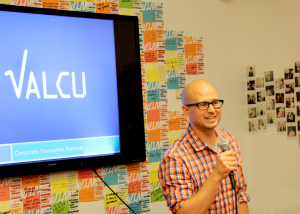
Mark Oblad: Valcu Inc.
Oblad, 36, is based in New York City.
He is a member of the New York bar.
Personal Twitter.
Social Media for Valcu
Website. Twitter. Linkedin.
Producthunt. Angel.com.
Ycombinator. Crunchbase.
Facebook.
Education: University of Utah, Honors B.A., Economics, 2004. University of Virginia School of Law, J.D., 2007. Charterholder, CFA Institute, 2011.
Extra Curricular: Editor of the Hinckley Institute Journal of Politics at University of Utah. Senior Articles Editor on the launch of UVa’s Law & Business Journal. I built my own multi-variate regression and chart algorithms, and was on winning team at two hackathons and won prizes at several others.
Launch date of Valcu: Sept. 2014.
Is this your first startup? Yes, if you don’t count my early entrepreneurial work via paper routes, my lawn mowing business and selling gum and other trinkets in school.
Audience: Lawyers and self-help users.
What problem does it solve? There is an enormous amount of friction that occurs in drafting, negotiating and closing corporate transactions. Valcu offers several tools aimed at streamlining corporate and other legal transactions. The Valcu incorporation tools are used by lawyers and do-it-yourself startups to incorporate companies in Delaware and to run the company setup (including vesting, 83b elections, technology assignment, etc.).
We have also rolled out DIY transaction automation tools, including:
• Documentation and parsers for a text-based scripting language for adding natural language scripting logic directly within Docx templates (see ).
• Drag-and-drop tools to automate document automation (double-automate).
• Data room integration for pulling company data directly into the generated documents.
Additional features include data room sharing and permissioning, two factor authentication data encryption, electronic siguature and user profiles.
What’s coming? We are working on several free open transactions tools for Series Seed and National Venture Capital Association equity financing. We also offer enterprise pricing for automating private documents. Other products in the works include cap table management and valuation modeling.
Why did you want to pursue this startup? In college, I wanted to do something different than the obvious path of math, having come from a family of engineers. Seeing great prospects for lawyers—and following the path of bright classmates—I went to law school. But I didn’t totally abandon my math/science past, always keeping a side project involving chemistry, electronics kits, math, economics, finance and statistics while learning various programming languages. As a corporate lawyer working on transactions, I had an advantage because I could build the Microsoft Excel models needed for transactions. Watching my start-up clients—and over time wanting to be on the other side of the table—I started building a site to automate corporate modeling and valuation. When the timing seemed right, I jumped.
Do you have funding yet? We are self-funded.
Biggest challenge re: the start-up: Successfully running a startup means getting many pieces right. There’s building a tool that can solve a problem and designing that tool so that people can actually use it. There’s getting it out so people find it, and convincing users that it is good enough to change internal processes. Our strength is building a tool that addresses corporate problems at a fundamental level—building a core model and structuring the data accordingly—helping users easily manipulate that model and integrate it with existing industry tools. This is also our biggest challenge—solving a large problem with many moving parts.

What do you need right now, in six months, in a year? We are now working with lawyers to build out transactions, we want to include more lawyers on these projects. In six months, I suspect we will be adding other transactions, but also pushing companies through the cap table management tools.In a year, I hope we will need to work closely with valuation firms to roll out a 409A valuation product.
What is next? Much of our current efforts are going into scripting equity financing transactions to be used in the tools. We also are moving to open source for some of these transactions. As we roll out these transactions, we’ll turn back to the cap table management tools. We may also head more down the enterprise path, and working on automating transactions privately maintained by law firms.
What have you learned that you wish you knew five years ago? I feel like I’ve spent most of my life jumping through hoops and working on goals that get thrown away. I would be better off if my goals had not revolved around getting good grades and obtaining degrees, but rather figuring out how to create something of value. Less schooling, and more being a part of organizations; less memorization and more writing.
Who influenced you the most? My brother, Hayward Oblad. I’ve always felt that Hayward was somewhat of a radical—he absolutely refuses to be told what to think and voraciously consumes sources of knowledge. Many of the things I believe (and many that I disbelieve) came from conversations with Hayward.
Two most important mentors: John Francis, professor at the University of Utah and Steven Boyd while at Gunderson Dettmer (he’s currently at Tiger Global Management). As it is for many people, college was a time for me to break out on my own intellectually and make core life decisions. I admired Francis for his intellectual rigor and depth; he was willing to overlook my pretentiousness and spend many hours tactfully challenging (and tempering) my thinking. He also helped me explore potential educational paths and prepare for law school.
Straight out of law school, I joined Gunderson Dettmer as a corporate associate. I didn’t live and breathe the law, and working in a professional services environment was new. I was eager to dig in and learn as much as I could. Boyd had many great deals that were international with novel issues. He gave me the opportunity to do as much of the work I could handle—not just the ministerial parts. He also had the capacity and patience to meaningfully review my work, and he imparted knowledge and provided contextual understanding.
Advice for other entrepreneurs: Don’t wait for a developer to build it for you (but listen to their feedback). Start solving problems now with tools that are already available and you know how to use (e.g., Microsoft Excel) and figure out how to put together a team uniquely positioned to work on the problem. Learn coding. Startup founders can make progress while working for someone else. As long as you can continue to make progress in your startup, let your current job keep funding you.
What are you afraid of? Making mistakes; making enemies. I fear having to make major re-adjustments.
Favorite musician or group: The violinist Itzhak Perlman has long endeared me for his near-perfect, but warm, performances and gentle, non-flamboyant character.
Favorite vacation destination: I love Southern Utah. The dry heat. Nothing to do but swim, and run at night.
Favorite quote: “Software is eating the world.”—Marc Andreessen
Your mantra: I get far more done if I try to complete a task when I first think about it—and when the need is clear—rather than keeping a long “to do” list.

Who would you want sitting next to you (other than family) if you got stuck for three hours on the tarmac in a 737? Michael Bloomberg. I see him as a true operator who creates widespread value, and whose success has resulted from having correctly aligned interests and by working smart and hard.
Edited by Monica Bay, CodeX Fellow. Do you want to participate in our Startup Snapshot? Ping me at mbay@codex.stanford.edu.