
Legal Tech and the Future of Civil Justice
In February and March 2021, CLP co-director and Professor David Freeman Engstrom hosted a four-session virtual event that brought together academics, judges and practitioners to explore how digital technologies are reshaping the civil justice system. In each of the sessions, academic authors presented papers, followed by responses from judges and practitioners. The papers will be published in a forthcoming edited volume. More than 1,300 people from around the world attended one or more of the sessions.
The sessions tackled a number of urgent questions including: What is the current state of legal tech and where can it plausibly go in the near- to medium-term? What effect will legal tech’s continued advance—from e-discovery to outcome prediction engines to virtual trials and proceedings—have on core features of our litigation system, and how should our procedural rules adapt in response? How can new digital technologies expand access to justice for low- and moderate-income individuals who often cannot retain counsel or lack the resources or know-how to engage formal legal institutions? And what aspects of judicial administration—particularly data infrastructure and accessibility—need to change in order to promote fair and responsible development of legal technologies and open the doors of justice wider for all? Debate around each of these questions of course has accelerated in light of the deep disruptions of the COVID-19 pandemic.
The first session, “Legal Tech and the Innovation Ecosystem,” provided an overview of the state of “legal tech,” from e-discovery and technology-assisted review (TAR) to software that performs advanced legal analytics and outcome prediction, online dispute resolution (ODR) platforms that many courts have begun to deploy, and a growing catalog of digital tools that serve the unrepresented. Speakers included Oxford researchers Mari Sako and John Armour with a paper on legal tech in the U.K., and commenters included California Supreme Justice Mariano-Florentino Cuéllar and Professor Gillian Hadfield, of the University of Toronto Faculty of Law. Drawing together experts on machine learning, the organization of the legal services industry, and legal ethics and lawyer regulation, this session provided a portrait of the current state of the art and legal tech’s likely trajectory over the near- to medium-term.

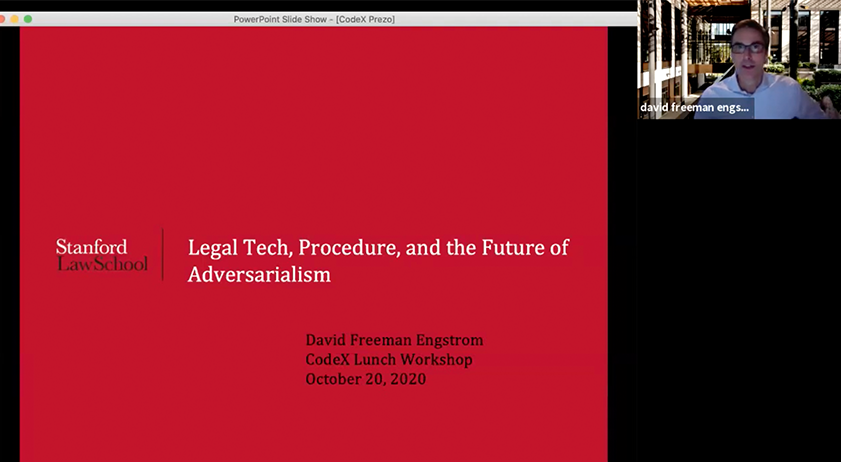
The second session, “Legal Tech, Procedure, and the Future of Adversarialism,” considered the implications of the new tech tools for civil litigation and the adversarial system, particularly the ways civil procedure rules may need to adapt as legal tech continues its advance. CLP’s co-directors, Professors Nora and David Freeman Engstrom presented their paper on the risks that technology exacerbates the divide between the “haves” and “have-nots” in litigation. Another Stanford Law Professor, Norman Spaulding, questioned the move to Online Dispute Resolution (ODR) and its implications for due process and meaningful participation from litigants, while Harvard Law Professor James Greiner and Harvard Access to Justice Lab Associate Director Renee Danser looked at the promise and peril of the migration to remote proceedings, including virtual trials.
The third session, “Legal Tech and Access to Justice,” considered the distributive effects of new legal technologies within the civil justice system. By necessity, Covid-19 accelerated the move to digital courts, and the coming spike of debt-collection and eviction cases—traceable to Covid’s economic fallout—will place additional pressure on state courts to innovate. This innovation includes expanded use of virtual hearings, pre-hearing diversion programs, and court-ordered online dispute resolution processes. Will this increased use of technology make it easier or harder for pro se litigants to access justice? Speakers included Michigan Supreme Court Chief Justice Bridget McCormack and David Slayton, administrative head of the courts in Texas, who talked about some of the lessons learned during their states’ move online during Covid.
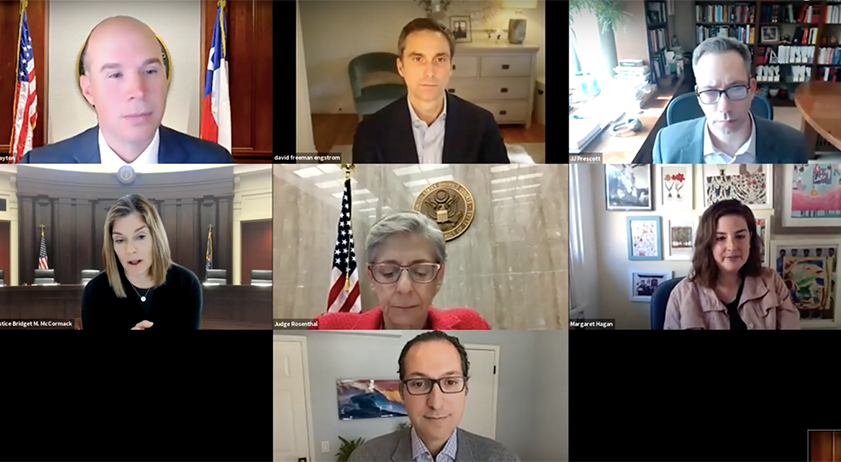

The final session, “Access to Data as Access to Justice,” focused on a concern that is gaining momentum among civil justice experts: that relatively few actors within the legal system have privileged access to the data necessary to develop and refine effective legal tech tools. With high data costs and the failure of federal and state judicial administrators to make court data available in bulk, relatively few litigants will be able to make effective use of potent new analytics. That’s worrisome because, over time, those with the means and technical know-how to harness data analytics will have a decided leg-up. In this context, speakers and commenters considered the challenges of access to court data and its uses and abuses, and innovative ways to expand access to court data while protecting privacy interests.