
Inside SLS’s Supreme Court Litigation Clinic: A Discussion with Easha Anand, Pam Karlan, and Gareth Fowler
Having three oral arguments before the United States Supreme Court in the same term is an accomplishment that only a handful of appellate lawyers can claim. One of them is Stanford Law School (SLS) Assistant Professor Easha Anand, who joined the faculty in 2023 to co-direct the school’s Supreme Court Litigation Clinic. To make the feat even more noteworthy, her three arguments this term are her first three ever before the high court.
Anand recently joined the Stanford Legal podcast to share her experiences as a Supreme Court litigator and her first year as co-director of the clinic. She was interviewed by her fellow clinic co-director and Stanford Legal podcast co-host Pamela Karlan, the Kenneth and Harle Montgomery Professor of Public Interest Law, and joined by Supreme Court Litigation Clinic student Gareth Fowler, JD ’24. They discussed some of the seven cases the clinic has at the Supreme Court this year.
“The Supreme Court only took 60 cases this year,” Karlan says, “so you can get a sense of the amount of the Supreme Court’s docket that we handle in the clinic.”
The following is an edited version of the full Stanford Legal transcript, which can be found here.
Karlan: Gareth, can you say a little bit about how you came to be in the clinic, what the clinic does, and your perspective on it as a student?
Fowler: The short answer is it’s the best thing ever invented for law school. Like all of our clinics at Stanford, the Supreme Court Clinic is a full-time experience. There is a brief introductory period where you learn more from the professors about how Supreme Court practice works, how the Court operates, how to write effectively for the Court, and then you’re placed on a team with three or four other students assigned a case, and you’re off and running. Depending on the case you’re assigned, that might be writing a petition asking the Supreme Court to hear a case or it might be asking the Supreme Court not to hear a case where our clients were successful in the lower courts, and we don’t want the Supreme Court stepping in and interfering with their victory, which is how we started with the case we’ll talk about later today.
Karlan: Easha, What makes the clinical model distinctive from other forms of Supreme Court practice?
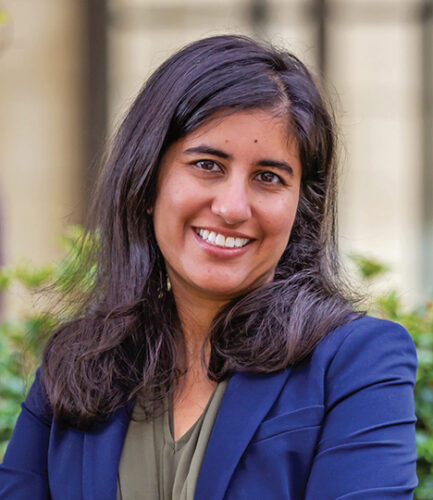
Anand: I have to confess I was a little skeptical before I joined Stanford. Really, second- and third-year law students are writing briefs that are getting filed at the U. S Supreme Court? But it’s true. The students produce every word. Sometimes it takes 10 drafts, 20 drafts, occasionally 30 drafts, to get to the place where we feel comfortable filing it, but the fact that students are producing every word, makes the work product much stronger because our target audience, at the end of the day, often are law clerks who work for the justices, who don’t look so different from our second- and third-year law students. Every project that I work on has an impact in two ways. It helps our client, most immediately. But it also trains another generation of advocates to share the kind of values and skills that the Stanford Supreme Court Clinic prides itself on.
Karlan: How do we get our cases?
Anand: You and Jeff Fisher, who’ve been running the clinic for nearly 20 years, have something of a legendary reputation. I would say a majority of cases come to us because somebody knows about Jeff or you and they know that their case is either headed to the Supreme Court and they want to stop it from getting there because they’ve won in the court below. Or they’d like their case to get to the Supreme Court, and so they reach out for assistance. That’s about two-thirds of our cases. The other one-third are cases that we see coming over the transom and we think: That’s a really interesting legal issue. We think our students would learn a lot working with this particular client and co-counsel. And we think this is the kind of case the Court is likely to hear and that it will be a good use of our resources to get involved in the case.
Karlan: So Gareth, what did you work on last spring when you were in the clinic?
Fowler: I was assigned to two different cases during the quarter. The first case that I was working on with Easha is an immigration case that we internally refer to Mendez-Colin as that was the name of our main client. If you were to look it up, it’s been listed under Campos-Chavez at the Supreme Court. It is a statutory case related to the Immigration and Nationality Act, 8 U. S. C. 1229, which is now burned into my memory forever. When Congress revised immigration law in the ’90s, they added a requirement that when the government was trying to remove a non-citizen from the country, they must give the non-citizen a notice to appear, which is essentially a charging document that lists the case against the non-citizen, the reason why they’re seeking to remove the non-citizen, and among other things, the government is required by statute to tell the non-citizen the date and time of their first hearing. Despite that fairly clear statutory language, for about 20 years the government did not put the date or time on those forms. Later, the government would send a second form, which the statute refers to as a notice of change, informing the non-citizen that this is the time your hearing will actually be held.
Starting around 2017, the Supreme Court intervened, saying that first form, the so-called notice to appear that does not actually have the required date and time information, is deficient and doesn’t count as a notice to appear under the statute. Which means, because the government was doing this for a long time, there are a lot of non-citizens, including our client, who have been through the process, despite the government failing to provide the required notice under the statute. And one of the ways that can really impact people, as happened with our client, is the statute allows, if you’re given the required notice and then don’t show up to your hearing, regardless of the merits of your case and your arguments against removal, the government can just automatically remove you in absentia, and that’s the end of your case. So that happened to our client. And our client is now trying to use a different provision of the statute which allows a non-citizen who was removed in absentia but was not given the required notice, to petition to have his case reopened and get a new hearing where he can go and argue that he actually has a right to stay in the country.
We started this case trying to get the Supreme Court not to hear the case of Mendez-Colin because he had won in the Ninth Circuit and didn’t stand to benefit from the Supreme Court hearing it. But the Supreme Court nonetheless granted the case and Easha got to argue it in January.
Karlan: And what was your other case?
Fowler: The other case I worked on in the spring of last year, as a full time student, is United States v. Jackson, which has been consolidated under United States v. Brown at the Supreme Court. It is a criminal case with a recidivism statute, the Armed Career Criminal Act, which imposes a heightened mandatory minimum for criminal defendants who have certain prior qualifying offenses. The dispute there is whether a state drug conviction counts as a qualifying offense if the state statute that you were convicted under punishes a drug that is not currently banned federally, even if it was banned federally in the past when you had the state conviction.
Karlan: This is one of seven cases we have at the Supreme Court this year, and the Supreme Court only took 60 cases this year, so you can get a sense of the amount of the Supreme Court’s docket that we handle in the clinic. Let’s talk about Easha’s first case, Murray v. UBS.
Anand: We represented a man named Trevor Murray who worked for UBS as an analyst. By law, the research branch of these banks should be independent of the sales arm of these banks. But that didn’t happen at UBS. The sales desk was putting pressure on the research desk to skew their research. So when they were publishing these reports and forecasts for the market, the sales desk was pressuring them to make certain products that UBS was pushing sound more favorable. Trevor did what I think we all hope we would do if we were put in that position, which is that he reported it to his supervisor. Not 30 days later, he was fired. That was almost 10 years ago. So, he filed suit under a provision of the Sarbanes-Oxley Act, which protects whistleblowers.
He won, but on appeal, the court said the way that the jury was instructed in this case was inappropriate, and so we’re vacating that verdict. His really stellar trial lawyer happened to know someone who knew someone who had worked with Jeff Fisher in the past, and said, “Hey Jeff is really, really good. His clinic is really, really good at guiding cases to the Supreme Court.” So I argued the case in October. I’m excited to report that we got a unanimous win from the United States Supreme Court. We’re incredibly proud to get to represent Trevor and I think it was particularly meaningful for our students because I think all of us will at some point be in a professional setting where we see something going on that perhaps doesn’t seem right to us. Maybe it’s illegal. Maybe it’s not illegal, but we think it’s just wrong, and I think it was really inspiring for all of us to get to work with someone who said something, suffered the consequences, and kept fighting.
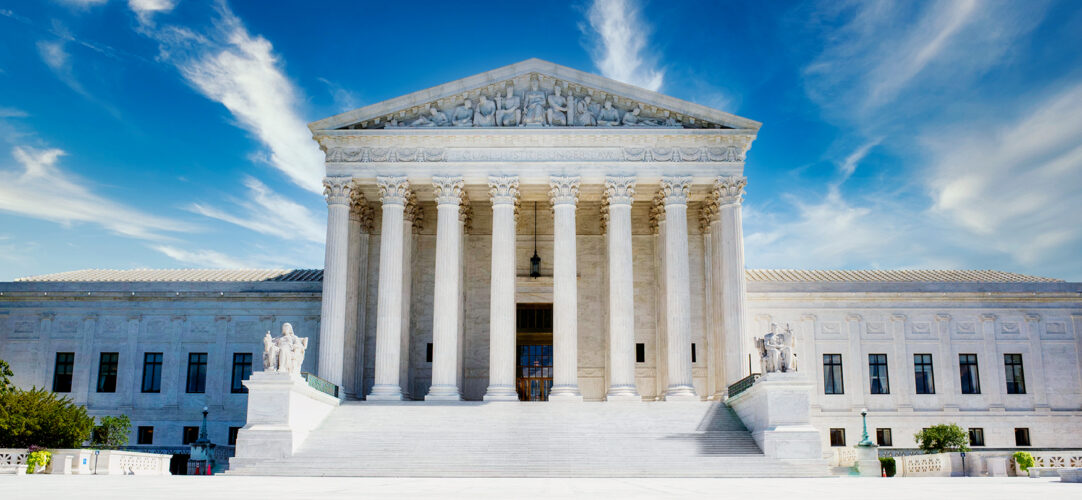
Karlan: You’ve done a ton of arguments in the courts of appeal. What was different about the Supreme Court?
Anand: When you argue in the lower courts, you have a lot more precedent to contend with because lower courts just produce a lot more cases. At the Supreme Court, often the reason that they agreed to hear the case is there’s not a case that’s squarely on point. And even if there are cases that are sort of adjacent, it’s the Supreme Court. When preparing for an argument in the lower court, you tend to go back and read dozens of cases that are kind of in the issue area that you’re arguing over. At the Supreme Court, that’s a much, much smaller part of your preparation. You get to make many more arguments from first principles. You are not trying to navigate between a bunch of established rules. You’re kind of telling the court what makes sense in the first instance.
Karlan: One of the great things about the fact that we have full-time clinics here is that the students in the clinic can go to Washington and spend a couple of days there, sometimes up to a week there, depending on how the preparations are going, getting ready to see the case they worked on. So Gareth, tell us a little bit about your trip to D.C.
Fowler: I was lucky enough to get to go to D.C. last fall to hear the Jackson criminal defense case argued, and then was also there in January for Easha to argue Mendez-Colin. It is a really fascinating experience being at the Court, seeing how much everything is dressed up–the ceremony. It’s an institution that takes itself very seriously, certainly. It is interesting the disconnect between hearing the justices go back and forth on some pretty abstract legal questions about, for example, what does the word “or” mean in this sentence—and the basic thing we were fighting for, which is this person who’s been in the country for 20 years, who’s been in this legal limbo with an in absentia order against him since 2004, who’s finally hearing his case go to the Supreme Court.
Karlan: Easha, tell us a little bit about the third case. This is a case you’re going to be arguing in a couple of weeks. How did this case come to us and what’s the case about?
Anand: That’s right. On April 15th, I’ll be arguing a case on behalf of Yasha Chiavarini, a jeweler in Napoleon, Ohio. [Editor’s Note: This interview was recorded prior to Anand’s April appearance before the Court.] He buys some jewelry that turns out to have been stolen, and over the ensuing few weeks, he’s trying to figure out what to do about this jewelry. He winds up getting into a little bit of an altercation with police officers. His lawyer tells him to do one thing, the police department says another. So the police get an arrest warrant. They find two charges for which there’s actually probable cause, but then they decide to fabricate evidence to add a felony money laundering charge to the warrant. They arrest him, charges are eventually dropped, but not until he’s spent several days in jail. So he files a lawsuit saying his Fourth Amendment rights were violated because the police made up one of these charges. And the Sixth Circuit says no. As long as there’s probable cause for some offense, it doesn’t matter if you completely made up another crime. I was really familiar with this issue because in my prior job at the MacArthur Justice Center, I’d worked on a number of cases where we were filing lawsuits about police misconduct and the Court said something similar. I was keeping an eye out for this issue, saw this case and sort of thought to myself, I really think that this is the wrong legal rule. It’s a legal rule that’s not just wrong in an intuitive way, but it’s wrong in a way that the Supreme Court really cares about. It’s wrong as a historical matter. If you look at the kind of common law and historical backdrop, this is not the way that things are supposed to work. A group of students helped me write the petition, a group of students helped me write the reply, the Supreme Court granted cert, and we’ve been working on briefing it ever since, and I’ll argue it on April 15 in the Supreme Court.
Karlan: Could you tell the story of what Mr. Chiaverini said when he flew out to Stanford for the workshop with our co-counsel?
Anand: This particular visit was especially meaningful for me and for my students because one thing Mr. Chiaverini said: “Look, this felony money laundering charge, it ruined my reputation. I’m a jeweler. My reputation is built on being able to trust me with precious gems, and I can’t tell you how much it has already restored my reputation to have people know that the Stanford Supreme Court Clinic is representing me. I’ve had people calling me up who had severed ties with me years ago telling me, I guess we were mistaken about you.”
It felt incredibly good for me and the students to feel like whatever happens with this case, we had already made a difference just by showing up and agreeing to represent someone. To me, that’s the best use of the Stanford name I can think of. Using our resources to try to help restore the reputation of someone who had been targeted by the state in an unfair way.
Listen to the Stanford Legal Podcast
Read the Stanford Lawyer Magazine Profile
Easha Anand joined the Stanford Law School faculty in 2023 as an assistant professor of law and co-director of the Supreme Court Litigation Clinic. A former Supreme Court and court of appeals clerk, Easha joins Stanford from the MacArthur Justice Center, where she served as Supreme Court & Appellate Counsel and litigated police excessive force, prison conditions, habeas, and other criminal defense and civil rights cases around the country. She was the Edwin A. Heafey, Jr. Visiting Professor of Law in the Stanford Supreme Court Litigation Clinic in 2022. Easha is a graduate of the University of California, Berkeley, School of Law and clerked for Justice Sonia Sotomayor on the United States Supreme Court and for Judge Paul J. Watford on the Ninth Circuit Court of Appeals.