
SLS Team Discusses How Some Attorneys Are Helping Russian Oligarchs Evade International Sanctions
On a recent episode of the Stanford Legal podcast, Erik Jensen, director of Stanford Law School’s Rule of Law Program, delved into the complex issue of international sanctions evasion. Specifically, Jensen and two of his students, explained how some attorneys are helping their Russian oligarch clients evade sanctions by hiding behind long-established norms governing the legal profession, namely attorney-client privilege and confidentiality. Sanctions evasion contributes to the ongoing Russian war in Ukraine, they say.
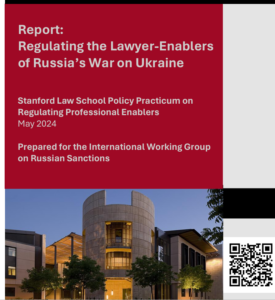
Joining Jensen in the discussion were Kyrylo Korol, JD ’25, believed to be the first Ukrainian JD student at Stanford Law School, and Sarah Manney, JD ’24. Both students participated in Jensen’s recent Law and Policy Lab that delved into the matter of sanctions evasion and ultimately produced the report Regulating the Lawyer-Enablers of Russia’s War on Ukraine.
Among the topics of discussion was the proposed, bipartisan Enablers Act, which was introduced in the U.S. House of Representatives in 2021. The Act aimed to close loopholes that allowed “enablers” to launder illicit funds in the U.S. by extending anti-money laundering requirements to professional service providers, including accountants, lawyers, and third-party payment services. However, in 2022, the Senate voted against the act’s inclusion in the defense budget, ending the Act’s progress for now.
Jensen, Korol, and Manney were interviewed by Stanford Legal co-hosts Pamela Karlan, the Kenneth and Harle Montgomery Professor of Public Interest Law and co-director of Stanford Law School’s Supreme Court Litigation Clinic, and Richard Ford, the George E. Osborne Professor of Law. The following is a shortened and edited version of the full podcast transcript, which can be found here.
Pam Karlan: Tell us about the recent Law & Policy Lab in which you researched and produced your report, and who the client was.
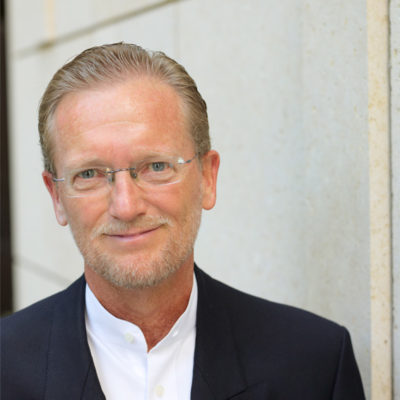
Kyrylo Korol: We started with a couple of policy papers produced by our client, the Freeman Spogli Institute’s International Working Group on Russian Sanctions here at Stanford. Those papers contained a lot of expertise from policymakers and economists, but not so much from lawyers–that’s where we thought we could add to the discussion. We wanted to look at how economic sanctions apply to Russian oligarchs because oligarchs contribute directly and indirectly to the war in Ukraine. We found that at least 81 of the richest Russians were openly involved in supplying the Russian army with guns, ammunition, and other military equipment, many of which was then traced back to atrocities in places like Bucha, Mariupol, and Vinnytsia.
Because Russia’s economy and the situation there generally is unstable, oligarchs tend to move their wealth to safer jurisdictions such as the United States. They invest in real estate, corporate securities, and luxury assets like yachts, aircraft, and artwork. We found that various professionals in different industries, including lawyers, help facilitate sanctions evasion, either knowingly, or by being willfully blind to their clients’ identity. We determined that if we could find a way to regulate these professionals, we could make sanctions more effective.
Pam Karlan: Do you know how much of this type of representation involves law firms that already had existing clients who were oligarchs, and just continued to represent them, versus law firms coming into the field in order to represent people for the purposes of getting around sanctions?
Kyrylo Korol: There is virtually no way to figure out if a lawyer actually provided services to a sanctioned individual because of attorney-client privilege and confidentiality. Those are legitimate privileges, but some lawyers weaponize them to conceal the true identity of their clients. One of the cases that we looked at was a case from New York where a lawyer who used to work with an associate of a sanctioned individual–who previously wasn’t sanctioned, but then was put on the sanctions list–continued working with him and accepted funds and used them to pay for rent and maintenance of luxury real estate in New York. That attorney in that particular case knew what was going on and continued working with the associate of a sanctioned individual.
Sarah Manney: There might be cases of purely benign breaches. There might be cases where someone approaches a lawyer to represent them and the lawyer doesn’t know who they are or if they’re being sanctioned. But lawyers must first understand who their clients are, determine if the client appears on a sanctions list, or if they work with associates who are on the list. If the client is a legal entity, the lawyer needs to determine if the parent company is on a sanctions list. Then, once they have that knowledge, to report it if it meets a very high standard of suspicious activity.
Pam Karlan: Erik, what was the overall scope of the project?
Erik Jensen: Working with really top-notch American law professors who teach professional responsibility, we discovered that there hasn’t been that much comparative analysis of how other countries handle these issues. So, we did a six-country comparative study on the regulation of lawyers related to money laundering, which was pretty innovative. It’s easy to develop a policy. It’s hard to figure out how to implement it, and the paper that we published spends a good deal of time on how to get these recommendations implemented. I think the students did an extraordinary job on that as well.
Rich Ford: Could tell us a little about the Enablers Act? Right now we have a problem where lawyers can weaponize ignorance and pretend that they perhaps don’t know that their clients are on a sanctions list. How would the Enablers Act change that?
Sarah Manney: The Enablers Act is a long time coming for the U.S. It was interesting to read assessments of the United States by a body that the United States actually helped to create in the G7. It’s called the Financial Action Task Force, and it reviews hundreds of countries around the world. They critiqued the United States for not focusing on what they call “designated non-financial business persons.” There are two prongs: one is knowledge and the second is reporting. So understanding who their client is, asking the questions, especially if it’s a legal entity. With regard to the second, if lawyers are approached to perform a transaction that raises several red flags, those are red flags that the Financial Crimes Enforcement Network reviews, especially high-risk transactions around sanctioned countries. If a client approaches a lawyer asking for a certain type of fund, or, it’s especially a large cash transaction, there’s a way to report that.
Rich Ford: How are lawyers currently treated differently than other types of professionals who might have an obligation not to facilitate these kinds of transactions?
Erik Jensen: Our report advocates for lawyers to not be treated differently from accountants, wealth managers and the like. Lawyers shouldn’t have a special privilege when they’re simply doing financial transactional work, when there is nothing uniquely “lawyerly” about the work that they’re doing.
Kyrylo Korol: We found that in many countries, lawyers are regulated similarly to financial institutions when they perform these types of non-lawyerly functions. In the U. S., however, lawyers are guided only by ethical rules, which leave too much discretion to lawyers as to how they should conduct client due diligence, what kind of information they have to collect, and when they are required to report potential money laundering schemes to authorities.
Sarah Manney: At the same time, it’s really important to protect the privileges that lawyers have and the reasons that they have them. We spent a lot of our report focusing on both ways to preserve attorney-client privilege and to make sure the regulations that we are proposing would be respectful of that, especially in cases where there are life and liberty issues at risk, and then also ways to look at the impact on underserved populations.
Kyrylo Korol: Sarah made a really good point about how we were only concerned with lawyers performing a very narrow set of transactional work, which has nothing to do with civil or criminal representation of sanctioned individuals. This is a very narrow set of transactions that we wanted to cover. We looked at other countries and all of these measures seem to be working in other countries.

Rich Ford: Given what seems to be a pretty common sense type of regulation, why hasn’t it passed yet? What’s been the pushback?
Sarah Manney: The American Bar Association has pushed back and raised questions around how to harmonize these proposed regulations with attorney- client privilege and other pillars of the profession. Our report really tries to serve an intermediary role of understanding the goals, the regulation, the intended targets and how they could fit in. We feel confident there’s a version of this that could work and be passed.It’s important to remember as well that the Enablers Act is ambitious and tries to cover several dozen professions, and each of those has their own set of pushback. So our task was really narrowly focused on addressing the critiques in the legal space.
Kyrylo Korol: Some of the critiques are certainly valid. Our proposed regulation would take into account attorney-client privilege and confidentiality obligations. I have a law degree from Ukraine. I’m about to get a law degree in the United States, and there are differences in the legal systems. But the thing that’s important all over the world is that lawyers are supposed to safeguard democracy, not threaten it. When lawyers weaponize some of the privileges of their profession, they cast a shadow over the profession as a whole.
Erik Jensen holds joint appointments at Stanford Law School and Stanford’s Center on Democracy, Development and the Rule of Law. He is Lecturer in Law, Director of the Rule of Law Program at Stanford Law School, an Affiliated Core Faculty at Stanford’s Center on Democracy, Development and the Rule of Law, and Senior Advisor for Governance and Law at The Asia Foundation.
Kyrylo Korol is a Ukrainian Stanford Law School student in the class of 2025. He earned his Bachelor of Laws degree from the Taras Shevchenko National University of Kyiv in 2017 and Master of Laws degree from the Ukrainian Catholic University in 2019. At SLS, he is the 2024-25 Editor-in-Chief of the Stanford Journal of International Law. He is formerly president of the Ukraine Support Alliance at Stanford and is a John Hart Ely Book Prize recipient.
Sarah Manney was a member of Stanford Law School’s class of 2024. She graduated from Stanford University in 2018 before heading to the University of Cambridge to get her MPhil in public policy. While at SLS, she was the founder and president of the Stanford International Rule of Law Pro Bono program, the Stanford National Security Law Society co-president, a Stanford Journal of International Law editor, a Teaching Assistant for the Ukraine Reform Course, and a research assistant to Professor Erik Jensen.