
The Brief: Private Universities in the Public Interest, 2024 Election (Nov 2024)
Welcome to The Brief, our redesigned newsletter bringing you focused insights on race, law, policy, and technology from the Stanford Center for Racial Justice.
Repairing the Relationship Between Universities and the American People
Private universities in America face a paradox: while they control unprecedented wealth and continue to lead global rankings, they face growing public skepticism and distrust at home. This erosion of public confidence comes at a crucial moment, as these institutions receive billions in public subsidies through tax exemptions and charitable deductions for their donors, yet remain largely accountable only to themselves.
In September, we convened a diverse group of education thinkers, innovators, and leaders at Stanford Law School to consider the role of these colleges and universities in society. Building on those thought-provoking discussions, we recently published a white paper, Private Universities in the Public Interest. Drawing on extensive historical research, we examine how the relationship between universities and society has evolved over time, analyze the causes of today’s crisis of confidence, and propose ways to renew higher education’s civic mission for our time.
The paper offers a framework for university leaders to address critical tensions as they work to rebuild trust and enhance their institutions’ contributions to society.
Read the full paper here.
FACULTY DIRECTOR’S CORNER
Professor Ralph Richard Banks on the 2024 Election
The 2024 presidential election really could be the most consequential in all of our lifetimes. Donald Trump unquestionably poses a threat to democracy and the rule of law. Concerns were warranted even before he announced his candidacy for the 2016 election. After decades as a real estate developer and then reality television star, he rose to political prominence on the basis of claims that Barack Obama was ineligible to be president because he was not really born in the United States. As ridiculous as his birtherism assertions were, they elevated Trump’s political profile. It is even more remarkable that Trump’s percentage of the black vote actually increased between 2016 and 2024, when he garnered a greater percentage of the Black vote than any Republican in decades. He also attracted considerable support among Asian and Latino voters. This “progress” was helped by a Democratic Party that has become ever more culturally disconnected from the concerns and values of voters who have historically been its base.
For us at the Center for Racial Justice, these developments underscore not only the centrality of race in American political culture but also the complicated and changing nature of our society’s racial dynamics. We all need to shed preconceptions about how people see the world and how society operates, and be willing to approach challenging circumstances with fresh eyes. Our analyses, policy initiatives, and events will remain focused on accurately diagnosing the state of affairs and charting a path forward. That’s our best hope for maintaining our democratic values and commitments during a perilous time.
From the Stanford Center for Racial Justice
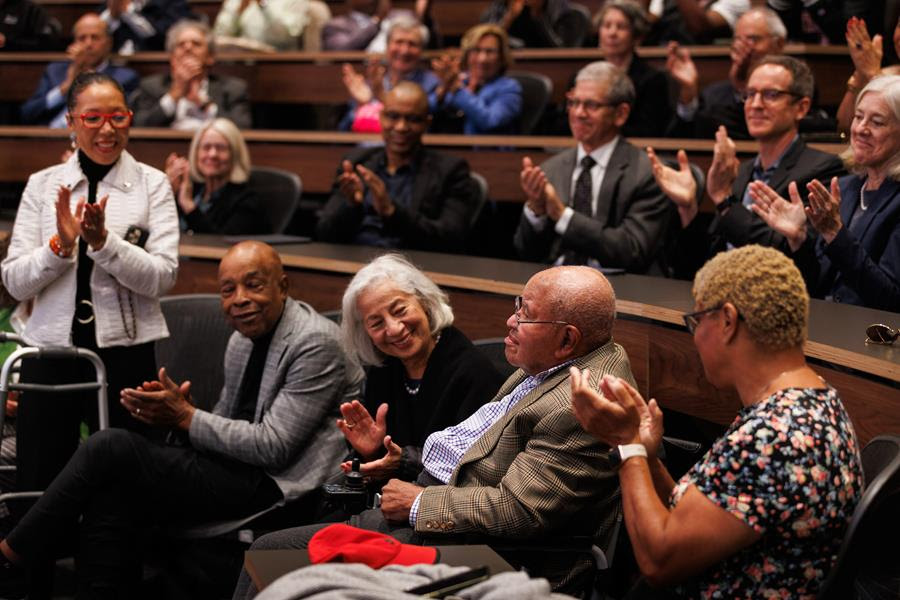
Enthusiastic applause for Harry Bremond at the launch of the Center’s Harry Bremond-Wilson Sonsini Foundation Fellowship program I Scott MacDonald
The Center launched the Harry Bremond-Wilson Sonsini Foundation Student Fellowship program open to Stanford 2L and 3L students. Applications are open now for the unique dual learning experience through work at the Center and exploring pro bono practice at Wilson Sonsini.
We convened the Summit on AI, Body-worn Cameras, and the Future of Policing with Stanford SPARQ and are exploring how the cameras and the footage they collect can–through evidence-based research–be used to improve policing in America.
Stanford Law School debuted “Narrative Strategies for Racial Justice,” an immersive course led by faculty director Ralph Richard Banks, renowned civil rights attorney Bryan Stevenson, and Stanford social psychologist Jennifer Eberhardt that took students to Montgomery, Alabama to examine how racial narratives have shaped America’s legal system and history.
Law students working for the Center collaborated with the International Human Rights and Conflict Resolution Clinic to conduct research that supported a report from the UN Special Rapporteur on Contemporary forms of Racism examining AI’s impact on educational disparities.
The Center welcomed its Fall 2024 intern cohort, featuring eight exceptional students from across Stanford—studying in fields including law, education, computer science, and anthropology—who will support our work analyzing the racial dimensions of critical issues in American society.
ON THE RECORD
“The problem is that the persistence of legacy admissions, in the aftermath of the Supreme Court’s decision in Students for Fair Admissions, leaves schools in the position of offering an admissions preference to students from the most economically advantaged families (most of whom are white) yet being precluded from extending any preference to students from racial minority groups in the interest of diversity.”
Ralph Richard Banks Faculty Director, Stanford Center for Racial Justice
In the Legal Aggregate after California Governor Gavin Newsom signed a law banning legacy admissions at the state’s private, nonprofit colleges and universities.
THINGS YOU SHOULD KNOW
How the racial makeup of colleges changed after the affirmative action ruling
Colleges and universities have begun to disclose the racial composition of their first incoming classes since the U.S. Supreme Court’s ruling to end affirmative action. As part of PBS’ “Rethinking College” series, Geoff Bennett and the New York Times’s David Leonhardt discuss the impact of the court’s ruling. According to Leonhardt, Black student enrollment varied significantly–dropping sharply at Columbia and MIT, while holding steady or increasing at Dartmouth and Northwestern. The data also shows a slight uptick in Asian American enrollment and in students not reporting their race– a trend suspected to be in response to the new ruling. Institutions have also begun shifting their focus to achieve greater economic diversity, which may result in more diverse student bodies overall. Despite these changes, the long-term impacts of the ruling on diversity in higher education remain uncertain.

Reconsider use of race in biomedical research, panel urges
A new National Academies of Sciences, Engineering, and Medicine (NASEM) report urges scientists to exercise caution when using race and ethnicity in biomedical research, emphasizing that race is a social construct, not a biological marker, and can therefore be misused in biomedicine, including instances of race-based clinical algorithms. The report recommends including race data only when it is essential to research questions, such as examining impacts of racism or certain social determinants of health. NASEM calls for research proposals and papers to clearly define and justify any use of race categories, and encourages funders and publishers to establish guidelines that support this approach. The panel emphasizes that decisions about using race and ethnicity in research should be made on a case-by-case basis, considering broader social and scientific implications.
ACLU challenges Kansas death penalty, citing racial bias
An ACLU-led coalition has initiated hearings to overturn Kansas’ death penalty. The Kansas Reflector recently explored how capital punishment can skew jury selection, a claim central to the case. The legal challenge targets the state’s “death qualification” process, which excludes jurors opposed to capital punishment–a practice that disproportionately disqualifies Black, female, and religious jurors. The coalition argues these systemic racial biases in jury selection make the state’s death penalty unconstitutional as applied.
Here’s what else we’re following.
ABA Reverses Course: The American Bar Association walks back a plan to remove “race and ethnicity” from its law school diversity rule following pushback from legal educators. Reuters
Race and Gender Discrimination: California’s new law protecting workers from discrimination based on multiple combined traits (like race and gender together) could spark more “intersectional bias” claims nationwide, even beyond state lines. Bloomberg Law
AI Documents Housing Bias: In Silicon Valley’s historically left-leaning Santa Clara County, Stanford researchers at RegLab identified racial covenants—now legally unenforceable—in over 5 million property deeds, with one in four properties carrying these discriminatory restrictions by 1950. RegLab