
Juelsgaard Clinic Asks Federal Circuit to Properly Scrutinize Expert Patent Testimony
The United States patent system grants to inventors the exclusive right to make, use or sell their inventions for a limited time. In exchange, the public gets immediate access to the information disclosed in a patent and eventual access to the invention itself. This balance between private rights and public access is facilitated by patentees’ ability to recover damages for unauthorized use of their inventions, but those damages must be limited to the inventor’s contribution. This concept is reflected in the legal principle of apportionment, which allows a fact finder to determine the value of infringing features by distinguishing it from the total value of a product that encorporates those features. Courts often rely on expert testimony to assist in making that determination. But what happens when courts admit unreliable expert testimony in support of a damages award far exceeding the patented invention’s value?
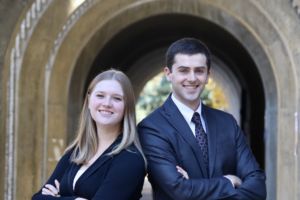
Students Victoria Gardner (’25) and Gregory Schwartz (’25) from the SLS Juelsgaard Intellectual Property & Innovation Clinic (JIPIC), with the supervision of Clinic Director Phil Malone and Supervising Attorney Nina Srejovic, recently wrote an amicus brief urging the en banc Federal Circuit to rigorously enforce Federal Rule of Evidence 702 when evaluating expert testimony on patent damages. The Clinic’s brief was submitted on behalf of fourteen professors specializing in patent and evidence law in the en banc rehearing of EcoFactor, Inc. v. Google LLC.
Last September, the Federal Circuit granted a rare petition for en banc rehearing in EcoFactor v. Google LLC, asking the parties to address whether the district court properly applied Rule 702 and Daubert to the expert witness damages testimony.
EcoFactor’s damages expert calculated the value of the patent at issue based on the licensing fees that other companies had paid for the patent. Using a method known as “built-in apportionment,” the expert claimed that these licenses inherently reflected the patent’s specific value, eliminating the need for independent apportionment analysis. However, these allegedly comparable licenses suffered from several defects.
For one, the licenses were structured as lump-sum payments, whereas EcoFactor sought a royalty rate. The expert inferred a royalty rate from contract language describing the lump-sum calculation. However, that language had no effect in the agreement itself and the expert conducted no independent verification of its legitimacy.
Additionally, the licenses encompassed rights to all of EcoFactor’s many other patents—not just the single patent Google infringed. The expert made no effort to disentangle the value of the infringed patent from the others, concluding instead that the entire value of the agreement could be attributed to the infringed patent.
In EcoFactor, the district court admitted the flawed testimony, and a Federal Circuit panel upheld the ruling—though not without a forceful dissent from Judge Sharon Prost. Recognizing the importance of the issue, the Federal Circuit granted en banc review, prompting significant interest from amici curiae, including academic experts, industry groups, and advocacy organizations.
The JIPIC amicus brief highlights the urgent need for courts to rigorously scrutinize expert methodologies in patent damages cases. By adhering to the evidentiary safeguards of Rule 702, courts can ensure that damage awards remain grounded in sound principles of apportionment, preserving the integrity of the patent system.