
Unconstitutional Attack on Law Firms? Stanford’s Mark Lemley Discusses How Legal Scholars are Pushing Back Against President Trump’s Executive Orders
read the submitted amicus brief Amicus Brief in Support of Susman Godfrey
Does presidential power extend to the ability to take aim at law firms, shutting them out of federal business? According to hundreds of legal scholars from across the United States the answer is a resounding no.
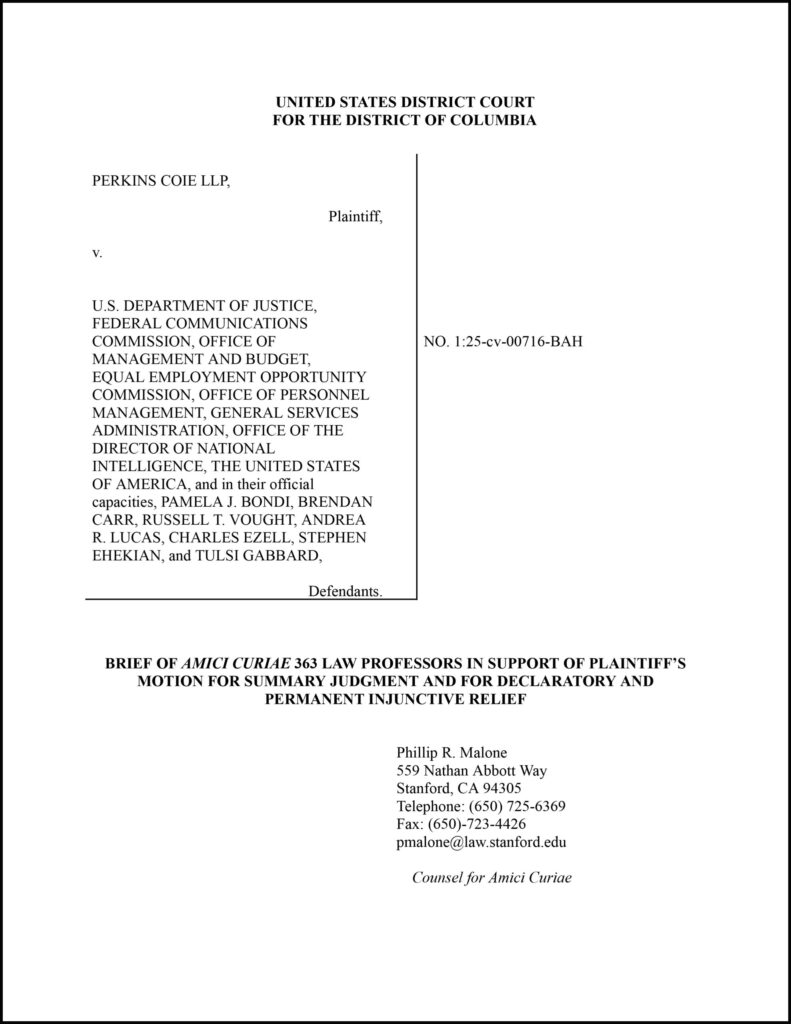
On March 6, President Trump issued the executive order “Addressing Risk from Perkins Coie LLP,” stripping members of the law firm of security clearances and access to the federal government, and gutting its ability to represent clients and carry out key aspects of its business. It was the first of several presidential orders aimed at law firms that represented clients and/or employed attorneys at odds with Trump.
Perkins Coie is fighting back. And members of the legal academy are supporting the firm.
Late on April 2 an amicus brief signed by 363 law professors from across the U.S.—experts in constitutional law, legal ethics, and the history of the legal profession, and other fields—was submitted in support of Perkins Coie. The brief notes that it was submitted “to emphasize the threat that the President’s Executive Order presents to the independence and integrity of the legal profession, the rights of clients to seek redress in the courts, and, by extension, the rule of law.” Separate briefs in support of Jenner & Block and WilmerHale, two law firms that are also fighting Trump executive orders, are likely to follow soon.
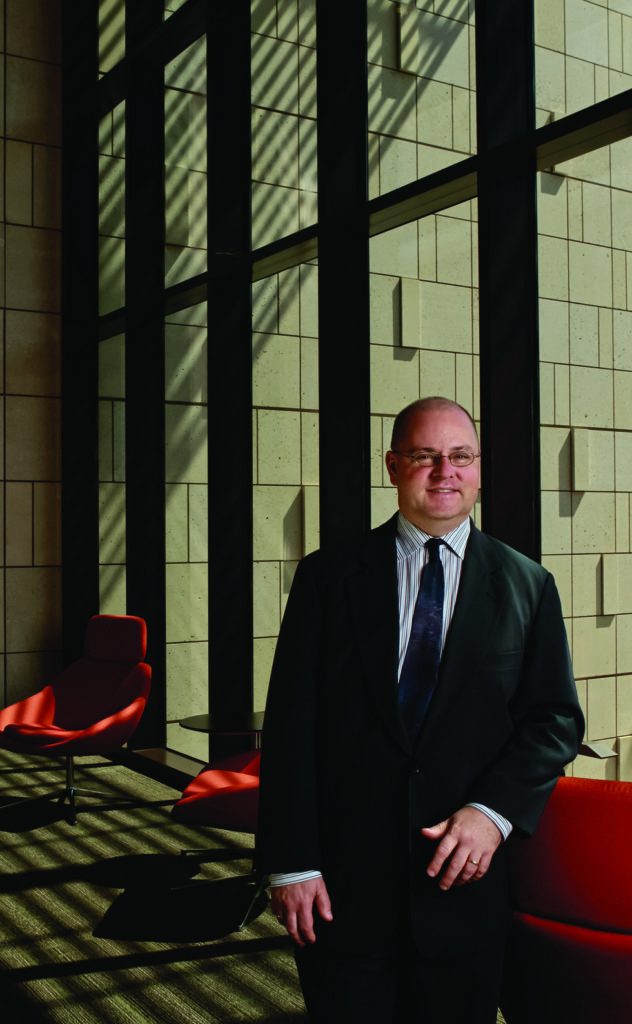
The amicus brief was drafted by several Stanford Law faculty and members of the Deborah L. Rhode Center on the Legal Profession. Here, Professor Mark Lemley, who led the effort, provides his thoughts on the executive order.
How important is this moment? What does this case mean to the rule of law in the U.S.?
This is nothing less than a frontal assault on the rule of law. Punishing lawyers for representing clients the government doesn’t like is something authoritarian regimes do, not democracies.
Trump’s executive order is extraordinary reading, with allegations that the firm violated election law, committed racial profiling, and more. Can you briefly outline why you find the executive order unlawful and unconstitutional?
There is no reason to believe there is substance to any of those allegations. But from our perspective it doesn’t matter. Trump isn’t targeting these firms because they have allegedly engaged in wrongdoing. The Administration is targeting law firms that represented parties that sued Trump personally or were involved in investigations into his wrongdoing. And the attacks extend not only to the firms but to any clients who do business with those firms. That is unconstitutional viewpoint discrimination. It is also an interference with the right to counsel in both civil and criminal cases. We can’t have the rule of law if people the government doesn’t like can’t have lawyers.
Our brief draws on the expertise of constitutional law and legal ethics experts. Several of my Stanford colleagues helped draft the brief, including Pam Karlan and Norm Spaulding, and members of the Rhode Center including Brianne Holland-Stergar, Rose Goldberg, Natalie Knowlton, and Daniel Bernal did amazing work in pulling this together in a short period of time. We were pleased to have over 350 law professors sign the brief.
How do you expect this case to play out? Might it reach the Supreme Court?
So far, all three cases in which the firms have chosen to fight have quickly resulted in temporary restraining orders precluding the Trump administration from enforcing its unconstitutional executive orders. That’s not surprising; the violation of the Constitution seems quite clear here. Once those orders are turned into preliminary injunctions, or some other appealable order is issued, I expect the administration will appeal. But they won’t win, at least not if courts apply the law.
Three law firms attacked by Trump’s executive orders are fighting back, but, as of the date of this Q&A, three chose to negotiate. Do you expect Trump to broaden his attack on law firms?

While three of the firms that Trump has targeted fought back and won, three others (Paul Weiss, Skadden, and Willkie Farr) chose to surrender rather than defend their rights. All three firms agreed to donate free legal services to causes Trump personally supports. The fact that those firms were willing to cave likely means that Trump will continue his campaign of intimidation against other firms, because even though it’s illegal, it seems to be working in part. That makes it all the more important that the courts clearly establish that this is unconstitutional. Hopefully our brief will help achieve that.
Mark Lemley is the William H. Neukom Professor of Law at Stanford Law School and the Director of the Stanford Program in Law, Science and Technology where he teaches intellectual property, patent law, trademark law, antitrust, the law of robotics and AI, video game law, and remedies. He is of counsel at the law firm Lex Lumina and cofounded Lex Machina, Inc., a startup company that provides litigation data and analytics to law firms, companies, courts, and policymakers.