
Stanford’s Allen Weiner on U.S. and Russian Military Actions—from Venezuela to Poland—and the Erosion of International Law
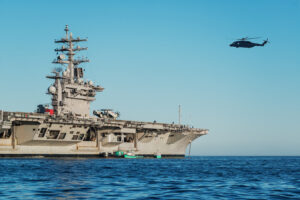
Within the space of a week, both the U.S. and Russia have exercised unilateral military force in new domains—the U.S. against private Venezuelan boats and Russia with a drone attack in Poland. Russia’s action represents an escalation of its unprovoked war against Ukraine—risking deeper military involvement of NATO countries. Here, Stanford Law Professor Allen S. Weiner, an international legal scholar whose research and teaching focus primarily on the fields of international security and conflict resolution, discusses these incidents—and the risks to international peace that they represent. [note: This interview was conducted before the second U.S. attack on a Venezuelan boat on September 15.]
How concerned are you about world stability right now?
These are alarming developments. We certainly seem to be entering a moment in which the great powers are manifesting a belief that they are free to disregard the fundamental rules of international law governing the use of force.
What exactly happened in these incidents?
Russia appears to have launched around 20 armed drones that entered Polish territory on the night of September 9. Both the Polish and German governments had said that these drones were armed with munitions. Sending armed drones into Polish territory is an act of aggression that plainly contradicts the prohibition on the use of force in international relations set out in Article 2(4) of the United Nations Charter.
The sinking by the U.S. Navy of a Venezuelan boat in the Caribbean allegedly operated by drug traffickers from the Tren de Aragua criminal organization, and the killing of 11 persons aboard that boat, is also deeply problematic, and the Trump Administration’s apparent legal justification is quite radical. This would be the case even if we take as true the administration’s claims that the people on this boat were indeed members of a criminal organization engaged in narcotics smuggling, a claim that, as outside observers, we really cannot evaluate.

Was the U.S. attack on the boat legal? Do countries have the legal authority to attack boats they suspect of wrongdoing—without hard evidence?
I don’t believe the attack on the Venezuelan boat, even if it was operated by drug smugglers from the Tren to Aragua criminal organization, is legal. We are not in a state of armed conflict with Tren de Aragua or Venezuela. There is no credible claim that this group has committed an armed attack against the United States, which is what would trigger our right to use force in self-defense under Article 51 of the U.N. Charter. Tren de Aragua is not an “associated force” of those nonstate armed groups — e.g., Al Qaeda, ISIS, al Shabaab — against which the U.S. government has said we are in a state of armed conflict. That means that there simply is no right to target Tren de Aragua members as “belligerents.”
And asserting that a boat carrying drugs to be smuggled into the United States presents an imminent threat of armed attack — which is what would be required to trigger the right of anticipatory self-defense — simply strips the concept of “imminent threat of armed attack” of any meaning.
When a state of armed conflict exists, it is permissible under international law for members of one party to the conflict to kill belligerents on the other side. But where, as here, there is no state of armed conflict — when what international lawyers call the “combatant’s privilege” does not apply— intentional killing without due process of law is murder.
Can you talk more about the law and what should happen? Aren’t there diplomatic channels to employ? Perhaps the Coast Guard might board and search the vessel before sinking it?
This is a complex area of international law, particularly when we are dealing with vessels in international waters, or the “high seas,” the preferred phrase of maritime lawyers. Ordinarily, the principle of freedom of navigation on the high seas means that the law enforcement vessels or warships of one country may not stop, board, and search flag vessels of another country, unless they have received the consent of the flag state. There is actually a 1991 treaty between the United States and Venezuela that provides for expedited processing of requests to board and search the flag vessels of the other country. Given the strained relations between the U.S. and Venezuela—the U.S. suspended embassy operations in Caracas in 2019—it is doubtful that the parties would be able to avail themselves of this consent-to-search mechanism.
That, of course, does not mean that it becomes permissible to fire on and sink boats that the U.S. does not have authority to stop and search.
And if U.S. officials were confident that this vessel was in fact involved in drug smuggling, the U.S. could have tracked the vessel until it entered U.S. waters, at which point the U.S. Coast Guard would have been able to exercise the authority, under both domestic and international law, to stop, board, and search the vessel.
Moving to the Russian drone attack in Poland, do you think it was a mistake—or deliberate? How serious was it?
I can’t know for sure whether the entry of these drones into Polish territory was deliberate, or whether it “could have been a mistake,” as President Trump has suggested. That said, the idea that such a large number of drones could have entered Polish territory on a single night by accident strikes me as implausible; it seems much more likely that this was a deliberate attempt by Russia to intimidate a NATO country that has staunchly supported Ukraine since Russia’s 2022 full-scale invasion.
On the question of whether this is a serious matter, it is certainly viewed as very serious by Poland and its NATO allies. Poland launched fixed-wing aircraft and fired Sidewinder missiles to attempt to shoot down these drones. There are also reports that aircraft from other NATO states shot down some of the drones. That would make this the first episode in which the armed forces of a NATO country have used force against Russian military assets since the start of the full-scale war in Ukraine.
The initiation of armed conflict between Russia and NATO states, even on a relatively small scale, represents a major escalation and significantly increases the risks of expanded conflict between NATO states and Russia. As such, this episode strikes me as extremely serious.
Can you say more about Poland and Article 4?
Poland has invoked Article 4 of the Treaty of Washington, NATO’s founding treaty. This provides that NATO members “will consult together whenever, in the opinion of any of them, the territorial integrity, political independence or security of any of the Parties is threatened.” This is a much more limited provision than the treaty’s more famous Article 5, the cornerstone of NATO’s collective security regime. Article 5 provides that NATO members “agree that an armed attack against one or more of them … shall be considered an attack against them all and consequently they agree that … each of them, in exercise of the right of individual or collective self-defence recognised by Article 51 of the Charter of the United Nations, will assist the Party or Parties so attacked by taking forthwith, individually and in concert with the other Parties, such action as it deems necessary, including the use of armed force, to restore and maintain the security of the North Atlantic area.” Poland has not, so far, indicated that it has sustained an armed attack that would trigger Article 5’s collective self-defense obligations.
What do you think the next moves for NATO—and the U.S.—will be?
In terms of next steps, it is clear that frontline NATO states that border Russia—Ukraine, or Belarus, i.e., Poland, Romania, the Baltic states, and Finland—will feel significant pressure to develop enhanced air defense systems to confront the threat of drone incursions. These low-cost, low-flying drones, present major challenges for existing air defense systems, which were designed to deal with air attacks from missiles and fixed-wing aircraft. According to one account, each of the Sidewinder missiles that was fired in an effort to shoot down the drones that entered Polish territory cost about $400,000. The drones themselves reportedly cost about $10,000-$15,000 to manufacture. So, NATO countries have work to do in developing sustainable air defense systems that can protect them from the kinds of weapons that are now being used in war.
Apart from the security response, I hope that we will see diplomatic initiatives through which the United States and other NATO states communicate clearly to Russia that incursions of armed drones into NATO states are unacceptable. I suspect the U.S., and perhaps other NATO states, will specifically warn Russia of security consequences if it repeats such drone deployments.
Do you expect this will bring NATO into direct conflict with Russia in the Ukrainian war?
Since Russia’s full-scale invasion of Ukraine, the U.S. and other NATO states have taken great care to avoid taking steps that might lead to direct fighting between NATO and Russia. First, we provided Ukraine with only defensive weapons. After we began to provide Ukraine with offensive weapons, we imposed restrictions on where such weapons could be used, i.e., we did not want (say) U.S.-supplied missiles to be used in attacks against the Russian homeland, as opposed to Ukrainian territory occupied by Russian forces. These restrictions on the kinds of support the U.S. and its NATO allies provided to Ukraine clearly reflect their desire to minimize the risk of armed conflict breaking out between Russia and NATO states.
Now, we have for the first time seen the use of armed force between Russian weapons systems and NATO weapons systems. It is ironic that Russia has provoked this crisis by sending its drones into Polish airspace.
That said, I don’t think either Russia or NATO wishes to enter into an active armed conflict with each other. I am hoping that Russia (assuming the deployment of these drones into Polish territory was intentional) will be satisfied that it has made its point, namely, to remind NATO states that if they do not press Ukraine to accept the terms Russia seeks to end that war, Russia has the ability to threaten NATO states directly.
If both of these moves—Russia’s deployment of drones into Polish territory and the U.S. attack against a Venezuelan vessel on the high seas—violate international law, what are the repercussions? What do you expect to happen next? The incident with the Venezuelan boat might make U.S. boats more vulnerable too, right?
Your question highlights the regime of reciprocity on which international law is based. As an international law scholar, I describe myself as a positivist, which means that I believe states, subject to a few exceptions, are bound only by those rules they have consented to. The reason why a country like the United States agrees to be bound by international legal rules, like the prohibition on the use of force in international relations or recognition of the right of freedom of navigation on the high seas, is because we believe it is in our overall national interest if those rules are generally upheld in international relations. The United States certainly doesn’t want to be attacked by other countries, we don’t want to see our allies invaded or attacked by their enemies, and we believe the world generally is better off if states don’t have freedom to invade one another whenever they choose, which was essentially the legal regime that governed the use of force in the 18th, 19th, and early 20th centuries. Similarly, freedom of navigation contributes to maritime trade, historically a major engine of global economic growth. In other words, compliance with these international legal rules is in the systemic interests of the states that negotiated them.
Of course, there are always situations in which states may decide that they have a short-term interest, at a particular moment or in connection with a particular matter, in not complying with the rules. We might think of this as involving a state’s transactional interests (as opposed to its systemic interests). If, for instance, we really thought that the Venezuelan boat the U.S. Navy attacked in the Caribbean was engaged in narcotics smuggling, one can imagine how administration officials could argue that destroying that boat and killing those aboard it was in the U.S. national interest.
The problem, of course, is that in the absence of a centralized enforcement mechanism, international law depends on voluntary compliance by states. And if powerful states like Russia and the U.S. choose to violate international law, it undermines the incentive for other states to comply. If compliance by other states helps us realize the systemic interests advanced by international law, violations of the law to advance our transactional interests serves to undermine our longer term, systemic interests.
With respect to the use of force, it is, of course, unlikely that the United States will be invaded by its neighbors. But if the fundamental prohibition on the use of force in international relations is flouted by Russia, it will become harder to oppose potential uses of force by other states, such as a possible effort by China to conquer contested territories on its border with India, or by Venezuela to take control of territory in the Essequibo region, on its border with Guyana. And actions like those taken by the U.S. Navy against the Venezuelan vessel in the Caribbean could embolden other states to attack vessels on the high seas that they believe, for whatever purported justification they advance, pose a threat to them. The net result would be a less stable, less predictable, and more dangerous world.
Allen S. Weiner JD ’89, is an international legal scholar whose research and teaching focus primarily on the fields of international security and international conflict resolution. He also studies the challenges of online misinformation and disinformation. In the international security realm, his work spans such issues as international law and the response to contemporary security threats; the relationship between international and domestic law in the context of armed conflict; the law of war (international humanitarian law); just war theory, and international criminal law (including transitional justice). He is the director of the Stanford Program in International and Comparative Law; director of the Stanford Humanitarian Program; and director of the Stanford Center on International Conflict and Negotiation.
Allen Weiner discusses U.S. strikes on alleged drug boats on CBS News