
SwiftLaw – February 12, 2026 Codex Group Meeting
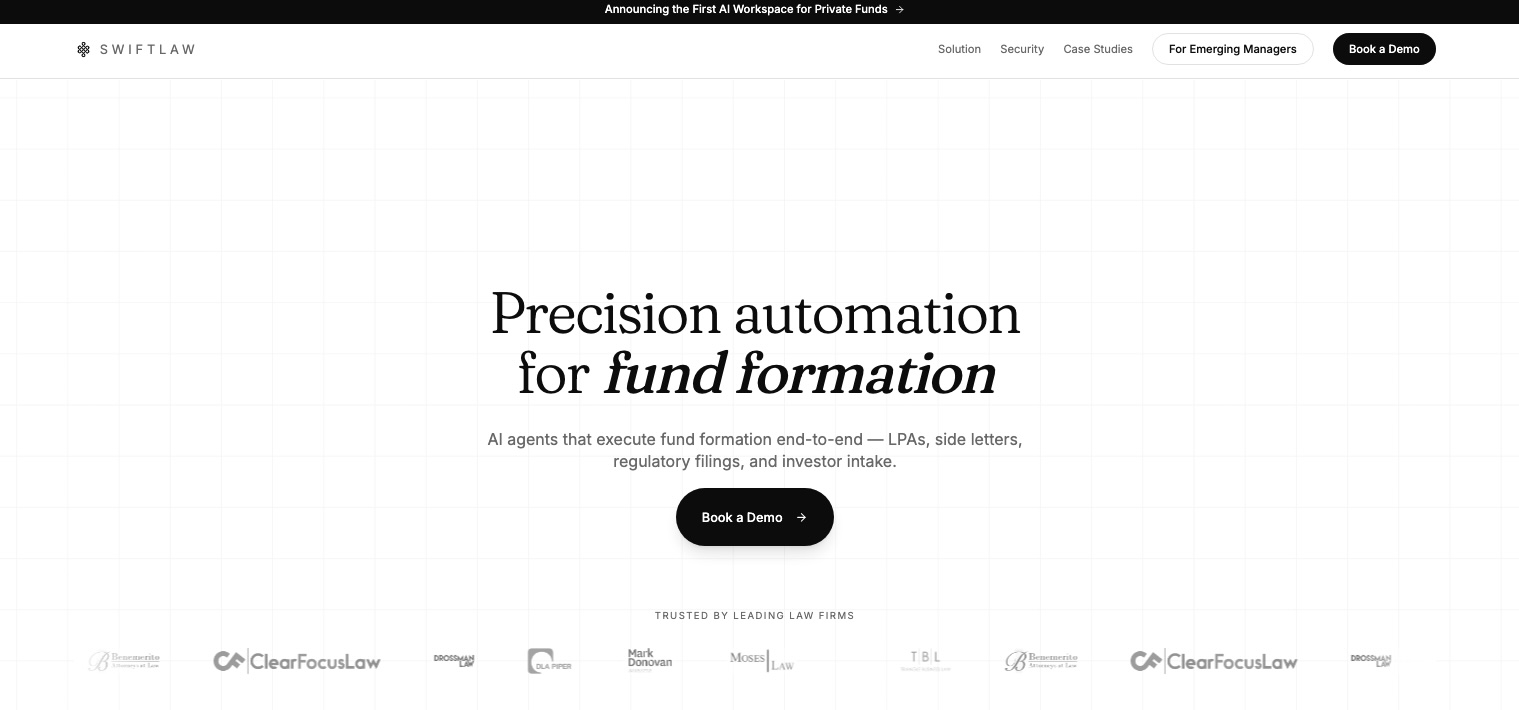
SwiftLaw, founded by Saketh Kesiraju, is a vertical AI platform that automates fund formation for emerging fund managers and their attorneys. The platform streamlines the creation of three core fund documents:
- Limited Partnership Agreement (LPA)
- Private Placement Memorandum (PPM)
- Subscription Document
It does this by generating a client questionnaire from a term sheet, then using the responses to auto-draft a complete document set in minutes rather than the months it traditionally takes. It also includes a native DocX editor, a co-pilot feature that cross-references documents against whitelisted legal sources like the ILPA guidelines, and visualization tools for key fund terms and entity structures. SwiftLaw operates both as a direct full-stack fund formation service and as a platform licensed to law firms, with the system running locally to ensure data privacy.
Watch 2.12.26 CodeX Group Meeting with SwiftLaw
Transcript
Roland Vogl:
We have Saketh Kesiraju, who’s the CEO and founder of SwiftLaw. So excited to learn from you.
Just a quick announcement—we just announced the CodeX FutureLaw conference. The main event is April 16, 2026 but we have other exciting events including a hackathon,a bootcamp, and a UN AI for Good law track conference that entire week. We call it CodeX FutureLaw Week and I encourage you to check out the program and hopefully join us in April.
codexfuturelaw.com—you can find all the information.
I will turn it over to Saketh. We’ve learned about SwiftLaw before and are curious to hear where the journey took you, Saketh. Over to you.
Saketh Kesiraju:
Thank you so much, everyone. It’s really an honor to be back here at CodeX. I think it was last year or maybe two years ago. A lot has happened since.
I’m founder of SwiftLaw. SwiftLaw is a vertical AI platform for fund formation. We just want to help people launch funds really quickly. That’s the premise. A little bit about me—first off, I didn’t necessarily get into funds or legal tech on purpose, I would say.
Back in 2023, I was very much into the crypto space and I was really trying to find people to buy the various crypto real world assets that I was trying to put on chain. I went to a conference in Salt Lake City with a bunch of emerging managers. I was trying to pitch these different emerging managers to sort of buy my crypto projects, and really no one was buying it. No one really cared. But while I was there, I befriended dozens of emerging managers. A lot of them were real estate professionals or HP executives and really these Bay Area Indian uncle types.
A lot of them really wanted to start these small venture funds, small real estate funds, and so on. While I was talking to them, you know, they were really excited about me because I was just an ambitious kid who took a gap from school to come there and work on something full time. They took me under their wing, and I basically worked with these fund managers building various tools for them. I built chatbots. I built a CRM automation tool.
I think the biggest headache that I saw was that their lawyers were just not very responsive to them, and the entire fund formation process was just something that was super expensive and tedious for them to just execute on. I decided to sort of take a swing at that. In that process and in learning more about fund formation, specifically for an emerging manager—someone that’s trying to raise, let’s say, under $150 million—large law firms, your AMLAW firms, are not necessarily geared towards these emerging managers.
Usually, it’s a very high-margin service for the law firm. Usually, it’s a very relationship-heavy sort of service that they provide. For an emerging manager that just wants to get their fund created and get them out the door so they can start raising capital, it’s sort of a little bit of an inefficient process for them—actually highly inefficient. Oftentimes, some managers would wait six months to get their fund created. It’s really sad if a fund manager’s asset management career ends before it really starts. And that was something that I’d seen constantly amongst these emerging managers, and so I sort of decided to do something about it.
In understanding why I chose this emerging manager sort of group to focus on, I really saw that even amongst my own peer group, there’s tons of people starting funds. In fact, Roland was someone that I was speaking to who started a fund recently. There are other people in my network—they’re starting funds. It’s really this long tail that’s emerging where even at fund launch, I met numerous fund managers that were doing really niche things or had new strategies.
For instance, one was starting a self-storage strategy fund, another one was starting a Pokémon card investment sort of strategy fund. There are all these various strategies that a fund structure can support because the fundamental sort of insight that I had was that a fund is simply just a vehicle to pool capital and do something productive with it. If you have a strategy or if you have some sort of edge, then you could potentially go out into the market, raise capital, and then scale whatever that strategy is.
In understanding what actually fund formation is, fundamentally it’s three documents.
It’s your LPA documents, a limited partnership agreement. It’s your PPM, which usually outlines your risk factors for your fund strategy, and your subscription document, which is how investors essentially onboard onto your fund. That’s how you get investors to come onto your fund or to invest. Usually, these documents are 160-plus pages long. They’re pretty long documents that previously, pre-LLMs, law firms would use something like Contract Express or try to use various tools, but it just wouldn’t work because these documents were far too long.
Law firms would actually have their entire fund’s practice be manual. So you’d have associates just write these 60-page documents or use templates and essentially do the full drafting process by hand. And what I realized is that really, looking at numerous fund documents over the past years, funds really break down into a small set of recurring terms. As you can see here, I said fees, carry, jurisdiction, fund size, entity structure, and so on. Really, what the work in practice is, is customizing these terms within those templates to create a full set of fund documents. That is essentially what our platform does—it’s a vertical sort of AI platform, a workspace for fund formation in which you can create a term sheet, assign that term sheet to a client so a client can fill it out, and then use that term sheet to then generate your LPA and subscription documents, so your larger fund document set. From there, you can use that into a chatbot that’s enriched with more research so that you can have a sort of chat interactive session with your documents. And there are sort of more tools that I’ll show off right now, actually, instead of describing it.
Right here is the current fund formation workspace. Rght here, I’ll go to a new deal and I’ll create a new client. Right, also, you know, talk about what is… on one… and I’ll create an empty client workspace. So now that I’ve created a workspace for myself, I’ll go into my documents tab—all the documents I’ve been working on recently. And I’ll click into a term sheet that I want to use. This is the term sheet. One thing to note here is that we’ve built a native docs editor into this workspace. That’s something that’s usually extremely hard. DocX is the formatting sort of underpinning for Microsoft Word. Any lawyer that drafts documents or uses documents needs a DocX native editor to fundamentally do their work. We spent a lot of the last 18 months really perfecting the DocX editor and making sure that documents can get imported into it, retain formatting, get exported out, and retain the formatting. Sounds simple—quite hard to do in practice.
Right here, you can see a term sheet. It has all these placeholders or blanks in it. What I’ll do from here is actually generate questions based off of those blanks so that I can create a questionnaire and assign it to a client. Right here, I’ll say a questionnaire and generate this. Over in the questionnaire tab, this is one that I’ve worked on before, and for the sake of time, I’ll just show you what that looks like. So here, the questionnaire is created. I can hit share, and I get a link. This is the interface that the client will see—it’ll be like a form view where I can answer the questions one by one. Yeah, 80 percent, etc., and when I’m done, I just hit submit.
Now my job as the client is over, so I can go back to the dashboard for the attorney, see that the answers from the client are all in the right places. If there’s something that I need to change, I can do that, and if everything looks good, I can hit submit and generate. Nw it will generate a complete term sheet. Well, it should… it should be a complete term sheet. I don’t know what’s going on. This is the humor with these live demos. But let me just show you what the term sheet it should generate looks like.
Okay, so this is sort of a term sheet that would get generated from it with all the insertions in the right place. From here, with this term sheet that’s been generated, I can go back to my workspace and say, you know, create now an LPA and a subscription document based off of this term sheet. So let’s say this one looks pretty good to me, and so I hit generate. Now it’s essentially extracting all those terms and creating an entire LPA and subscription document. And the way it’s doing that is we have sort of a set of LPAs that we have in the back end that we use as sort of golden reference documents. It essentially uses that as well as the terms in the term sheet to create this full document set for the LPA and the subscription document.
So we’ll give it maybe a few seconds. While that’s going, I can just show you what it should look like, which is the document that’s generated will look something like this. It’ll be a full LPA, usually 60 pages, with—this is an insertion that was made. I just ran this entire sort of flow right before the call. I didn’t really anticipate that it would start working on the call, but I guess you’ve got to anticipate that. Well yeah, this is sort of a full 60-page LPA that was generated. You can see that all these insertions are made. Everything looks pretty good. I’ll show you the subscription document as well.
It’s essentially from term sheet to complete document set within a matter of minutes. And usually, if you’re a private funds group, the time it takes to go from a term sheet or not even having a clear idea of what the terms of a fund are to a complete document set is months. It can be. In terms of drafting time, it’s like 20-30 hours. And if you’re getting billed at a partner rate, that’s pretty expensive. And so fundamentally, we’ve abstracted and compressed the timelines to be far, far shorter than what it is today.
Now that these fund documents are created, I’ll just add them to my workspace here. And I can go to the Co-Pilot tab here, add it as context—one of these documents, let’s say the term sheet—add some sources. Let’s say the market standards, SEC, the web, some state codes. I’ll say something like, “Hey, are there glaring errors or issues in my term sheet I should watch out for?” And now what it’s doing is it’s essentially making web searches to all these various whitelisted sources that I’ve previously bookmarked, and it’s finding the relevant sources and then using our document as context to provide a sort of real informed sort of feedback for the document. And this is a back-and-forth conversation that you can continue to have. Aas you can see, there are really specific issues that it’s highlighting. It provides some citations for me as well. I can click on one of these—this is a pretty in-depth LPA sort of guide that is what a professional fund attorney would use as a reference document. These are the recommendations. I can sort of keep going, or another sort of visualization tool or tool that… well yeah, maybe, maybe folks have some questions, you know, anything specific you still want it to show, or otherwise, I’m sure…
Yeah, just… yeah, maybe this is just a visualization tab here, which is the fund that we’ve just created. These key terms are the main sort of backbone of a fund, and so you can visualize it right here. And if I wanted to change one of the key terms, let’s say from 80 to 50 million, it updates those things across the document. So this is just a really easy way to change terms in your fund without having to sort of go into the document, search for it, and make drafting-related changes. You could sort of just use this interface as a shortcut.
Another visualization we have here is an entity structure visualization. I find it pretty helpful considering that funds are complex structures, and it’s hard to understand what goes into what and how carry works or how various parts of funds work. And so this is sort of just a visualization to help fund attorneys understand exactly what those documents actually mean in practice. But that’s the sort of full workflow. It’s really an end-to-end vertical platform for funds. And that’s it.
Roland Vogl:
That’s pretty awesome. So does this help practicing fund formation attorneys with their work just to be more efficient, or is this something that the fund managers will use themselves instead of using an attorney?
Saketh Kesiraju:
So it’s really for the attorney. But how we… so we sort of operate as a full-stack sort of fund formation business as well as we sell this platform to other law firms as well. So if we have a fund manager that’s in our network and wants to come to us, then we will essentially be sort of the full-stack solution for that manager. But that’s where really our vision is. However, for now, we’ve been working with sort of pilot law firms to just make our workflows a lot stronger and to just validate them in the real world as well.
Roland vogl:
So you’re seeding the system with whatever the templates are from the law firm, and those templates, they have the different variations of specific clauses, right? Then from those templates, your system can create a questionnaire that will then help you sort of create the custom documents. Correct?
Saketh Kesiraju:
Correct, yeah. I think that’s most helpful for the term sheet, right, because that’s probably the easiest one-to-one placeholder replacement workflow. But for your larger LPA and subscription documents, it’s really, you know, there are clause-specific replacements that need to be done. It’s not just term-for-term replacements. And so that’s where it runs sort of a longer process to do this sort of document creation workflow, which I skipped over earlier just to save some time. But yeah, that is sort of a more robust workflow.
Roland Vogl:
That’s a cool feature to be able to run those documents by some external benchmarks, for example. How do you know what kind of data are you using to enable that feature?
Saketh Kesiraju:
Yeah, so market terms are really from whitelisted sources that I’ve run into or fund attorneys have told me that they use as reference points. So the LPA guideline for the Institutional Limited Partners Association—they essentially set standards. They put out templates, they put out various sort of private market data and information regarding private funds. And so that’s the number one source that we go to. And then there’s also just web search. So we also scrape the entire web, essentially, for private funds or market-related terms. And then we try to figure out if that’s a credible source and then whitelist it and see if… yeah, essentially that is in line with what we hear from our attorneys as well.
Yeah. So in terms of privacy, there’s no reinforcement learning happening to ingest the content. In fact, the entire system runs locally. So you can think of it as like Claude Code fine-tuned specifically for… or like Claude for Work, something that you might have seen, fine-tuned specifically for private funds, in that the entire system is just local, so it’s using your local files and so on.
Roland Vogl:
So Cristiana and Juan are asking, can you get capital from other jurisdictions for entities outside the US?
Saketh Kesiraju:
Yeah, you can. In fact, one firm that we were working with was actually a Canadian GPU stakes firm. And for them, their limited partnership agreement had a special feeder vehicle as well that was necessary for them to essentially raise capital from outside US investors. And so yeah, the actual structuring of these fund vehicles is obviously dependent on an actual attorney advising you on this. But yeah, that is all doable on the platform.
Roland Vogl:
Thank you so much for the updates. It’s exciting. But I know you have to hop to your next event already, so really appreciate you joining us. It’s very cool. And yeah, good luck with all the next steps.
Saketh Kesiraju:
Thank you. It was a real pleasure to be here and speak to you all. So thank you for having me, and have a great day today.
Saketh Kesiraju can be reached at saketh@tryswiftlaw.com