
Charley Moore – Axon Fusus & Lightpost – CodeX Group Meeting – February 19, 2026
Charley Moore, Product Manager at Axon, presented on the company’s real time crime center technology Axon Fusus and Axon Lightpost, an automatic license plate reading (ALPR) camera.
Fusus is an open-platform system that integrates existing cameras, body worn cameras, drones, and other security assets into a single common operating picture, allowing law enforcement to act on real time data and AI-driven analytics.
Lightpost draws power from streetlights to capture vehicle and license plate information, and when combined with Fusus, enables officers to track suspect vehicles, build hotlists, and resolve incidents rapidly — as demonstrated by a beta program hit-and-run case resolved in 20 minutes that recovered $80,000 in illegal drugs.
The Q&A covered topics including privacy compliance (governed by MOUs and local retention laws), the donor program that provides free Fusus cores to local businesses, the absence of facial recognition in the platform, and a subscription/hardware-based business model tailored to each agency’s existing infrastructure.
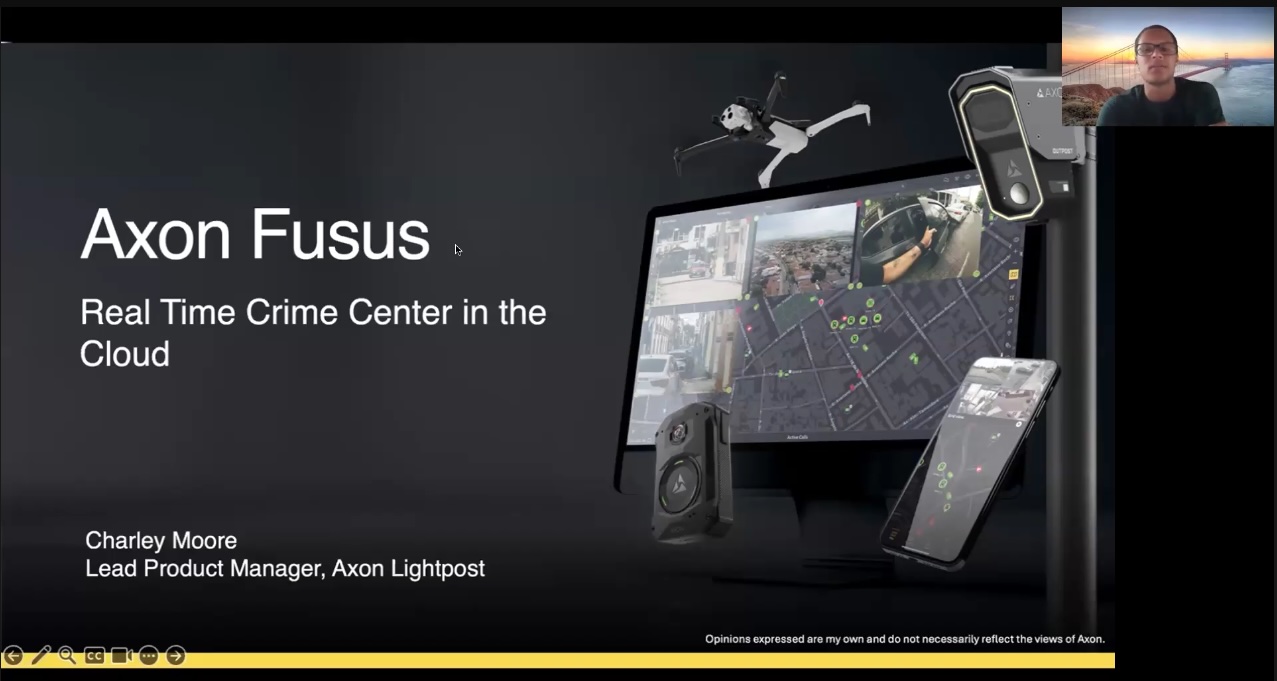
Watch Charley Moore’s presentation at the CodeX Group Meeting
Transcript
Roland Vogl: Today we have Charley Moore, who’s the product manager at Axon and is in charge of Axon Lightpost. Axon is a leading company in the real time crime center space. That’s an area and technology space we haven’t covered much before. So we’re really curious for you, Charley, to educate us a little bit about that space and tell us specifically what you’re doing there, and maybe show us a little bit of the technology.
There are no other updates other than Future is coming up in two months. So if you haven’t registered yet, please do so at codexfuturelaw.com. And with that, I will now turn it over to Charley.
Charley Moore: My name is Charley Moore. As Dr. Vogl said, I am the lead product manager for Axon Lightpost, which is a new ALPR — automatic license plate reading — solution that we launched in December. I had the privilege of meeting Dr. Vogl when I was actually representing Axon at the career fair back around September, and he invited me to present here. I could not be more grateful for the opportunity.
So I’m looking forward to talking about Axon Fusus, which is where the majority of my work at Axon has revolved around, and then giving a little background about Axon itself.
Axon was founded as TASER International. The first product that came out was the TASER, then cameras, then body worn cameras. And now the majority of my work has been in the real time crime center space. That’s what I’m going to talk about mostly for this presentation.
I started at Axon as a mid-market enterprise executive, as an SDR on that team, working in security operations centers — selling the same technology that we use for real time crime centers to enterprise customers and private businesses, allowing them to share video footage and incidents directly with law enforcement, and using a lot of the same technology that law enforcement uses for their own operations.
From there, I became a product manager on the Axon Vehicle Intelligence team, helping develop our strategy around vehicle information for crime prevention. The two cameras we came out with are Axon Outpost and Axon Lightpost. Axon Outpost is a solar powered ALPR camera, and Axon Lightpost — which you can see here — is a streetlight-powered ALPR solution. It draws power from the street light, which allows you to power the camera and provide connectivity for high-speed, high-distance, very accurate vehicle capture and license plate information for crime prevention.
What Is a Real Time Crime Center?
The first real time crime center was established by the New York City Police Department in 2005. Real time crime centers can come in many forms — they can be as large as a dedicated room with multiple different screens, or as small as a laptop. The key to a real time crime center is the opportunity to take data and analytics, merge all of your different security operation assets into a single common operating picture, use that data and those analytics as efficiently as possible, and get that information to first responders in real time — so that they have as much situational awareness as possible heading into a situation.
Axon Fusus
Fusus is one vendor in the real time crime center space. Some of the advantages of Fusus:
Fusus is an open ecosystem. It allows you to work with your existing infrastructure — whatever you have — and merge it into a common Fusus operating picture. Fusus works with multiple different camera vendors. What you can see is a Fusus core box, which sits on a network and allows you to draw video streams from multiple different vendors. So whatever cameras you already have in place — whether you’re an agency or a private business — it allows you to take your existing cameras and merge them into a common operating picture, along with all of your different security assets: body worn cameras, drones, anything you have for your security operations.
One of the other things Fusus allows you to do is use AI-driven workflows with your existing cameras. The Fusus core — which will fit in the palm of your hand — allows you to run AI analytics directly on your existing cameras, even if those cameras themselves don’t have AI analytics. So when I get into the workflows of Lightpost, one of the things to think about is: if you don’t have a license plate, you can still use Fusus to search for things like the car’s make and model, shirt colors, and so on, using those AI analytics on the cameras themselves.
To summarize, Axon Fusus provides:
- A common operating picture
- Real time emergency video access
- More efficient use of personnel, because you know what’s going on on scene
- Enhanced precision policing
- Fostered community collaboration
- Cost savings, because Fusus works with your existing infrastructure
Example Workflow: Axon Lightpost
I’m going to dive into an example workflow for Lightpost — the ALPR camera that I am the product manager of — and talk through one of the workflows and cases that came out of our beta program.
This incident was a hit and run. A vehicle was driving, crashed into another car, and immediately sped off. The victims provided officers with a picture of the suspect’s vehicle. As I noted, even if they hadn’t had a clear image of the license plate — which in this case they did — we can still use Fusus to solve that crime, because instead of searching by license plate specifically, you can search by things like “blue vehicle.”
But in this case we had the license plate. So the officers entered that license plate into Fusus to receive an automatic alert on what’s called a hotlist, which alerts when that vehicle is found on another Lightpost camera. From there, officers actually had a nearby traffic camera that was also integrated into Fusus. They were able to pull up that traffic camera, confirm that the incident took place, and then send that footage to the real time crime center in their command center — both to gather more evidence of the incident and to confirm the victim’s statement.
Officers then performed an ALPR search, going back to see all the locations that vehicle had been captured by their previous Lightpost cameras. They performed that search and were alerted to the nearest location where that vehicle had been found in the city. From there, they searched one of their other nearby traffic cameras and found that vehicle turning into a parking lot. They then dispatched officers to that location and, in real time, were able to stream that body worn camera footage directly to Fusus to see that the situation was being resolved — helping the officers on scene understand what was going on, communicating with them, and recording the incident.
If you haven’t heard of Axon — if you ever see body worn camera footage on YouTube in the future and look in the upper right-hand corner, you’ll see a yellow triangle. That’s the Axon logo. So you’ll start to notice that a lot of body worn camera footage you come across is from an Axon body worn camera.
Results of this workflow:
- Recovered $80,000 worth of illegal drugs; a large quantity of illicit substances packaged for individual sale were removed from the streets.
- Footage of the incident was used to confirm the victim’s statement, resulting in an evidence-backed arrest.
Here’s a direct quote from the officer: “Without the technology available to us, the case would have likely gone unsolved, as the driver was not the registered owner of the suspect vehicle.” In this case, had we not resolved that incident within 20 minutes — from initial call to suspect apprehension — and had footage of where that vehicle traveled, it would have been difficult to confirm that the person in the vehicle was at the location when the incident took place. But because we had all this information available, it allowed the officers to make sure they were arresting the right person, understand the situation as they were heading into the response, and proceed from there.
Video: Royal Bahamas Police Department
Before Q&A, I’ll play a short video from the Royal Bahamas Police Department, which I think is very helpful in showing the value of Fusus through a real example of them using it to capture a shooting suspect.
Royal Bahamas PD representative: You want an agency that can act fast when crime happens. You need people in a command center letting those mobile units know — “hey, this is happening, a shooting is happening, a robbery is happening.” That also helps with community trust. Once the community sees that police are responding fast enough, that is what our real time crime center was established for.
Before Axon Fusus, we had all these different platforms spread out. You would have CCTV cameras on one platform, another system on another. But now with Axon Fusus, everything is integrated into one. You have body cams, ShotSpotter, our CCTV program — everything is on one platform. It makes the response time a lot quicker.
For instance, we had a matter in 2024 with a shooting incident. ShotSpotter went off in Fusus. We clicked on the cameras, which pulls all cameras within a mile radius of where the shot happened. Of course, we don’t know exactly what happened just yet, but we see there’s a white Honda running past a red light behind the victim’s vehicle. We were able to get the license plate — and not only alert control on how the vehicle looks, we were able to broadcast a photo of the vehicle in Fusus so they could actually see the vehicle. So not only can we get a description over the radio, we’re actually seeing it on our mobile device exactly how the car looks. And within an hour or two, that suspect was arrested.
Technology revolutionizes policing, enhancing efficiency, accountability, and crime prevention through surveillance, analytics, and real time data. We balance safety and hospitality through crime prevention, rapid response, and strategic policing to protect all, while upholding the Bahamas’ welcome and reputation.
Charley Moore: While that video was from the Bahamas, I think it really shows the value of real time information in precision policing and policing operations, and the value that Lightpost and other security assets provide. With that, I’ll turn it over to questions. Thank you again for your time.
Q&A
Roland Vogl: This is super interesting. I have a couple of questions. First, how many cameras are typically deployed in a city that you provide, and how much information is coming in from other sources? The video mentioned CCTV, and sometimes you hear about feeds from Ring cameras or gas stations. How is all this information being brought together and put in front of the police officers?
Charley Moore: Great questions. For the first — how many cameras — it’s really up to the agency, what their budget is, and what they’re looking for. We’ve done pilot programs with as few as four cameras, just to capture the entrances and exits of a city, so that if something happens in their location, they can alert a nearby jurisdiction that a suspect is heading their way. Other agencies can deploy up to 50 or many more cameras. It really just depends on the size of the city and the size of the agency.
For the second part — how many assets can be in a Fusus panel — it can be every officer’s body worn camera, every drone, every single security asset. There’s no limit in Fusus; Fusus doesn’t charge by the number of assets you integrate. It’s pretty easy to integrate specific assets that have existing integrations with Fusus. So there’s really no limit. It’s up to the agency for how much information they want in Fusus, whether they want to focus on specific security assets, and what their budget is for their real time policing operations.
Roland Vogl: What about other intermediaries that try to aggregate information and then sell it to the police? For example, if a private security company has installed a camera at a gas station and a crime occurs there — is there an agreement with the police to have a feed, or does the police have to go there and subpoena or request the video?
Charley Moore: Yes, there are some companies that aggregate that data. That’s actually related to our Fusus donor program. One of the things that every agency gets when they sign up with Fusus is an allotment of those Fusus core devices that I talked about earlier. The agency can actually give those cores for free to local businesses — especially gas stations, convenience stores, stores that see a lot of crime and are very affected by it. They sign an MOU with the police department that details when and where the police can access that footage. From there, instead of having to manually share footage with law enforcement, when you call law enforcement they can immediately access that footage, see what’s going on, help with community safety, and know exactly what situation they’re getting into when they respond.
Roland Vogl: What about compliance frameworks that govern Fusus — specifically about legal document automation, chain of custody, and evidence disclosure workflows downstream from Fusus data.
Charley Moore: Right now, sharing video feeds with Fusus is governed by a memorandum of understanding signed between the business sharing their video feeds and the police department. There are also community council meetings when deploying Fusus, and it’s publicized so that the community has input. The community can see the privacy safeguards in place, and there’s a lot of documentation to make sure Fusus is very transparent about when and where the police can access video footage and how they can use it. The primary mechanism is that MOU between the business, homeowner, or private citizen who wants to share video directly with the police department.
Roland Vogl: What about privacy rules, what does compliance mean in practice? The information picked up isn’t always of a specific crime, so there’s still a lot of other information that could be otherwise sensitive. What’s done with that information — is it stored, then deleted? What practices are in place?
Charley Moore: That’s a really good question. Every state and county has its own rules and restrictions on when the video can be deleted, how it can be deleted, and how long it has to be retained. So before deploying Fusus, it’s important to understand what those agency’s rules are. Fusus was founded — I believe in 2019 — but video feeds for law enforcement have been around for a while, so most agencies are already familiar with the rules around storage and use. Fusus is able to remain compliant by automatically setting video feeds to be retained only for the duration that the county specifies, and we figure that out before deployment to make sure we’re in compliance with all local ordinances.
Roland Vogl: It sounds like body cameras have brought a lot of clarity to situations that might otherwise have been unclear, and some of those situations have led to significant public incidents. Are there rules requiring that body cam footage be shared with the public or be accessible through public records requests?
Charley Moore: Yes. There are a lot of different rules depending on the county, but in some counties all of that footage has to be stored for, let’s say, 30 days. If a member of the public makes a Freedom of Information Act request, they can request that footage directly from the agency. Within Fusus, you can go in, select the video clip from a specific camera that you want to share, and download it to your computer. If it’s a private company using Fusus, you can share that video clip directly with them — for example, if it’s a shoplifting suspect that Walmart is looking for. But if it’s a request from the general public, you download the video clip, save it, and then share it securely in response to the Freedom of Information Act request.
Roland Vogl: How does the system manage legal consent. Is the system used to perform facial recognition?
Charley Moore: Axon does not do facial recognition today in the use of Fusus. When I talk about object detection, I’m talking about things like shirt color, shoes, pants — but today Fusus does not provide facial recognition.
Roland Vogl: Benjamin is asking about the Fourth Circuit Court of Appeals saying that blanket surveillance — specifically all cameras — violates the Fourth Amendment right to privacy.
Charley Moore: I would have to look up that case specifically and do some research. To be totally transparent, I have not heard of that specific case. I’d definitely want to look into it and am happy to connect offline if you want to have a discussion, because I’d love to learn more about that. But from what I can see, we’re fully in compliance with all local laws.
Roland Vogl: Most of your customers are police departments, but you’re also selling to private organizations?
Charley Moore: Yes, exactly. Security operations centers — using the same technology that law enforcement uses, but applying it to your stores and businesses to merge all of your operations and security assets into a common operating picture.
Roland Vogl: What’s the business model — is this a subscription sold to police departments?
Charley Moore: For Lightpost, it’s part of a five-year contract and involves buying the hardware. So you’re purchasing Lightpost, you own the hardware, and then the service is billed annually. It depends on the specific products. With Fusus, it used to be that you paid per stream — for however many cameras you have, you paid for each of those cameras. Today, you’re buying packages depending on how large a real time crime center you’re building out with Fusus. But not everything is bundled together — Fusus doesn’t necessarily come with Lightpost or another camera. It’s really about building and mixing and matching the technology for each agency’s needs. A lot of that also depends on what technology the agency already has, because there’s no point in buying extra cameras if you already have high-functioning cameras in place. We come in, work with those existing cameras, and bring them into Fusus the same as any cameras you might purchase directly.
Roland Vogl: How does the software work — is it machine learning, visual recognition algorithms? What’s the tech stack used to match and track?
Charley Moore: That depends on the product. For Lightpost, it’s a third-party algorithm that runs on the device today. For Outpost, it’s a proprietary algorithm that runs on device. And then for standard video cameras, those have their own AI algorithms that run on the device and also do some processing in the cloud. They allow you to take those video feeds through what’s called RTSP — a standardized protocol for video feeds — take that video feed, run it through the core, process it with AI analytics, and then send that video to Fusus.
Roland Vogl: All right, well, thank you so much, Charley.
Charley Moore: I’m happy to continue the conversation — I love this technology and I’m really passionate about all of it. Happy to connect with anybody and talk about Lightpost and policing.