
Horace King – Lextar AI – CodeX Group Meeting – March 5, 2026
Lextar AI: Governance-Grade AI for Legal Reasoning in Regulated Environments
Horace King, Co-Founder & CEO of Lextar AI, joins the CodeX Group to present his vision for responsible AI in legal practice. Drawing on Canada’s directive on automated decision making and U.S. executive frameworks, Horace walks through how Lextar AI is built from the ground up to meet government-grade standards for transparency, explainability, and human accountability.
Unlike general-purpose AI tools, Lextar AI is a structured legal reasoning platform — not a chatbot. It breaks legal analysis into 25–40 explicit, auditable steps, is jurisdiction-aware (currently supporting Canada and the U.S.), and understands legal hierarchy from constitutional law down to policy directives. The goal: defensible work product that lawyers and judges can stand behind.
In this session, Horace demos the platform, explains how it differs from outcome-simulation tools and generic AI, and takes questions on its RAG architecture, underlying model, training data, and what “governance grade” actually means in practice.
Watch CodeX Group Meeting in Youtube
Transcript
Roland Vogl: Welcome, everyone. Let’s get started. Welcome to our CodeX group meeting. We’ll hear from Horace King, who is the co-founder and CEO of Lextar AI, which is a governance-grade legal reasoning platform for regulated environments.
Horace King: I feel deeply honored to be invited to make a presentation today, knowing that all of you are experts in AI and the relationship between AI and law. Today I’d like to talk about responsible AI. My presentation is not just a promotional pitch. I would like to talk about my perspective as a businessman running this business and about responsible AI and structured reasoning in regulated decision making.
I know Vogl and Codex. I look to you as forerunners in responsible AI research. I am Canadian, so I live in Canada. The first unified legal document regarding responsible AI in Canada is the Directive on Automated Decision Making. It includes several rules regarding algorithmic impact assessment, transparency, explainability, human-in-the-loop, quality and bias testing, and auditability.
In the U.S., there is not just one unified document regarding responsible AI — there are three: the Executive Order in 2020, the Executive Order in 2025, and the Office of Budget Memorandums 2521 and 2522.
I started this business — it was actually incorporated on the first day of this year, but I started designing this product as early as 2024. I always kept in mind that I needed to explore how AI could be used to facilitate or assist lawyers, judges, and others in the legal field. This is not my first startup. In 2020, I built a database of Chinese law in English. That database is still working on the market. I’ll come back to why I designed this product in more detail, but to summarize, the responsible AI requirements in government systems should at least include algorithmic impact assessment, transparency, explainability, human-in-the-loop decision making, bias testing, and auditability. I always kept those requirements in mind when designing this product.
Almost everybody knows that it can be risky for regulated industries — for lawyers, for judges — because some lawyers have been sanctioned for using hallucinated authorities, which is essentially AI-generated legal psychosis. Another issue is the black box problem: a lack of traceable reasoning and jurisdictional confusion. AI may sometimes confuse jurisdictions or use outdated sources.
More and more lawyers are using AI to facilitate their work, but they also face great risk potential. Because automated AI output is used without sufficient verification, there is a lack of accountability — a serious issue for lawyers and judges. Almost all institutions are now making policies or guidelines regarding AI adoption, and in the absence of governance controls, that gap remains.
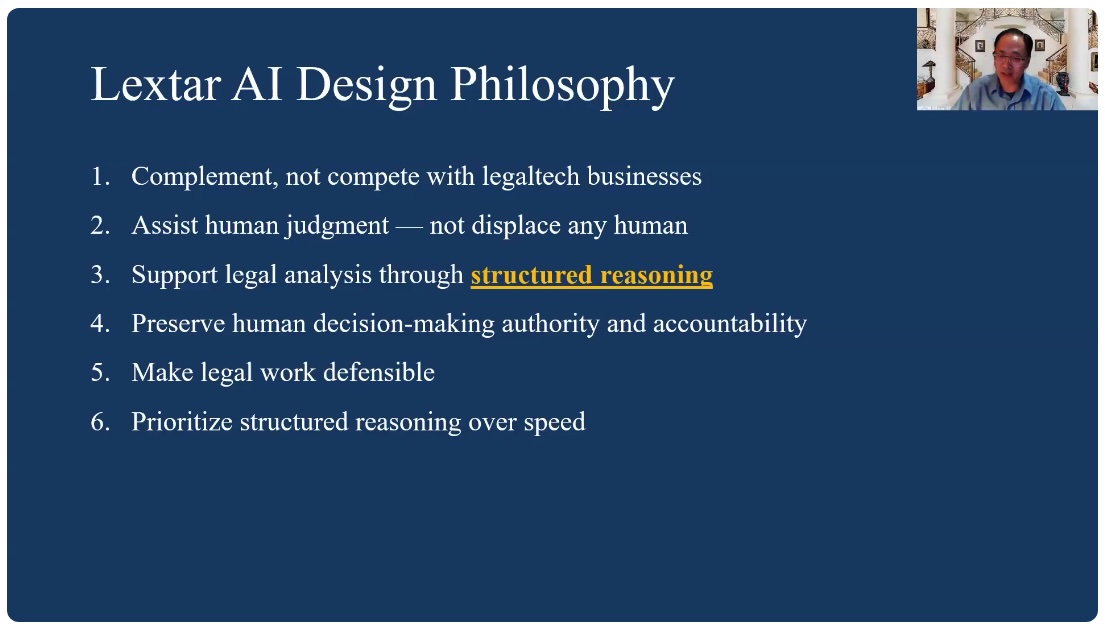
When I designed this AI, I kept several things in mind. The first is that it is designed not to compete with existing legal practice tools, but to complement them. Over the past two decades, technology has largely been used to facilitate legal research — the retrieval of laws, regulations, policies, and cases. LexisNexis and Westlaw have made great contributions to that, and it is genuinely very helpful.
When I designed this product, I asked whether I could find something new that could genuinely help people. It seems to me that in legal practice, very few tools have addressed legal drafting and legal reasoning in a way that is transparent and auditable. That is the first thing I kept in mind: to complement existing tools by focusing on the reasoning and drafting stage.
Second, the system is designed to assist human judgment, not displace it. It is not meant to substitute for or take over the work of a lawyer. Accountability remains human. The system is there only to assist lawyers and judges, to support legal analysis through structured reasoning, to preserve human decision-making authority and accountability, and to make legal work defensible — by keeping the reasoning trace transparent. You can see how the AI reasoned and how it verified against rules and laws. I will show you an example shortly.
The system prioritizes structured reasoning over speed. It may take several minutes — five, seven, or ten — depending on the complexity of the case.
DEMO WALKTHROUGH
This is the website, which is already launched. On the first intake page, you can input up to 5,000 words in the text box, or you can browse and upload PDF or Word files for AI to process.
The AI has role awareness. You can choose the role of the AI as a neutral legal analyst, as counsel representing the applicant, or as counsel representing the respondent. There is also a role for adjudicators — such as arbitrators, judges, and tribunal members — but that role is not available on the website to avoid confusion. We are keeping it for visiting professionals.
The analysis runs through approximately 25 to 40 steps depending on the complexity of the case. When complete, it will show ‘Processing complete — all analysis complete,’ and the button will change to ‘Expand All,’ allowing you to review every step and verification. Different colors are used to indicate AI confidence levels. A 50% confidence rating, for instance, signals that the claim should be verified. The system also makes recommended actions: what to address immediately, what is urgent, what can be deferred, and a conclusion with citations.
STRUCTURED LEGAL REASONING
In my view, structured reasoning means the system does not jump directly to an answer. Instead, it breaks legal analysis into explicit steps. In a litigation case, it first sorts and structures case materials — organizing evidence and other materials the litigation lawyer has received from the client. It then organizes legal claims and issues, identifies missing legal elements or claims, tests each required legal element, evaluates supporting evidence, and detects gaps, inconsistencies, contradictions, and unsupported assertions. It then drafts the output and recommends verification steps and corrective actions.
This is the distinction from generic AI to governance-grade legal AI. We implement what we call a Lex AI reasoning pipeline: the system is designed first to plan, then to retrieve, to verify, to ground, and then to synthesize — broken into roughly twenty-seven steps.
The promise of Lex AI is simple: to produce defensible work product, reduce the risk of hallucination, maintain high consistency, and preserve human authority.
There are currently two different approaches to AI in dispute resolution and regulated decision making. One is outcome simulation. The other is structural legal reasoning — the approach we adopt. Both approaches have strengths and limitations, and I am not suggesting one is strictly better than the other.
Q&A
Q: How does it compare to reasoning models in ChatGPT, for example? It breaks out steps and explains what it’s doing — is this the same but just in a legal context, or have you done something specific in terms of training?
Horace King: When people talk about AI, they often refer to general AI — chatbots. But Lex AI is not a chatbot. General AI is not jurisdiction-aware and it can reason too broadly, which is why it may hallucinate. Lex AI is designed to reason within a boundary. You first choose a jurisdiction — right now we support Canada and the U.S. If you input a case where Canadian law would apply but you’ve selected U.S. jurisdiction, the system will decline to process it and explain that it doesn’t apply.
Q: Is this a multi-agent reasoning system using RAG and in-context learning?
Horace King: Yes, we use RAG pipelines. Lex AI differs in that we train it to be aware not just of jurisdictions but of the legal hierarchy — which law overrides which. It searches first at the constitutional level, then legislation, then regulations, policies, manuals, and directives. It understands the different levels of legal force and effect, and it also understands the precedential weight of cases. We use our own curated legal database. We are not trying to build a comprehensive database like LexisNexis or Westlaw — we build a targeted database of the required statutes and cases needed to enable the AI to reason well. If any law or case is not found in our database, it alerts the lawyer or judge. There is also a live interaction panel on the right side of the website where users can ask questions about the output, refine the analysis, or make amendments to the case.
Q: What is the underlying model and what training data was used? What does ‘governance grade’ actually mean — do you have a compliance certification?
Horace King: ‘Governance grade’ means the system satisfies the responsible AI requirements set by government — those I described earlier, including explainability, transparency, accountability, and human-in-the-loop. A judge or lawyer can defend their use of the tool by showing the reasoning trace: how the AI reasoned and how it verified against laws and cases. As for training data, it comes from the public domain but is curated with our own taxonomies, downloaded from official government websites. We are currently using an enterprise-grade model — Microsoft Copilot — though we have considered using both Copilot and other models as the product evolves.