
Jennifer Chacón on Trump’s Immigration Agenda and How it is Reshaping Policing, Detention, and Local Power
The Trump administration came in promising mass deportation. What has followed goes well beyond border control to matters of local policing, detention, federal power, and the limits of the law inside the United States. On a recent episode of Stanford Legal, co-host Professor Richard Thompson Ford talked with immigration expert Jennifer Chacón, the Bruce Tyson Mitchell Professor of Law, about the Trump administration’s immigration enforcement agenda and the consequences it is having in cities and communities across the country.

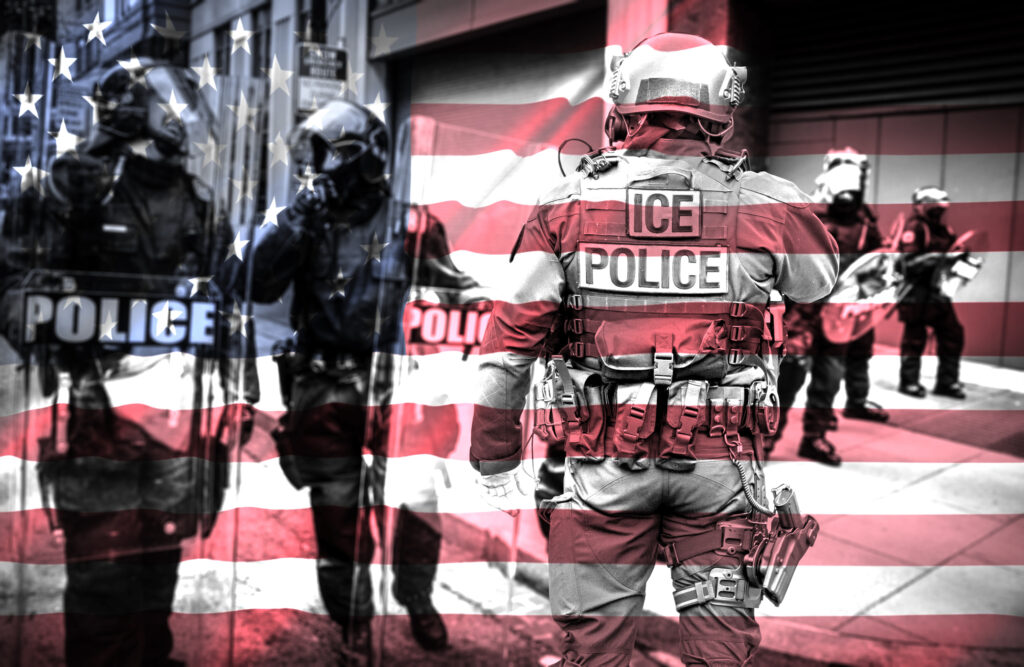
Ford and Chacón focused on Trump’s deployment of federal border and ICE agents, leading to a surge in armed and masked personnel on the streets of largely Democratic cities such as Los Angeles, Portland, and Minneapolis. The conversation turned to profiling, court orders ignored by the administration, pressure on states and localities, and the widening reach of immigration enforcement into everyday civic life.
Professor Chacón, author of a casebook on immigration law, addresses some of the same themes in her new paper “The Law of the Immigration Raid.” She teaches and researches about the issues that arise at the nexus of immigration law, constitutional law, criminal law, and procedure.
The following is an edited and shortened version of the full podcast transcript, which can be found here.
Rich Ford: Let’s start by talking about the current immigration situation in the U.S. a bit more than a year into the second Trump administration.
Jennifer Chacón: In some ways, what we’re seeing is the Trump administration trying to fulfill a campaign promise. But we’re also seeing a mismatch between what many people thought they were voting for and what the administration actually wants to do.
During the campaign, President Trump’s rhetoric focused on deporting people he called “criminal aliens” — presumably individuals who had committed violent crimes in their communities. But what we’re seeing, of course, is a much broader set of enforcement practices. That isn’t surprising to anyone who was paying close attention to immigration policy before the election, but I think it has surprised many people who were swept up in the campaign rhetoric.
Many people seem to assume that large numbers of unauthorized migrants in the country are committing heinous crimes. Those cases do exist, and they are often amplified by the media because they are sensational. But the reality is that the vast majority of unauthorized migrants have no criminal record and no contact with the criminal legal system. In fact, the data consistently show that they are less likely to have such contact than similarly situated citizens.
So it is unsurprising that there are not vast numbers of so-called “criminal aliens” who are low-hanging fruit for the administration to remove. Instead, this has become a campaign targeting virtually anyone present in the country without authorization, as well as a significant number of people who have or once had legal status. We can see the administration stripping legal status from various groups and then targeting those same groups for deportation.
Rich Ford: You’ve argued that there is really no way to implement the Trump administration’s agenda without affecting large numbers of Americans, both citizens and non-citizens, something we’re now seeing in places like Minneapolis. Why is this?
Jennifer Chacón: Border apprehensions are way down. In fact, encounters at the southern border are now at historically low levels, not just compared with the Biden years, but compared with much of the last two decades. There are several reasons for that. Under President Biden, the administration was dealing with a backlog of people who had been prevented from seeking asylum under COVID-era policies. At the same time, major political upheaval in places like Venezuela pushed more people toward the southern border. The reopening of asylum pathways, combined with those external pressures, produced a large increase in arrivals. The Biden administration spent much of its time trying to move those people into legal channels and process their claims, but that also fueled a public perception of chaos and unfairness.
When Trump came into office, he made clear that asylum processing would largely stop and that people with temporary protections, such as humanitarian parole or TPS, could lose them. The underlying conditions driving migration have not necessarily been solved, but the message is clear: the United States is closed. That has an obvious deterrent effect.
At the same time, border numbers were already falling toward the end of the Biden administration as the backlog was being addressed. So Trump inherited a downward trend and then effectively declared the border closed.
If there are relatively few people to apprehend at the border, but Congress is giving the administration billions more for immigration enforcement, that enforcement energy has to go somewhere. And what we are seeing is a shift toward interior enforcement: ICE and Customs and Border Protection operating in places like Minneapolis and Portland, and not just big cities. There was a report today about a major immigration raid in rural Idaho.
So the dynamic is fairly straightforward: a large and growing immigration enforcement apparatus, fewer people arriving at the border, and therefore much more policing inside the United States. That is why large numbers of people, citizens and non-citizens alike, are feeling the effects.
Rich Ford: You mentioned that Trump has effectively closed the border, including by refusing to process asylum claims, despite the United States’ obligations under international law. Many of the administration’s immigration policies appear to be in tension with the law. One example is the use of race and racial profiling in immigration enforcement. Can you talk a bit about how that is playing out, and what the courts are doing with it?
Jennifer Chacón: The Trump administration did not invent racial profiling in immigration enforcement. The United States has a long history of using race in this context. But what we are seeing now is a real step backward.
The legal roots go back to a 1975 Supreme Court case, Brignoni-Ponce, which allowed Border Patrol to treat race as one factor in deciding whether there was reasonable suspicion of an immigration violation. Even then, that approach was troubling. And over time, it has become even harder to justify. The country has changed, the undocumented population is far more diverse, and the idea that someone’s appearance can tell you whether they lack legal status simply does not hold up.

The Ninth Circuit recognized that years ago, holding that in Southern California it was impermissible to rely on race in immigration policing. But in 2025, the ACLU challenged stops in Southern California in which ICE and CBP agents were targeting people in places like Home Depot parking lots and car washes, essentially treating “appearing Mexican” or speaking Spanish as a basis for suspicion. Predictably, that swept up many citizens and lawfully present immigrants, some of whom were questioned or detained for far longer than the law permits.
A district court temporarily blocked those practices, and the Ninth Circuit left that order in place. But the Supreme Court then stepped in and allowed the profiling to continue while the litigation moves forward. So now we are seeing similar patterns not only in Southern California but elsewhere, including Minneapolis, where Somali and Latino communities have been disproportionately stopped. Overwhelmingly, the people caught up in those stops are citizens or lawfully present immigrants. So the problem is both practical and legal. You cannot tell by looking at someone whether they are undocumented. And yet the Court’s intervention has, at least for now, given a green light to enforcement practices that are hard to square with the legal principles that govern most other forms of policing.
Rich Ford: This seems to raise a broader concern: that aggressive immigration enforcement is corroding other parts of civic life. It may be worsening policing practices, straining relations with local law enforcement, and normalizing defiance of court orders. We’ve also seen judges express alarm that the administration has ignored orders in immigration cases. What does that tell us about whether the judiciary can still meaningfully check unlawful enforcement?
Jennifer Chacón: On policing, I think you’re exactly right: aggressive immigration enforcement changes the character of local law enforcement. One important reason is that immigration proceedings are civil, not criminal. In criminal court, illegally obtained evidence can sometimes be suppressed, which creates at least some deterrent against unlawful policing. But the Supreme Court has held that suppression generally does not apply in immigration proceedings. So evidence gathered through an unlawful stop, search, or seizure may still be usable in immigration court. That weakens an important constraint on law enforcement behavior.
Some states and localities have tried to limit that dynamic by reducing cooperation with federal immigration enforcement. Others, including places like Texas and Florida, have moved in the opposite direction, making that cooperation easier and more aggressive. In those places especially, some of the same problematic practices can spill over into local policing.
On the courts, much of this has arisen in the detention context. Immigration detention is civil, but the administration has taken an extremely broad view of who can be held without release. It has argued that even people who entered without inspection years or decades ago can be subject to mandatory detention, with no individualized determination of danger or flight risk and no real opportunity for bail. Many federal judges have rejected that reading of the law and ordered people released.
What is especially troubling is that those release orders have not always been promptly followed. So you have longtime U.S. residents with jobs, families, and deep community ties whom courts have said are being held unlawfully, and yet they remain in overcrowded detention facilities. That raises a serious question not just about immigration policy, but about whether judicial orders are actually being respected.
Rich Ford: Do you have a sense of how much of this is about capacity and how much is deliberate defiance? On one hand, there are signs the system is overwhelmed — government lawyers are handling huge caseloads and seem badly overstretched. On the other, there are indications that the administration simply disagrees with some of these rulings and is choosing not to comply. Which do you think is driving this?
Jennifer Chacón: I see those two things as connected. The administration made a deliberate decision to pursue policing, detention, and adjudication practices that it knew the system did not have the capacity to carry out lawfully or constitutionally. That choice came from the top down.
Once you make that choice, noncompliance with court orders becomes predictable. Officials are being asked to implement an agenda that the existing system simply cannot sustain. So what we are seeing is not just understaffing, and not just defiance, but a top-level policy choice that made constitutional violations all but inevitable.
Rich Ford: What can states like Minnesota do in the face of this kind of aggressive immigration enforcement? You’ve written about the role states and local governments can play in rebalancing immigration law and enforcement. What are some of the most important ways they can act?
Jennifer Chacón: Immigration law is primarily a federal function, so the federal government decides who may enter the country and under what conditions someone may be removed. But that does not mean states and local governments are powerless. Congress has left substantial room for states and localities to govern their own residents, including in areas such as education, tuition policy, and the rules that govern whether local law enforcement will cooperate with federal immigration authorities.
One important way states and localities can act is by declining to use their own resources to carry out federal immigration enforcement. So-called sanctuary policies do not stop the federal government from enforcing federal law. What they do is say that state and local officials will not voluntarily share information or provide assistance unless federal law requires it or unless doing so aligns with local priorities. Under long-established constitutional principles, the federal government generally cannot commandeer state and local officials to do its work.
That matters because the administration often frames the issue deceptively, suggesting that if localities cooperated more fully, there would be less aggressive federal enforcement on the ground. But many jurisdictions, including ones labeled sanctuary jurisdictions, already make exceptions for people convicted of serious violent crimes. What the administration is often demanding goes much further: broad access to information about people who may have only minor contact with the criminal legal system, or none at all. And that is very different from a targeted effort focused on serious offenders.
More broadly, immigration can be used as a justification to pressure states and localities across a wide range of policy areas. Once the administration claims that almost anything — policing, voting records, education, health care — has some connection to immigration, it can use immigration exceptionalism to try to override local preferences and pull states into carrying out its agenda. That is why it is so important to recognize that the weaponization of immigration policy can spill far beyond immigration itself.
Rich Ford: It sounds like what you’re describing reflects a broader reality: immigration is not easily separable from the everyday work of state and local government. So in many ways, states and localities are simply trying to govern effectively in communities where immigrants, and people suspected of being undocumented, are part of the population they serve, correct?
Jennifer Chacón: Yes. And the other way I think about this is that federal immigration law itself contains competing impulses. Some parts of it are harsh, and often unfair. But it also includes important protections: asylum rights, due process protections in removal proceedings, safeguards for trafficking victims, and protections for children.
What this administration has done is seize on the harshest parts of that system while disregarding the parts that recognize people’s humanity and that implement both statutory and international legal protections. So in that sense, some of what states are doing is helping to restore balance. They are putting some real force behind the parts of immigration law that protect rights and provide procedural fairness, even as the federal government focuses almost exclusively on enforcement.
Jennifer M. Chacón researches issues that arise at the nexus of immigration law, constitutional law, and criminal law and procedure. Her writings elucidate how legal frameworks on immigration and law enforcement shape individual and collective understandings of racial and ethnic identity, citizenship, civic engagement, and social belonging. She is the co-author of the immigration law textbook Immigration Law and Social Justice, now in its second edition, and the co-author of Legal Phantoms (Stanford University Press, 2024), which explores how the past decade’s shifting immigration policies have shaped, and been shaped by, immigrant communities and organizations in Southern California. She has written dozens of articles, book chapters, and essays on immigration, criminal law, constitutional law, and citizenship issues. Her research has been funded by the Russell Sage Foundation, the National Science Foundation, and the University of California.