
2026 LLM x Law Hackathon #6 Winners
On April 12, 2026, as part of CodeX FutureLaw Week, some of the brightest minds in artificial intelligence and law gathered for the LLM × Law Hackathon — a full-day event bringing together AI innovators, machine learning specialists, and legal professionals to build the next generation of legal technology. Over the course of a single day, participants moved beyond theory and into practice, prototyping tools at the intersection of large language models and the legal system. The hackathon wasn’t just a competition; it was a glimpse into what becomes possible when the people who understand AI and the people who understand law are finally in the same room, building together.
1st Place – Overall: ClauseWise
Sharpe Challenge Winner
PatentVC | Trademarkia Winner
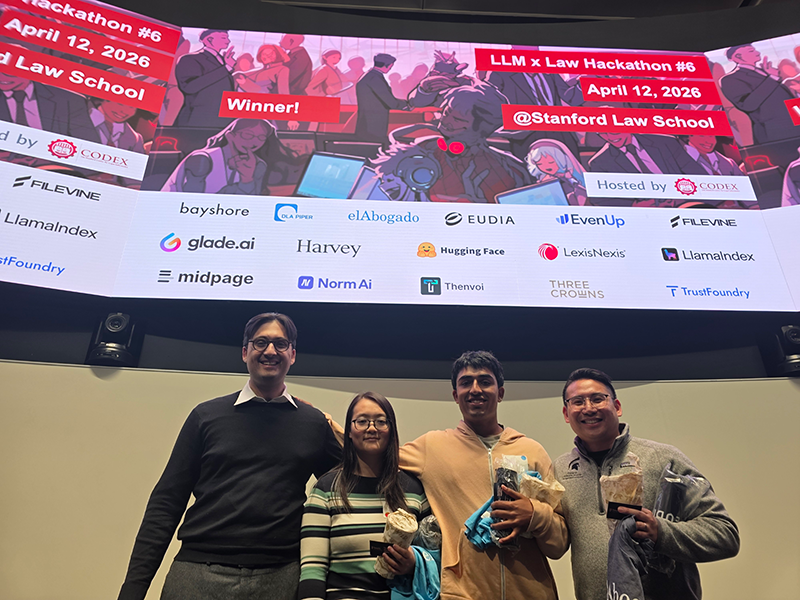
ClauseWise is a logic-based middleware designed to bridge the gap between static legal text and active financial systems. It transforms contracts from passive documents into executable code, allowing for automated enforcement and “what-if” scenario modeling.
The Challenge: “The Execution Gap”
- AI Hallucinations: Standard LLMs are probabilistic, meaning they “guess” terms rather than calculate them, which is dangerous for legal compliance.
- Revenue Leakage: Companies lose roughly 9% of revenue annually because they fail to track complex contract triggers like late fees or price escalations hidden in PDFs.
- Trust Issues: There is no standard way to turn machine logic back into human-readable legal text without losing the original intent.
The Solution: A Two-Way Pipeline
- Parsing: Converts messy contract text into a Structured Intermediate Representation (IR) that understands math, dates, and conditions.
- Execution: A “Logic Runner” simulates facts (e.g., a late payment) to determine exactly what is owed or who is in breach.
- Decompilation: A deterministic decompiler (non-LLM) converts that logic back into English to ensure the output is audit-ready and byte-identical to the intended law.
Market Impact
- Target: Corporate Legal and FinTech departments managing high-volume, complex agreements (SLA credits, procurement, debt).
- Value Prop: It shifts legal teams from reactive “document reviewers” to proactive “logic managers.”
- Core Benefit: Eliminates “contract leakage” and provides the transparent, verifiable results required for regulatory and judicial scrutiny.
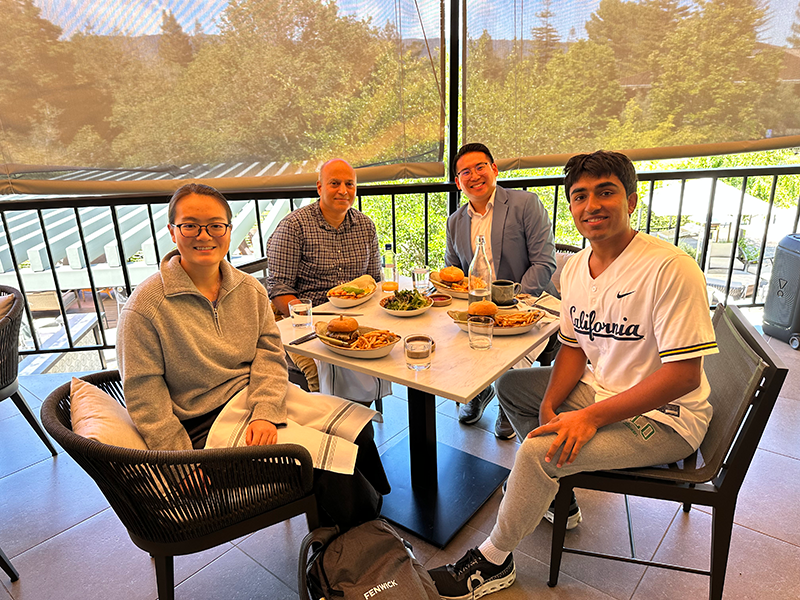
Team
Alex Moon, PM at Coupa Software
Armin Heydari, PhD Candidate at Harvard University
Danhong Cao, Associate at Fenwick & West
Harit Patel, Builder
Yuvraj Taneja, High School Student and an AI Builder.
1st Runner Up – Miranda AI – Voice AI for the Moment Rights Matter
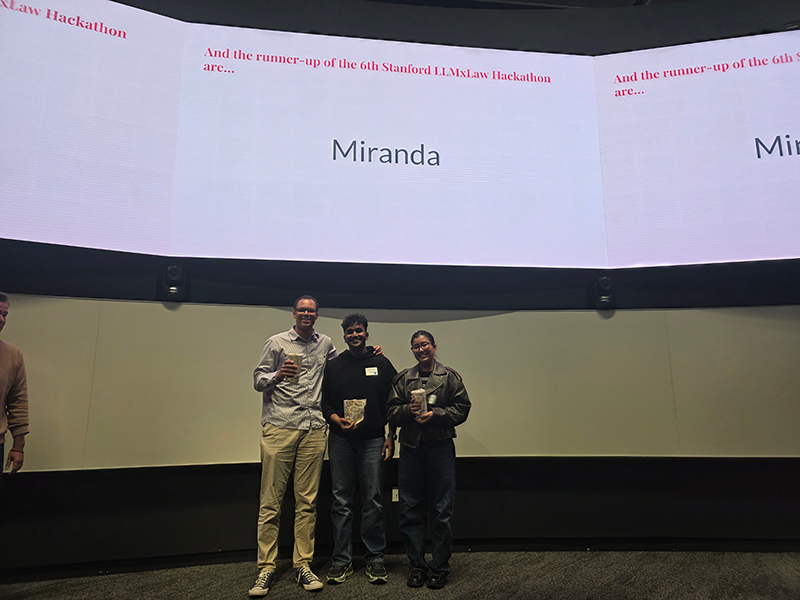
Every day, thousands of people are arrested and pushed into a legal system they don’t understand. Critical information—about their rights, their charges, and what happens next—is delivered at the worst possible moment: when they are stressed, intoxicated, confused, frustrated or unable to process it.
As a result, that information doesn’t land.
- This creates cascading bottlenecks during booking and processing:
- Individuals don’t understand instructions or next steps and make avoidable mistakes
- Jail staff must repeat information and manage frustrations
- Systems slow down due to inmate frustration
Miranda is a voice agent that anyone can call directly from jail / anywhere to get immediate, clear, state-specific information about their rights, their case, and what to expect next. This reduces confusion, improves compliance, and removes friction across the system.
For jails, this means:
- Fewer repeated questions and less strain on staff
- Smoother booking and intake processes
- Potential to reduce escalations by giving inmates a clear answers
When Miranda identifies that someone may need legal representation, it connects them with a partner law firm who matches their case. With the individual’s consent, Miranda shares a structured summary of the interaction.
- This benefits everyone:
- Individuals get faster access to the right lawyer
- Lawyers receive pre-qualified leads, pre-briefed clients
- Jails save time and money dealing with frustrated inmates
US law firms spend $2.5B annually on advertising. The US jail phone call industry generates $1.4B annually. Our mission is to modernize access to preliminary legal information. Through this mission, and an expansion into all areas where private citizens first interact with our justice system–hospitals, civil courts, etc. –we intend to become the #1 source of converted leads for lawyers.
Built on a multi-agent voice pipeline: Pipecat, Deepgram, GPT (13 multi-agent tools), Cartesia, PostgreSQL, and LangGraph.
Team
Kollaikal Rupesh
Ruomeng Sun
Charley Moore
2nd Runner Up: Bridge
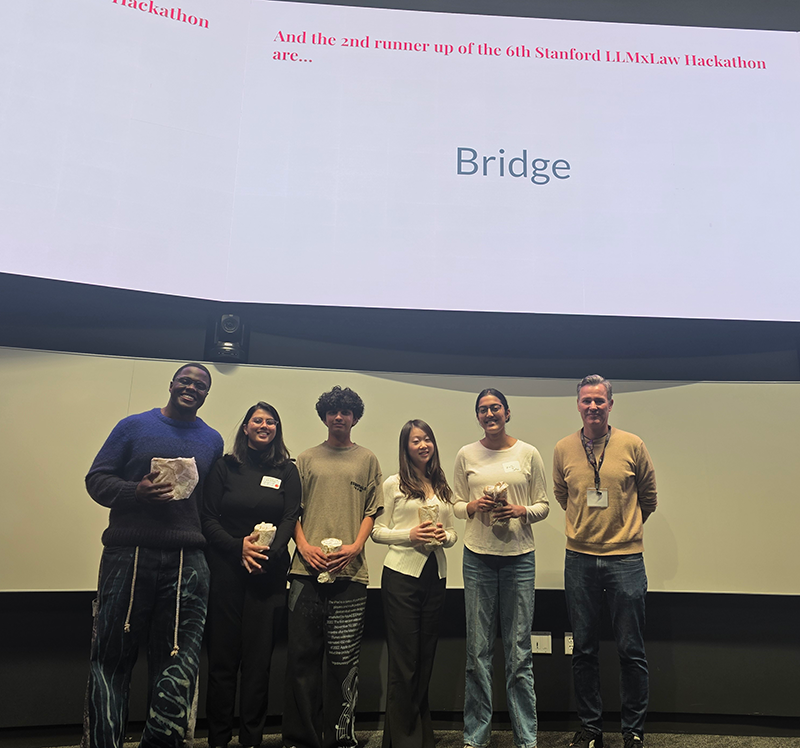
Bridge is a legal intelligence platform that helps firms turn senior review into scalable associate training. It captures the value hidden in redlines and revisions so every correction becomes part of a firm’s collective know-how, not just a one-off edit.
In most firms, senior lawyers spend time correcting junior work, but the insight behind those edits is lost once the document is returned. Bridge changes that by helping firms learn from how their best lawyers review, so associates improve faster, firms develop more consistent standards, and institutional knowledge compounds over time.
The product is designed to fit into existing lawyer workflows without asking seniors to change how they work. By sitting between senior and junior lawyers, Bridge makes it easier for firms to preserve judgment, reduce repeated mistakes, and build stronger legal teams over time.
Team
Ayomide O. Oloyede
Iris Cai
Malti John
Mihir Modi
Tejaswita Kharel
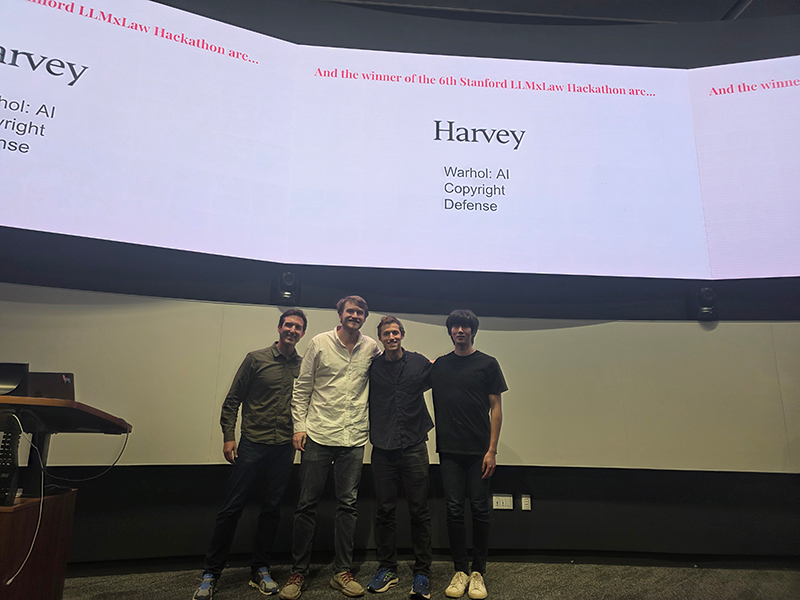
Harvey Challenge Winner: Warhol: AI Copyright Defense
52% of designers now use generative AI tools. 2.5 billion images are stolen every day, which constitutes more than $600 billion in annual damages from lost licensing fees alone. And AI tools aren’t just getting better at generating images. They’re getting better at finding infringement. The copyright storm isn’t on the horizon. It’s here. In-house IP clearance teams built for a pre-AI world and freelance creatives working without legal cover aren’t remotely prepared for what’s coming.
The exposure is massive and almost entirely unaddressed. Designers, marketers, and agencies generate AI images daily for commercial work: for landing pages, ad campaigns, product mockups, merchandise, etc., and with little real visibility into whether those outputs resemble copyrighted works. Today’s copyright image search tools only catch exact copies. They can’t evaluate stylistic similarity, compositional overlap, or the legal doctrines that actually determine infringement (e.g. Fair Use, Substantial Similarity, Merge, Scenes a Faire, etc.). The gap between how copyright law works and the tools that impact it has never been wider.
Warhol is a copyright legal agent that closes that gap. It searches the internet for visually similar prior works using multi-provider reverse image search, scores candidates through a machine learning similarity pipeline that goes far beyond pixel matching, and runs the top matches through a doctrine-aware legal analysis layer — evaluating substantial similarity, fair use, merger, scenes a faire, and independent creation — grounded in real case law. Integrated directly into your AI image tool, Warhol evaluates any generated image in one click and delivers a structured copyright risk report before you ship.
Team
Will Dinneen
Josh Waldman
Chris Um
Dhanin Wongpanich
Band AI Challenge Winner: Cura: Multi-Modal Agentic Dataroom Creation

312 hours per lawyer per year are lost on document management challenges. In M&A, the pain is sharpest. Over 10,000 U.S. deals close each year, each requiring hundreds of documents compiled under a closing clock. That means weeks of email ping-pong, associates at $600/hour chasing PDFs, and 40% of large deals missing their projected closing timeline. Virtual data rooms didn’t fix this.
Cura’s multi-modal agentic document retrieval gives in-house counsel more time to spend on high value judgment matters. Picture an M&A deal. The outside lawyer sends a checklist to the seller and the seller’s in-house counsel is now on a wild goose chase to retrieve the documents requested. What if agents could help?
The client gets a guided flow — think TurboTax for legal documents. AI agents run in parallel across local storage, Google Drive, QuickBooks, and bank accounts via Plaid — finding, classifying, and renaming every document automatically. The lawyer opens a complete data room with AI summaries and pre-populated disclosure schedules before the first meeting. Zero follow-up emails. The first conversation is law, not logistics.
The firms that adopt Cura compress timelines and capture margin. The ones that don’t keep lighting money on fire chasing PDFs.
Team
Will McDugald
Sola Melville Paterson-Marke
Kaitlyn Angel Kwan
Taruni Kavuri
Emmanuel O. Daudu
Photos by Pierre-Loic Doulcet and Jay Mandal