
Can Machines Think? – Revisiting the Alan Turing vs. John Searle Debate
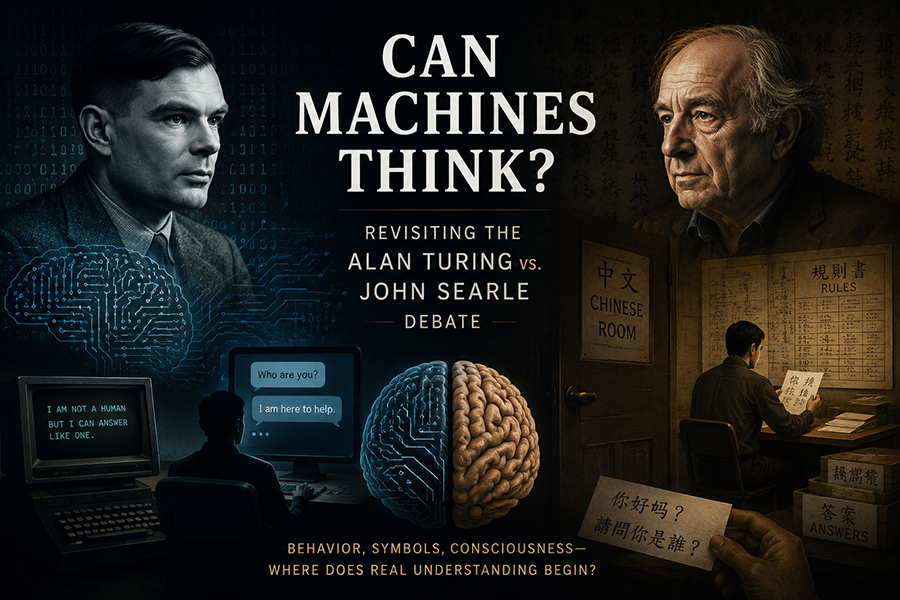
In memory of Alan Turing (23 June 1912 – 7 June 1954)
Can a machine genuinely think, understand, or have a mind? Or, in other words, can machines possess intelligence?
One may argue that the answer depends on how we define intelligence. Is intelligence simply the ability to produce intelligent behavior? Or does real intelligence require inner understanding, consciousness, and maybe even the unconscious?
Two of the most important positions in this debate come from Alan Turing’s “imitation game” and John Searle’s “Chinese room argument.” Turing shifted the question toward behavior: if a machine can perform intelligently enough that we cannot distinguish it from a human, then we have reason to call it intelligent. Searle pushed back: producing the right output is not the same as understanding what the output means.
Let’s first briefly review the two sides.
Alan Turing’s imitation game, proposed in 1950
In 1950, Alan Turing proposed the “imitation game” to move beyond the vague question “Can machines think?” Instead of asking whether a machine has a soul, inner feelings, or a human-like mind, Turing focused on observable performance. If a human judge, communicating only through written language, cannot reliably distinguish between a machine and a human, then the machine has passed the test.
Turing’s move was powerful because it made the question testable. Rather than trying to look inside the machine for an invisible essence called “thinking,” he asked us to evaluate what the machine can do. In this sense, Turing’s approach is behavior-focused and functional: intelligence is judged by performance.
But this also creates a problem. Does intelligent behavior prove intelligence, or does it only imitate intelligence?
John Searle’s Chinese room argument, proposed in 1980
John Searle’s Chinese room argument was designed to challenge exactly this problem. He wanted to distinguish between symbol manipulation and actual understanding.
In his thought experiment, imagine a native English speaker locked in a room. This person does not understand Chinese. Inside the room, there are Chinese symbols and very detailed rulebooks written in English. Someone outside the room slips questions in Chinese under the door. The person inside follows the rules and produces perfectly coherent responses in Chinese.
To the person outside the room, it appears that the person inside understands Chinese. But from the inside, there is no understanding. The person is only manipulating symbols according to formal rules.
Searle’s point is that syntax is not the same as semantics. A system may process symbols correctly without understanding their meaning. For Searle, this means that computation alone is not sufficient for genuine understanding.
Are Turing and Searle views enough?
Are these two views necessary and sufficient to answer whether machines can possess intelligence? I do not think so.
Turing gives us an important condition: if a machine thinks, it should probably be able to behave intelligently. But behaving intelligently is not enough to prove that the machine actually thinks. A good example is the current state of large language models. With their language capabilities, it is getting easier for LLMs to perform well on Turing-style tests. It is also getting harder to distinguish between human and machine performance, especially when the task is clearly defined and the success metric is measurable.
But this does not settle the question. LLMs can produce responses that look like reasoning while still making mistakes in logic, common sense, grounding, and time. They can sound coherent without necessarily having a stable model of the world. This is why I do not think that predicting the next token from an enormous amount of data, by itself, fully answers the question of machine thinking.
On the other hand, Searle’s Chinese room also raises a question for me. What happens if the process inside the room is repeated thousands or millions of times? What happens if we add memory, feedback, learning, and the ability to connect symbols to action and experience? If the person or system changes over time, learns from past experiences and from semantic understanding in English, and begins to use the symbols in flexible and meaningful ways, is it still just symbol manipulation?
This is where the argument becomes more complicated. Humans also learn language through repeated exposure, correction, memory, association, and social use. We do not begin with full understanding. We build it gradually. So, the question is not only whether symbol manipulation is enough. The deeper question is: what must be added to symbol manipulation for understanding to emerge, if it can emerge at all?
Intelligence, Thinking, and Reasoning
I am not sure whether intelligence and thinking are the same thing. Maybe intelligence is a capacity for solving problems, while thinking is a broader mental process. Maybe thinking is one tool of intelligence. Or maybe intelligence, thinking, understanding, and consciousness are deeply connected in ways we still do not understand.
On the thinking side, Daniel Kahneman’s distinction between System 1 and System 2 is useful. System 1 is fast, intuitive, and automatic. System 2 is slow, deliberate, and effortful. This distinction loosely echoes some of the current language around LLM reasoning models: some systems produce immediate answers, while others are designed to reason more slowly and explicitly.
Consciousness, the Unconscious, and the Missing Piece
But the human mind has other aspects that are mostly missing from the classic Turing-Searle debate or the system1-system2 distinctions: consciousness and the unconscious.
The definitions of consciousness and the unconscious are still debated. But a simple starting point is this: consciousness is the capacity to experience, feel, perceive, or be aware of oneself and the world from a first-person point of view. The unconscious is the set of mental processes that influence thoughts, feelings, behavior, memory, and perception without being directly available to awareness.
These concepts matter because human intelligence is not only explicit reasoning. Much of what we call understanding depends on background perception, emotion, memory, bodily experience, attention, intuition, and unconscious processing. A person does not only manipulate symbols. A person lives in a world, acts in that world, feels consequences, and builds meaning through experience.
Philip Goff, in his 2019 book Galileo’s Error: Foundations for a New Science of Consciousness, argues that modern science became powerful partly by leaving consciousness out of its picture of nature. That move helped science describe the objective, measurable world, but it also left us with a hard problem: how do we explain subjective experience itself?
This is why the question “Can machines think?” cannot be answered only by looking at external behavior or internal computation. Turing shows us why behavior matters. Searle shows us why behavior may not be enough. But neither fully answers what thinking is.
To answer whether machines possess intelligence, or whether they can actually think, we may need a deeper theory of the human mind first. The Turing-Searle debate is not only about AI. It is part of a larger debate over whether mind is behavior, computation, brain activity, biological consciousness, causal role, embodied experience, or something else entirely.
Maybe the real question is not simply whether machines can think. The real question is what we mean by thinking in the first place.