
The Paris launch of the fifth Computational Antitrust report
On 17 September 2026, we launched the fifth cross-agency report of Stanford Computational Antitrust at the Autorité de la concurrence in Paris. We were delighted to be welcomed there for the first time. The Autorité is one of the very few agencies to have contributed to all five reports, so the report could hardly have found a better home. The afternoon ended with a cocktail reception. As always, we are most grateful to Stanford CodeX for its incredible support of everything we do.
Watch on YouTube, or listen on Spotify and Apple Podcasts.
Read the report, open access, at shorturl.at/wmEaW
A growing network
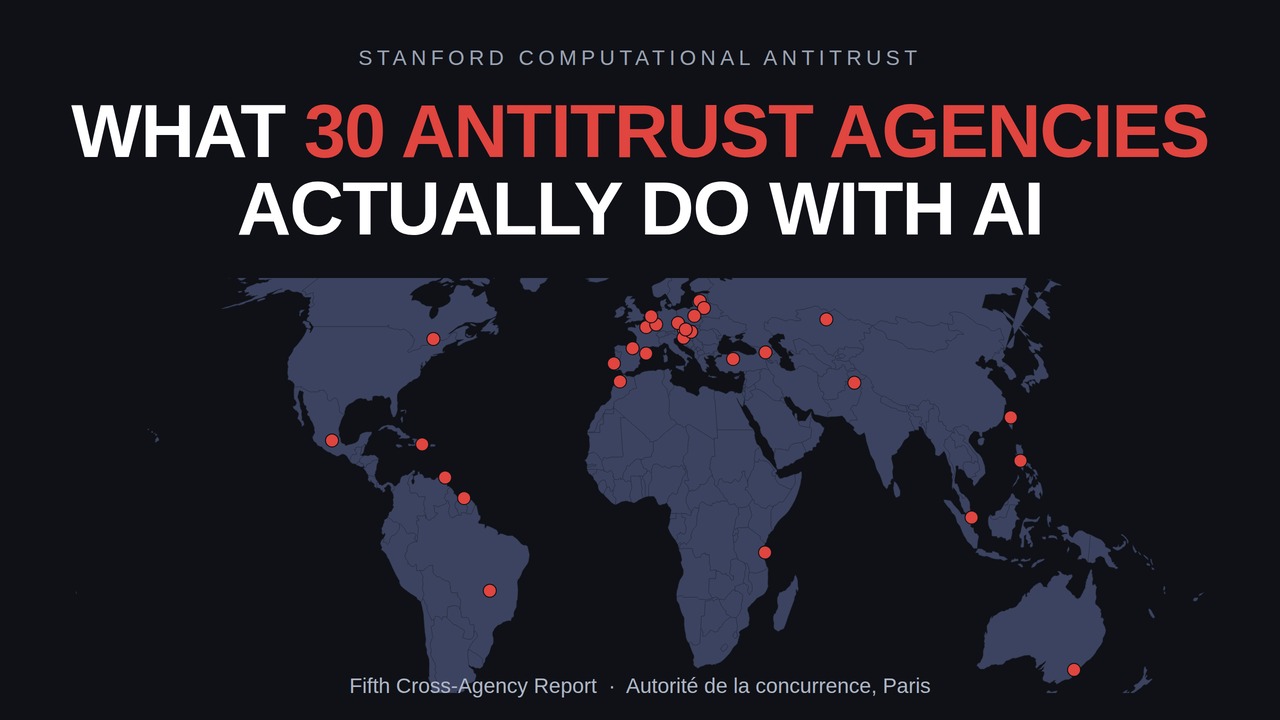
88 competition agencies now take part in the project, and 52 have written for at least one report. 30 contributed to this edition, 11 of them for the first time, which makes it the largest yet. Five agencies have written every single year since 2022, namely Brazil, Catalonia, Czechia, Singapore and our host, the French.
The answers to this year’s question fall into two kinds. Some agencies point to a case they would not have opened. Latvia’s price monitor flagged coffee machine distributors, which led to dawn raids in three Baltic countries and an infringement decision this year. Others point to conduct they could not examine at all before. Poland studies dark patterns with eye tracking and has reviewed more than three hundred websites, and the Netherlands reads the news for mergers that were never notified.
Three developments
Agencies write their own rules. No legal regime tells an agency what may go into a model, so agencies have begun writing the rules themselves. Luxembourg built its AI strategy on the principles its government set for the whole public administration. Tanzania chose to wait until its infrastructure includes validation safeguards. Only one court of appeal has ruled on computational evidence so far, in Brazil’s Novo Rumo case, where a warrant based on network metrics and econometric screens was held valid.
Agencies put numbers on their work. Earlier editions almost never reported precision, recall or false-positive rates. This one does. Kazakhstan identifies indicators of collusion in two days instead of two months, and opened 139 investigations in one year against 67 over the previous three. Singapore shortlists suspicious tenders in under ten minutes where it used to take weeks. Pakistan reports ninety-two percent detection accuracy on a test set of four thousand records.
Data decides more than technique. What holds deployment back is access to data and the agreements needed to obtain it. CARICOM cannot compel firm-level data in several member states, so it runs econometrics on public macroeconomic data instead. Lithuania paused its bid-rigging screen when public procurement data lost detail. The Autorité itself sees only winning bids in French tenders. Some agencies lobbied their parliaments to change the law. Others renegotiate access every time.
What it adds up to
The first generation of tools helped agencies do the same work faster. This generation lets them watch markets continuously and bring cases of a different kind. 19 of the 30 agencies now run or build an internal assistant based on a large language model, a category absent from the report two editions ago, and a third of them are on one side or the other of a tool exchange with another agency. The most pressing questions are now legal ones, which, as Thibault Schrepel put it in Paris, is good news, because “we lawyers can actually do something about that.”
Where to jump in
- 09:09 Screening tenders. Public procurement has become the field where agencies build their strongest tools, because it produces large and fairly standard datasets. Alba Ribera Martínez presents two of them. The Dominican Republic’s Semáforo Colusorio scores each tender on forty-nine variables and sorts it into one of five risk levels. Pakistan links procurement data to the corporate registry in a graph database and reports ninety-two percent detection accuracy on a test set of four thousand records.
- 14:23 Cases that would not exist. Thibault Schrepel sorts the agencies’ answers into two kinds. Some tools found cases an agency suspected but lacked the staff to pursue. Latvia’s price monitor flagged coffee machine distributors, which led to dawn raids in three Baltic countries and an infringement decision this year. Brazil’s Cérebro project produced a bid-rigging proceeding worth 2.2 billion dollars against sixteen companies and fifteen individuals.
- 14:23 Conduct no one could see before. Other tools open ground that did not exist. Poland studies dark patterns with eye tracking and facial expression analysis and has reviewed more than three hundred websites. Türkiye runs a deep-learning model over producer prices in 555 sectors at once. The Netherlands reads the news for mergers that were never notified.
- 14:23 The Very Cool Use Cases. Schrepel then picks one use per agency that no other agency reports. Taiwan runs speech-to-text in interview rooms, trained on Mandarin, Taiwanese Hokkien and Hakka, on a four-billion-parameter model that never leaves the building. Kazakhstan screens three to four hundred regulatory acts in minutes and flags anticompetitive restrictions to members of parliament. The rule for making the list? “You have to be unique to be cool.”
- 23:28 When the data is not there. Ribera Martínez turns to the obstacles. CARICOM has no power to compel firm-level data in several of its member states, so it runs econometrics on public macroeconomic data instead. Lithuania built a bid-rigging screen and then paused it, because the public procurement data it relied on had lost detail over time. Tanzania has chosen to wait until its infrastructure includes validation safeguards.
- 29:18 The question no court has settled. Agencies now use these tools from the opening of a case to the evidence file. What happens when a company asks them to reproduce the result on appeal? Schrepel walks through what an agency may have to keep, from training data to model weights to every internal run. “If the competition agency comes your way and says, well, my machine learning system told me this is illegal, this is not good enough.”
- 29:18 Three minutes for a merger decision. The president of Brazil’s competition agency said on the project’s podcast that a draft phase-one merger decision is generated within three minutes of receiving the file, then checked by staff. Schrepel also counts that a third of the thirty agencies are on one side or the other of a tool exchange with another agency, and Canada offers its tool to any agency that asks.
- 34:07 Why build a digital unit. Elodie Vandenhende explains why the Autorité created its Digital Economy Unit in 2020, reporting directly to the General Rapporteur. The unit brought lawyers, economists and data scientists into one team. It has since written the Autorité’s opinions on cloud computing, generative AI, the energy and environmental footprint of AI, and, this July, AI agents.
- 41:52 Asking ChatGPT and Gemini five hundred shopping questions. Yann Guthmann presents the experiment behind the July opinion. Asked in French, ChatGPT searched the web in English and drew on Reddit in nearly nine generic queries out of ten, without citing it in its answers. Gemini leaned on YouTube. A small group of websites supplied most of the sources for both. The questions and the results are on the Autorité’s GitHub, so anyone can rerun the test.
- 41:52 A search engine across agencies. Guthmann shows project TARDIS, run within the ICN, which puts decisions from France, New Caledonia and Switzerland into one open database, with French Polynesia and Chile to follow. A retrieval tool answers in English from decisions written in French. His case for open data is practical. Agencies cannot share confidential files with each other, but they can build together on public data.
- 55:24 From filing cabinets to full maturity. Teodora Groza traces five editions of the report, from agencies scanning archives in 2022 to whole data departments in 2025. Her marker of the first real gains is Spain, where the share of cartel cases detected by in-house tools went from thirty to seventy percent. On Singapore’s self-assessment tool for companies, she describes “the enforcer and the firm” as “not adversaries but collaborators.”
- 55:24 The capability divide. Groza closes on what she will watch next. Some agencies in this edition report supercomputers, while others report no budget at all. Tools travel easily between agencies, but computing power does not.
- 1:08:22 The data, not the tools. Asked how the Autorité uses AI, Guthmann describes open-weight Mistral models running on its own servers, used to digest merger filings and to group the answers when fifty firms reply to the same request for information. Asked why France does not screen public tenders, he answers that French public data covers only winning bids, and anomalies are hard to detect without the losing ones. “It’s not a problem of we don’t have the tools, it’s a problem that we don’t have the data.”
- 1:10:41 The only ruling so far. Schrepel notes that one court of appeal has assessed computational evidence produced by an agency. In Brazil’s Novo Rumo case, a search warrant based on network metrics and econometric screens was held valid, and the case went on.
- 1:21:45 A digital brain of every EU merger decision. To close, Schrepel shows a knowledge graph linking some 8,500 European Commission merger decisions by the concepts they address. A case handler can ask it questions in plain language, or drop in a draft decision and see where it departs from past practice. Agencies are already working with the project to build their own, and practising lawyers can do the same.
Speakers
Thibault Schrepel, Associate Professor of Law at Vrije Universiteit Amsterdam, Faculty Affiliate at Stanford CodeX and Director of Stanford Computational Antitrust Alba Ribera Martínez, Assistant Professor in Law and Technology at Vrije Universiteit Amsterdam and Editor-in-Chief of Stanford Computational Antitrust Elodie Vandenhende, Deputy Head of the Digital Economy Unit, Autorité de la concurrence Yann Guthmann, Head of the Digital Economy Unit, Autorité de la concurrence Teodora Groza, Postdoctoral Researcher at the Chair for Law and Artificial Intelligence, University of Tübingen.