
A Court That Meets People Half Way
A Court That Meets People Half Way: CodeX Explores Alameda County’s Homeless and Caring Court.
Have you ever been to a courtroom that erupts in applause when the judge congratulates the defendant for staying sober? Or a place where warrants are guaranteed to be recalled by merely showing up? Well, neither had I before visiting the Alameda County Homeless and Caring Court.
Access to justice is a core mission here at CodeX, and to further this mission during my final months as a CodeX Residential Fellow, I’ve been researching ways to apply technology to the criminal justice system, starting with prosecution and police data.
The fact remains that real criminal justice reform won’t automatically happen just because we’re able to better structure police data or design attractive interfaces. Transparency is a necessary but not sufficient condition to achieving true reform. Data systems will help us evolve, but they aren’t a magic talisman.
At the end of the day, it is the people who operate the criminal justice system that make access to justice a daily reality. It is the host of clerks, coordinators, public defenders, district attorneys, IT managers, and judges that are the secret sauce to disrupting this system.
As technologists, we will fail unless we learn from the best of them.
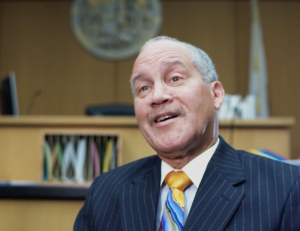
I was recently connected with the Alameda County Homeless and Caring Court. It was founded in 2004 and spearheaded by Alameda County Superior Court Judge Gordon Baranco, to improve access to justice in the City of Oakland, which suffers from a long history of police department abuses.
On this docket, the individuals whose cases are consolidated and reviewed are called “clients.” They are not criminals. They are not numbers. They are not confused by who does what, and they are not filtered through an endless array of faces behind plastic windows. Here, people are greeted with a handshake, applauded and listened to. So, how does it work?
For one, the court doesn’t take place in a courthouse. It takes place at St. Vincent DePaul Church in West Oakland. Every other month, the team sets up a pop-up courtroom to hear and (and largely dismiss) the cases of individuals who have been referred to it. At each session, there is on average anywhere between 50 to 130 clients who are seen for each and every one of their pending infractions. You would think this would take all day, but it doesn’t! They get started at 1 p.m. and go until 3:30 pm on most occasions.
The environment is ad hoc and stage-like. In the morning, IT packs a few computers into boxes. Printers are piled in. A variety of cords are wound together and placed on top. The “IT box” is secured with a bungee chord and hand delivered to the church. All the team needs is a good Wi-Fi connection and some skilled clerks who can navigate the plurality of government E-Systems. With web access, they can clear records at the DMV, small claims, the family law courts and several others.
However, not all forms are accessible via web and must be hand delivered and filed. The clerks juggle this vast puzzle of information before them. They are the silent, unsung heroes of this operation.

Besides the few computers, the environment is void of technology. The judge and defendants sit at fold-out chairs. The public defenders have handwritten notes that they read from. Even the District Attorney, who sits next to the judge, goes through the case docket from a printout. She speaks up when there are more serious misdemeanor charges, probations and warrants in the defendant’s record. However in every instance, the D.A. recalls each outstanding issue.
Nearly all of the court’s clientele are African American and male. If this court didn’t exist, these individuals would likely never get out of the system. The efficiency, the friendliness, and the compassion of this court provides a glimmer of hope in the hearts and minds of people who have rightfully lost faith in a system that has long abandoned them.
Judicial services like this one are the missing link in today’s public service sector. Imagine if we could use big data to streamline these operations? Such data services might help to consolidate records and provide a way for public defenders and community leaders to stay connected to at-risk individuals and better aide in their journey to a better future. At the very least, it could improve the lives of the many clerks who currently bear the biggest and most challenging administrative burdens.
As is the case with Code for America, the U.S. Digital Service, and California’s Department of Justice OpenJustice project, CodeX and its community will play a big part in improving the judicial system and access to justice. It is an exciting time of transition, and the message I hope to leave here is this: Make sure to keep your eyes peeled for “good models” such as Judge Baranco’s Homeless Court.
If you haven’t found any yet, go out and find them.

Nicole Shanahan is a Residential Fellow at CodeX and Founder and CEO of ClearAccessIP. She is a member of the California bar. She earned her J.D. at Santa Clara University, where she was the editor of the High Technology Law Journal.
Baranco photo: https://vimeo.com/155445378