
Deals Demystified
A New Book by Professor Michael Klausner Explains the Economic Forces at Play in Business Transactions
Transactional lawyers are skilled at steering their clients through tricky issues, negotiating contested deal points, and drafting airtight contract clauses. But they might not fully understand the economic challenges underlying their deals, according to Stanford Law School Professor Michael Klausner.
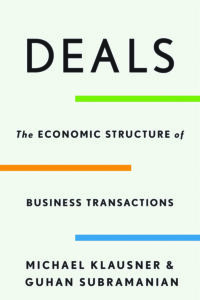
That’s the knowledge gap he aims to close with his new book, Deals: The Economic Structure of Business Transactions (Harvard University Press), co-written with Harvard Law School Professor Guhan Subramanian. In plain language, with frequent use of real-world case studies, the book explores how all deals—from biotech-pharma collaborations to technology licenses to earnouts in mergers and acquisitions—respond to fundamental economic challenges. By better understanding these beneath-the-surface dynamics, Klausner says, dealmakers can address issues that may not be initially apparent and unlock greater value. For more than two decades, Klausner has taught an SLS course with the same title and much of the same content as the book, teaching students to analyze business transactions from an economics perspective. All of the economic concepts applied in Deals have led to Nobel Prizes for the economists that developed them, he says. Moral hazard, adverse selection, and asset specificity are some that figure prominently in analyzing deals.
Moral hazard, for example, refers to a situation in which the details of actions a party must take to perform a contract, or the circumstances surrounding the action, will be unobservable by the other party, and where the parties’ interests do not align. In that situation, the threat of legal enforcement may not be an effective means of ensuring performance of a deal because the aggrieved party will not be able to prove that a breach occurred. Consequently, to reach a deal, the parties must find another way to induce performance.
Insights and Understandings
“If i were in law practice, I might not be a transactional lawyer. There are aspects of that work that I might not be good at,” Klausner says. “But the economics of deals—how the application of economic theory can lead to factually correct insights and understandings—that is what’s interesting to me. I like the fact that economic theory, which is one of our comparative advantages in academics, is useful in this context. I get emails all the time from students, ranging from those in summer jobs to those 10 years out of law school, telling me about a deal in which the Deals course was useful.”
Klausner hopes that his book will have the same impact—occupying a sweet spot between academics and real-world practice.
Describing their collaboration as a “why” rather than a “how to,” Klausner and Subramanian note that they wrote the book for students (Deals can be used as a textbook, they say), practicing attorneys, and fellow academics. Senior practitioners with a conceptual leaning “might even read it and say, ‘Hey, I’ve been doing this work for a long time, but I’ve never really thought about what is actually driving some of this,’” says Klausner.
“But the economics of deals—how the application of economic theory can lead to factually correct insights and understandings—that is what’s interesting to me.”
Responding to Underlying Challenges
Using case studies such as an offshore oil and gas deal between BP and the Vietnamese public utility and actress Scarlett Johansson’s contract dispute with Disney, the authors break down some of the common roadblocks in business transactions. They explain how economic challenges like moral hazard, information asymmetry (when one party to a deal knows more than the other), and asset specificity (where assets or investments are highly specialized for one particular use or partner) can complicate dealmaking—and they show with real-world examples how parties structure transactions to address those challenges.
Using the example of SPACs, a topic of Klausner’s past research, Klausner and his coauthor explain how dysfunctional incentives and opaque economics have systematically resulted in shareholder losses. SPACs [special purpose acquisition companies] are shell corporations whose sole purpose is to merge with a private company, thereby allowing that company to go public without going through a traditional IPO. A SPAC sponsor gains if its SPAC finds a merger partner and loses if the SPAC doesn’t. This creates a strong incentive for a sponsor to complete a deal, even if it’s not a good one for SPAC shareholders. And the financial structure of SPACs essentially pre-ordains a bad result for shareholders—a result that Klausner has shown is supported by data.
“Yes, there are lawyers who think the best thing in the world is to pound their hand on the table and act like big guys,” Klausner says. “I find that idiotic. If each party recognizes not only the economic challenges it faces but the challenges its counterparty faces as well, each will negotiate more effectively and deals will be more likely to be struck.” SL