
E. Tendayi Achiume
Reimagining International Law to Combat Racism and Exclusion
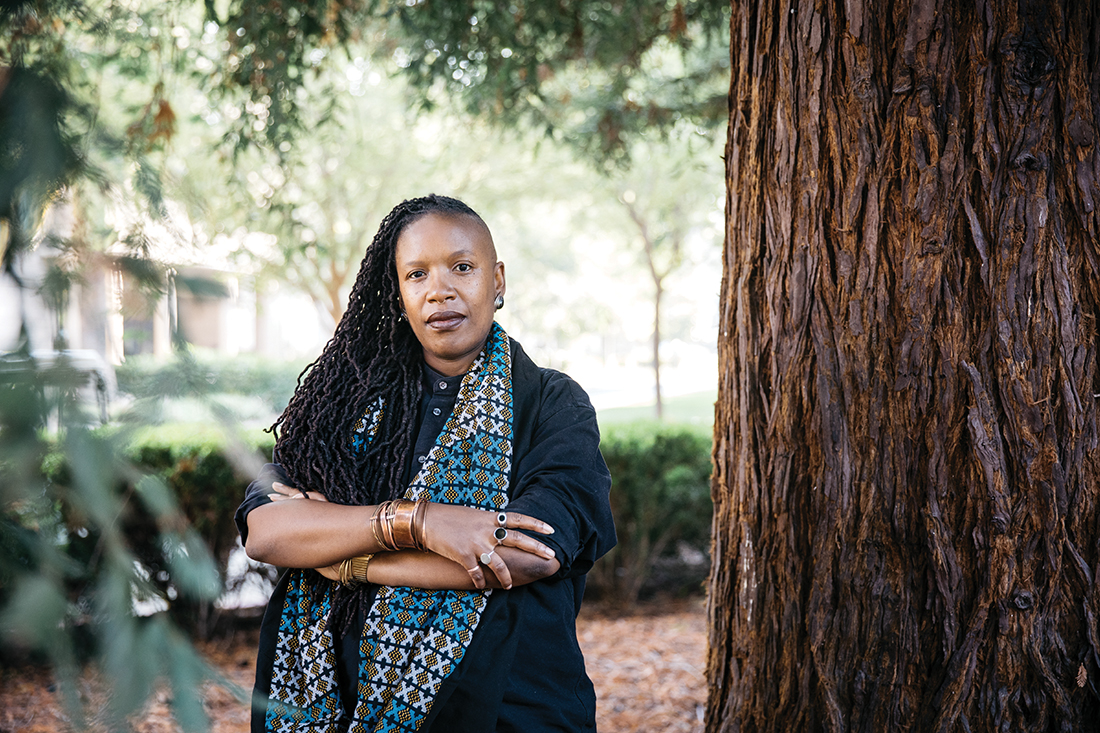
Fresh out of law school, E. Tendayi Achiume was working as a staff attorney for Lawyers for Human Rights in Johannesburg when she began to see the limits of the international legal system. Asylum seekers displaced by economic adversity, armed conflicts, and other perils didn’t always fit neatly into boxes defining refugees.
“I was really frustrated at how rigid and disconnected the law was from the experiences of people fleeing real hardship,” says Achiume, who joined Stanford Law School as a professor of law in July 2024. “In practice, I felt more and more that the legal frameworks were not emancipatory. They were actually part of the problem.”
Achiume’s career in academia has focused on reimagining those frameworks—first by exploring novel ways to deploy existing laws and then identifying concrete ways in which legal structures contribute to injustices. Now, Achiume has broadened that lens to probe how the origins of international law have in fact set it up to reinforce inequality and exclusion. “The project isn’t patchwork legal reforms,” she says. “It’s about a fundamental transformation of the system having recognized that the logics of injustice are embedded in the system.”
Achiume was born in Zambia and moved throughout southern Africa with her family as a child. As she crossed borders, she noted how external forces, such as internationally sponsored economic reforms, fueled migration and inequality.
Achiume’s father was an attorney, and while she had always respected his work, she hadn’t planned on following a similar path. That changed when an undergraduate seminar on law and international development at Yale University inspired her to pursue a career in human rights law. She stayed on at Yale for law school, where she devoted herself to clinical work, including a project with Human Rights Watch supporting the rights of Zimbabweans seeking asylum in South Africa.
After graduating, Achiume spent a year clerking with two justices at the Constitutional Court of South Africa. She had assumed direct legal services would be the best fit for her interests, but following a formative year with Lawyers for Human Rights, she decided academia would give her space for reflection and advocacy on a larger scale. She spent a decade teaching at the UCLA School of Law, most recently as Alicia Miñana Professor of Law, and won the school’s highest honor for excellence in teaching. She served as Leah Kaplan Visiting Professor in Human Rights at Stanford Law School for two years before joining the faculty.
“We can’t afford to cede global policymaking spaces if what we care about is transnational justice.”
Professor E. Tendayi Achiume
When she first entered academia, Achiume’s research focused on ways that existing laws could be reinterpreted to more broadly advance human rights. One of her earliest papers argues for a structural approach to the xenophobic discrimination that accounts for how refugees can be systematically denied access to housing and health care, rather than limiting the legal definition to individual victims of direct and explicit prejudice. Later, she interrogated how legal frameworks exacerbate injustice, such as when chaotic approaches to governing migration fuel xenophobia.
Currently, Achiume’s work critiques how dominant legal systems, including the notion of state sovereignty, benefit some groups while excluding others and advocates for an alternative approach to global migration and human rights. “The reason I came into academia was to squeeze the full potential out of frameworks I presumed were committed to solving injustices,” she says. “Now I view the project as being an almost inconceivable remaking of the world of international law.”
Outside of academia, Achiume has served on the O’Neill-Lancet Commission on Racism, Structural Discrimination and Global Health, and she was the first woman to be UN Special Rapporteur on Contemporary Forms of Racism, Racial Discrimination, Xenophobia and Related Intolerance.
“I think of my academic work and my legal policy and practice work as very symbiotic,” she says. “With my students, I’m trying to develop in them a commitment to practice anchored in reflection and reflexivity.”
In 2023, Achiume’s work earned her a MacArthur Fellowship, known as the “genius grant.” She is spending the 2024-25 academic year as a scholar in residence at the Institute for Advanced Study at Princeton University, where she is working on a book about how corporations constitute and manipulate borders to generate profits and exacerbate inequality.
When she returns to Stanford, Achiume is excited to help strengthen the Center for Human Rights and International Justice and work directly with students. “The students are sharp, passionate, and committed to thinking about power and its relationship to the law. That’s something that’s very inspiring to me,” she says.
Despite her disillusionment with the reigning legal order, Achiume believes conceiving of an alternate reality is not at odds with working within and improving existing institutions.
“Sometimes people imagine that just because you see how deeply flawed legal frameworks are, you have to walk away from them and rebuild separate from them,” she says. “That’s not my own view. We can’t afford to cede global policymaking spaces if what we care about is transnational justice.” SL