
The Declaration of Independence and Conditions for Democratic Flourishing
What does it actually take for democracy to work?
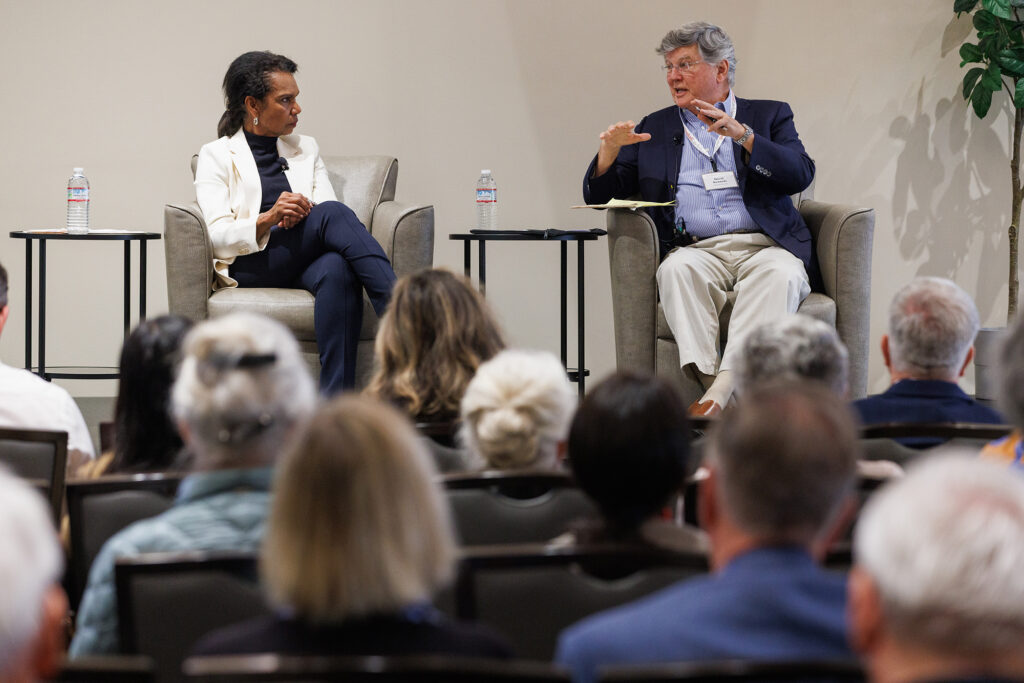
In the opening episode of The Declaration at 250, Michael McConnell introduces former Secretary of State Condoleezza Rice and historian David Kennedy to ask a deceptively simple question: what does it actually take for democracy to work?
Rice argues that the Declaration of Independence marks not the birth of democracy, but the end of tyranny—and that the real work begins afterward. Democracies flourish only when citizens build durable institutions: a workable balance of power among branches, an independent judiciary, and (often most crucially) a vibrant civil society that channels protest into law, governance, and everyday problem-solving. Drawing on her experiences—from segregated Birmingham to global transitions—Rice highlights how democracies fail when executives become unchecked (Russia) or when states are too weak to govern (Afghanistan), and how they can succeed when institutions gain legitimacy over time (Poland, Kenya, and examples shaped by external constraints like the EU).
Kennedy responds by tracing the Declaration’s promise of equality as principle, observed condition, aspiration, and enforceable law—while emphasizing the tension between democratic equality and a pluralistic society. He closes with a warning about declining trust in institutions and one another, urging renewed attention to civil society—the practical, local, often unglamorous work that turns founding ideals into lived reality.
This episode originally aired on June 23, 2026.
Pam Karlan: This is a special episode of Stanford Legal, a recording from one of the many special discussions that take place here at Stanford. Keep following the feed for our regular programming
Michael McConnell: Welcome to The Declaration at 250, a special series from the Stanford Constitutional Law Center presented by Stanford Legal. I’m Michael McConnell, and as we approach the 250th anniversary of America’s founding document, we’ve gathered eight of the nation’s leading scholars, historians, and jurists to explore a deceptively simple question: What new can be said about the Declaration of Independence today?
In this first episode, we examine the fundamental conditions that allow democracies not merely to survive, but to flourish. Our guest is Condoleezza Rice, the 66th United States Secretary of State and current director of the Hoover Institution, whose unique perspective bridges the worlds of diplomacy and scholarship.
Drawing on decades of experience navigating global affairs and teaching political science, Secretary Rice reflects on how democracies are built and sustained, not through idealism alone, but through hard work, historical awareness, resilient institutions, and above all, dedicated citizens willing to do the difficult work of self-government.
Responding to Secretary Rice is Professor David Kennedy, an eminent historian and author of the Pulitzer Prize-winning book, Freedom from Fear: The American People in Depression and War. As we begin our exploration of the Declaration’s enduring significance, there’s no better place to start than with the essential question: What does it actually take for democracy to work?
Let’s listen.
Condoleezza Rice: Good morning. I have the following challenge, which is that I’m going to talk about the US Constitution with one of the most eminent American historians ready to comment on what I say. And with that little caveat, let me thank, first of all Mike O’Connell and his colleagues for this opportunity to talk on Constitution Day about this very special this very special anniversary that we are about to welcome, which is the two hundred and fiftieth anniversary of the Declaration of Independence.
But I’ve spent a lot of time recently saying to people that the Declaration of Independence was actually, in many ways, not necessarily the start of democracy. The Declaration of Independence was a declaration to overthrow the old. And if you start with the lovely language about when in the course of human events, and of course, you do come to the consent of the governed and so forth, but maybe my favorite line in the Declaration of Independence comes a little bit further down.
And I have to say, I was Secretary of State, and I decided I wanted to go to the National Archives and see some of our foundational documents. Now, the reason that you go when you’re Secretary of State is later on you might have to stand in line. But they let you go in, and I saw the Emancipation Proclamation, which for me, as an a descendant of slaves, was particularly moving.
But also, then got to actually read the Declaration of Independence, and I thought to myself, “When did I last read the Declaration of Independence? Maybe in fourth grade at Brunetta C. Hill Elementary School, maybe not completely understanding it.” So here’s my actually favorite line to make the point that the the transition from my topic, the Declaration of Independence to democratic flourishing, is not something that can be taken for granted.
And so here’s the line. “He has plundered our seas, ravaged our coast, burnt our towns, and destroyed the lives of our people. He has brought the woes of death and desolation and tyranny.” Okay, not exactly a high-minded notion about democracy, but rather a criticism of the old and intention to overthrow the old.
And I think one of the things that’s worth thinking about is how do you get from that petulant list of particulars against King George, which would then lead to war, to what the title of this day is, Constitution Day. How do you get to that moment, and how do you think about it and its continuing lessons?
The main point that I wish to to reflect on is that the point of revolution is not necessarily the beginning of democracy. It is the end of tyranny And those two are necessary conditions, but not necessarily sufficient. The French Revolution is a very good example of this. There was the overthrow of the old, and then there, as you will remember, a lot of guillotines and the terror, and ultimately the reestablishment of an emperor.
And so that is a con– that is a transition from the moment of revolution to the democratic flourishing that actually didn’t work out so well for quite a long time. I can tell you a little story about that. I was actually there for the sixty– for the two-hundredth anniversary of that moment in France, and that was because we were all invited.
I was Secretary of State at the time. We were all invited to, to be a part of it. And there was one very poignant moment which is that Margaret Thatcher had said something along the way that the French Revolution was not actually the beginning of democracy, it was the beginning of communism in Europe.
And so they sat her in the third row with the leaders of not very, from their point of view, important countries, but she actually might have been right. What does that transition depend on? That, that, that transition from the moment of revolution, the moment of throwing off the old, to the moment of the democratic flourishing and ultimately democratic consolidation.
The first is, I think you do have to account for circumstances and I’ll come back to this in some of the cases that I want to talk about. But you have to say that if you are fortunate in your circumstances it’s a lot easier. And in fact, the United States was really rather fortunate in its circumstances.
Having from the time of the arrival of the settlers, the col- the colonists on this land they found not a completely open field, but a pretty open field compared to what others would see. In other words, the institutional landscape was theirs to shape in a way because there was not a great deal of competition from other organized forces at the time.
And they also had a little luck. They– A lot was in America’s favor. They were relatively homogeneous white male landowners. They had a fairly long period of managing political affairs even before that declaration. And there was no oppressor with a monopoly of the use of force as most tyrannies have.
Now let me repeat that. We know that the Declaration of Independence leads to a war with Great Britain, but one of the advantages that the Continental Army would have is that Great Britain was a long way away and actually found it more difficult therefore to fight this war from a great distance despite its great power.
And so no oppressor with a monopoly of force… a mo- monopoly on the use of force. So relatively homogeneous fairly long period of managing political affairs before the declaration, no oppressor with a monopoly of force that was proximate to them, and even it almost failed twice. It almost failed because the Articles of Confederation were too weak, and there was too little centralized power.
And then, of course, it almost failed when in the time before the Civil War, the reckoning with the original sin of the American founding slavery would come to create a moment in which it looked like it might not survive at all. And so even with these favorable circumstances, this is an experiment that almost failed twice. Now, it didn’t fail, of course.
And after the experience with the Articles of Confederation the founders, of course, created the Constitution, an institutional framework through which people would be able to carry out their interest. People had to accept that there was this sort of abstraction called a constitution through which you would carry out your interest and your desires as was said in the Declaration of Independence, where you would pursue happiness.
I’ve always thought maybe pursue fulfillment is a little bit better way to think about it. And they were able then to create this institutional framework that we now know had several features. I’m gonna focus in a moment on one particular feature, which is this distribution of power among three co-equal branches, which in many ways I think is the story of why this Constitution has survived for so long.
So they made the transition. And we, as Americans have what has been called a spirit of constitutionalism. In other words, a kind of fealty to the Constitution almost as our personal protector. I’ve always thought that it’s extraordinary that many of the cases before the Supreme Court are actually about an individual or a group of individuals saying, “You have violated my rights, and now I will take you to the judicial branch to resolve that.”
So think Brown versus the Board of Education, for instance. And our kind of personal protector. Since I worked a lot internationally this is sometimes a bit of a of a mystery to even other democracies. I had a German friend say to me “The problem with you Americans is that you think just because you have rights, you have to exercise them.”
And I do think while it’s not an exclusively American thing, the way that they are exercised through this Constitution that itself is a couple of centuries old is pretty remarkable. Now, one of the problems is that I think that as we go back in our history and we look at moments when that Constitution actually played the role of pushing the American experiment forward, we sometimes don’t actually think about the history, the degree to which various elements of this democracy are really the story of how it got pushed forward.
And let me use an example that I personally know very well. So I was born in segregated Birmingham, Alabama. I was born in Alabama at a time when you couldn’t go to a movie theater or to a restaurant if you were Black. Where despite the 1954 Brown versus the Board of Education separate but equal would not stand, the schools in Alabama were still segregated.
And so it was a moment at which, in fact, constitutionally protected rights were being denied to a large part of the population. It is also the case that I was eight when the Civil Rights Act passed, and I’ll come back to that. But for my parents or for my grandparents, this was an even more searing experience.
My father and my mother were engaged in 1952, and they went down to register to vote. And my mother, who was very fair-skinned and beautiful was asked by the poll tester “What is it that you teach?” And she said, “I teach American history.” She taught English. He said “So you probably know who the first president of the United States was.”
And she said, “Yes, George Washington.” He said, “You pass.” He looked at my father, six foot three, dark-skinned, and a football player, and said, “How many beans are in this jar?” Now, my father was very despondent about this, and he went back and there was this older man who was a… My father was a Presbyterian minister and high school guidance counselor.
He went back and he talked to this elder in his church, and this elder said, “Oh, Reverend,” he said, “I tell you how to get registered.” He said, “You go down there and you find this one clerk.” He said, “She’s trying to register Republicans.” This was in the days when there were no Republicans in Alabama. He said, “If you will declare yourself to be Republican, she’ll register you.”
And my father was registered, and from that on- day on, he was a member of the Republican Party. So they learned to work around it, but it was a searing experience to try to exercise your rights at this time. I remember, too being with my uncle as a little girl and at- on election day, the day that George Wallace was running for governor.
And even in my little six-year-old self, I knew that this was probably not a good thing for Black people. I’d known that this man was a segregationist. But there were long, long long lines of Black people going to vote. And I said to my uncle, “If all of those people vote, then George Wallace probably can’t win.”
My uncle said no, we’re a minority. He will win.” And I said to him, “Then why do they bother?” And he said, “Because they know that one day that vote will matter.” And so these are experiences that I had, and of course, the experience with the civil rights movement is very different if you lived it in Birmingham than if you now see it in various documentaries and renderings of it.
If you want to understand what happened with the civil rights movement, most people would focus on Selma and the marches in Birmingham and the great speeches of Martin Luther King. All of those were important in the sense of the protest that ultimately there has– we have had enough. However, there were other elements of the progress in civil rights that are more institutional in nature starting in 1937, Thurgood Marshall and and lawyers of the NAACP would get together on Friday mornings to decide what court cases they could bring that might bring down segregation.
There was something called the Margold Report, in which they actually would say, “We can maybe win that one in Oklahoma. Maybe we can win that one in Ohio.” They won some, they left some, lost some, but they were working, if you will, the system to see what they could get overturned. And then, of course, there was the appeal to the 14th Amendment, which had been passed to eliminate slavery, but which had language to which they appealed.
And then finally, the legislation itself, which ironically would come under a Southerner, Lyndon Johnson. I can tell you, too, that as a little kid, when John F. Kennedy was assassinated, there was great despair in the Black community as to whether or not civil rights legislation would go forward because as my fourth-grade teacher said, “There’s a Southerner in the White House.
What will become of us now?” What became of us now was the ’64 Public Accommodations Act and the ’65 Voting Rights Act. Now, I do have to tell you a funny little story about the 60– about the Public Accommodations Act, which was the one that said you basically have to serve Black people, too, in a restaurant.
About two days after it passed, my father said, “Let’s go out to dinner.” And so we did. And we walked in, and people stopped eating, and they looked up, and then they went back to eating. And it said something to me about the importance of law. People always talk about changing attitudes and changing culture.
But if you change the laws, sometimes the great majority of people will realize, “Oh, yeah, now it’s legal. I guess I’ll go back to eating.” And that has always stayed in my mind when I hear changing the law isn’t enough.” It may not be enough, but it’s a very important prerequisite. So consolidated democracy, which I think we can argue we have in the United States, although I know David has another term for it, we talked about this.
But let me tell you what I mean by consolidated democracy. So we go through the Declaration of Independence, the s- we go through the Revolutionary War, the Articles of Confederation, the Constitution, the Civil War, and then we emerge on the other side. And I would call the sixty-four, sixty-five period a second founding, because until then, there were large numbers of the American population in the South, principally, who lived under Jim Crow, explicitly denied constitutional rights.
So we go through the second founding. So what do I mean by consolidated democracy? It is a time when many things have happened de jure. In other words, laws have changed, as I just expressed. But the institutions are beginning to get moral authority, normative acceptance, not just an acceptance because it’s legal.
That is a fact that once institutions get to that place, they tend to be stickier, they tend to fight back when there are challenges to them, and it is also a matter of, at that time, it’s actually unhar– it’s hard to undo them. Now, it also is the case that what exists at the time will have a very big impact on when that moment comes.
We’ve talked about the American case, which I would argue, maybe because I’m a specialist in international politics, in retrospect, looks relatively straightforward if you think about some of the cases that we have seen since So one way to the admonition here to think anew about the Declaration of Independence is to think about its continuing influence on countries and peoples that are trying to make the journey from the overthrow of tyranny to the flourishing of democracy.
And I can tell you in my work as secretary abroad, that the lessons of the US case are almost always the first reference point for those who are trying to overthrow tyranny. And it is most certainly the r- the first reference point for those who want to keep tyranny in place. Because they understand that if you have certain kinds of institutions, it is actually a lot easier to keep people down.
Now, what are some of those? I would say that the most important is really this separation of powers, and it comes in the following form. If there is too strong an executive and the other institutions are weak, the independent judiciary, the legislature, and most misunderstood sometimes civil society and the organization of civil society, those become the institutional basis on which once tyranny is overthrown, people can begin to move to democratic flourishing.
It’s very well n- not very well understood, for instance, that in Gorbachev’s Russia, Gorbachev’s Soviet Union in nineteen eighty-five, the first signs of what we would come to know as perestroika, in other words, people and glasnost speak… people speaking their minds, would actually be a civil society organization devoted to cleaning up Lake Baikal.
So just think about that. It’s not always a rights issue. Sometimes it’s just that people organize, and it is one reason that authoritarians go after civil society. The independent media, yes, but the independent media they can control much better. Civil society is much harder. So I think I want to to now reflect on just a few cases of understanding how this institutional landscape, that is what becomes of the separation of powers, what becomes of civil society, how do we think about the overthrow of tyranny and that moment when they have a chance for democratic flourishing?
Let me talk about one first of all that is near to my heart that just didn’t work. That would be the Russian Revolution. Not the Russian Revolution of 1917, we all understand why that didn’t work, but the revolution of 1991. And there is a story, the Soviet Union collapses in December of 1991, and Boris Yeltsin a few months later is the president.
He’s the president of Russia before the Soviet Union collapses, and then he becomes the president of the Russian Federation, which includes some other countries as well, some other former former republics as well The general story that you hear about this is they just didn’t have the DNA, they just didn’t have the tradition.
But I wanna suggest to you that this is actually an institutional story, and that institutional story is that you had too strong a pow– a president, too strong an executive, who we all loved, Boris Yeltsin, we all loved him, but who failed to actually exercise power through institutions. At an early point in his presidency, he got sick and tired of the legislature, the Duma, as it was called, doing things that he didn’t like, and so he just started ruling by decree.
What, in that circumstance, happens to the Duma? It becomes weaker and weaker because institutions have to be used, people have to see them succeed, and then they began to get this normative power. Interestingly it would have maybe worked if it had just been Yeltsin or had he transferred the presidency to a man named Boris N-Nemtsov, who would later die in what was an assassination.
But Boris Nemtsov might have treated the strong presidency differently than did the man that he chose, Vladimir Putin. And so one way to think about institutions is, if they cannot constrain the worst, then they’re not very powerful. It’s not about constraining the best that is important for institutions and the separation of powers.
It’s about constraining the worst, and I think Boris Boris Yeltsin’s decision to give that to Vladimir Putin is an example. Now, there’s another one where it didn’t work for the opposite reason. That would be Afghanistan. There, you had too little centralized power in a country that had s- twenty-five years of civil war, that had never really been an integrated country in Kabul, and we tried to make it an integrated country in Kabul using the landscape that was there, who were the warlords, who actually each took responsibility for their part of the country.
And you were never able to get a strong enough government, central government in Kabul to control those circumstances, and therefore terrorism arises within them, some make their deals with terrorists, and so forth and so on. So this is an example of too weak a, an executive. So we have an example of too strong an executive and now too weak an example– a too weak an executive.
Now, a couple of cases where I think you could argue that it did work The transition from that moment at which the old is thrown over is one thing that we all will remember as the Arab Spring, where the old is thrown over and there are great hopes about whether or not the moment for democracy has arrived in the Middle East.
And probably the country that did best was Tunisia. There is an interesting institutional story in that almost all of these other cases, Egypt Algeria, et cetera, were located in the capital, not in the country as a whole. But Tunisia had a nationwide union movement that became one of the sources of institutional stability outside.
Unfortunately, it did not last, and Tunisia is now moving more and more toward too strong an executive and toward and toward tyranny. Another one where it did work, Poland. The story about Poland is often a story about the overthrow of Soviet power in Eastern Europe and the rise of solidarity.
But what is forgotten is that in 1981, when martial law was declared in Poland, solidarity, which had been formed in 1979 under Lech Walesa at that shipyard in Gdansk, had to go underground They were sustained by a very odd troika, Ronald Reagan’s CIA the AFL-CIO, since they were after all a labor union, and the Vatican.
Pope John Paul II, a Pole, who had obviously a lot of contacts to village priests everywhere, and Solidarity was sustained with things that now seem a bit archaic, but printing presses, so they could continue to get their message out. And when communist power could no longer hold the next moment of revolutionary possibility, Solidarity was already organized.
It was able to emerge very quickly to negotiate with the communists in what was called the Round Table Negotiations in January and February of 1989, and ultimately to take power in the fall of 1989. And then finally, one– two others, one that I think people don’t recognize, but I was myself intimately involved in.
In 2007, there was an absolutely horrible Kenyan election contested election. Part of the problem for Kenya is that their parties are ethnically isolated. So you have parties for each of the ethnic groups in Kenya. As you might imagine, this means that any election is really very fraught. And this one in 2007 was particularly fraught.
A thousand people had died in tribal and ethnic violence. And I was asked by Kofi Annan to come and help him negotiate a government of national re-reconciliation, which we did. Not very easy, but it came about. Fast-forward five years later, there was a contested election in Kenya. But this time, they said, “We will take this to the electoral courts and let it be resolved there.”
That is an interesting institutional evolution where people somehow decided we don’t want to go that route of violence anymore. We will have this institution called the Electoral Commission the Electoral Courts to decide it. Every Kenyan election is is a high wire act, but knock on wood, until now, there’s been nothing that looks like two thousand and seven.
And so the lesson here is that institutions can start to evolve and get normative power. And then finally, one that we’ve just seen, which is particularly interesting, and that’s the fall of Viktor Orbán in Hungary. Everybody talked about the democratic recession and how Hungary was an example of the democratic recession.
But very interestingly, it looks as if some of the institutions survived during that twenty-five plus years. It also looked as if one institutional intervention from the outside mattered perhaps more than others. Hungary was a member of the European Union. The European Union had begun to sanction Viktor Orbán about fifteen years ago.
It was therefore not the the benefits of European Union membership were not available to Hungary, and Hungary sunk to be the twenty-seventh economacy– economy in the European Union. That is what Mayer used against Viktor Orbán in the elections, and Viktor Orbán is no more. Fortunately, he agreed to leave power but it shows that institutions can sometimes be inchoate or even latent, but will come back to the fore.
Now, all of the stories that I’ve told you is are stories about the moment of revolutionary opening and then whether or not they move to that next stage of at least democratic resilience, if not consolidation. But they’re institutional stories, and I want to close here. There is too much of a tendency to explain whether or not you get from the moment of revolution to democratic consolidation or resilience by reference to something that political scientists, when they don’t know what else to call it, call culture is a residual category that assumes that there are some people who just don’t have the DNA for democracy, and you hear it in almost every case.
Or they don’t have the traditions, or they don’t have somehow the cultural traditions of democracy. This used to be said about Africans, by the way, because they were just too tribal. It used to s- be said about Asians, they were just too Confucian. It used to be said about Latin Americans they just preferred men on horseback or caudillos.
And so we have to ask ourselves, do we underestimate the passion of people to live outside of tyranny, which is in fact universal? And instead of saying they just don’t have the DNA,” to recognize that even in the history of the United States, this was a very difficult, long transition that is in fact still underway.
The Declaration of Independence declared a core value. Governments are instituted among men, deriving their just powers from the consent of the governed. Exactly how to put that into practice is a very long road that continues to this day. So when tyranny is dissolved, the work has just begun to translate the moment of revolution into democratic flourishing, and we owe it to others who are trying to make that journey not to sell them short.
Thank you very much.
David Kennedy: Thank you, Condi. Characteristically comprehensive and provocative. So I wanna make a couple of observations on your your observations about history, and then I wanna riff on another, my favorite sentence from the Declaration of Independence. And I wanna come back e- especially to your point about the vitality and health of civil society.
My T.S. Eliot, I believe, said, “The essence of revolution is to murder and create.” And it’s been observed by many people, closer observer than I, most likely, mo- most prominently Louis Hartz back in the mid-20th century, and way before him, Alexis de Tocqueville, that part of the good fortune of the American revolutionaries is they achieved a state of democratic aspiration without having to commit the murder.
They had to separate from Great Britain, to be sure, but they didn’t have to extirpate a, an aristocratic class or an entrenched clergy and so on and so forth. So the… In a sense, the American Revolution was easier, and I think you were pointing to the same idea. So it’s just a w- something to keep in mind about the fortune, the good fortune of this country at its moment of birth in the late 18th century.
But look, my, my favorite sentence from the Declaration is less belligerent and bloodthirsty than yours. But it’s the most, probably the most famous sentence, the first sentence, the first sub- sentence of the first substantive part of the Declaration, about we hold these truths to be self-evident, all men are created equal.
And Jefferson goes on in that same sentence without breaking into another sentence, and he substitutes for the word truth the word principle So this is a, some foundational idea, right at the very outset of the whole mechanism of the declaration is to enunciate this principle. 59 years later, the very first sentence of what I take to be the most incisive thing ever written about the character of democracy in this country and elsewhere, I’m referring to Alexis de Tocqueville’s Democracy in America.
The very first sentence of that book, like the very first sentence of the substantive sentence of the declaration, goes as follows, “Among the novel objects that attracted my attention,” said Tocqueville writing in 1835, “during my stay in the United States, nothing struck me more forcibly than the general equality of condition among the people.”
Now, it’s a different level of observation. It’s not– he’s not stating equality as a principle or a truth, but as a condition, something he observed. Four score and seven years after 1776, so that many years later, and Abraham Lincoln in the famous Gettysburg Address repeats verbatim, essentially, Jefferson’s notion about all men are created equal.
So we have three… and he– but he calls it a proposition. This country was founded on the proposition that all men are created equal. So we have three different ways of thinking about the notion of equality here. It’s either a foundational principle, or it’s a descriptive condition, or it’s a proposition, which to me has the connotation of something a little bit hypothetical or aspirational rather than absolutely hard foundational.
Ninety-two years after the declaration, 1868, as you referenced, the Fourteenth Amendment passes, and it incorporates the following language, that no state can deny to any person within its jurisdiction the equal protection of the laws. Here, the equality principle gets instantiated in law, the highest law of the land, the Constitution.
So you might say, here’s the fourth notion about the notion of equal– or interpretation of the notion of equality. It’s both a foundational principle, it’s a observed condition, it’s an aspiration, and now it’s an instrument that can be used operationally to move things politically and socially. So i-it’s got a deep and complicated history, this notion that we dates from our founding.
But let me go back a little bit further in history, even before Tocqueville. 1832, Andrew Jackson in his veto of the second the bill to recharter the Second Bank of the United States, he says the following, “Distinctions in society will always exist.” Equality of talents, of education, or of wealth cannot be produced by human institutions.
Now he limits it. He- it’s equality of talents, condition, and ed- and wealth, not general equality or certainly not political equality. He leaves that alone. But it’s a reminder that we live at even more so than in Jackson’s day, in a highly diverse society with all kinds of competing interests and aspirations.
And I go back to another case that the lawyers here will know well, Lochner versus New York, where Oliver Wendell Holmes Jr. in his famous dissent said, “The Constitution is made for people of fundamentally different views.” So here’s the dilemma. We have aspirations to equality. We debate what it means, whether it’s a principle or a condition or an aspiration or an instrument, but we live in a highly diverse society.
So go back to the Civil Rights Movement of the 1950s, ’60s that you dwelled on Seems to me one of the great opportunities that people like Martin Luther King and Thurgood Marshall in particular seized upon was we had a declared set of values embodied in the Constitution, embodied in our original documents like the Declaration, to which the Black civil rights movement could appeal.
We want the society to live up- … to its declared principles. The women’s movement of the roughly the same period, the ’50s and ’60s, had a different- … challenge because it seems to me that the conditions of women’s lives were changing dramatically in the post-World War II era as women entered the labor force and claimed different positions and status in our society than they had previously largely enjoyed.
And they, but they lacked that declared set of principles to which they could repair. They couldn’t ask society to live up to its declared principles about women. Those that, that, this really didn’t exist any serious way, which is why there was a failed attempt to get the Equal Rights Amendment passed to establish such principles.
Never happened.
Question 1: Still,
David Kennedy: so the challenge for the women’s rights movement was really to make legitimate the changes in their condition, a wholly different challenge than faced the civil rights movement. A- as I say, this is the complicated relationship between diversity, which is a fact of life, and equality, which is some kind of aspiration is just an ongoing challenge, I think, for this society from the beginning.
I want to dwell just a little, for just a moment on your emphasis on the vitality of civil society which is something I agree with. So if I could riff on the biblical notion about there, by these things, faith, hope, and charity and the greatest of these is charity. I’m stretching a point here.
You’re saying there’s executive, legislative, and judicial and civil society, and the greatest of these is civil society.
Question 1: Absolutely.
David Kennedy: And I’ll share a story with these people in front of us here that I shared with you the other day in our conversation. My encounter with the problems with, in our society today with the notion of health and civil society Everyone here, I’m sure, is familiar with the polling data that shows that from roughly the 1950s forward, as a people, we have progressively and increasingly lost confidence in our institutions and in one another.
That’s, to me, the single most disturbing part of it. And if you parse the polling data by age, it turns out younger people are the most distrustful of both institutions and their fellow citizens, deeply disturbing. So this tells us something really alarming, I think, about the health of civil society in our day, in our place.
So here’s the story. Some of you might know I live for the– a few months of the year, every year on an island in Puget Sound, essentially. And a few years ago, there was a controversy there where a developer wanted to build a s- very small dam on a very small creek, a creek not as wide as this room even, far less, in fact.
And a group of environmental activists got very upset about the prospect that this place was going to be dammed. And they held a rally that I attended in an open field one early evening, and they were full of passion and energy, and there was one… two young women, actually, one of whom said, “If they try to build that dam, I will throw myself in front of the bulldozers, and they can build it literally over my dead body.”
And another young woman said I’ll go you one better. I’m gonna chain myself to the bulldozer. It wouldn’t be able to move without dragging me through the mud behind.” So I said, “Whoa.” I said, “This is really impressive. My God, I’m really impressed.” I said, “Did you bring that kind of energy and passion to the hearing at the county commission when they had to issue the permit for this?”
They said, “Huh?” They had no idea there was such a thing as a permitting process or a county commission. That’s, it’s pretty basic kind of ground-level stuff, but if younger people today especially don’t know about the availability of these institutions and their capacity for meaningful consequential action in society, I think we’re in pretty deep trouble.
All right I won’t cavil with you here publicly about your use of the term consolidation. We had a little argument the other day.
Condoleezza Rice: I’m a political scientist. It’s a term we use.
David Kennedy: Y- I g-
Yeah.
…
David Kennedy: To, to me, consolidation connotes something I think you don’t intend- No … which is stasis, No
that we- Not at all … it’s, once it’s consolidated, it’s done.
Condoleezza Rice: Yeah.
David Kennedy: So that’s why I preserve- Yeah … pr- prefer the term as, resiliency- Yes. … Which connotes more capacity for
Condoleezza Rice: action.
David Kennedy: Yeah. But this is a question, actually, it goes to our discussion about the health of civil society. Y- in your book on democracy a few years ago, and again here this after- this morning, you used the term the spirit of constitutionalism.
What exactly do you mean by that?
Condoleezza Rice: Yeah. By the spirit of constitutionalism, I mean that it means that it’s something more than what’s on paper. That somehow it is an animating part of your s- your existence, your citizenship, your relationship to your government your relationship to your rights.
That somehow there’s something more than just that is on paper. And I’m probably, David, influenced by this, by having watched countries that are young in this process, where it’s on paper, but it hasn’t yet become a part of the spirit. And part of that is that if the constitutional institutions are not allowed to work, it will never be the case.
Part of the reason I think the US has the spirit of constitutionalism is we’ve watched it work over a very long period of time. Little by little, step by step, so that you do have what happens with the civil rights movement. You do have gay people being able to marry. We see that this constitution is more than something on paper.
I do wanna say just one thing about the civil society point too. One of the reasons that I talk the way that I do about the civil rights movement is exactly your example from Washington. That people somehow, particularly when you’re young, I think this is all about protest. If I just protested, then I’m changing things.
You may be setting, helping to set conditions for change, but actually protest in and of itself will rarely change anything. It has to somehow translate into institutional or legal or other change, and so your example is exactly the one. The other thing de Tocqueville said was he talked about these these associations, these voluntary associations just to do good.
And when I’m feeling despondent at all about American democracy, that’s where I go, is to think about civil society not just as changing the political process, but civil society as the place where ex- Americans express their concern for and desire to help each other, where that no individual will be l- will be left behind.
We would think of it today as Rotary Clubs and Boys and Girls Clubs and American Red Cross or whatever. And I think that, and the fact that we are not just Washington DC, but we are decentralized, so if you go to any community, you may see that spirit. It’s a, there’s an old, well-known fact in political science that people hate Congress they rarely hate their congressperson.
And I wonder sometimes if the we don’t trust each other is an abstraction about trusting each other, because do I trust my neighbor? Do I trust the person that I sit next to in synagogue or in church? Do I trust the person that I work with? I’ve always thought it would be interesting to do that survey in a slightly different way, because I think we’re picking up some of the abstraction.
If you asked in the 1960s in Birmingham, 19- late 1950s in Birmingham what about the rights of Black people among the white population? You probably would have gotten more segregationist views. I can tell you that it was breaking down among individuals. My father was very well respected.
He was a Presbyterian minister, high school guidance counselor, and the head of guid- guidance counseling in Birmingham was a man named Clay Sheffield, who was white. And Clay Sheffield really loved my father. So one, one day I learned that there was this thing called the circus, and I wanted to go. But it was segregated.
You couldn’t go. So my father talked to Clay Sheffield, and he said, my daughter…” I’m an only child I was a little spoiled. “Can my daughter go to the circus?” So Mr. Sheffield got us into the circus. I realized about 10 minutes in that I didn’t particularly like animals. And so I was ready to leave.
My father said, “We’re staying,” right? Because he had called in chips. But an- another little story about this. So my mother got a very bad case of bronchitis. And again, Mr. Sheffield recommended a doctor, a white doctor. And we went to see Dr. Carmichael, and Blacks had to sit in a waiting room that was above the phar- pharmacy that was all peeling and pretty awful, and there was a very nice waiting room up front for white patients.
And Dr. Carmichael said to my father, John, I’m gonna have to see Angelina weekly for a while, but why don’t you come after 5:00?”
And so after 5:00, we… So I just– sometimes when we talk about each other knowing somebody actually helps. It’s one reason that the work that we’re trying to do here at Stanford, I see Josh Ober out there where you actually encounter people who think differently.
You count- encounter people who are different because it tends to break down that abstraction about the group or the or the ethnic group or the like.
David Kennedy: But the very fact that we have to target and put together organized institutional- Yeah … effort to have some kind of common conversation- Yeah
where we think that once upon a time, that sort of thing happened more or less organically. I agree. The very fact that it’s now become a named problem that we have to address- … institutionally, I think is very unsettling. And and the kind of community spirit amongst people who actually knew each other and so on that you’re describing, I think that’s quite laudable.
Yeah. But again, the polling data is so disagreeably consistent about this- Yeah … that we have lost confidence in these communitarian or collective institutions- Yeah … over the last two generations or so. You look at the work of Robert Putnam, for example. Yeah. Bowling Alone. Yeah. He’s- No, that’s great
the great the voice about this. And there’s… A- as he describes it in this book, The Upswing, there is a steady increase in what we might call collective or communitarian practices and institutional robustness and so on from roughly 1900 through some date in the 1960s, when then communitarian practices, beliefs, habits begin to erode.
Yeah. And we get to where we are today, where we just have less of that. Bowling Alone is the metaphor- Yeah … for it all. One homely example that he gives, for those of you who read the book will be familiar with it- among many. He traces data across all kinds of domains: electoral behavior movie titles, song titles, preferences for different forms of entertainment, so on and so on, and one of them is naming practices, and it’s one of the lines that he traces.
Fabulous. And from roughly late 19th century through the 1960s, by and large, it’s a big generalization, people named their children o- after family members. And beginning in the 1960s and continuing down to this moment people started naming their children after something else. Either other people or things that weren’t even animate.
So for example, my youngest grandson, born last year, one year old, is named River. So- Okay. To- Toc- Tocqueville saw this coming- Yeah … as he saw so many things coming. Yeah. He said, “In democratic societies, the warp and woof of time is every moment erased- Yeah … and the face of generations, the trace of generations effaced.”
So there’s something depersonalizing about the- Yeah, there,
Condoleezza Rice: there
David Kennedy: is … society we live in.
Condoleezza Rice: Yeah, and, but David, I d- look, I’m not a Neanderthal about social media. I use it ’cause I… But there is something that is accelerating it by the way that we interact, which is, I can’t get anybody to actually give me a phone call anymore, I get the long text and finally I say, “Could we just talk on the phone?” It’s it would be a lot easier. But I do think this is one of the issues that we have. I remember when Facebook first came out, and I thought to myself “Friend? I am going to friend somebody that I’ve never seen?”
Fri- friend is a
David Kennedy: verb.
Condoleezza Rice: Friend is a or people that I’m gonna declare friends but I don’t actually know them or know anything about them. And so I do think that the depersonalization has been going on for a while, but it’s probably been accelerated over recent years by the way we communicate.
David Kennedy: Yeah, even before that by s- certain structural developments like suburbanization.
Condoleezza Rice: Yes.
David Kennedy: People are more spread out. They just have less common space that they habitually inhabit and interact with other people.
Pam Karlan: This has been a special presentation from Stanford Legal. I’m Pam Karlan. See you next time.