
Stanford’s John Donohue on the Supreme Court’s Affirmation of Gun Rights
On Thursday, the Supreme Court struck down a Hawaii state law that prohibited licensed concealed-carry holders from bringing firearms onto private property open to the public, including stores and restaurants, unless the property owner expressly permitted it. The Court’s decision puts the onus on property owners who do not want firearms on their premises—to post a sign or otherwise communicate a no-guns policy. Writing for the majority in Wolford v. Lopez, Justice Samuel A. Alito Jr. said the Hawaii law violated the Second Amendment because it “hobbles what the Second Amendment protects: the right of Americans to carry arms for self-defense as they go about their daily lives.” Here, leading empirical scholar and gun law expert Professor John Donohue explains the Court’s decision and offers historical context on rulings that have strongly protected gun owners’ rights.
The June 25 decision focuses on the right to carry guns into private establishments such as a store or restaurant. Can you give us the highlights of the decision and why it is an important gun safety decision?
By a 6–3 vote, the Supreme Court in Wolford struck down a Hawaii law that barred licensed concealed-carry permit holders from bringing firearms onto private property open to the public—gas stations, restaurants, stores—unless the property owner had affirmatively invited such entry, via a posted sign or explicit permission. The Court instead places the burden on the property owner to post a sign or otherwise communicate a no-guns policy if the owner would prefer not to have guns on the property.
Every single Justice in Wolford—majority, concurrence, both dissents—agreed that a private property owner can exclude anyone carrying a gun, for any reason, with no constitutional problem whatsoever. No one on the Court thinks the Second Amendment gives a permit holder with a gun the right to walk into, say, a bakery against the owner’s expressed wishes. But the Court wants the property owner to have the burden to act first to assert his or her right.
Thus, in a case that pitted the interests of private property owners against those of gun carriers, the gun interests prevailed. The six-member majority continues to strive to make it easier for everyone, from illegal drug users (the recent Hemani decision on behalf of heavy marijuana users) to those subject to domestic violence restraining orders (Rahimi), to carry guns in as many places as possible on both public and private property.
Wolford is the first major post-Bruen decision testing the wave of “default rule” statutes that Hawaii, California, Maryland, New Jersey, and New York all adopted after Bruen forced them to liberalize carry permitting—and it resolves a split with the Second Circuit, which had already struck down New York’s nearly identical law. Presumably, Wolford puts California’s, Maryland’s, and New Jersey’s parallel statutes on the same path to invalidation.
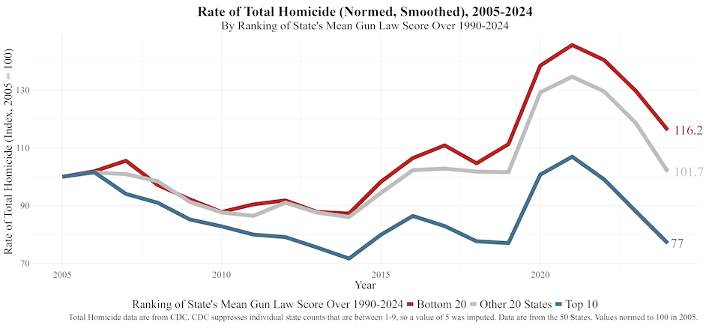
The gun lobby will deem this a win for gun rights, but it will also constitute a loss for gun safety as the empirical literature has established—at the highest level of evidentiary support according to a RAND assessment—that expanding concealed carry increases homicide and overall violent crime. This explains why the firearm-regulating states have a strong interest in trying to restrain what the former president of the NRA had once pejoratively referred to as “the promiscuous toting of guns.” Indeed, there is a very clear pattern of homicide in the United States over the last two decades: since 2005, the ten states that have been most aggressive in regulating firearms—including Hawaii, California, New York, and New Jersey—have enjoyed a 23 percent drop in homicide while the 20 least regulated states have suffered a 16 percent increase in homicide.
Did the Court make a distinction between types of firearms?
Wolford concerns only licensed concealed-carry of handguns by permit holders, so this means that the case does not address the carrying of shotguns, assault weapons, and other long guns. Of course, there is plenty of room for concern that the six conservative members of the current Supreme Court will soon be striking down bans on assault weapons and high-capacity magazines that many of the most restrictive states have (as did the federal government for the period from 1994-2004). Since these laws have restrained death from mass shootings, it will be another lamentable development if we end up with that result.
Note also that a modern semi-automatic pistol is already a far more deadly weapon than anything carried around at the time of adoption of the Second Amendment (particularly if equipped with a high-capacity magazine), so Wolford, lamentably, will almost certainly expand the number of individuals who are carrying deadly weapons throughout society. This will inevitably lead to higher gun thefts–which currently occur about 400,000 times per year across America–and other adverse consequences. Notably, my research has shown that greater gun carrying degrades police performance in fighting crime. The overall expected increase in violent crime will then be used by the gun lobby as a marketing ploy to sell even more firearms. Hopefully, Hawaii’s licensing requirements will screen out at least some of the individuals who are most prone to lose, abuse, or misuse their weapons (although strict licensing requirements–predominant throughout the affluent nations of the world who enjoy much lower levels of firearm violence–are also in the crosshairs of some of the conservative justices).
We’ve had two Supreme Court decisions this term involving the Second Amendment. What did the Court decide in last week’s unanimous decision involving marijuana users? Is this part of a Court trend regarding gun rights? Where do you see it ending?
The Court in United States v. Hemani, decided June 18, 2026, held that the federal ban on gun possession by “unlawful users” of controlled substances can’t be applied to a heavy user of marijuana, absent some additional showing of actual dangerousness. The defendant in that case admitted to the FBI he smoked marijuana every other day (of course, with an incentive to downplay the prevalence of his illegal drug use) and cocaine was found in his house, so one might be concerned about his gun possession. The Court’s ruling showed that its prior suggestions that only law-abiding, responsible citizens had the protection of the Second Amendment were simply not true.
Earlier, the Court had suggested in the Rahimi case that the federal law that barred gun possession by those subject to a domestic violence restraining order was similarly unconstitutional absent an additional showing of dangerousness. The gun industry of course wants to maximize the number of guns it can sell and therefore wants to eliminate as many restrictions as possible on who can buy and carry firearms, where the weapons can be taken, the level of firearm lethality, and any safety-enhancing measures that inconvenience gun owners (like waiting periods for purchase, safe storage requirements, or the need to ensure that one’s gun possession is not opposed by private property owners). The Supreme Court seems to have a strong interest in gratifying this preference, so the relentless stream of decisions undermining gun safety measures in largely blue states is likely to continue as long as this six-member majority–and the Heller–McDonald–Bruen line of cases–remains intact.

On the positive side, it should be emphasized that the holdings in these Second Amendment cases are all highly questionable at best, so at some point down the road, it would not be hard to imagine a Supreme Court decision sweeping them away while mimicking Alito’s comment in Dobbs v. Jackson Women’s Health Organization (2022) that Roe v. Wade was “egregiously wrong from the start.” But we are a long way from that today.
Do states have any legislative avenues to restrict guns, given the current Court’s views on the issue? Congress?
The ball-wrecking onslaught of Second Amendment cases has yet to jettison a number of valuable gun safety measures, such as bans on assault weapons and high-capacity magazines and minimum age laws for gun possession. If more states and the federal government would adopt them, it might chasten the overly activist tendencies of the current Supreme Court majority in this area. Enacting a requirement that all gun purchases be subject to universal background checks would certainly be advisable, and the uniform support across the country for this measure is almost unimaginably high. Indeed, I have documented one of the most striking failures of democratic responsiveness in the history of the American Republic: while universal background checks have been adopted in the 12 states in which they command at least 90% support, only 8 other states have done so among the 36 states that have support between 80-90%. Even in the least supportive state (Montana), 73 percent of its citizens endorse universal background checks. It is shameful that the gun lobby has been able to prevent Congress from adopting this obvious and enormously popular gun safety measure, which even this Court would be unlikely to dismantle.
Can you talk about the Second Amendment—and what the Constitution says about the right to carry guns? Is the Court stretching the text?
Surveying the Second Amendment landscape a decade after the 2008 Heller decision, the then-retired (Republican) Justice John Paul Stevens concluded that “District of Columbia v. Heller, which recognized an individual right to possess a firearm under the Constitution, is unquestionably the most clearly incorrect decision that the Supreme Court announced during my [34-year] tenure on the bench.” Fourteen years after Heller, the Supreme Court’s Bruen decision substantially enhanced the damage by announcing a constitutional right to carry guns outside the home. Perhaps even more ominously, Bruen adopted a bizarrely inept legal and historical analysis delivered with a combination of sophomoric and pugilistic rhetoric to super-charge the Second Amendment in ways that offer no sensible basis for evaluating the constitutionality of gun regulations and with little to constrain the whims of the pro-gun Justices.
The foolishness of this approach is on display once again in Wolford in that its entire discussion is fought on Bruen’s historical-analogue terrain, without even a nod to the consequences of impeding Hawaii’s firearm regulation. Of course, the need to have—let alone carry—guns in Hawaii is dramatically less than at the time of the Founding because 1) the primary goal of the Second Amendment was to have a well-regulated militia to suppress rebellions and deter foreign aggressors (now handled entirely by the U.S. military), 2) guns are no longer an important source of food or protection from roaming wildlife or Native American tribes, 3) there was not a single police force in the United States in 1791 and no active correctional institutions, at a time when crime was much greater than it is today and the abilities of the state to constrain it were far more limited. At the same time, when the need for weapons in civilian hands is much less important for advancing “the security of a Free state,” the type of weapons available today are vastly more dangerous than anything available for common use in 1791. Mass shootings were simply not—and could not be—a problem at the time the Second Amendment was adopted because the technology simply did not allow the massive killing potential that is unfortunately too often unleashed on innocent Americans today.
In other words, the entire edifice that has emerged from the Heller and Bruen cases is simply predicated on a profound misunderstanding about both wise constitutional law as well as the nature of guns in America over the last 250 years. As Professor Noah Feldman emphasized:
It’s worth noting that the Bruen did not tell the lower courts to follow the original meaning of the Second Amendment, despite the fact that the case’s author, Justice Clarence Thomas, is supposed to be an originalist. The reason, no doubt, is that the original meaning of the Second Amendment is clearly spelled out in the amendment’s own text, which explains that the purpose of the amendment is to ensure the existence of a “well regulated militia.” … Unwilling or unable to rely on the amendment’s original meaning, Thomas and the conservative majority instead concocted the novel legal category of “historical tradition.” The trouble is that no one, lawyer or otherwise, knows what it means to decide cases by historical tradition.
Thus, the Court tells us to decide Second Amendment cases based on text, history, and tradition, and then proceeds to ignore all three in rendering its highly contentious decisions focused on a cherry-picked view of the historical record that has little relevance to the safety concerns of modern America.
In Wolford, Justice Alito continued to tell just-so stories about fictional young ladies who will only be safe if they can have a gun on their person as they buy their groceries, pause for a coffee break, and stop for a pastry. If there were any reason to think that having millions of Americans traipse about with highly lethal weaponry would enhance public safety, Alito might have a point, but no credible study supports that view. The most that the NRA lawyer arguing in Bruen could say was that, in his opinion (in contradiction to the empirical evidence cited above), crime will not rise if more guns are carried on the streets. In other words, even the most dedicated advocate for the gun lobby was conceding that there would be no net benefit from more gun carrying.
Thus, if the empirical reality matters, Alito’s fictional narrative is really quite irrelevant. Perhaps one could rescue his vision of the Second Amendment if one conceded that even if the post-Heller conception of private gun ownership elevates violent crime and diminishes the safety of the public, what matters is perception not reality. In this view, there are enough individuals who have accepted gun lobby claims that guns will make them safer, and we should cater to this belief, however mistaken. While I would not favor such a move, at least it would eliminate the dishonesty and befuddled irrelevance that characterizes much of the pronouncements under the current Second Amendment doctrine the conservative majority has crafted.
Is there anything you’d like to add?
Since the Court in Wolford was trapped in its own doctrinal confusion, it never even noted that ordinarily, when one thinks about a default rule in the law, one should adopt the default that best captures the preferences of most of the people. This approach is advisable since it limits the burdens on the public to move to the preferred outcome by overcoming the default. Given the enormous power that the gun lobby has over legislatures across America, if the legislature has adopted a default rule that favors the public over gun owners—as Hawaii did—one has fairly convincing evidence that the law has accurately captured the preferences of the public. If there is some overwhelming interest that might dictate why the default mandated by the Hawaiian law should not favor property owners over gun owners, there might be a basis for objection, yet the Supreme Court offered no such justification, instead burying its head in the sands of some irrelevant historical precedents. Pro-gun states would be free to adopt a different default, and the electoral process across states has a far better chance of reaching good policy choices than the six justices of the Supreme Court majority. Moreover, even in Hawaii, businesses that wanted to encourage gun carrying on their property were entirely free to put “guns welcome” signs in their windows.
We do have evidence from insurance markets that insurance companies think that the presence of more guns will lead to greater danger rather than the safety benefits that Alito imagines. Of course, this is again a reason that the gun lobby wants to avoid the Hawaii default because adopting a “guns welcome” policy would invite higher liability premiums (which presumably wouldn’t happen if firearms were really protective).
We also have the unfortunate evidence that making businesses put up signs indicating that guns are not welcome on their property makes them targets for angry, armed protestors, as happened to Starbucks when its President asked customers not to bring openly carried assault weapons into their stores. It is clear that the state legislature is in a far better position to understand the appropriate default rule in these cases: states like Montana will leave the burden to complain on the businesses, while states like California, New York, Hawaii, etc., will benefit from the opposite default. Once again, the Supreme Court has blundered into an area with little comprehension of the harm it imposes.
John J. Donohue III has been one of the leading empirical researchers in the legal academy over the past 30 years. Professor Donohue is an economist as well as a lawyer and is well known for using empirical analysis to determine the impact of law and public policy in a wide range of areas, including civil rights and antidiscrimination law, employment discrimination, criminal justice and the death penalty, and factors influencing crime, such as guns, incarceration, policing, and legalized abortion.