
Where Theory Meets Practice
For Albert Choi, the Most Interesting Legal Questions Spring From the Gap Between Rules and Reality
The tension between elegant economic theory and the messy realities of billion-dollar business transactions has animated Albert H. Choi’s scholarship for over two decades and made him one of the country’s leading scholars working at the intersection of economics, contract law, corporate law, and finance.
Choi joined the Stanford Law School faculty in July as professor of law, continuing a career devoted to understanding how legal rules shape incentives—and how actual contracts, organizations, and markets often challenge conventional theory.
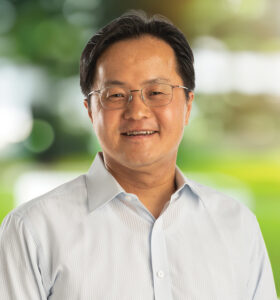
“As a scholar, I’m always interested in the gap between theory and practice,” Choi says. “Economic models can help us understand why legal rules exist, but they also raise new questions when we compare them with how transactions are actually structured and how legal institutions operate.”
That perspective began to take shape when Choi was a student at Pomona College studying economics and mathematics. As graduation approached, Choi’s advisors offered conflicting advice. Some encouraged him to pursue a PhD in economics, while others urged him to attend law school. He decided to do both.
Over the course of seven years, Choi earned a JD from Yale Law School and a PhD in economics from the Massachusetts Institute of Technology. Moving back and forth between the two disciplines gave him a new perspective.
“I was studying contract theory from the economics side and contract law from the legal side,” says Choi. “There were so many interesting questions that neither field fully answered on its own. I realized there was an opportunity to connect the two.”
He has since built a broad research portfolio spanning contract law, mergers and acquisitions, corporate governance, litigation, and corporate finance. For Choi, there is a throughline that cuts across these seemingly disparate fields: the quest to understand how legal rules and contractual design influence the behavior of firms, investors, managers, and courts.
“Albert is incredibly versatile intellectually,” says A. Mitchell Polinsky, Josephine Scott Crocker Professor of Law and Economics. “Most law and economics scholars are either good at applied theoretical work or at empirical research. Much of Albert’s earlier work was of the first sort, but now he is also undertaking empirical research, which is a rare combination. In seminar presentations, I have been impressed by the analytical rigor of his thinking and by his insightful responses to challenging questions.”
The puzzles behind the practice
Choi was born in Seoul, south Korea, and grew up in Southern California. After his graduate work, he was hired by the University of Virginia as an assistant professor of economics before joining the UVA law faculty, where he spent more than a decade. In 2019, he moved to the University of Michigan Law School, where he was the Paul G. Kauper Professor of Law.
George Triantis, JSD ’89, Richard E. Lang Professor of Law and Dean, met Choi at the University of Virginia more than 20 years ago and has since partnered with him on close to a dozen articles examining contract design, bargaining power, modification, and relational contracting.
“We are always searching for puzzles in the existing scholarship and trying to bridge the gap between how contracts are actually written, formed, and executed in the real world and what may be missing from the scholarship,” Choi says.
“We’re entering a period where we can study legal practice at a scale that wasn’t possible before.”
Professor Albert Choi
A recent example is their 2026 article in the University of Chicago Law Review, “Designing Contract Modification,” which explores why parties to long-term commercial agreements often renegotiate as circumstances and bargaining power change, even though contract doctrine tends to view such modifications with suspicion.
Harvard Law School Professor Kathryn E. Spier, another frequent collaborator with Choi—including on recent work examining IPO non-disclosure liability—says, “Albert is one of the most thoughtful and generous scholars in our profession. He has an extraordinary ability to see both the mathematical structure of a problem and the legal institutions behind it, and he is always looking for ways to make the ideas clearer, deeper, and more compelling.”
In the classroom
Choi says he relies heavily on real-world contracts and other documents in his classes. “Cases are essential to legal education, but transactional lawyers spend their careers drafting contracts, negotiating deals, and designing legal relationships,” he explains. “One thing I try to bring into the classroom is a sense of what actual contracts, merger agreements, charters, bylaws, and corporate filings look like and how such real-world contracts fit into a broader legal framework.”
While at Stanford in the fall of 2023 as the Herman Phleger Visiting Professor of Law, Choi taught an intensive mergers and acquisitions course that brought together JD students and LLM students who had practiced transactional law. He says what made the experience especially rewarding was the rich classroom discussions generated by students with diverse backgrounds.
Looking ahead, Choi believes new sources of data and advances in artificial intelligence will create unprecedented opportunities to study how contracts and legal institutions function.
“We’re entering a period where we can study legal practice at a scale that wasn’t possible before,” he says. “That creates exciting opportunities not only for scholarship but also for improving how lawyers design transactions, resolve disputes, and think about legal institutions.” SL