
The Court Records We're Not Allowed to See
A sweeping Stanford Law study reveals how routinely federal courts seal records, sometimes concealing information with profound implications for public health and safety.
Evidence of dangerous drugs, defective products, and corporate misconduct is often hidden from public view through sealed court records. And federal judges are granting requests to seal records at an astonishing rate, often without applying the proper legal standard, according to the largest-ever study of the issue.
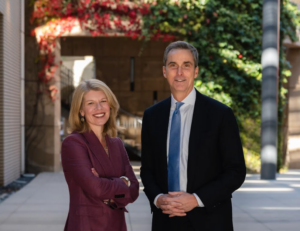
Stanford Law professors Nora Freeman Engstrom, JD ’02, and David Freeman Engstrom, JD ’02, co-directors of the Deborah L. Rhode Center on the Legal Profession, join Pam Karlan to discuss their findings. Their research reveals that roughly 90 percent of sealing requests are granted, about three-quarters go unopposed, and judges frequently fail to cite any legal standard at all.
Why is secrecy so pervasive in a justice system built on public access? The Engstroms explain how the incentives of litigants, lawyers, and judges can leave no one looking out for the public’s right to know. They also discuss their push for a new federal sealing rule and why, with civil trials increasingly rare, access to court records is more important than ever.
This episode originally aired on October 15, 2026.
Nora Freeman Engstrom: The bottom line here is if we’re going to watch adjudication in this country, we’re watching it on paper. We have to be able to see our motions to dismiss and our motions for summary judgment, because trials have essentially gone the way of the dodo bird.
Pam Karlan: This is Stanford Legal, where we look at the cases, questions, conflicts, and legal stories that affect us all every day. I’m Pam Karlan. Please subscribe or follow this feed on your favorite podcast app that way you’ll have access to all our new episodes as soon as they’re available. One of the great things about the justice system in the United States is that what it does is quite public generally.
You can read the complaints and cases if you’re interested in them. You can obviously read the opinions when they come out, and that tells you what’s going on. But one of the things that we’ve discovered is that the justice system isn’t quite as transparent as it might seem. And my guests on the show today, my colleagues David Freeman Engstrom and Nora Freeman Engstrom—from the names, you might guess that they are connected in a number of different ways here—are going to talk about their research on this issue, research that has revealed some quite shocking things.
So let me start by introducing them. Nora Freeman Engstrom is the Ernest W. McFarland Professor of Law here. She’s the Associate Dean for Strategy at Stanford Law School, and she’s a co-director of the Deborah L. Rhode Center on the Legal Profession. She’s an expert on torts. She’s an expert on professional responsibility, and in particular on the role of lawyers in cases that involve personal injury and mass disaster and the like.
David Freeman Engstrom is the LSVF Professor of Law here at Stanford Law School, and he’s another co-director of the Deborah L. Rhode Center on the Legal Profession. He’s an expert on civil procedure and related topics. So first of all, thanks so much, David and Nora, for coming onto the show.
David Freeman Engstrom: Thank you, Pam.
Nora Freeman Engstrom: Thanks for having us.
Pam Karlan: I wanted to start by asking you: there are obviously some things in litigation that people deserve to be able to keep secret. One thing I know, for example, in immigration cases, is people have to give their immigration number and the like, and so that gets sealed out of the record.
You never find that, or Social Security numbers, other kinds of personal identifying information like that. But usually when that stuff gets sealed out, you still have the complaint. It just doesn’t have that data in it or the like. So Nora, I want to begin by asking you what it means to seal a document, and then what sorts of documents or what sorts of information should be sealed, and when should they be sealed?
So, let’s start with: What does it mean to say that a document’s been sealed?
Nora Freeman Engstrom: So, a document is sealed if it is a court record, and that’s a document that’s actually filed with the court, yet it is not public. So you can’t go to the courthouse and open it.
It’s important to recognize that a lot of folks get confused between protective orders and sealing orders, and it’s really important to draw a clear line between these two things.
A protective order governs discovery, and that’s the Rule 26 standard, and that standard is for good cause. Sealing really ratchets up that protection. It’s important to keep in mind that there is no common law right of access to discovery material. In fact, that makes sense, right? In the early days of our republic, we didn’t have Folsom discovery.
But there is a common law right of access to court records and to being able to access court records. In fact, the common law right of access to court records predates the Constitution. So it is very firmly rooted in the United States in this notion that you should be able to go to the courthouse and see how justice is being done.
Pam Karlan: What kinds of things do you think should be sealed?
Nora Freeman Engstrom: So, things that should be sealed are where there isn’t a kind of traditional common law right of access. That’s one place to start, and those are things where there’s long been a kind of hands-off policy. That includes trade secrets, matters of national security, documents involving the privacy or welfare of children, medical records, and specific personal information such as, for example, Social Security numbers.
Everybody agrees that just because, for example, a Social Security number appears in a summary judgment motion, it makes sense that that should be redacted from that summary judgment motion.
Pam Karlan: Is there a difference between sealing and redaction, or is redaction just a smaller little sort of mini seal within something?
Nora Freeman Engstrom: So redaction is essentially a mini seal. And so one of the things courts say is, you shouldn’t seal an entire court record if you can seal just a portion of it, and you shouldn’t seal a record if just redaction will do it. So you can kind of think of it on a spectrum, but certainly the favored approach, if you have, let’s say, a Social Security number in a summary judgment motion, is not to seal the whole thing, but to just black out that particular number.
David Freeman Engstrom: I think the general principle is that courts are supposed to use a scalpel, not a sledgehammer, when they’re entertaining these sealing motions. So if a redaction will do, then the wholesale sealing is improper. And yet, in many or even most of the orders that we reviewed, courts sealed entire filings, including, for example, an entire motion for summary judgment.
Pam Karlan: Yes, it sort of seemed reminiscent of that scene in Catch-22 where Yossarian is reading the enlisted people’s mail and then is supposed to be marking things out. In one of the letters, he just leaves the word “the” every time it appears, and everything else is blacked out.
Nora Freeman Engstrom: I have to give a little shout-out to Judge Chuck Breyer in the Northern District of California. He has a famous decision regarding sealing where he is essentially calling out the parties for their excessive efforts to seal. He writes what, I think, is a 14-page opinion denying the motion, but then he redacts all but a few words of it. It’s kind of recognizing the absurdity of the litigants’ efforts to protect what they’ve done.
Pam Karlan: Yes, it’s kind of like erasure poems, where somebody takes the Declaration of Independence and takes out words, and what’s left is what you’re supposed to get.
Nora Freeman Engstrom: Yes, absolutely.
Pam Karlan: Yes, and I wanted to focus on two big things about the study that you’ve done. One is the nature of the study, because I think just technically what you did will interest people, and then I want to focus on the results. So technically, you looked at two million different cases to start the process. How did you do that?
David Freeman Engstrom: Well, we did it the way we do a lot of our empirical work at the Rhode Center, which is we had a team of lawyers and data scientists and computer scientists who could do it. And so we had two million dockets, but then obviously you can’t review those by hand. You can’t do that in some kind of eyes-on manual way, the way associates used to review documents in Houston warehouses back in the day.
And so we had this team, and we built a machine learning pipeline, and we used that. We built models and then we used that to analyze the documents. We weren’t content to do that, though. That gives you sort of great large-end transparency over the transparency of the system, but we also wanted to understand it at a more granular level.
And so for that, I believe for this paper, we did a random draw of 600 cases in particular and really got to ground on what had been decided, and in particular, how it had been decided. For instance, whether the court articulated the right standard or indeed any standard at all. I think that’s one of the real lightning bolt findings of the paper, which is that in certain half of the instances…
Pam Karlan: Yes. I was struck by the fact that you look at these 600 cases in which there was a sealing, and you say, in a lot of the cases, the court didn’t cite the standard at all. But in the cases where it did cite a standard, a majority of the time it cited the wrong standard. So it cited a standard that’s used in discovery. Maybe it’s worth teasing out the difference a little bit, and you can tell me if I’m getting this right. In discovery, the parties get lots of documents from one another that don’t actually ever go into the judicial record.
If somebody files an interrogatory request, the answers to the interrogatories don’t go to the court at all. The depositions don’t go to the court at all, unless and until you get to something like a summary judgment motion where you’re putting this stuff into the record. And so at that point, these things are still kind of private, if you will, and the standard for getting a protective order under Rule 26 is pretty lenient on this stuff.
It’s pretty easy to say, “No, you can’t simply take my deposition and then send it to The New York Times or the like.” But what you were talking about is not stuff that’s in the discovery process and just in the hands of the parties. This is stuff that’s actually been put onto a docket, uploaded to a docket in a federal courthouse.
Nora Freeman Engstrom: That’s absolutely right. So, for protective orders under Rule 26(c), the standard is good cause. That is not a nothing kind of review, but it’s certainly not a searching review. The standard for sealing is different from that. The sealing standard varies a little bit by circuit, but generally, the sealing standard is close to a kind of strict scrutiny standard.
It’s a compelling justification that is narrowly tailored to promote or serve that justification. For us, I found it staggering that it’s exactly what you said, Pam, which is to say, most of the time, district courts don’t cite any standard, and when they do, they cite the wrong one. They get confused between the protective order standard and the much stricter sealing order standard.
It’s just this: you don’t expect to see trial courts making mistakes that often. But what we found is that this kind of category mistake was quite rampant.
Pam Karlan: Yes, and the stuff that gets sealed also goes beyond the things that you were talking about originally. You give a couple of examples in the paper from personal injury cases where the things that were sealed in case number one are things that people should have been able to find out from looking at the records in these cases. And yet, they couldn’t find these things out because the records were sealed, and the sealing involved not just a particular detail, but the wholesale sealing of papers in the case.
Can you give us a couple of examples that you found most striking of this, and what the consequences of this sealing are? It’s not just that people who have idle curiosity and want to randomly pick things out of federal dockets can’t look at them. It’s much worse than that.
Nora Freeman Engstrom: Yes. So, one of the reasons it’s worse than that is that sealing, we know, has concealed public health hazards.
For example, early litigation involving OxyContin allowed the sealing of records regarding OxyContin’s risks. How many lives would have been saved if we had found out about the risks of OxyContin much earlier? In Propecia litigation, we know records were sealed showing that Merck had downplayed the drug’s negative effects.
In roof crush litigation against GM, dockets were sealed. In Bridgestone Firestone Tire litigation, documents were sealed that would have disclosed the hazards of that product.
Pam Karlan: Now, a lot of these cases the sealing was kind of rubber-stampish. Both the plaintiffs, because I think you’re talking about most of these cases involving documents that came from the defendant originally, and the plaintiffs in these cases didn’t seem to fight back on the sealing.
In most of the cases, as I understand the data in your paper, the sealing motions were unopposed.
Nora Freeman Engstrom: Yes. Overwhelmingly, that’s true. That was a really interesting facet of the research. The folks who were doing this hand-coding that David talked about kept saying, “Well, it’s strange. We have these motions to seal, and they’re not joint motions, they’re not stipulated motions, they’re not consent motions, but we can’t find oppositions in the docket.”
David and I kept saying, “Well, you have to go back and look again,” because there are two paths, right? It’s either going to be a consent or it’s going to be opposed. But what we found is that there are actually three paths, not two. The third path is what we call in the paper “shadow consent.” Plaintiffs don’t tend to formally consent to sealing, but they also don’t kind of take the time and effort to get out the pen and write an opposition.
That makes sense if you think about how plaintiffs’ lawyers are paid. They’re paid on a contingency fee basis, and it’s not really going to maximize the value of the case to fight the sealing motion. To do so would be to vindicate the public interest, but not necessarily your client’s interest in maximizing the value of the case.
And so it seems to be this kind of gray no-man’s-land of secrecy.
Pam Karlan: Do you think that it increases the settlement value of a case not to oppose the motion to seal? Because if the stuff gets out there, it’s worse for the defendant. So presumably, the defendant would be glad to pay something to the plaintiff to keep this stuff out in public afterwards, right?
Nora Freeman Engstrom: Conceivably, although that kind of bleeds into secret settlements, which we’ve also done research into. So it’s not obvious to me that that’s the calculation. I kind of think it’s more likely to be this path of least resistance. We all have limited time and lots of work to do, and we’re going to spend our limited time doing the work that is actually going to pay some kind of concrete dividends.
Pam Karlan: When folks look at these motions to seal, I take it it’s not just that the judges, in their orders to seal, didn’t cite the right standard. But I also take it that the party moving for the sealing wasn’t citing the right standard to begin with. It’s not as though the parties are saying, “We have a compelling interest,” and the judge says, “Oh no, all you need is good cause.”
David Freeman Engstrom: I think the conflation of the legal standards is probably committed by a lot of different actors within the system. But just keep in mind, one of our overarching theories for why there is too much secrecy within the civil justice system is that there’s no constituency for transparency. The plaintiffs at the protective order stage generally want to get the show on the road.
They’re willing to do anything to get hold of the needed discovery that they need to try to make out the claims of their clients. Defendants always prefer secrecy. Those same incentives, or at least a version of those incentives, continue into the sealing stage. And then the judge is generally a beleaguered judge who’s trying to move her docket. She has too many cases, too little time, and too much support to do it.
I don’t know. I think that your question just kind of underscores the fact that there’s no party within the system that actually has an incentive to try to vindicate the public interest in making the innards of the civil justice system more transparent and visible to everyone.
Pam Karlan: Are there points at which, for example, the press goes back in and tries to get some of this stuff unsealed? I wonder whether, having read your paper, some members of the press might want to go and start looking for, or asking you to share, the 600 cases with them so they could go in there and see what actually got sealed.
Nora Freeman Engstrom: So…
Pam Karlan: You’ve gotten some great press coverage of the paper.
David Freeman Engstrom: Yes, we’ve been very lucky.
Pam Karlan: …especially for a paper that hasn’t come out yet.
Nora Freeman Engstrom: Yes, we’ve been delighted that Adam Liptak, for example, wrote a lovely column about the paper, talking about secrecy run amok.
One of the things we’ve often—we meaning those of us who think hard about the civil justice system and are committed to its health—kind of contented ourselves with the idea that the parties don’t really care about transparency. The judge may be overburdened and might not care about transparency, but if it’s really important, the press will vindicate the public’s right.
And so, never you fear, don’t be too concerned, because if it matters, the press will intervene on the public’s behalf.
Pam Karlan: I would think that might be true for a case that’s a headline case from the get-go, right? If you have a headline case from the get-go that the press is covering, they’re going to be checking the docket all the time. When they notice a motion to seal something, they might come in.
But a lot of the examples you gave in the paper are small cases in areas where there are going to be frequent litigants, but nobody is going to be covering the individual cases. The case that involved the rifle that starts the paper off, nobody is really going to be covering that case from the get-go.
So there isn’t going to be a press person in there to see the motion to seal something. That’s different from a case where a state AG files a big case against a product, which you would expect the press to cover.
Nora Freeman Engstrom: Yes. Well, the evidence shows that these intervention motions that folks have really kind of counted on as a fail-safe are extremely rare.
Elizabeth Rowe, a terrific scholar, has a recent paper where she has looked at precisely this question. She has found that third parties, which is to say, folks like the press or academics, have appeared in less than 0.2% of cases with a motion to seal over the past five years.
In my conversations with journalists, when I’ve probed this a little bit, they have said essentially that getting my boss, my boss’s boss, and my boss’s boss’s boss to hire Williams & Connolly to press this intervention motion costs hundreds of thousands of dollars. It really takes a commitment from the newspaper to do that. Not surprisingly, in today’s journalistic age, that doesn’t happen very often.
So this comforting idea that we don’t need to worry because other folks will intervene if it’s really important is comforting, but it is a myth. If we’re going to have transparency within the system, we, the actors in the system, we, the litigants, we, the judges, we, the rulemakers, need to clean up the house.
Pam Karlan: Yes, I was thinking, while Nora was saying that, David, I was thinking of some of the other work that the Rhode Center’s doing on pro se litigants and making things easier for pro se litigants. Maybe you ought to have, like, a little toolkit for journalists on how to make pro se motions to unseal documents in cases where they’re interested in the documents.
David Freeman Engstrom: That’s one of the suggestions we’ve made. It should be easier to challenge overly aggressive sealing. Why couldn’t there be a form pleading or even some kind of interface, some kind of a user interface, some kind of website where a journalist can go and easily register an objection without hiring a lawyer?
Why wouldn’t that be a better way to run this railroad?
Nora Freeman Engstrom: At the Rhode Center, we are hiring a staff attorney who’s actually going to do some of this work and intervene in cases where we hear that sealing is protecting material that would be in the public interest to uncover.
This also leads to another activity that we’re doing out of this paper. The picture that we draw in the paper is a system that is quite intolerable. It is a system where the law on the books is strict and the law in action is lax, and there’s this real disjunction. You can think of this as a disjunction where there’s too much privacy.
You can also think of it as a disjunction where there’s too much disobedience, with lower courts not following the commands of higher courts. Some might say this is a transparency problem. I see it also to be a rule of law problem, and so I do think it cries out for a solution.
One of the solutions is this kind of roll up your sleeves and start intervening a little bit. Another solution that we’ve tried to do is—there does seem to be this confusion between protective orders and orders to seal, as you talked about, that courts keep on granting orders to seal while citing the protective order standard. I chalk that up in part to this idea that there is no rule of sealing.
Pam Karlan: Yes. You…
Nora Freeman Engstrom: Yes.
Pam Karlan: You’ve written to the rules committee to ask them to actually pass a rule, right?
Enact a rule for sealing to make it really clear that it’s different from protective orders, and that the standard’s higher.
Nora Freeman Engstrom: I think it’s just critical. It wouldn’t be necessary if there weren’t evidence of clear confusion, but I really feel like we’ve brought the receipts. There is clear confusion, and they ought to clear that up. It makes sense that courts are confused, because if you go through the rule book, you can look and see rules for almost everything in civil litigation, and not sealing, which is actually one of the most common kinds of motions in the federal courts.
It’s clear motions to seal are commonly filed, and they are very frequently confused and granted when they shouldn’t be granted. And this, I think, is a problem that is really calling out and crying out for a solution by the rules committee.
Pam Karlan: This is Stanford Legal, and today I’m talking with my colleagues David Freeman Engstrom and Nora Freeman Engstrom about their recent work on the sealing of court records.
David, I want to ask you: why does it matter so much? Why did you devote so much energy and so much time and so much creativity to this particular problem? Why does the sealing of records matter, many of which nobody’s ever going to ask to see anyway?
David Freeman Engstrom: Here’s where I can get on my high horse a bit.
I like to think that litigation transparency is law 101 and civics 101. In fact, that’s how the Fifth Circuit put it in a 2021 opinion. I guess I can break it down further, though, and say that litigation transparency does three types of work. It does regulatory work, it does procedural work, and it does democratic work.
So the regulatory work is that litigation transparency services information about threats to public health or public safety. It thereby enables law to warn, teach, and deter. I think that’s really important. That’s one of the principal benefits of litigation transparency. It also does procedural work, though, right?
It makes the law legible to all of us. The idea is that law is incompletely specified. Knowing one’s rights and obligations often requires getting under the hood of cases, because it’s the stuff of litigation. It’s litigation exhibits and expert reports that actually render a ruling legible to the next set of litigants.
So rules that promote transparency achieve that. And then finally, there is democratic work. I think that’s the easiest to see and maybe the easiest to state. Litigation transparency equips citizens with the raw material that they need to watch power and hold it to account.
Pam Karlan: And that’s to watch the judicial power you’re talking about there…
David Freeman Engstrom: Sure.
Pam Karlan: …as opposed to the regulatory power you were talking about earlier.
David Freeman Engstrom: Democracy only works if you can watch power, both public and private.
Nora Freeman Engstrom: This point has a broader frame as well. My favorite quote about this is by Chief Justice Burger, who wrote nearly a half century ago, “People in an open society do not demand infallibility from their institutions, but it is difficult for them to accept what they are prohibited from observing.”
This idea is that for people to have faith in courts, and for people perhaps to obey courts, they need to be able to see courts. I actually also think that there are certain things in society where the more you know, the less faith you have, and I think the courts are really quite the opposite.
I think to see our courts at work is to have faith in the men and women who mete out justice. Yet they’re acting like they have something to hide. I don’t think they should. I think if people saw just how seriously they take their responsibilities and how careful and thoughtful they are, that would be good for our third branch of government.
But right now, they’re seemingly operating with more opacity than before. Perhaps it’s not a coincidence that the trust in courts is at an all-time low.
Pam Karlan: One thing that you guys said earlier resonates with me here is: the discovery process now is so much bigger than it was at common law, and the resolution of cases now is mostly done on the papers.
It’s not done in courtrooms. The disappearing civil trial has been a kind of leitmotif of people writing about procedure for 30 years now. The average judge might try four cases a year, five cases a year in federal courts?
Nora Freeman Engstrom: Lower than that.
Pam Karlan: Everything they’re doing is on these papers. If the public can’t see the papers, it’s as if the public was being locked out of the courtroom in the old days when everything was done in the courtroom.
Nora Freeman Engstrom: Yes. So, these days, the federal civil trial rate is around .3%. That’s not even measuring the cases that are resolved by trial. That’s measuring the cases that get to trial. It’s this bizarre definition of what constitutes a trial that is extremely broad. Anything is a trial if it is a contested hearing where evidence is adduced.
So, for example, a class action certification hearing is a trial, and still, with that definition, it’s .3%.
The bottom line here is if we’re going to watch adjudication in this country, we’re watching it on paper. We have to be able to see our motions to dismiss and our motions for summary judgment, because trials have essentially gone the way of the dodo bird.
If stuff is going to come out, it needs to come out before trial. That makes it incredibly important to make sure that we’re able to see how these all-important motions are resolved.
Pam Karlan: Are you guys optimistic that having the combination of the work that you’ve done and the work that some other people have done revealing this big problem?
Are you optimistic that it’s going to lead to change, or are you skeptical of that?
David Freeman Engstrom: I think we are optimistic, and it’s for a reason that I think Nora already articulated: we’ve really brought some pretty important receipts here. We’ve already received quite a reception from courts and judges. We sort of know some things that are happening inside of courts related to articles that maybe we shouldn’t disclose, but there’s a lot of interest in this.
So I think by bringing those receipts, we maybe really have catalyzed something that could lead to some kind of change. Now, of course, the Advisory Committee on Civil Rules, which makes civil procedure rules, they’re busy. They have plenty of things to do. It’s not obvious why we would get priority in that, but maybe we will.
We’ve certainly done what we can. I think the interesting further question is this: suppose the advisory committee were to promulgate a new rule or put out a new rule. What would that rule be? Where would we strike the balance between privacy and transparency? That’s a tough question.
And so keep in mind, I think our papers are plenty powerful, but they’re largely descriptive in their approach. They don’t say what the standard should be. Indeed, I think there’s even a little bit of disagreement within our team as to what the optimal standard should be.
For instance, my view is that in an era of high-velocity information and viral information, so basically the digital era, maybe it should be relatively easy to get a protective order at that discovery stage. Indeed, maybe we should have presumptive or even automatic protective orders for discovery materials at that stage of a litigation.
But I think we’re all in agreement that at the sealing stage, it’s a different story. Once you have judicial records, once you have materials that are being used for the actual merits adjudication of cases, there you have this mix of common law considerations and First Amendment considerations. That just becomes a completely different matter.
Nora Freeman Engstrom: It’s not for us to say what the standard should be for sealing. It’s for the circuits to say what the standard is for sealing. Our rule proposal just says that the Rules Committee should endorse what the circuits have said. So this is not a bunch of academics from California or anywhere else saying what it should be.
This is some folks saying what the standard is and pointing out that the standard is not being followed. I think that is a problem that, whether you believe in transparency or you simply believe in the rule of law, ought to be addressed.
Pam Karlan: So it seems to me, and this is my last question for you, that there are two kinds of things that might be sealed.
One is things where we could all agree they should be sealed, and maybe the rules should be very specific on that. That is, you should always have to seal a Social Security number or a bank account number or the like. And then there’s the bigger stuff: should you be sealing an expert’s report on the safety of a gun or the safety of an opioid or the like?
And there, it is about a standard, not about a defined rule, right?
Nora Freeman Engstrom: Yes, I think if you can say in a clear way that there’s a compelling interest in secrecy here, and that it’s very clear in the circuits that it’s not just reputational harm. Reputational harm does not suffice. Even if it’s embarrassing for you to say how the inner workings of your firm happens, you do not get a sealing order.
But if you can show a compelling interest in secrecy and it’s narrowly tailored, have at it. A recent Fifth Circuit opinion, for example, pointed out that the documents that were sealed included an arrest report from a police department’s public website and articles from The New York Times.
That’s how far we’ve gotten in just green-lighting things that don’t even have the most attenuated claim to meeting the very rigorous and robust standard. District courts need to do better, but we ought to give them the tools to make it a little easier to comply with their obligations.
David Freeman Engstrom: You’re right, Pam, that any rulemaking or policymaking in this space is going to require that we bring up that eternal question of rules versus standards. I feel like that’s above my pay grade. Maybe it’s up to the advisory committee to decide what mix of those two things makes the most sense.
I do think that with the kind of systematic disobedience that we have surfaced via this empirical work, that maybe puts a thumb on the scale in favor of some rule-like formulations. Otherwise, once again, there is no constituency for transparency down at the trial level. It’s going to be too easy for things to drift again in precisely the direction that they seem to have drifted.
Pam Karlan: Well, I’m glad that you guys have shed some light on the things that are not coming to light. It’s a terrific article. It’ll be out in the Duke Law Journal this coming year. So for all of our listeners, keep your eyes open for this. I want to thank our guests today, David Freeman Engstrom and Nora Freeman Engstrom.
This is Stanford Legal. If you’re enjoying the show, please tell a friend and leave us a rating or review on your favorite podcast app. Your feedback improves the show and it helps new listeners to discover us. I’m Pam Karlan. See you next time.