Assessing Whether Fossil Fuel Companies Have Disseminated Disinformation (809V)
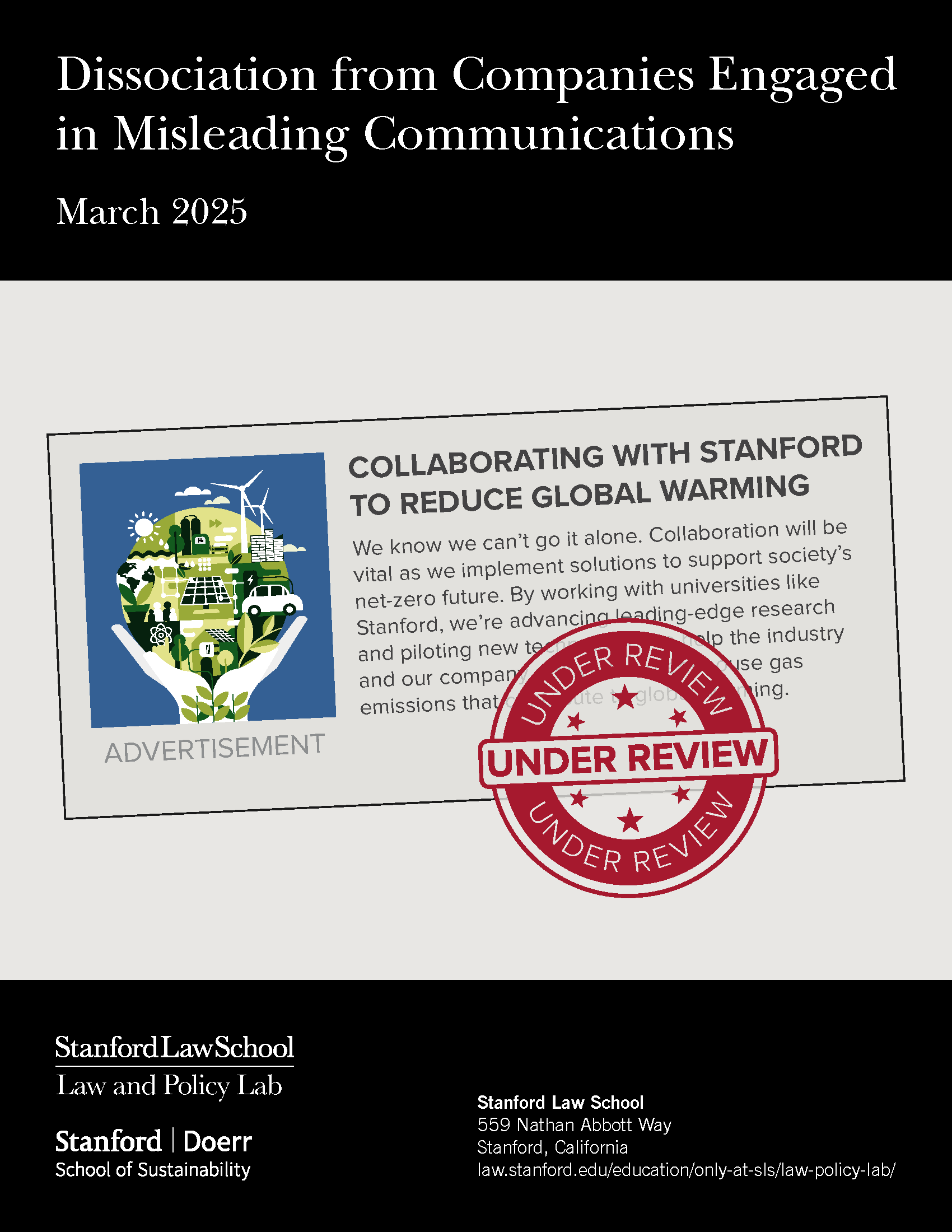
This Policy Lab responds to the recommendation of the University’s Committee on Funding for Energy Research and Education (CFERE) to “develop clear and objective standards for determining whether a company or trade association has systematically engaged in propagating disinformation.”
We will tentatively adopt the Princeton University Faculty Panel on Fossil Fuel Dissociation’s definition of disinformation: a communication made “with the intent to mislead.” Although the dissociation process could in principle apply to any corporation, we will look particularly at fossil fuel companies, which were the focus of CFERE’s inquiry.
We begin with the hypothesis that the outcome of litigation involving fossil fuel companies’ deception of consumers, investors, and other stakeholders (see, e.g., City of New York v. Exxon Mobil Corp.) has the potential to provide reliable information on which university dissociation might be based. Fortunately, Columbia University’s Sabin Center for Climate Change Law maintains comprehensive information about such litigation through its Climate Change Litigation Databases.
We will begin by examining the statutes under which such litigation is brought for their relevance to dissociation, and explore issues such as what judgments by what courts could a university rely on; what is the appropriate standard of culpability; how recent and pervasive must a company’s behavior be to justify dissociation; what process should a university employ to consider a company’s dissociation, including what due process rights the company should be accorded; and what behaviors could mitigate its culpability.
In addition to Stanford Law students, students from the Stanford Doerr School of Sustainability and other Schools are invited to apply.
Elements used in grading: Attendance, Class Performance, Class Participation, Written Assignments.
Cross-listed with Doerr School of Sustainability (SUSTAIN 213)