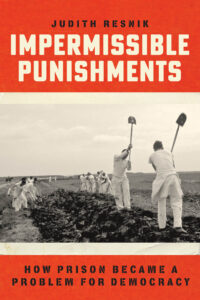
Impermissible Punishments: How Prison Became a Problem for Democracy

- This event has passed.
Join Judith Resnik, in discussion with Pam Karlan and David Sklansky. Can prisons escape their ties to plantations and concentration camps? This wholly original book by Judith Resnik explores the history of punishment inside prisons and the rules that organize prisons. Resnik charts the invention of the corrections profession that imposed radical restrictions on human movement as if doing so was normal. She weaves together the stories of people who debated how to punish and the stories of people living under the regimes that resulted.
Resnik excavates the first-ever international rules aiming to improve the treatment of prisoners, which the League of Nations adopted in 1934 as the Nazis rose to power. Her trans-Atlantic account documents the impact of World War II, the United Nations, the U.S. Civil Rights movement, and of pioneering prisoners who insisted law protected their dignity as individuals. Resnik maps the results, including a trial in the United States about the constitutionality of whipping, which was Arkansas’ preferred “discipline” in the 1960s. This book traces the constitutional challenges thereafter to hyper-crowded cells, filth, violence, and profound isolation, as well as the cross-border expansion of the prison industry, waves of abolition efforts, and the impact of legal precepts rejecting “excessive,” “cruel and unusual,” and “degrading” sanctions. Exploring the interdependency of people in and out of prisons, Impermissible Punishments argues that governments committed to equality cannot set out to ruin people and therefore many contemporary forms of punishment need to end.
This event is co-sponsored by the Stanford Constitutional Law Center and the Stanford Criminal Justice Center (SCJC)
|
|
|
| IMPERMISSIBLE PUNISHMENTS How Prison Became a Problem for Democracy |
Judith Resnik Professor of Law, Yale Law School |