
Legal Design Lab
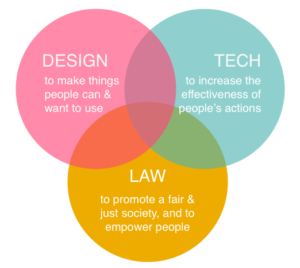
The Stanford Legal Design Lab sits at the heart of innovation in public interest legal services.
We build and study new tools, services, and policies that help people resolve their legal problems. We host the communities where the access to justice field coordinates, we steward the shared standards and data the field depends on, and we develop responsible AI with the courts and legal aid groups serving people directly.
The Lab has done this work at Stanford Law School and the Stanford d.school since 2013.
Our Mission

Train law students & professionals in human-centered civic innovation and public interest technology.

Research & Develop new models of legal services, tech, and policy that promote equity and access to the civil justice system

Coordinate leaders, infrastructure, and policies that scale promising innovations to improve the justice system
Legal Design Lab Projects
We work with courts, government agencies, legal departments, law firms, and legal aid groups to reimagine how they provide services.
Our Lab designs, pilots, and evaluates new solutions that aim to make the civil justice system more accessible and equitable. Using human-centered and community-driven design, we identify what kind of solution will be most impactful. Our projects typically are in 4 categories:
- Technology Projects: Many of the Legal Design Lab projects are technology-based: applications, websites, text message flows, and AI models. We run some of these technology systems ourselves, but most often we work with our legal aid and court partners to implement and operate them.
- Visual Design Projects: The Legal Design Lab has worked closely with courts, legal aid groups, and government agencies to improve how they communicate with their users about important legal system information. We have created new forms, notices, fliers, posters, process maps, and other visuals to help people navigate the justice system.
- Community-Building Projects: The Legal Design Lab has led many projects that are about building relationships among justice professionals, community members, and other agencies. These focus on identifying and spreading promising practices, establishing common infrastructure, and coordinating groups inside and among jurisdictions.
Explore some of the projects below. For a complete list of projects, visit: http://legaltechdesign.com
Past Projects
The Legal Design Lab has worked over the past decade to launch many different legal innovation projects. Please explore our past project work here.
Court Visual Guides
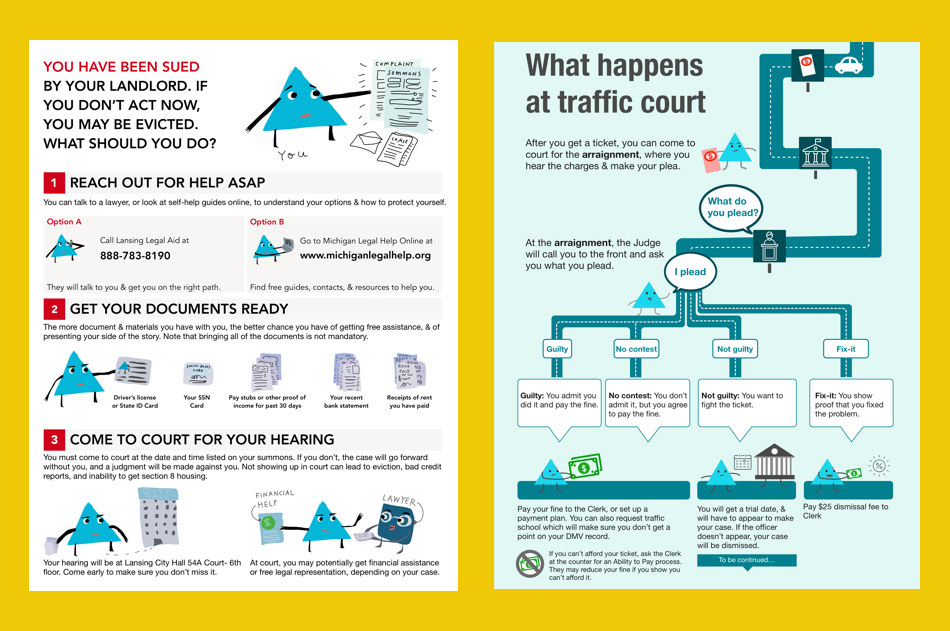
We are creating fliers and posters that use visuals to explain how to navigate complicated court processes. We design them in partnership with courts and judges.
We have worked with Alameda County Courts to make guides for people facing traffic tickets, to help people protect their rights and avoid financial burdens.
We are working with Lansing, Michigan courts to create visual resources for people facing evictions, to prepare for their court hearing.
Courses We Offer
The Legal Design Lab team teaches hands-on classes that mix legal research, design work, and technology development. Recent classes include Justice By Design: Eviction, in which students work with the NAACP partners to develop innovative, effective eviction prevention pilots (806Y) and Unlocking Technology to Promote Access to Justice, in which students work on developing new policies, data infrastructure, and tech that scale to serve self-represented litigants (808J).
The Legal Design Lab Team

Margaret is the Executive Director of the Legal Design Lab, which she founded in 2013 at Stanford.
Margaret holds a JD from Stanford Law, as well as an AB from the University of Chicago, an MA from Central European University in Budapest, and a PhD from Queen’s University Belfast in International Politics.

Nóra Al Haider is the Lab’s Assistant Director. She works on combining the fields of law, tech and
design to find human-centred solutions for complex problems. At the Lab, she has taught classes including Justice By Design, New Spaces of Justice, and Blueprints of Justice. Nora’s work includes a focus on virtual legal systems, data-driven legal help, and the future of AI and justice. Nóra holds a Bachelor (honours) and Research Master in Law from Utrecht University. In her spare time she loves to make art and travel around the world.

Vasyl Rakivnenko is AI Technical Lead at Stanford Law School’s Legal Design Lab, where he’s working on building LLM copilots and RAG pipelines to widen access to justice. He also researches LLM performance, pricing, and bias with Professor Haim Mendelson from Stanford GSB and Nestor Maslej, from Stanford HAI, and mentors students through Stanford AI4ALL program.
Aditesh Kumar works on the Legal Design Lab’s R&D with legal aid groups to develop responsible AI solutions.
Aditesh is a Master’s student in the Computer Science Department at Stanford University. He’s broadly interested in the tension that arises where information technology meets law, and is passionate about designing technology that can bridge that gap. He holds a BS in Computer Science and a BA in Criminology, Law, and Society from UCI.
See his Github here.

Miles Krim is a freshman at Stanford University studying Economics and Public Policy on the pre-law track. As a Research Assistant at the Legal Design Lab, he explores how design and innovation can make legal systems more accessible and effective. He is especially interested in public defense, drug policy reform, and the intersection of law and policy. Outside the Lab, he competes as an attorney on Stanford’s Mock Trial Team and works as a Junior Consultant with the TAMID Group, gaining experience in business strategy and consulting.

Kylie Price is a pre-law student majoring in Earth Systems and co-terming in Public Policy at Stanford University. At the Legal Design Lab, she works as a Research Assistant and Project Guide interested in the intersection of science, technology, and law to promote equity in justice systems. Kylie also works at the Santa Clara County Public Defender’s office as a legal intern in the post-conviction unit and is an attorney competitor on the mock trial team. With a background in activism and grassroots organizing, she is passionate about advocating for and communicating with underserved communities to enact policy change.

Pierre works with the Lab to facilitate the Access to Justice Network.
Pierre was born in northern Luzon, Philippines, and grew up in Myrtle Beach, South Carolina. He is studying Design on the Physical Manufacturing track, aiming to create lasting and beautiful artifacts. With a passion for both service design and legal studies, he hopes to merge these interests to work as both a lawyer and a designer. In his free time, he enjoys dancing, woodworking, and cooking.

Kalissa Greene is a senior from Alpharetta, Georgia, double majoring in Data Science and Political Science with a Notation in Science Communication. With a passion for the intersection of technology and law, she focuses on AI ethics and data privacy, striving to shape the future of technology policy.

Chidubem is a current undergraduate pre-law student studying international relations and bioengineering in the Stanford class of 2027. She is interested in the intersection of technology and civil society, and its implications for accessibility and advocacy in legal environments.
Nabikshya Rayamajhi

works with the Legal Design Lab to facilitate the Access to Justice Network.
Nabikshya is a junior at Stanford University, majoring in Political Science and minoring in Human Rights. As a pre-law student, she is passionate about civil rights law, with a focus on advancing women’s rights and expanding access to the legal system for underrepresented communities. She is involved in Stanford Women in Law and contributes to the Stanford Law Review, where she engages with critical legal issues and works to promote diverse representation within the legal field. Whether researching reproductive rights or using AI to tackle legal challenges, Nabikshya is committed to using the law as a tool for systemic justice.

Sarah was a Master’s student in the Policy, Organization, and Leadership Studies (POLS) program at Stanford’s Graduate School of Education. She’s interested in how technology, policy, and education can intersect to expand access to justice through human-centered design.
Sarah also supports disability policy research at the National Center for Learning Disabilities and mentors students and faculty on ethical AI use and AI literacy through Stanford’s Accelerator for Learning. She holds a B.A. from UC Berkeley, where she served as Senior Class President.

Roda Nour is a San Diego native and is the youngest of a family of 9. She double majored in Management Science and Engineering and Public Policy at Stanford University while working as a research assistant with the Legal Design Lab. Roda aspires to be a lawyer working with underserved communities in need of imminent legal aid. In her free time, she likes to write poetry and soak up that California sunshine on the beach.
RJ grew up in Franklin, Tennessee and graduated from the University of Tennessee in 2015 with a B.A. in Literary & Advocacy Journalism.
Afterwards, he moved to Yangon, Myanmar to work at The Myanmar Times via a Princeton in Asia fellowship. In 2017, he joined Law360, a legal news outlet where he helped launch the company’s first Access to Justice beat. His stories focused on topics like bail reform, legal aid funding, and self-represented litigants. At SLS, RJ helps coordinate the Housing Pro Bono project.
He is also a board member of the American Constitution Society, FLI Professionals, Older Wiser Law Students (“OWLS”), the Stanford Environmental Law Journal, and the Stanford Law & Policy Review. RJ spent his 1L summer working at the American Civil Liberties Union of Southern California. In his free time, he enjoys hiking, playing volleyball, reading The New Yorker, and watching hockey.

Sabina is a Symbolic Systems major and Human Rights minor at Stanford University, with an interest in leveraging technology to facilitate access-to-justice.
She has been working with the Legal Design Lab for three years on projects including creating the Navocado platform to train pro bono lawyers in new fields, increasing the accessibility of online legal help, and optimizing Internet search engines for legal queries.
Outside of the lab, she was the president of the Business Association of Stanford Entrepreneurial Students, and is conducting Honors Thesis research on the ethical implications of corporate secrecy.
Rachel (she/her) Wang is a senior studying Psychology and Sociology at Tufts University, with an interest in attending law school in the future. She has been working with the Legal Design Lab for over a year now, designing the online court observations survey and building a legal help website evaluation tool. In her free time, she loves sketching with her non-dominant hand and promoting mental health awareness on her college campus.

Olivia is a 2L at SLS, and is a lead fellow on the Eviction Innovation project, our multi-city strategic network with the National League of Cities, and our eviction pilots in Hamilton County, Ohio.
She has a background in access to social services, particularly reproductive and maternal care.
She spent the past summer in Richmond, Virginia researching potential programs the city can implement to address its eviction crisis.
Yue is a Computational and Mathematics Engineering master’s student

at Stanford. Her projects at the Legal Design Lab include auditing Google search results for legal queries and doing data analysis the American Bar Association’s online platform. She is excited about how technology and data can be leveraged to provide better access to justice. Outside of school, Yue loves listening to storytelling podcasts, knitting, and hiking.

Juan is a Chilean lawyer, interested in creating seamless dispute resolution systems and using out of the box solutions to improve trust in legal institutions.
Currently a Master of Laws candidate at Stanford University, in the Lab he is involved in cross-functional projects in which technology can provide meaningful access to justice, from simple legal queries to get legal help on search engines, to better ways to answer legal complaints using SMS.
Prior to Stanford, he worked as a Research Associate at the justice studies center of the Organization of American States. There, he acquired a strong record of working effectively with governments to implement criminal and civil justice reforms in Latin America. In addition to his participation in the lab, Juan conducts research in Procedural Justice and Trust on Chilean judiciary as a Fellow of the Stanford Program in International Legal Studies, with a grant of the Freeman Spogli Institute for International Studies. He also has lead creative writing workshops for incarcerated people in California, as a member of the Stanford Prisoner Advocacy and Resources Coalition.

Daniel holds a JD from Stanford, and a PhD from the University of Arizona. He is an affiliate member of Harvard Law’s A2J Lab.
His research focuses on language access, self-help, and the role that information plays in cases of summary eviction.

Jane Wong was the Lab’s Post-JD fellow during 2017-18. She worked on access to justice innovation, with a focus on more coordinated Bay Area legal services. Jane graduated from Stanford Law School in 2017. While a student, she worked as a student fellow in the Lab on how to design the courts to be more accessible to the public.
Jane received a B.A. in Sociology and a Korean minor at the University of California, Berkeley. Prior to law school, she worked at a policy firm that improved the effectiveness of social service programs. She came to law school with an interest in pursuing a public interest law career in health care and affordable housing.
Jose joined the Lab as its first full-time fellow, to work on a year-long design project around new modes of Dispute Resolution. During his fellowship, he also led workshops and classes around new business models, process mapping, logic and arguments, and design research methods brought to law.
He is the Director of the Center for Innovation in Law at the Sergio Arboleda University in Colombia and a co-founder at Lexter, a legal tech company in Colombia.Prior to that, he was a Senior Associate at the M&A practice of Posse Herrera Ruiz (Colombia), an associate in the international arbitration practice of Skadden Arps, Slate, Meagher & Flom LLP in London and a Legal Affairs Officer at the Legal Affairs Division of the World Trade Organization.
Jose holds a JD from the University of Los Andes in Colombia, an International Diploma on International Trade Regulation from the World Trade Institute in Berne, and an LLM in International Economic Law & Policy from the University of Barcelona.

Jorge Gabriel Jimenez was the Lab’s full-time Fellow for 2018-19. He completed his master’s degree at Stanford in the Law, Science and Technology program.
Since 2013, Jorge worked as project director of Francisco Marroquin Law School, where he participated in a project called ‘rethinking law school’ to innovate legal education.
While a law student in 2011, he co-founded Guatecambia, the first NGO to promote open government in Guatemala. In 2013, he co-founded Chamba Co-working, the first open space whose goal is to accelerate the process of entrepreneurship in Guatemala. In 2014, he co-founded a law firm in Guatemala called Nexus Legal. Jorge has also actively participated in other organizations related with Law, Innovation and Technology, such as Creative Commons, Legal Hackers and Hacks Hackers.

Emma holds a JD from Stanford Law School. Prior to law school, Emma was a research analyst at the Office of the Attorney General of New York, where she worked with public records data and incorporated machine learning and natural language processing into casework. Since starting at Stanford Law School, Emma has helped form a new student organization, Stanford Law Students against Gendered Violence, and leads an accompanying pro bono project focused on domestic violence policy work and direct services.
She was a Member Editor of the Stanford Law Review, the Managing Editor of the Stanford Technology Law Review, and a Vice President of Student Initiatives for the Stanford Public Interest Law Foundation.
Emma is from Ashford, Connecticut and earned her B.A. in English and American Literature with a minor in Computer Science from Middlebury College.

Diego Ramos is a Chilean lawyer who graduated from the International Economic Law, Business and Policy LL.M. program at Stanford Law School in 2018, where he studied with a Fulbright Scholarship. He works with the Lab on language access in the courts. Diego has focused his practice in Arbitration, both domestic and international, ADR and Antitrust Law. He has studied Antitrust Law at Pontificia Universidad Católica de Chile and International Commercial and Investment Arbitration at Roma TRE University, besides attending numerous courses and workshops on alternative mechanisms of dispute resolution.
Since his first years in law school, Diego has been very involved in academic activities, being a teaching assistant in more than ten courses in three different Chilean universities, mainly in the fields of civil and criminal procedural law, economic analysis of law and antitrust law. Diego is a member of several organizations related to arbitration, alternative dispute resolution and antitrust law in Chile and abroad, such as the Silicon Valley Arbitration and Mediation Center – Young Professionals and the Antitrust Law Committee of the Chilean Bar Association.

Tom holds a JD from Stanford with a background in legal operations and management consulting. Prior to law school, Tom was a Legal Operations Associate at Google where he led cross-functional projects focused on legal technology, knowledge management, and process improvement. Before his time at Google, Tom worked in Deloitte Consulting’s Federal practice with an emphasis on healthcare technology. Tom currently supports the Corporate Legal Operations Consortium (CLOC), a non-profit group designed to establish standards and best practices within legal departments of all sizes around the world. At Stanford, Tom is the Co-Director of the International Refugee Assistance Project and OutLaw, in addition to his involvement with the Legal Design Lab. Tom is a 2012 graduate of American University with a Bachelor’s degree in Political Science and Law & Society.

Guillermo Aldunate holds an LLM from SLS’s Environmental Law & Policy program.
Prior to coming to Stanford, Guillermo took part in several designing processes of both public and private initiatives. In 2013, he was involved in the design and implementation of a Clean Production Agreement in the Maipo river watershed in Chile, which was led by the Chilean government. Through this agreement, water users in the Maipo river watershed committed themselves to implement cleaner and more sustainable methods of production.
Also, in 2015 he guided a team of experts in the redesign of a water management system for a water user organization in Chile. By using a participatory and user-centered approach, Guillermo managed to make water allocation within the organization more efficient and effective. Guillermo is a member of several organizations related with environmental protection and water management in Chile, such as the Confederación de Canalistas de Chile and the Centro de Derecho y Gestión de Aguas at Pontificia Universidad Católica de Chile.

Kevin was a student fellow while a JD-Candidate at Stanford Law School. His design and research focus is on reimagining the Internet as a portal for legal help and information for ordinary consumers. Prior to law school, Kevin served for three years in the Obama Administration as a political appointee at the White House and the U.S. Department of Commerce, focusing on policy communications and media relations. Before joining the Administration, he worked as a media strategist in Malaysia and a political campaign staffer and fundraiser in New Hampshire, North Carolina, and Massachusetts.
Kevin received his B.A. in International Relations from Brown University. He loves to swim, hike, learn foreign languages, and code side projects to hone his technical skills.

Jessica was a fellow while studying at Stanford Law School. She brought over ten years of patent prosecution and strategy experience. Jessica has worked in law firms, in-house, and most recently as the Founder and President of a Silicon Valley patent strategy consultancy.
As a named inventor on a number of patents, Jessica has a long history of designing and bringing new inventions to market. Her current interests include inventing and developing technology solutions for intellectual property prosecution and litigation. Additionally, Jessica is researching law firm innovation and working to reimagine the 21st century firm.
Jessica is a published author, editor and guest lecturer at Stanford University on a variety of topics relating to patent law, strategy, and design.
Legal Design & Innovation
Virtual Legal Systems

The Stanford Legal Design Lab had an ongoing collaboration with Virgil Abloh, MIT Architecture, and Oana Stănescu to redesign how legal systems operate virtually — and what the future of courthouses will be.
We worked closely with courts in Massachusetts and Utah to assist them in redesigning ‘hybrid court houses’. This was a unique project to investigate and design the future for hybrid, virtual and physical spaces of justice.