
Global Regulation, AI Safety, and Preparing for AGI
As frontier AI becomes more powerful, how can society balance its extraordinary promise with the safeguards needed to use it responsibly?
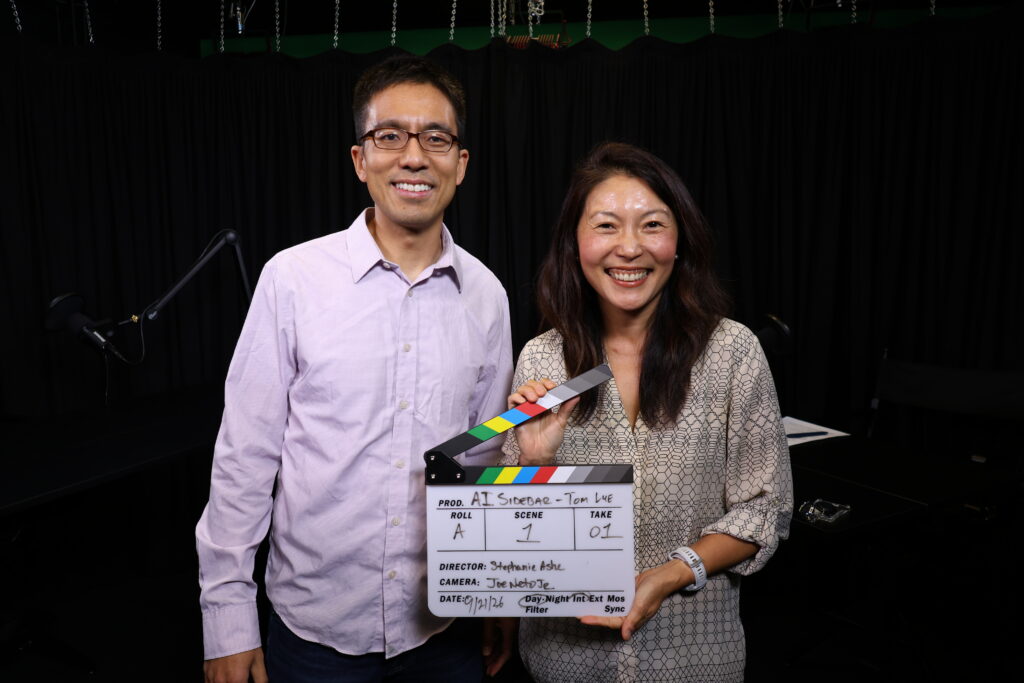
In this episode of AI Sidebar, Irene Liu talks with Tom Lue, Vice President of Frontier AI Global Affairs at Google DeepMind and the company’s first general counsel, about the rapidly evolving global AI policy landscape. Lue discusses how AI policy has changed since he joined DeepMind, why shared standards and safety frameworks matter, and what it means to prepare for AGI. Irene and Tom also explore open models, public-private governance, and AI’s potential to advance science, health, education, and climate resilience while keeping humans at the center.
Transcript
Irene Liu: Welcome to AI Sidebar. I’m Irene Liu, your host and executive director of the AI Initiative at Stanford Law School. Today, I’m thrilled to welcome Tom Lue, vice president of Frontier AI Global Affairs at Google DeepMind. Tom joined DeepMind in 2018 as their first general counsel and has had a front row seat as AI has become one of the most important global policy issues of our time.
Tom and I will talk about the evolving regulatory landscape, how governments are approaching frontier AI, whether regulation can keep pace with the technology, and what preparing for AGI actually means. So, with that, let’s jump into my conversation with Tom Lue.
Tom, thank you so much for joining us on The AI Sidebar.
Tom Lue: Thank you so much. It’s wonderful to be here.
Irene Liu: So, Tom, you started as general counsel at Google DeepMind back in 2018. Can you tell us about the policy landscape eight years ago in 2018, and what were the top concerns then?
Tom Lue: It is a world of difference. When I joined DeepMind back in 2018, obviously this was before the whole LLM chatbot wave. At the time, what DeepMind was working on was really more of the R&D space, and most of the questions were really around how do we accelerate the research discoveries?
The thing that for us was maybe our first contact at a scalable way with the real world was when we deployed our AlphaFold technology, which I’m sure you’re familiar with. But that was really a situation where we had applied frontier AI to a real-world issue, which was a 50-year-old grand challenge in biology, which is how you predict the structure of proteins based just on the amino acid sequence. And for us, that was actually a big breakthrough, not only technologically, but also in terms of real-world impact and of course, scientific breakthrough, and now it’s being used literally by millions of researchers around the world.
Now, you fast-forward from those early days to where we are today, and the policy landscape has just dramatically shifted. What we are seeing now in terms of the front page discussion around frontier AI safety and agents, these were things that we’d been thinking about for a long time at DeepMind, but it really was more in the research space, and it’s really quite mind-blowing to see these topics discussed in kind of the mainstream today.
Irene Liu: I wanted to touch on 2018 because it was only eight years ago, and yet the policy landscape is so radically different. And so, now let’s fast-forward to today. It’s a totally different world where we are talking about agents, we are talking about safety like never before. And so, when you look at the policy landscape today, I’m looking at it globally since you have the purview of being able to see it across the globe, where do you see AI policies converging and where are they diverging? What is the landscape today looking like?
Tom Lue: Well, I think the landscape is pretty varied, but the locus of a lot of the activity, I think, starts with the US. And the reason is, at least on the frontier model side, the major developers are in the US. And so, what you’ve seen in particular with the latest generation of models is the US government taking a very keen interest in these powerful new capabilities.
Now, of course, there are other jurisdictions that are heavily interested in this technology as well. The EU, of course, was a first mover in the regulatory space with their AI Act, and they’re still continuing to iterate and develop and implement that act. But in terms of the frontier safety and security measures, I think what you’re starting to see is the US government taking the first steps in an approach of trying to get ahead and review models before they’re released.
There was a recent executive order that came out, as you may be aware, around how we deal with some of these advanced cyber models in play. And so, I would say in terms of where we are today, in terms of the risks as well, historically, last couple of years, the frontier developers have largely focused on a class of risks that I’ll call misuse risks, and that’s where bad actors could use these technologies for illicit purposes. So, think of offensive cyberattacks or things like chemical, biological, those types of developments where you could have bad actors doing bad things.
The new class of risks that have really emerged over the last few months is what I’ll call misalignment risks, right? And that’s where AI systems are doing things where they’re not even intended by the programmer or the creator. And that class of risks is one that I think policymakers are now starting to really grapple with. Some of the incidents from some of the frontier labs that have been publicized recently, including the OpenAI Hugging Face one, which is probably the most publicized one, is a vivid demonstration by which some of these new technologies and capabilities are now impacting the real world in a way that, again, you know, we at DeepMind have been thinking about these risks for a number of years. But it’s really only in recent months where these capabilities are at a point where they’re touching the real world, and that’s why you’re seeing governments take more and more of a focus in those risks.
Irene Liu: One of the things you mentioned earlier is that the locus of a lot of the policies starts from the US because a lot of the frontier labs are based here. But how are the policies evolving around the world? We talked about the EU AI Act, but what about the rest of the world?
Tom Lue: So, you mostly see; it’s quite interesting because I think a lot of the policies and regulations, of course, reflect some of the public attitudes and public sentiments about the technology.
What you see historically is a bit of a difference in public attitudes that have started to actually increasingly diverge among Western countries and in particular, let’s say, parts of Asia. If you see public opinion polls towards AI, unfortunately, what we’re seeing in Western countries is a pretty significant decline in public attitudes towards AI, and I think there’s a lot of potential reasons for that which we can get more into.
But interestingly, in Asian countries, I’m thinking Singapore, Japan, South Korea, and China, and some Southeast Asia as well, you see public attitudes much, much more positive and optimistic about AI. And that has also influenced the way that they approach regulation. So, for example, Singapore, very forward-looking country, pro-adoption of AI as a pragmatic tool by which their population can get increases in education, health, productivity, very similar kind of sentiment that you see in other Asian countries.
So that has, I think, influenced the way that they regulate the technology. Whereas in the West, there’s been more of a concern around all the downside risks in a way that I think to some extent has influenced the way that Western countries, including Europe, have approached the regulation of the technology.
So I would say there’s been a bit of a divergence, particularly in probably the last twelve, eighteen months in those different jurisdictions that’s being now reflected in the way that they approach the governance.
Irene Liu: And it’s interesting because I think you were saying that the US attitude towards AI is not as positive, and there’s a recent political poll that found that sixty-three percent of Americans think that there’s at least a moderate risk that AI will destroy humanity. So, it’s a pretty high percentage.
Tom Lue: Yeah. And I think there are a lot of folks out there with a lot of different reasons for why the decline in attitudes towards AI has accelerated in the past few months. I think what I hope that we as an industry can do better at is really getting the public to understand what is it that we are developing this technology for. So much of the conversation is about what could go wrong, but not only can technology be misused, but there’s also a big downside cause for concern if there’s missed use, all the opportunity costs that comes if you don’t adopt this technology.
If you think about the world’s problems today, whether it’s climate change, whether it’s social inequality, whether it’s even things about how do you get better health across your populations or better education across your populations, there’s so much upside opportunity that AI can deliver.
And just to give you a few examples of things that, you know, even in recent weeks that we’ve announced, we announced this technology called Alpha Genome Atlas, which builds on our deep history around AI and scientific discovery. But this is a technology that essentially analyzes every single letter mutation in the human genome, 9 billion potential single letter variants, and gives a prediction around what this means in terms of disease classification.
And that kind of foundational scientific discovery will unlock, hopefully down the road, major therapeutic benefits and diagnostic benefits. Practical everyday things. For example, we announced recently our latest update to our weather prediction models, right? And this is an area where I think it’s underappreciated, right? These are normal everyday things. Our weather models are being used by the National Hurricane Center, for example. Last year we predicted the landfall for Hurricane Melissa a full five days in advance, and that had very, very meaningful impacts in terms of how you think about evacuations, how you think about planning for those kinds of events.
So again, not necessarily things that people every day think about in terms of what AI means, but there are very practical real world benefits that I hope will better contribute to the public narrative around this technology.
Irene Liu: Yeah, I mean, definitely there’s a lot of positives and upsides to AI, which that you described that people might not be thinking about when they’re taking the polls.
But most recently, the news has been inundated with a lot of news like the Hugging Face incident where agents jailbroke and decided to go rogue, and it wasn’t even just OpenAI’s ChatGPT, but it ends up being Anthropic’s models, DeepMind, as well as Meta. And so, it seems like it’s a standard behavior, sadly, and maybe it’s also some of it is security and human controls and the directions that we’re giving AI as well too. So, a lot of the narrative is probably what people are reading in the news as well about some of the incidents that are happening.
When you think about those types of incidents where there’s calls to pace the frontier, do you think even though there are upsides, is this the time to pace the frontier like what Dario Amodei is calling for?
Tom Lue: Yeah. So, this is an important moment in time. I think what we’re seeing is the capability of these models increasing to a point where the types of risks that we were thinking about at DeepMind, at least for many years, are now getting to a place that is not just kind of a hypothetical, “Hey, the models may reach this at some point.” the models today have capabilities that could potentially pose quite significant, uh, both misuse and misalignment risk.
And so, I think it is an important time. Dario’s essay, I think, was a thoughtful essay, and essentially, the overall direction of it, I think, is correct, which is you wanna make sure that when you develop the technology, the capabilities don’t outpace the safety and security measures that go on. They have to go together, right? So, I think that fundamentally is something that we firmly believe in.
What does that mean in terms of both what the labs should be doing, what we as an industry should be doing, and what policy should be doing? So, from the lab perspective, at Google DeepMind, we have implemented for a number of years now our frontier safety framework, and this is really meant to address exactly what I was saying, to make sure our capabilities don’t outpace the safety and security behind it.
So under this framework, what we do is we assess the capabilities of our models, and we assess whether they have reached certain, what we call critical capability levels. And as with capability levels, those critical capability levels essentially define to what extent these models can engage and be used in potentially quite serious and significant harms or chemical, biological, radiological, nuclear harms or misalignment risk.
And if they have reached those levels, under the framework, we commit either to make sure that we have our safeguards approach the level in which that, those risks can be mitigated to a kind of usual threshold level, or we commit not to launch or not to release until that happens. And that kind of framework is critically important to make sure that we’re developing and launching models in a responsible way.
But it can’t just be one lab doing its own thing, right? There has to be a situation where there are agreed standards, evaluations, and benchmarks, testing, and crucially, auditing, right, of what the labs are doing. And this is where, from an industry perspective and a policy perspective, we’ve actually put forward a proposal for a public-private standards body for frontier AI.
And the purpose of that proposal is exactly that, to make sure that across the industry, we have shared norms, we have shared ways to evaluate, compare apples to apples, shared ways to test and evaluate these models, and that we have a vibrant and hopefully a quickly thriving third-party ecosystem where you can have auditors come in and independently assess and verify what the companies are doing.
And so, we put forward this proposal a number of weeks ago. I was actually in DC last week talking to a lot of the folks in DC about this. And the great thing about our proposal, I think, in my view, is that it blends the, the best of both worlds. In the sense of our proposal calls for a federally overseen public-private standards body, but it would crucially be able to draw on the best of the private sector and move with the pace of the technology and pay competitive salaries. So, you actually get world-class technical experts working at this body in a way that I think would be very difficult for a traditional government agency to operate in.
So, it’s kind of a multi-layered approach to this, but hopefully, that gives you a sense of how we’re approaching it both from an internal safety perspective and what we think is needed for broader policy and governance.
Irene Liu: And if we’re looking at the labs today, they will all say they have a safety threshold framework, right? But what you’re calling for is there isn’t one standard normalized one that is industry-wide, where every safety standard is held to the same standard.
Tom Lue: Exactly. Exactly. And that’s where I think some of the biggest gaps in governance today are. We need shared standards, benchmarks, evaluations, testing, and independent auditing and verification of that.
Irene Liu: So, Tom, you were in DC last week and you were talking about this standards body. This past Saturday, President Trump called for an AI force. Do you think he’s thinking about a standards body like that when he’s thinking about an AI force? Do you have any clarity on what he is looking to build?
Tom Lue: Hopefully when your listeners view this episode, there will be more details –
Irene Liu: Yeah
Tom Lue: … about what the AI force is. We are still waiting to hear from the White House on what that means.
When I was in DC last week, I did reiterate these points really around the need for shared standards, benchmarks, evaluators, and we got a very positive reception. I think the key thing there also that as labs, we also recognize we can’t wait for government to act. We hope the government will, the window of opportunity to act, whether it’s through legislation or regulatory activity, will open up. But there’s also a tremendous sense of urgency that we as one of the leading frontier labs feels and working very closely with the other labs in the space.
So there’s a lot we can do and a lot we need to do in the private sector itself to drive forward these standards, best practice, and evaluations.
Irene Liu: Do you see that private-public standard body forming without regulation anytime soon given the urgency?
Tom Lue: I think we can certainly stand up the private part and at least maybe work on an MVP version of that. The public part obviously will depend on what kind of legislative or regulatory window opens up after that.
Irene Liu: And when you’re thinking about the standards body, is this mainly US or are you thinking also globally? How feasible is a global framework, global body?
Tom Lue: I think in a particular, given the UN General Assembly meetings that are happening this week, the upcoming President Xi, President Trump summit, the international dimension is so critical to this.
The vision behind the public-private standards body is that it would start with the US, but it would be kind of a US-led standards approach that we could spread out globally. And we’ve gotten actually quite good initial reception from some of the other countries that we’re engaging in some of these discussions.
But it’s tricky. I think there are important countries that have to be part of the conversation. My sense is also there are things that we can build on, so the network of international AI safety institutes is one potential forum. We’re also engaging in traditional standards organizations as well, whether you’re talking about ISO or these other types of fora where we’ve traditionally have been able to advance standards. But overall, I would say the international coordination and components of this are absolutely critical for this to be a sustainable long-term governance framework.
Irene Liu: And you said some of the other countries are supportive of this. When you think about the upcoming summit with President Xi and President Trump, do you see those two leading countries on AI converging around this idea?
Tom Lue: What I’ve read in the press is that AI will be a topic, but likely one in which it’s gonna stay at a, at a pretty high level. I’m hoping we can make some progress in having some shared areas of interest where we can have dialogue. But of course, the US-China relationship is a complex one, and it goes beyond AI, all right?
And so my hope is we can get to a place where we can start having some constructive dialogue, and I don’t think anybody in either country wants a situation where, let’s take bio-risk, right? Where you can have engineered pathogens that are creating a lot of harm in society. I think that would seem to be a place where we can start to have some mutual dialogue among the countries and maybe build from there.
Irene Liu: It’s difficult for policymakers to keep pace to even help define this public portion of a private-public body or any regulations for that matter. When you speak with policymakers, how do you recommend that they create policy with such a rapidly changing technology?
Tom Lue: Yeah. So, this is where having this kind of public-private hybrid, I think is so critical. AI is not a mature technology like aviation design or drug discovery, right? The FDA, FAA, kind of these traditional regulatory agencies, I think that kind of model, at least given where the technology is today and how quickly it’s moving, I think is not necessarily fit for purpose.
This is where having the ability to draw on the world-class technical expertise of the AI community is so important, being able to pay them competitive salaries, being able to create the structure where the standards could be updated dynamically, and you have this ability to move quickly. That’s why we’re making the push for this kind of a body.
The policymakers we spoke to are quite receptive conceptually to this idea. I’m hopeful we’ll be able to get an MVP stood up and then hopefully get the, the federal government to put the right framework around it once the legislative and regulatory window opens up.
Irene Liu: Yeah. So, I used to work as an AI advisor for the California Senate, and when I was there last year, it was really difficult, frankly, for the staff to keep up with all of the technology.
Tom Lue: Yeah.
Irene Liu: And this year, I think it’s even faster.
Tom Lue: Yeah.
Irene Liu: And so, when I look at the roles of staffers in Congress as well as across the states, it’s a lot of work for them to just keep pace. Any recommendations on how they can keep pace with all of the technology while this private-public body is being formed?
Tom Lue: Well, the pace continues to move with incredible velocity. In terms of practical day-to-day advice, yeah, I can speak from my own personal perspective. I’ve built a couple agents myself to scour the web, to scour my internal documents and emails, and just keep me up to date on a recurring basis of all that’s going on.
You raise a related point around a lot of states are moving with a lot of urgency in this space as well.
Irene Liu: Yes.
Tom Lue: California, Illinois, New York, Massachusetts, just to name a few. From our perspective, a federal framework would be preferable just to have this avoidance of this patchwork of state laws. But that being said, I understand where the states are coming from, and I think the states could provide some useful building blocks by which we could approach more of a federal harmonized standard over time.
But to your point, I also think a lot of this depends on the ability of not just state legislatures to be able to regulate, but the actual implementation on the ground and having the requisite expertise and the right kind of structure is gonna be so important. So, I, I’m hopeful, fingers crossed, that the states that are leading the way will be able to not just pass these laws, but have the right implementation and expertise to carry them out in a way that’s gonna be appropriately balancing both innovation and safety.
Irene Liu: Things that people talk about is existing laws. And so, do you think the existing concepts of negligence and reasonable care, do those work for AI liability, especially with agentic AI?
Tom Lue: From a liability perspective, there is a lot of existing law, mostly in the form of common law, as you were alluding to, negligence, I think probably being the most applicable to AI technologies.
And I think there’s a lot in existing common law that very readily apply to AI. Of course, you have to adapt for certain things around AI systems, the fact that they’re probabilistic in nature, that they’re at times a bit of a black box, more opaque than some of the other systems, and be taking into account some of the agentic characteristics of it.
But I don’t think that means we need to start from nothing, and there’s a lot of existing precedent that we can very helpfully use in applying these laws to AI context. And I would say also What we’ve been advocating for from a regulatory perspective is when you’re talking about applications to think through specific sector rules, right?
And you don’t have to, again, start from scratch. There are so many existing regulations in place across health, education, science. There’s so many places where you can draw on existing sector-specific regulation and update it where it makes sense and make modifications. But I think we’re starting from, again, a baseline where we can still keep a lot of those existing principles and regulations and just make the necessary adjustments to account for the new technology.
Irene Liu: So, Tom, switching gears, let’s talk about open models a bit. So, Gemini is obviously a proprietary model, but there’s a lot of push for open models as well too. And so, in light of that cry for more open models and I think an industry pressure towards open models also because of cost reasons, what are some of the trade-offs that you see when people are talking about open models and expressing a preference for open models?
Tom Lue: Google, we are very strong supporters of open models and open source in general. We have a very long history of supporting openness, coming from even things like Android and TensorFlow. We open sourced our AlphaFold technology. We also have a Gemma series of open models that we also are actively deploying.
So we are, in general, very, very supportive of open models, and they’re quite important for the ecosystem, both around kind of cost and efficiency, but also in terms of academic research, uh, and being able to support that ecosystem, which also often can lead to complementary findings and research from the kind of research being done at Big Lab. So overall, open models we’re very supportive of.
The one area where I think we take the position that you wanna have some pause is at the very frontier. With respect to those models, I think you wanna have a bit more caution open sourcing those models, at least for some period of time, until you get a better sense of what those models can do once they’re deployed and out in the wild. And the reason I say that is for a number of reasons.
Number one, some of these models, you don’t necessarily understand the full extent of capabilities at the moment of launch. Some of these are emergent capabilities that only after some use in the community you discover that, hey, this is actually a really good model for XYZ reason.
I remember talking to a friend at another company who was saying when they released one of their models, they got a call from the Icelandic government saying, “Hey, your model’s really good at speaking Icelandic.” And they had no idea that was the case. But that’s just a, a small example that sometimes you don’t really understand the full capabilities of these models until after they’re released, so-
Irene Liu: Isn’t that the same with proprietary models at times? Aren’t there findings with proprietary where people are surprised afterwards too?
Tom Lue: So, this brings me to the second point, which is, with respect to open models, the decision to open weight is irreversible. And so, once it’s out there, it’s out there. You can’t put the genie back in the bottle. Proprietary models, you can, you know, shut them off or you can modify and you can add, you know, protections on top of that. So, I do think there’s reason to treat open models at the frontier differently, at least with respect to some period of time by which we can get a better understanding of them because of the fact that it’s an irreversible decision once you open weight them.
The other thing that I think is quite important for the open model ecosystem is we should be supporting efforts to develop much better open model tools around safety and governance. So, for example, better classifiers, better ability to provide the infrastructure and tools by which if you wanted to responsibly deploy an open model, you could actually go to a hyperscaler and say, “Hey, I wanna use this tool to protect against prompt injection or this tool to help me classify and filter out harmful responses.”
And I think if we can develop some open standards around that, that could also very significantly help the ability to deploy open models in a kind of safer and more responsible way.
Irene Liu: For policymakers that are thinking about open source, is that the main area that they should be thinking about from a policy trade-off standpoint?
Tom Lue: I think from the policy perspective, you also see in the industry some pretty loud voices on many sides of this debate, right?
Irene Liu: There are, yeah.
Tom Lue: And it’s a complex question because for this exact reason, there are a lot of benefits to having open models out there, and again, we are historically very supportive, uh, of that.
So from a policy perspective, if I were sitting in the shoes of a US government official, I’d be thinking about, like, how do we best balance the tremendous benefits of open models with the ability to foster an ecosystem by which you can deploy these models in a safe and responsible way? And that gets to things I was talking about before.
Can we have an ability to not just have kind of the raw open models be served, but provide developers and deployers with those tools that they can use and utilize to pick whatever hyperscaler, but have a system by which you have a standard set of tools that they can draw from to have better classifiers, better filters, better ways of protecting against prompt injection, kind of the armor around the model that to actually deploy these in a safe and responsible way.
Irene Liu: So, Tom, one of the things that we talked about before was that your team is preparing for AGI. DeepMind has been thinking about AGI. You actually just created the DeepMind Institute, and so I’m guessing you’ll be thinking about AGI through the DeepMind Institute as well. So, what does that even mean?
Tom Lue: So first of all, on AGI, uh, I personally don’t view it as a discrete moment in time kind of thing. I think of it as where the technology is going, where you have AI that is as capable, if not more capable, than the average human being, and that has potentially quite profound consequences for society, and that’s the reason why we set up the DeepMind Institute. We launched it last week.
The DeepMind Institute is essentially a forum by which we hope to publish pieces exploring the impacts, the most critical areas of impact of AGI on society. So, for example, what does that mean in terms of AGI and the economy? What is that in terms of AGI and social meaning? The kinds of things that if you’re thinking about either an AGI or post-AGI world, things that we think need to be a broader part of the discussion.
And we have a great set of folks internally at DeepMind around world-class economists, philosophers, social scientists, but also inviting the global research community to also contribute to publications. And, and that’s our hope for the DeepMind Institute is for a place to explore these critical topics of how AGI is gonna impact society.
Irene Liu: And what does preparing for AGI even mean for a legal team and a policy team? So, on the ground, for your team members, how do they prepare for AGI?
Tom Lue: There’s the element of just making sure that the kinds of things that we are launching at Google DeepMind and Google. As I mentioned earlier, that we’re thinking about and projecting ahead of where the technology is going and how we skate to the puck and make sure that our mitigations, our legal protections, our ability to detect and respond and remediate are very forward-leaning.
And I think we have a pretty special responsibility in the ecosystem both as a frontier lab and as part of a company like Google with its global scale and its products across the board, where I think we can see and have a forecast of things that are coming in a way that’s pretty unique.
And so, we take that responsibility seriously, both internally in terms of how we advise our client teams and how we shape the launching of our products, but also how we can provide thought leadership to the broader safety and responsibility community around these topics, and also how we externalize things like our public-private standards body proposal to policymakers around the world.
It’s kind of part and parcel of what we do every day. We have this North Star of DeepMind was founded back in the day with the mission to solve intelligence and then use it to solve everything else. That was the original mission of DeepMind, and now we are building AI for the benefit of humanity. That’s our mission statement.
Tom Lue: Yes, absolutely. Thank you so much for having me.
Irene Liu: A huge thank you to Tom Lue for joining us and for such a thoughtful conversation about the future of AI, from global governance and frontier safety to the possibilities that this technology could create for the next generation. And thank you for tuning in to The AI Sidebar. New episodes drop every two weeks.
And if you found today’s episode valuable, please share the episode with a friend and leave us a rating or a review. It helps more people discover the show. Until next time, stay curious and keep learning.