
A Community Built on a Legacy
Judge Duniway’s Clerks and Scholarship Recipients Are Building Ties Across Generations
Near Michael Kahn’s desk, just over his shoulder, is a photograph of Judge Benjamin C. Duniway, LLB ’31, the Ninth Circuit judge for whom he clerked in the early 1970s. Many of the late judge’s clerks keep the same photograph in their offices, Kahn says, a testament to the influence of a man they describe as brilliant, exacting, warm, imposing, and deeply humane.
In 1986, Kahn, JD/MA ’73, and others in Duniway’s long line of clerks were preparing to celebrate the judge’s 25th year on the federal bench. But the celebratory reunion never took place because Duniway died unexpectedly.
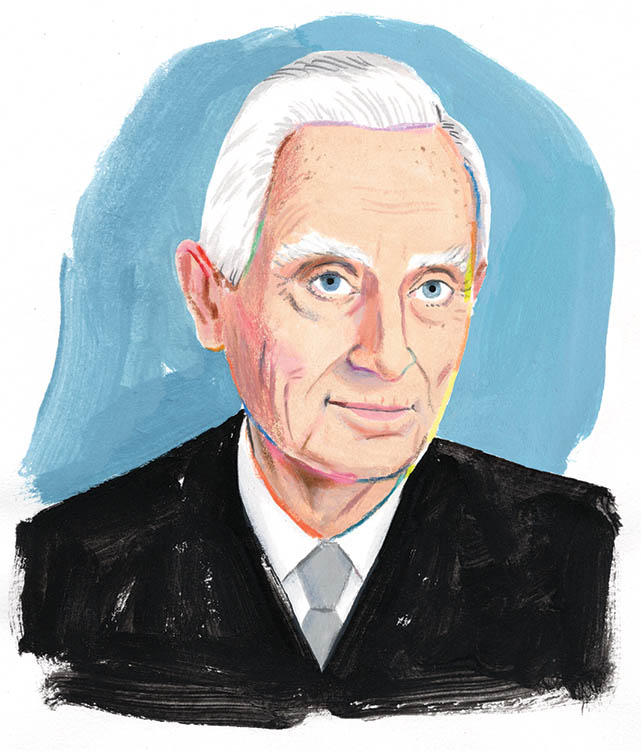
Kahn and his fellow clerks decided to establish a scholarship in the judge’s name at Stanford Law School, which Duniway loved and supported—all 34 of his clerks were SLS alums. In the years since, the Judge Benjamin C. Duniway Memorial Scholarship Fund has helped more than 50 law students defray the cost of their legal education.
On the 40th anniversary of the need-based fund, Kahn and a committee of fellow clerks and scholarship recipients are working to strengthen the Judge Duniway community and connect it more intentionally to current and future scholarship recipients.
Part of that effort is a panel during reunion weekend that honors Duniway’s legacy. Moderated by U.S. District Judge Susan Illston, JD ’73, the October 17 panel will feature Gordon Davidson, JD ’74 (BS ’70, MS ’71), former chair of Fenwick & West; Jonathan Weisgall, JD ’73, who has held corporate, public interest, and in-house roles; and Kahn, a trial lawyer who also served as an advisor to three California governors. Panelists will explore how the practice of law has changed in the past half-century and how clerking for Judge Duniway shaped their lives and careers.
Davidson says the discussion will be an opportunity to revisit Duniway’s “very high standards in everything he did” and to consider them as an example to today’s lawyers and judges, including his insistence that writing be precise, direct, and free of unnecessary flourish.
“I still remember his first comment on the first opinion I drafted,” Davidson says. “I started with the appellant’s first assertion and stated that ‘the appellant is clearly wrong.’ Judge Duniway’s first edit was to cross out the word ‘clearly,’ explaining that it is stronger to just say ‘the appellant is wrong.’ I have never used an adverb since.”
The art of judging
Kahn remembers Duniway as a figure from another era: courtly, dressed every day in a suit and tie, smoking in chambers, and commanding respect. “He was an absolutely brilliant person,” says Kahn, an active Stanford Law alumni leader who, among other roles, has served on the Dean’s Advisory Council. “He remembered everything.”
“For Judge Duniway, judging was a craft, an art. He would say that his
chambers were ‘an artisan’s shop.’”David F. Levi, JD ’80
Duniway would be appalled by today’s partisan rancor, Kahn says, especially the way people speak about judges, courts, and those with whom they disagree. Duniway could disagree sharply without losing respect for the person on the other side, Kahn says.
That was true with his fellow Stanford Law alumnus U.S. Supreme Court Justice William H. Rehnquist, LLB ’52 (BA/MA ’48), whose views, according to Kahn, stood in stark contrast to Duniway’s classic liberalism. Not long after Rehnquist joined the Supreme Court, he flew from D.C. for a Stanford Law visit. Duniway asked Kahn to pick up the justice at the airport.
“I don’t think there was a single opinion of Rehnquist’s that Duniway agreed with,” Kahn says. “But he got along so beautifully with him.”
After Duniway died, Rehnquist’s remarks in a tribute volume reflect the respect the chief justice held for him. He called Duniway “a great friend and supporter” of Stanford Law School and praised his “contemplative instinct,” which he described as “the truly indispensable requisite for a first-rate judge.”
David F. Levi, JD ’80, former dean of Duke Law School and former chief judge of the U.S. District Court for the Eastern District of California, says his Duniway clerkship has remained a touchstone throughout his career. When Levi joined the federal bench 10 years after his clerkship, he drew on his time in Duniway’s chambers. “He was a person of great kindness and decency,” Levi says.
“For Judge Duniway, judging was a craft, an art,” Levi says. “He would say that his chambers were ‘an artisan’s shop,’ and he meant it.” Duniway was not constrained by a fixed judicial ideology, Levi adds. He focused on each case, with close attention to both the immediate dispute and “a deep fidelity to the place of law in a changing world.”
Inside Duniway’s chambers
Unlike many appellate judges, Duniway did not have his clerks prepare bench memos. He read the briefs himself, pencil in hand, circling errors and absorbing the record.
Kahn remembers one case that involved many people with similar names and a complex fact pattern. During oral arguments, Duniway pressed the government lawyers, elegantly moving through the specific details of the case from memory.
“The person sitting next to me said, ‘That guy must have the best bench memo in the history of the world,’” Kahn recalls. “But he didn’t have a bench memo at all, because he didn’t need one.”
On the clerks’ first day, Kahn says, Duniway told them that the most important people in the courthouse were the staff who kept the institution running. “He was a very egalitarian person,” Kahn says. “He would have wanted the scholarships to go to those who needed them the most.”
A legacy carried forward
Duniway was born on the stanford campus in 1907, grew up there, attended Stanford Law School, and later served as a university trustee.
Four decades after his death, the Duniway Scholarship has become a bridge between the Stanford alumni lawyers who knew the judge and the students who have—or will—come to know him through the scholarship that bears his name.
“The Duniway Scholarship was meaningful support during my time as a law student, and I remain grateful for it,” says Elizabeth Pollman, JD ’05 (BA ’99), the Perry Golkin Professor of Law at the University of Pennsylvania Carey Law School. “The gift reflects the generosity of distinguished Stanford Law alumni, all in the spirit of Judge Duniway’s enduring legacy, and I feel fortunate to be part of this community.”
“Judge Duniway gave all of us an extraordinary gift,” says Kahn. “The scholarship is one way of passing that forward. We want the students who receive it to know they are part of a community shaped by the judge’s example.” SL
The reunion weekend panel will be on Saturday, October 17, at 10 a.m. Alumni interested in attending should email: externalrelations@law.stanford.edu.