
A Path Forward for the Fourth Amendment
In his new book, Professor Orin Kerr shows how the Supreme Court could apply the Fourth Amendment to our increasingly online world
In recent years, most examinations of the U.S. Supreme Court have laid bare what seems to be the increasingly vast ideological divide between conservative and liberal justices.
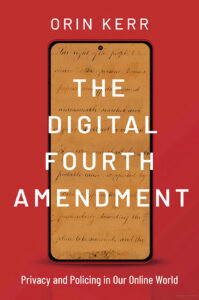
Stanford Law School Professor Orin Kerr (MS ’94) offers something different. In his new book, The Digital Fourth Amendment: Privacy and Policing in Our Online World, Kerr highlights an area of constitutional law in which justices on the Supreme Court—including adherents of ideologically opposed theories ranging from pragmatism to originalism—have found common ground in Fourth Amendment cases using an approach he traces to the late 19th century.
Kerr calls this approach “equilibrium-adjustment.” He defines it as an attempt by the Court—presented with rapidly evolving technologies and tasked with protecting both public and private interests—to preserve the Fourth Amendment’s foundational role in guarding against unreasonable searches and seizures while adapting and responding to changing facts. Kerr coined the term in a 2011 law review article; in the book, he shows how the theory works, applies the framework to physical computers that are not connected to the internet, and develops an approach for how to translate existing physical rules of Fourth Amendment law to our increasingly online world.
“The book is about how the Fourth Amendment applies in the digital age. We are in a world of electronic evidence. How should courts adapt 18th-century protections to 21st-century facts?” says Kerr, who helped develop the field of computer crime law.
Kerr offers a historical perspective, with examples of equilibrium-adjustment over the past century, including cases involving searches of automobiles (from Carroll v. United States in 1925) and the monitoring of payphones (from Katz v. United States in 1967). He also examines two of the most important recent
Fourth Amendment cases that dealt with searches of cellphones and cellphone location data (Stanford’s Supreme Court Litigation Clinic successfully represented the defendants in both). The first, Riley v. California from 2014, about a man whose smartphone was searched upon his arrest, resulted in a unanimous ruling that the Fourth Amendment prohibits such a search without a warrant; and the second, Carpenter v. United States, saw the Court rule 5-4 in 2018 that a warrant is required to obtain cell site location information from a mobile phone provider.
New Tech, New Rules
Riley, says Kerr, is an illustration of “classic equilibrium-adjustment.”
“Technological change gave the government a massive windfall,” he writes in the book. “The new technology changed the meaning of the old legal rule [which had allowed searches upon arrest]. … Riley restored the equilibrium by restoring the function of the old rule before the era of smartphones.”
Kerr points to Riley and Carpenter as proof that equilibrium-adjustment is “not just a possible way to apply the Fourth Amendment to digital evidence. It is now the Supreme Court’s adopted methodology.”
“Yes, changes are needed to restore the role of the Fourth Amendment in the digital realm. But the need to rebalance search and seizure rules in response to technology is not new. … The Supreme Court has engaged in equilibrium-adjustment before, and it should do so again now and into the future.”
Professor Orin Kerr (MS ’94)
Justices “can all realize when a rule is leading to outrageous results,” he said in an interview with Harvard Law School Professor Jack Goldsmith on the Lawfare Daily podcast. “We don’t want a world where either there are no limits at all on policing or there’s just no ability to police, so they’re naturally going to try to look for some middle ground. … They’re all going to have that instinct.”
Kerr shows that even the Court’s originalists have applied the approach wholeheartedly. He offers the example of Justice Antonin Scalia’s 2001 decision in Kyllo v. United States, a case involving thermal imaging.
“Justice Scalia’s methodology squares originalism with equilibrium-adjustment by allowing new facts to be balanced anew,” Kerr writes. “Originalist justices approach Fourth Amendment reasonableness in technology cases under the same interest-balancing test as other justices.”
Kerr traces his argument as far back as what he considers the first major decision on the Fourth Amendment’s scope, Boyd v. United States, a case involving imported plate glass seized at the Port of New York and decided by the Supreme Court in 1886. The Court held, referring to an English ruling from 1765 that was in part the basis for the Fourth Amendment, that the relevant principles “apply to all invasions on the part of the government and its employees of the sanctity of a man’s home and the privacies of life.”

Kerr’s book takes the equilibrium approach and applies it to the digital world. He argues for digital-only rules—in Kerr’s words, a digital Fourth Amendment. Chapters in the book are devoted to specific rules courts are grappling with today, such as when digital data is searched, when it is seized, and the law of digital warrants. Other chapters address searches of digital data at international borders, internet surveillance, and the purchase of internet records from commercial databrokers.
Court Shies Away from the Fourth
Kerr writes that the Supreme Court hasn’t taken any Fourth Amendment cases in recent years—a fact, he noted in his Lawfare Daily interview with Goldsmith, that might relate to his own 2011 unsuccessful argument in Davis v. United States. In that case, the Court’s justices ruled 7-2 that evidence obtained in searches conducted pursuant to Fourth Amendment case law that was applicable at the time of the search cannot later be excluded.
“The implication of this is that a lot of criminal defense attorneys will not raise novel Fourth Amendment arguments because they know it’s not going to go anywhere—even if they win, their client is not helped,” he told Goldsmith.
Still, Kerr is “optimistic” about the Fourth Amendment and its privacy-protecting powers, even in a world where people’s personal information has increasingly migrated online.
“Yes, changes are needed to restore the role of the Fourth Amendment in the digital realm,” he writes in the book’s epilogue. “But the need to rebalance search and seizure rules in response to technology is not new. And the path to restoring that balance is not new either. … The Supreme Court has engaged in equilibrium-adjustment before, and it should do so again now and into the future.” SL