
Anna Makanju
A career that has taken her from the International Criminal Court to the White House to OpenAI
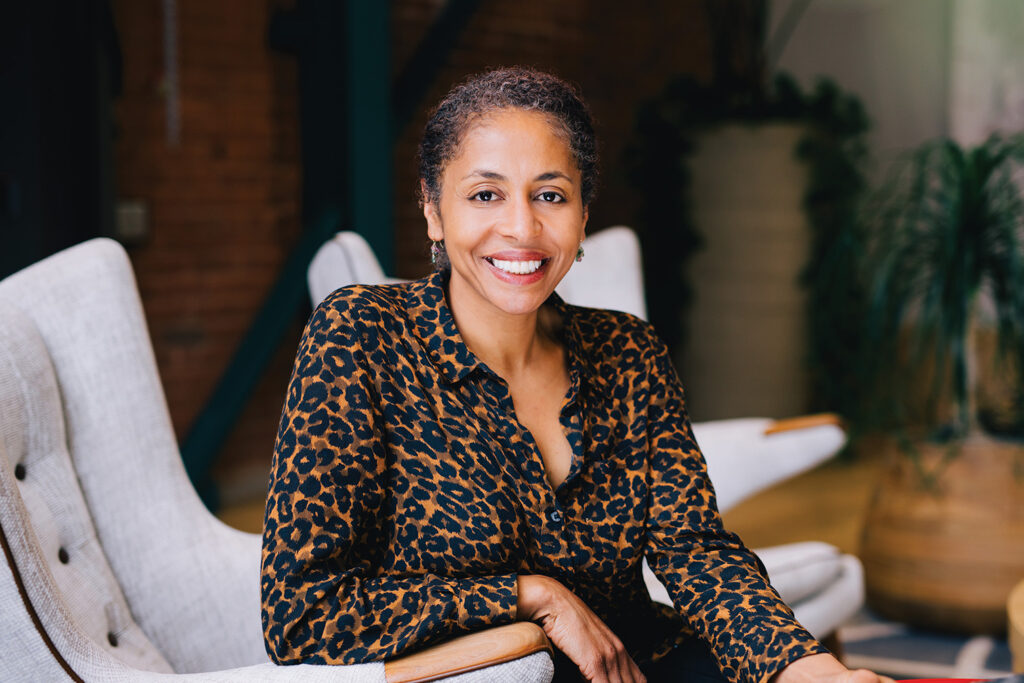
When Anna Makanju, JD ’04, was taking orders at Burger King as a teenager, she never envisioned enrolling at Stanford Law School. As a law student, she couldn’t predict her career would take her from international criminal courts to the White House to global tech powerhouses. And she never expected to land her current role as vice president of global impact at OpenAI, driving critical, far-reaching conversations at one of the world’s leading artificial intelligence companies.
“I’m a really good example of how you can have a career never having planned or imagined any of it,” Makanju says. “I just always did what seemed interesting and valuable and hopefully beneficial.”
Makanju’s childhood was equally unpredictable. Born in Soviet Russia to a Ukrainian mother and Nigerian father, she and her family moved to Kuwait when she was 13. In 1990, when the Gulf War broke out, she returned to the Soviet Union to live with her grandparents—just in time to see the nation collapse. Makanju’s stepfather was taken hostage by Iraqi soldiers and, after his release, the family reunited in Texas. At 16, Makanju enrolled at Western Washington University and spent a postgraduate year studying in France on a scholarship.
Tragically, Makanju’s mother died of cancer at age 42, having been denied treatment by her insurer due to a preexisting condition. Makanju started waiting tables to support herself and her sister, who struggled with addiction. Those experiences were the prompt for Makanju to study law.
“I realized it would’ve been really helpful to be able to engage with the legal system myself,” she says.
At Stanford Law School, Makanju initially focused on U.S. criminal law, hoping to assist incarcerated youth like her sister, until coursework on genocide sparked an interest in redressing the harms of authoritarian regimes. “This was a moment when it felt like we were aligning as a global community on the idea of accountability even for leaders of countries, and I wanted to be part of building that system,” she says.
One influential mentor was Professor Allen Weiner, JD ’89, who taught two of her international law courses. “Anna is a brilliant thinker who is deeply committed to building a better world,” he says. “Even though she has immersed herself in the weightiest of professional issues … she approaches the world with a wonderful sense of lightness and a remarkable sense of optimism.”
After law school, Makanju clerked for the International Criminal Court, the International Criminal Tribunal for the former Yugoslavia, and the U.S. Court of Appeals before joining Cleary Gottlieb Steen & Hamilton as an associate. When Barack Obama first ran for president, his promise to require that insurers provide coverage for preexisting conditions resonated deeply with Makanju, and she spent five months working as a campaign organizer.
After Obama won, Makanju was invited to work at the Pentagon on policy related to former Yugoslavian states. Later, she was promoted to chief of staff for European and NATO policy. Other positions in Washington followed: Russia director at the National Security Council, policy advisor at the United Nations, and special advisor to Vice President Joe Biden on matters such as the Cyprus peace process and the war in Ukraine.
“It was incredibly rewarding to be able to play a role, at the highest level, in the outcomes of issues I cared about so deeply,” Makanju says.
Responding to the change in administration in 2017, Makanju searched for a field that would allow her to continue making an impact. She seized on tech. Her first stop was SpaceX, where she worked to expand global access to Starlink, a satellite-based internet provider. In 2018, she moved to Facebook (now Meta) to establish policies around election interference and content regulation.
“It was incredibly rewarding to be able to play a role, at the highest level, in the outcomes of issues I cared about so deeply.”
Anna Makanju, JD ’04
Three years later, Makanju made the leap to OpenAI as head of public policy, before assuming the role of vice president of global affairs and, more recently, vice president of global impact. Ignoring the repercussions of AI is not an option, Makanju argues.
“There’s a great deal of skepticism and a narrative that AI isn’t nearly as impactful or capable as we at the labs make it out to be,” she says. “But I absolutely believe that AI is going to transform all of our lives in the next decade and likely even sooner. What I’m thinking about is how to create an infrastructure that ensures a really broad benefit of this technology.”
Josh Lawson, a colleague of Makanju’s at Meta and now OpenAI, believes she’s uniquely suited to the position. “Anna takes the world as it is without losing sight of what it can be,” he says. “I cannot think of a better person to shape answers to the hard questions on our horizon and make sure we’re asking the right questions to start with.”
In the legal field, the technology is already reshaping everything from discovery to drafting of briefs, and Makanju believes it will soon dramatically change job descriptions, especially for entry-level positions. She thinks that law schools have a vital role to play in preparing students for this impending reality.
“Most jobs will involve collaboration with AI tools, and it’s critical that law students learn how to use them,” she says. “It’s important to not just outsource work, but to figure out how they can enhance your expertise.”
Makanju sees it as her job to ensure that the coming transformations serve a wide swath of society.
“I feel an immense responsibility to make sure that we are doing our jobs in a way that ultimately ends up benefiting people,” she says. “We can’t just expect it will all be positive—we have to craft the environment to ensure that it is.” SL