
Cassandra Knight, Court-Side
Google VP of litigation and discovery oversees most trial work for the tech giant while making time for Stanford sports
Since Cassandra “Sandi” Knight, JD ’94 (BA ’91), joined Google as vice president of litigation and discovery in 2022, the technology giant has had to defend itself at the U.S. Supreme Court in two different cases that threatened the very foundations of most social media and content-sharing platforms.
Google, which owns YouTube, and its co-defendants went relatively unscathed in both, but the questions the cases presented—whether online platforms can be held liable for user content posted to their sites (Gonzalez v. Google LLC, 2023) and whether they can be forced to provide or moderate certain types of content (Moody v. NetChoice, LLC, 2024)—are far from resolved.
“I don’t know if there is much more interesting legal work out there than some of the things that we’re doing on a regular basis,” Knight says, reflecting on her position at Google. “Obviously, we want to protect the company and that means, number one, that we protect our users. And we also want to be able to do what we can to monitor and prevent harm from the content on our site.”
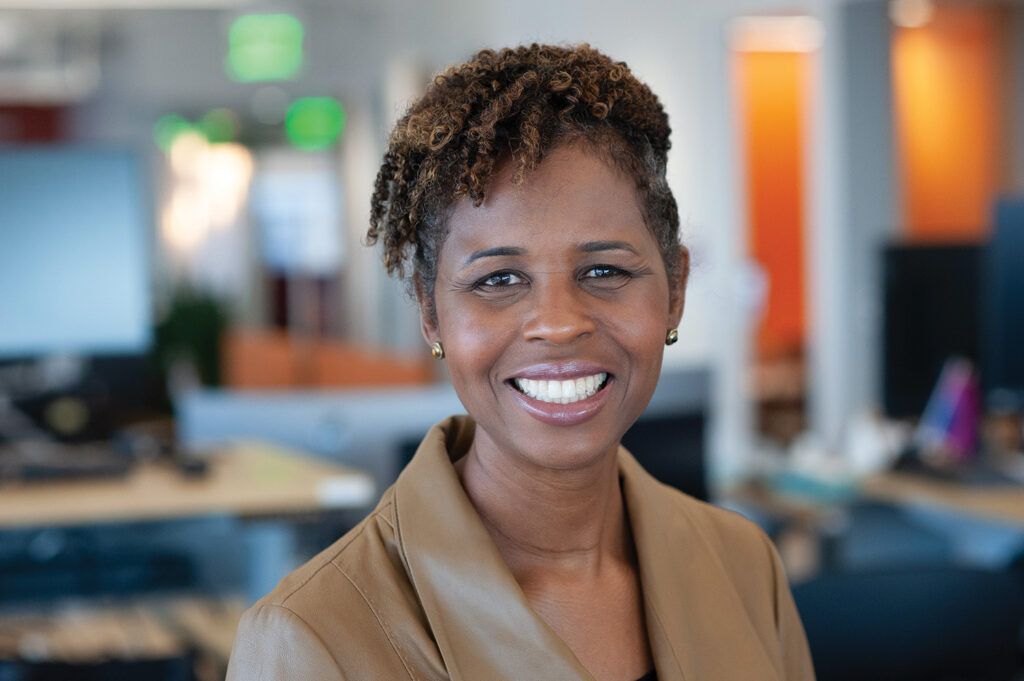
While Google relies on outside counsel in court, Knight oversees all aspects of civil litigation for the company: managing the cases, steering strategy, and coordinating witnesses, among other responsibilities.
In trials, Knight stands out, says Scott Tucker, JD ’94, who previously worked with her at Morgan Stanley and has been on the same side of cases with her in his current role as vice president and deputy general counsel for global litigation at Meta (including in the Gonzalez and Moody cases).
“She has very high emotional intelligence as well as being intelligent and sharp,” he says. “She’s got a sense for the human dynamics.”
Knight has been a litigator from the start. The California native studied international relations as an undergraduate student at Stanford University and thought she might continue in that field when she enrolled at Stanford Law School, where she served on the Stanford Journal of International Law. But courses with Miguel A. Méndez and Barbara Allen Babcock—Stanford Law’s first Latino and first woman professor, respectively—set her on a different path.
“I hadn’t really thought before about doing any kind of criminal work, but some of the professors I really admired had done stints early in their careers,” Knight remembers.
After graduating in 1994, Knight joined the public defender’s office in San Diego. Looking back, she says, “it was good that I just went into the deep end of the pool.”
“I tell young lawyers, it’s good to try cases early because, frankly, people get too scared to do it later in their careers,” she says. “As crazy as it was to be in my early 20s in front of juries, figuring out how to get evidence in and argue cases gives you a certain amount of moxie and swagger that you’re otherwise not going to get.”
Knight next spent several years at Keker, Van Nest & Peters and in the San Francisco City Attorney’s Office, where she helped defend the city in the so-called Fajitagate scandal stemming from a fight involving three off-duty police officers. In 2006, seeking a change, she accepted a job in litigation at Morgan Stanley on the recommendation of a friend.
“I knew nothing about securities,” she remembers. “I just needed to find a different path, and I took a chance. I’m so glad I did.”
“I tell young lawyers, it’s good to try cases early because, frankly, people get too scared to do it later in their careers.”
Cassandra “Sandi” Knight, JD ’94 (BA ’91)
During her 11-year career at the bank, Knight served as vice president and executive director in litigation roles in San Francisco and New York. One of her biggest cases during her tenure came in 2015 when a federal jury cleared Morgan Stanley of insider trading in a case involving a Russian oligarch.
On the recommendation of Tucker, Knight also moved to London to serve as acting chief operating officer of compliance for Europe, the Middle East, and Africa and later served as head of company compliance in New York. The experience outside of litigation was invaluable, helping her land the top litigation job at PayPal in 2017.
Knight had no intention of leaving Morgan Stanley—she hadn’t even kept her resume updated—but three separate people recommended her for the PayPal position.
“I was taking on a much bigger role, learning how to manage a much bigger team,” she recalls. “If I hadn’t gotten out of my comfort zone [at Morgan Stanley], I never would have had that opportunity.”
At Google, Knight says she enjoys the complexity and challenges of the job—“being able to think through some of these things that aren’t completely settled and what the future looks like and what we can do on our part to be a responsible player going forward.” Stanford Law School, she says, helped prepare her for those kinds of questions.
Haywood S. Gilliam Jr., JD ’94, a friend and former classmate, says the “extraordinarily and uniquely broad” career path Knight has paved is a testament to her “breadth of interests and curiosity.”
“There are very few people who have been public defenders, city attorneys, in private practice, and in-house in different capacities,” says Gilliam, a U.S. district judge for the Northern District of California.
Knight is also a true friend, adds Gilliam, who officiated Knight’s wedding to Andrew Keen in 2021. When Gilliam had his investiture ceremony about 10 years ago, Knight flew from London, where she was working at the time, to speak at the ceremony—giving up tickets to the semi-final of the 2015 women’s French Open to do so (Knight is a major sports fan; Gilliam says she is a “killer” in their fantasy football league).
“It wouldn’t have been the same without her, and it meant the world for her to come all that way to share that day with me,” he says. “That’s the kind of person she is.”
Knight remains a loyal Stanford fan, attending all Stanford home football and many basketball games. Even when she lived in New York, she had season tickets to both the 49ers and Stanford football teams. When they had home games on the same weekend, she would fly across the country on Saturday morning, tailgate outside of Gate 12 before her alma mater’s game, attend the 49ers game on Sunday, and then catch a red-eye flight back to New York in time for work Monday morning.
Knight has been an active alumna, including serving on the advisory board of the Stanford Law School Black Alumni Association, and she received a 2025 Governors’ Award from Stanford Associates, which each year honors exemplary and long-standing volunteer service to the university. She says her time on campus “changed my trajectory.”
Knight’s mother and father, both from Mississippi, were the first in their families to go to college. One great-grandfather, who lived almost to 102, had personally known relatives who had been enslaved.
“I went to his 100th birthday party,” she remembers. “He couldn’t believe one of his babies had been able to go [to Stanford], travel internationally, live overseas. It was so unfathomable to him. Stanford changed the course of my life and my family’s in more ways than I can count.” SL