
Comparing Criminal Law in Germany and the United States
Field study offers insights, collaboration, lifelong lessons—and friendships
Sitting in on a criminal trial. Visiting prisons. Joining a police officer on a shift for a ride along. Interviewing probation officers. Talking with judges, prosecutors, and defense attorneys.
Watching the criminal legal system in action—as a complement to readings and classroom discussion—is not something many students get to do in their own country, let alone in two.
When Kyle Melatti, JD ’26, signed up for Comparative American/German Criminal Law Seminar, a field study offered by the Stanford Criminal Justice Center with support from the W.A. Franke Global Law Program, he knew little about how the U.S. criminal law system works in practice—and even less about Germany’s. An aspiring civil and appellate litigator, Melatti was drawn to the course, which ran for two weeks before the start of fall quarter. “It’s one thing to have an academic interest, but another to see the criminal justice system unfold before your eyes,” he says.

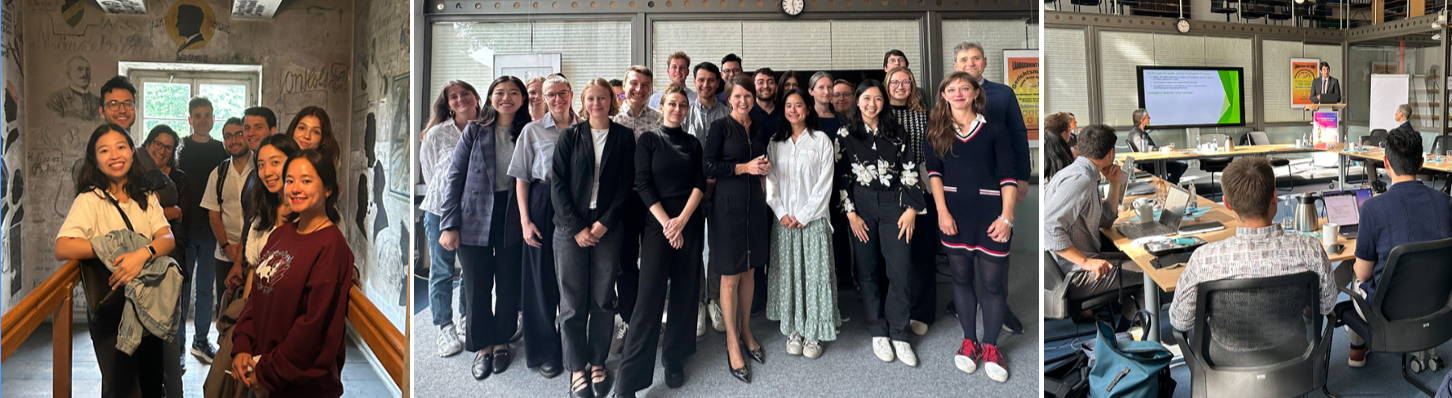
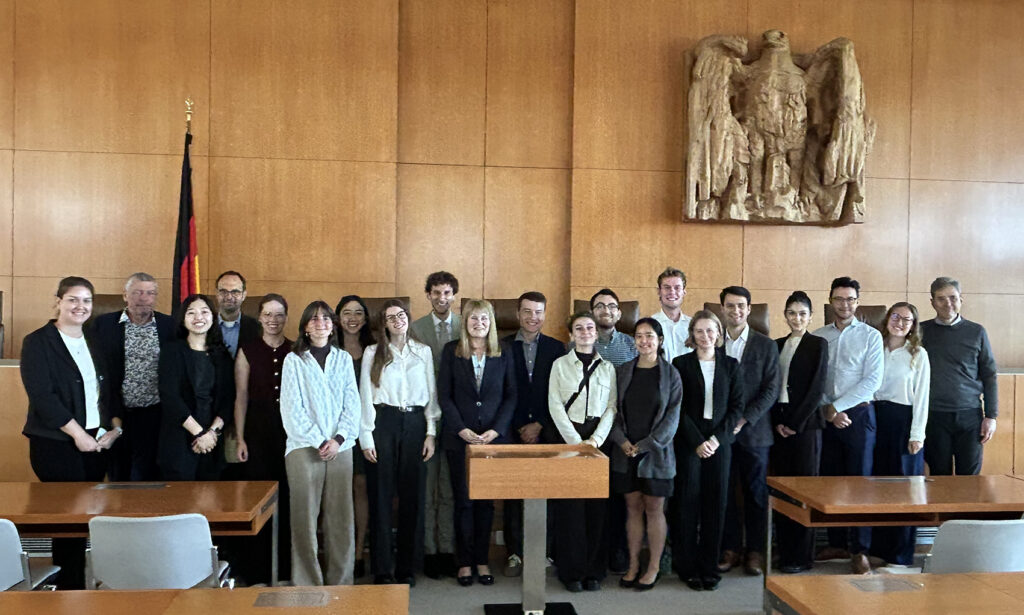
And unfold it did—for seven Stanford Law and seven University of Göttingen students who, with one week of intensive study in Germany and another in the Bay Area, completed an experiential field study on the criminal legal systems in each country. “It was important to us when designing the course that students be exposed to incarceration, to policing, and to adjudication in both countries. That meant that we wanted them to go to courtrooms, to meet with police officers and judges and prosecutors and defense attorneys,” says David Sklansky, Stanley Morrison Professor of Law and co-director of the Stanford Criminal Justice Center. Among those with whom they met, students had the opportunity to learn from Stanford Law alumni working as criminal defense attorneys, prosecutors, and reform advocates.
“Growing up in America, you get used to the way things are and the way things have always been. It’s hard to see how things might be different,” says Michelle Phan, JD ’27. “Going to Germany and seeing how different things were and also the ways in which things are actually similar was eye-opening.”
A spontaneous meeting gives rise to seminar
The spark for the comparative seminar started when Professor Alexander Baur, director of the department of criminology, juvenile criminal law and penology at the Institute of Criminal Law and Justice at the Institute of Criminal Sciences at Georg-August University of Göttingen, was vacationing in September 2023 in Northern California. He reached out to the Stanford Criminal Justice Center (SCJC) on the off chance that faculty members might have time to meet.

“We were excited about the possibility of collaborating with Alex because it seemed that his center was focused on a lot of the same questions that we were,” says Sklansky. “American legal education and criminal law could certainly use more comparative work.”
“We realized quickly that there might be some magic in a partnership,” says Debbie Mukamal, SCJC executive director.
That partnership formed during a meeting between Baur, Mukamal, Sklansky, and Robert Weisberg, JD ’79, Edwin E. Huddleson, Jr. Professor of Law and co-director of SCJC, and the seminar soon took shape. “What made this course different, and exciting,” says Sklansky, “was that we had German students studying alongside American law students, so it wasn’t just comparative—it was collaborative, across national boundaries.”
Each group had a turn playing host in their home country, while also interpreting key aspects of their criminal legal system.
“We got to use each other as thought partners and engage in dialogue in between classes and afterward,” says Melatti. “When we had a knowledge gap about something in Germany, they had answers. And we did the same thing here in the U.S. for our German colleagues.”
Studying each legal system—and noting stark differences
The two countries have their own civil law system of adjudication—and distinct histories. “They have different things that are haunting them,” Sklansky says about Germany, “and for that reason their criminal justice system has evolved in different ways.”
For instance, Germany’s criminal legal system is anchored in Article I of the country’s constitution, which prioritizes human dignity, while the Fourth Amendment’s right to privacy is a core aspect of the U.S. system.
“It was very important for our students to see these different guiding principles and how each legal system operates differently—and to question how and why, particularly so early in their careers,” says Mukamal.
Fundamental differences in the underpinnings of each country’s legal system helped students to understand how each system evolved.
“There’s a stronger narrative about rehabilitation in Germany and an effort to make sure that people have the resources they need so that the crime doesn’t occur to begin with,” says Camila Santana, JD ’27. “They use incarceration as a last resort. More than 80 percent of people who are convicted of a crime in Germany never end up behind bars. It’s a very different approach from ours.”
For most of the students, the seminar was their first chance to experience the criminal legal system in real time.
“I found that sometimes it was just over a conversation at dinner or on a walk that some of the most important insights were made.”
Michelle Phan, JD ’27
“I had never been in a prison or talked with prison guards,” says Melatti. The design and location of the buildings served to reinforce each country’s principles. “The key difference is that German prisons emphasize rehabilitation while America’s prisons emphasize punishment. From the moment we walked into the Hamburg prison, you could see that by the programs offered and the interactions with guards that they focused on rehabilitation.” The contrast was clear when the students visited Solano State Prison in California. “Punishment seemed to be the only thing going on there,” notes Melatti.
Santana recalls observing a court proceeding during her time in Germany—and the contrast to the U.S.
“It was the most impactful moment for me and showed the starkest difference between the U.S. and German systems,” she says of watching a witness answer questions in an assault case. Another highlight was having direct access to the people involved. “After, we were able to ask the defense attorney and prosecutor and judge questions. It was an incredible experience.”
Still, the students didn’t always reach the same conclusions.
Melatti describes the reaction of German students who attended an American court proceeding, for example. “They were very critical of the jury system,” he says. “I had the opposite takeaway in that watching their inquisitorial system I gained a newfound appreciation of a jury-led criminal procedure as opposed to a judge-led one.”
Sharpening skills for a legal career
The course was designed with an emphasis on student interaction—the goal being to develop critical thinking through conversation and shared reflections.
“The discussions turned out to be an extraordinarily powerful part of the seminar—more important than we had anticipated,” says Sklansky. “I think that’s partly why the students responded so positively to the course.”
These critical thinking skills were honed in the daily debriefing sessions, some of which lasted for hours—with students and faculty discussing their observations from that day’s lesson.
“It was great to see how quickly we all bonded and how quickly we were willing to get to know each other and exchange viewpoints. It was important to actually talk with our German counterparts as we tried to figure out what we as Americans were missing—culture, society, history, and the impact they have that we weren’t clued in to,” says Phan. “I found that sometimes it was just over a conversation at dinner or on a walk that some of the most important insights were made.”
They are lessons the students will draw on as they plan their careers.
“One of the biggest takeaways is the importance of critical thought and asking if there’s something that can be done about the systems that you engage in,” says Melatti. “This was not a muscle that I was used to flexing before this class. I think I’ll find it useful throughout my career and generally.”
“This was a really great chance to zoom out a bit and think about what I might take forward with me as I think about reform—and my career more broadly,” says Nathan Abraham, JD ’27.
With most of the seminar students planning to work in criminal law, the insights they gained from the field study could help improve the U.S. criminal legal system someday.
“It’s a problem when lawyers think that the system has to operate the way that it does because that means that the only people who really understand the system also are uninterested in improving it,” says Sklansky. “This course helped to inoculate our students against that.” SL