
Investment to Underpin Democracy
Michael Strauss, JD ’01, General Counsel of the European Bank for Reconstruction and Development, Discusses the Critical Role of Building Market Economies and Fostering Democratic Institutions
When Michael Strauss, JD ’01, stepped into the role of general counsel of the European Bank for Reconstruction and Development (EBRD) in 2020, he joined the institution at a moment of extraordinary geopolitical uncertainty. The EBRD was created after the Cold War to foster democratic institutions, market economies, and private-sector growth across the former Soviet bloc—and has since expanded to cover the Middle East and North Africa, as well as sub-Saharan Africa most recently. EBRD offers support to economies through, among other things, private-sector lending and equity investments, as well as infrastructure and public/private partnerships. The mission is broad, with a strong focus on corporate governance and forward-thinking environmental policies. Today it faces new and complex challenges, from Russia’s full-scale invasion of Ukraine to rising authoritarianism and fractured global economic alliances. Strauss, who also sits on the bank’s Executive Committee, is a key voice in navigating these pressures. As he notes, “If there has been a slide toward authoritarianism in some countries, that is precisely the challenge we were created to help counterbalance. Yet, today, we face this challenge in places where people are concerned that things are moving in the wrong direction.”
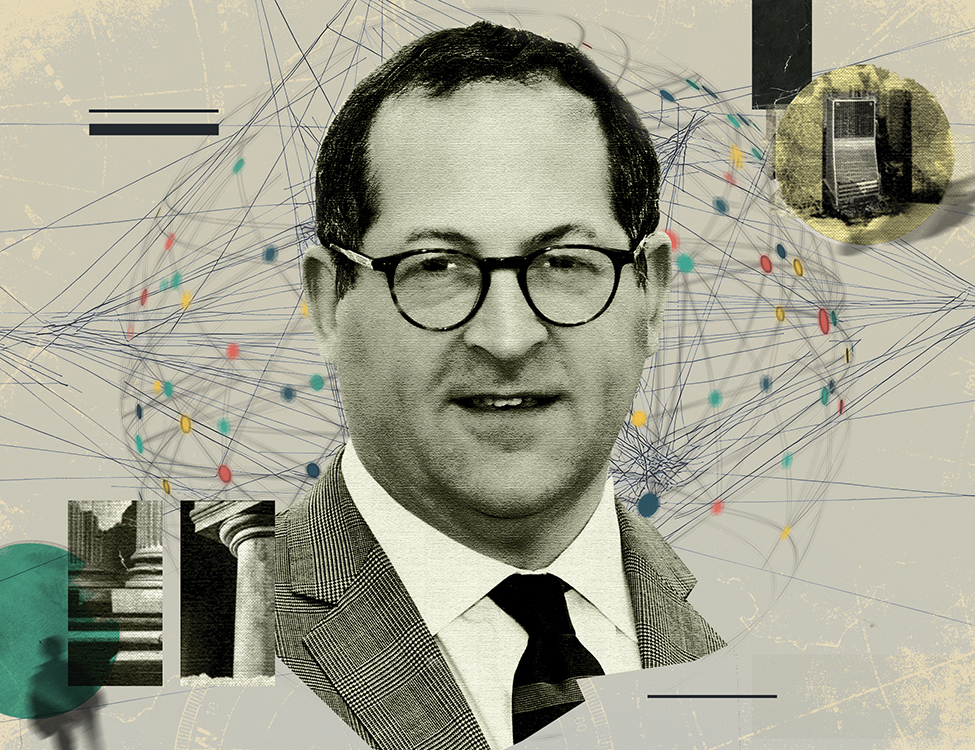
Strauss’ path to international development law has wound through numerous multilateral financial institutions. Before joining the EBRD, he practiced in Washington, D.C., London, and Paris, represented the United States on the board of the Asian Development Bank in Manila, served as a senior advisor at the U.S. Treasury, and worked in the legal departments of both the International Monetary Fund and the World Bank Group. Fluent in French and, as he says, with a “basic level” of Russian, he brings deep regional experience to a bank now expanding its work from Eastern Europe into the Middle East, North Africa, and sub-Saharan Africa. Strauss traces his career back to his time at Stanford Law School, where an externship at the World Bank and mentoring from Erik Jensen, lecturer in law and director of Stanford’s Rule of Law program, helped launch his international career.
Curtis Milhaupt, William F. Baxter-Visa International Professor of Law and a leading scholar of comparative corporate governance and international economic law, interviewed Strauss. This continued conversations the two started during Stanford Law’s W. A. Franke Global Law Program (known colloquially as the Global Quarter), an immersive business law program featuring field studies in Europe, Asia, and Latin America for firsthand student engagement with legal professionals in global law firms, businesses, and legal institutions. Their exchange explores how the EBRD’s mandate has evolved and how its legal department manages the realities of weak judiciaries, corruption risk, climate transition, and shareholder politics. —by Sharon Driscoll
Curtis Milhaupt: Michael, it is wonderful to speak with you again after our visit to the EBRD two years ago. Let’s start with a bit of background about the history and mission of the EBRD.
Michael Strauss: The bank was set up at the end of the Cold War. It was designed in some ways like one component of a Marshall Plan to assist in the former Soviet Union and Eastern Europe at the fall of Communism, though I don’t know if they would have described it this way at the time.
I identify strongly with that mission. I think all of us can look back on that moment and think that if we had been able to do more then, we would be in a better place now as a result of having engaged. That engagement was two-pronged for the EBRD. It follows the model of the other multilateral development banks in terms of structure. But unlike the traditional MDB models, which focus more on lending to sovereign governments, we pursue development and transition primarily through investment in companies and projects within those countries.
Given that the private sector did not historically exist in most of these countries, the EBRD took a leading role in developing and investing in the private sector itself. The second part was a democratization mandate—to focus on working only in countries that had a commitment to multi-party democracy and pluralism. That is spelled out in our treaty; we cannot do work in countries that are not committed to those principles. How that works in practice is necessarily quite complicated.
How does being general counsel at a multilateral development bank differ from being general counsel at a private financial institution?

I spend some time with corporate GC groups, and I’m often the odd one out. We’re an institution with privileges and immunities set up by treaty. And that protects us in critical ways so that we can get our work done.
We also benefit from preferred creditor status, which means that institutions like ours are effectively put first when it comes to the payment of sovereign debt, and have protected access to foreign exchange. A particular focus of the legal work that we do is on our management of our preferred creditor status and privileges and immunities, which is very different from anything a company would be concerned with.
Also, importantly, our shareholders are countries, not people. And our governors are generally those countries’ finance ministers. So that, of course, makes this a very different structure. As a technical matter, we’re not even subject to bilateral restrictive measures or sanctions from countries, including even the United States. But we act as if we are because, frankly, it would be very hard to get our job done if we didn’t—we wouldn’t be credible from a reputational risk perspective.
Which brings me back to how our legal team functions in ways similar to what other GCs might expect. A lawyer at a law firm or in-house at a company would recognize the vast majority of the work we do: project finance or classic bank lending. We do equity, we do capital markets work, etc. Many of our lawyers move in and out of the private sector.
But in an organization like the EBRD, you and your legal team are dealing with some unique circumstances, I would think, in terms of judicial integrity, corruption, and weak legal systems. How do you navigate that incredibly challenging terrain?
I should start by saying that we have a separate integrity function within the bank that is devoted entirely to ensuring that there’s no corruption in any of our projects or corruption related to it. They’re very good at both doing the analysis to ensure that, but also in engaging to mitigate it if we do find anything that’s potentially of reputational concern. Ultimately, these decisions are political in the sense that we have a board made up of representatives of our members who get to decide how much reputational risk is acceptable. In general, and understandably, they are quite intolerant of integrity risk. The region is so diverse, with so many different legal systems—it’s what makes this fun and interesting. But it’s also incredibly complex. It’s one of the reasons that we have maybe 40 different nationalities represented among the lawyers in our legal department.
You mentioned the EBRD’s Legal Transition Program—the bank’s work helping countries build strong legal and regulatory institutions. Please describe that program and explain how your office is involved.
Because we’re a bank designed, in part, to create institutions in countries in which we work, we have the legal transition program, which is rooted in what I mentioned before—our democratization mandate, the rule of law, and establishing, most importantly, good private-sector institutions in countries. The legal transition program focuses on areas of law that are fundamental to a properly functioning private-sector economy—developing things like non-performing loan laws, bankruptcy laws, public-private partnership laws. We work on corporate governance, where we are experts at helping companies unlock value by recognizing that they could improve their corporate governance and then improve their valuations.
We also work on climate. We’ve been at the forefront of developing a whole field called corporate climate governance, where we’re helping companies understand the financial benefits of climate-aware corporate governance. There’s an element of anti-corruption to our corporate governance work as well.
We also work on procurement law. For example, we help countries build the capacity needed to join the WTO’s Government Procurement Agreement, which can unlock significant value for developing economies while also serving as a tool to fight corruption.
“[The EBRD] was designed in some ways like one component of a Marshall Plan to assist in the former Soviet Union and Eastern Europe at the fall of Communism, though I don’t know if they would have described it this way at the time.”
Michael Strauss, JD ’01, general counsel of the EBRD
What legal reforms have had the biggest impact?
Government procurement is huge. For example, we were behind the establishment of the Prozorro system, which was designed to open the government procurement system within Ukraine to scrutiny and transparency. This is a huge leap forward for the country. We’ve done this in many other countries too—in the Balkans, for example. And we have other countries interested in working with us on it.
Corporate governance has to be to the fore, and we are experts in this area. We work in places where the private-sector model isn’t new anymore—it’s been 35-plus years since we were founded and since the end of the Cold War. Following best practices is a crucial way to unlock value for companies. And I think our team has been doing phenomenal work in this area.
And then again, on the climate side, we’ve been on the cutting edge by making some really good reforms there.
There are significant challenges in legal reform, but the key factor in determining impact is a country’s own commitment to the effort. We’re being more deliberate about ensuring that the reforms we support are truly owned by the governments we work with, because that’s what leads to implementation. If a reform is pursued simply because it’s the “flavor of the month,” it won’t take hold. So we focus on reforms that countries genuinely embrace and that we believe will deliver meaningful results.
As a corporate governance scholar, I find your answer music to my ears. Can you say a little bit more about your work in this area?
We have experts who step into a project and develop what we call a corporate governance action plan, or CGAP. That plan becomes a key part of the project’s transition impact. Our role isn’t just to invest in a company. There’s a larger discussion to be had about state-owned enterprises and whether they should remain state owned, but even in those cases, our experts help them move toward functioning as competitive, market-driven enterprises.
“Green economy transition actually accounts for just over 50 percent of our work now.”
Michael Strauss, JD ’01, general counsel of the EBRD
Please also expand on sustainability. Obviously, in the United States we’ve gone through a period of intense focus on ESG and then political backlash against it. How does the bank go about ensuring commitment to both growth and sustainability?
This is, for me, one of the most important aspects of EBRD because I had planned, early in my career, to focus on environmental policy. The focus on sustainability was right for EBRD, given the time when it was founded and the history of the countries where we work. For example, Chernobyl is in our region, and we manage the Chernobyl account that helps neutralize the environmental damage and handle the ongoing cleanup in the area. We have it built into our treaty that environmental sustainability is part of what we do—something you won’t see in most of the other institutions. The genius moment came before my time, but it was the recognition that our transition mission in our countries is also actually quite in demand on the green energy front. We were working in very fossil-fuel heavy energy-generation countries, and we had an opportunity here to help them diversify their energy supply by transitioning from inefficient fossil fuel plants to clean energy.
Green economy transition actually accounts for just over 50 percent of our work now. We do a lot of solar and wind in countries that have the natural resources to take advantage of them but need the financing to make it happen.
You’ve mentioned a few times that your shareholders are countries. Can you say more about how this shapes the bank’s governance—and about your own role in this respect, including your service on the Executive Committee?
It’s actually what makes the job fun because it’s both diplomacy and banking at the same time. It also creates all sorts of challenges. It means that we operate in a political context, by definition. And that’s okay, because I think these countries came together to develop these institutions in multilateralism for precisely this reason.
When I was on the Asian Development Bank board, my wife, who works for a traditional bank, saw me reviewing papers one by one. And she asked, “Does the board approve every single project?” And I said, “Yes.” She wondered how any bank could function that way. But imagine you were a bank that was run by almost 70 countries. Of course you would have to approve every single project, because of the political sensitivities. The EIB [European Investment Bank] is also one of our shareholders, so we work alongside the EIB, but sometimes we’re competing for projects. That is also interesting from a corporate governance perspective.
We have a deep engagement with the policy priorities of the countries that we work with. We are global in our membership, and we focus on specific regions. Issues do arise that are particular to a country. An example is that we’re in the process, like many other institutions, of considering investing in nuclear power. For some shareholders, that’s a very positive thing. For others, not so much. So, the politics have to balance, and sometimes it’s a matter of compromise and consensus, while other times it’s a matter of the majority prevailing.
Let’s turn now to Russia’s invasion of Ukraine. This was the subject of fascinating meetings that we had two years in a row when the Franke Fellows visited you at the EBRD during the Global Quarter. Please discuss how the bank responded to Russia’s invasion.
We had already stopped investing in Russia after the 2014 annexation of Crimea and the invasion of the Donbas. Management decided it would no longer bring Russian projects to the board, because our major shareholders—the G7 and, in a different configuration, the EU—made clear they would not approve them.
When the full-scale invasion began in 2022, we confronted difficult questions. One major shareholder—formerly one of our largest investment destinations—was attacking a neighbor that was also a significant recipient of our resources. We have been, and will likely remain, Ukraine’s largest institutional investor. We do have a provision in our treaty, Article 8.3, that allows us to suspend access to resources for a member that is a country of operations when either of two circumstances arise: one, when it is not observing those principles I mentioned upfront in Article 1, which focus on multi-party democracy and pluralism, or two, in “exceptional circumstances,” which isn’t defined. One of the things I really enjoyed with the Global Quarter students was exploring the legal questions around what that phrasing may mean.
Article 1 is about democratization. It’s clearly intended to be a fairly domestically oriented question. You could make a lot of arguments about why Russia decided to invade Ukraine, but the link to multi-party democracy and pluralism in Russia, if any, would be complex to demonstrate formally. But there are very clear animating principles for the institution around non-aggression in Europe and principles of non-interference that are deeply established in international law, particularly post-World War II. We proceeded upon that basis (i.e., “exceptional circumstances”) with our Article 8.3 Board of Governors Resolution. After a month of consideration by our governors, they passed it by the very large requisite majority. Thereafter, we have no longer invested in Russia and Belarus. And we’re divesting from anything that we had left in our portfolio from pre-2014. That has been a watershed moment for the bank. Article 8.3 had never been used before. From a legal perspective, it was absolutely fascinating. It’s exactly the type of work that lawyers and law students who get into this field are excited to have the opportunity to do.
“If there has been a slide toward authoritarianism in some countries, that is precisely what we were created to help counterbalance—or at least to influence against.”
Michael Strauss, JD ’01, general counsel of the EBRD
Let’s broaden the focus now. Looking back at the EBRD’s mission, how has it evolved? And if you were to give the bank a report card, what has it done well, where has it perhaps fallen short of expectations, and what key challenges does it face today?
I’ll take that in three parts: first, how our geographic focus has changed; second, where our impact may have fallen short of what we hoped; and finally, the new challenges we’re facing and how we’re managing them.
We were set up to work in the economies of the former Soviet Union and Eastern Europe, for obvious reasons, given the history. But during the “Arab Spring” in the early 2010s, our shareholders came to us and said our model of transition was exactly what these countries needed. We were designed perfectly to help Tunisia and Egypt and countries like that with what they were struggling with—the process of converting from state-driven economies with authoritarian regimes into functioning democracies with good market-based economics. We expanded into what we call the SEMED region—the southeastern Mediterranean, essentially the Middle East and North Africa. Interestingly, this expansion took shape around the same time as Russia’s annexation of Crimea and first invasion of the Donbas in 2014, just as our work in the new region was getting underway.
It ended up being quite an important moment because it gave us additional places to invest in. And it rounded out a new cultural awareness in the bank because we were working in places we had never worked before.
If there has been a slide toward authoritarianism in some countries, that is precisely what we were created to help counterbalance—or at least to influence against. Yet we now operate in places where many feel things are moving in the wrong direction, and that’s not easy. We have mechanisms to respond, but fulfilling our Article 1 mandate has become increasingly difficult. You could even say that Russia’s trajectory shows how much work remains to be done.
At the same time, our shareholders are being pulled into competing regional economic spheres. That creates additional challenges for us because we were designed around a more traditional liberal model—one in which countries trade freely, procurement is open and merit-based, and global markets remain accessible. That model is now under significant strain.
You have 79 shareholders, and 77 of those are nations. Are you still finding the support that you need from those countries?
This has been a really interesting aspect of my job over the past year or two. On the one hand, having formally been the U.S. representative on the board of one of these institutions and having worked at the U.S. Treasury, which manages the American relationship with the bank, has been helpful. When this administration came in, we were told that it was doing a review of the U.S. participation in every international organization. And we had the opportunity to engage on that. As I understand it, the intention is to stay in the international financial institutions. We are designed in a way that seems to dovetail very well with what the expectations are for how these institutions should be structured, in that we are more focused on the private sector. We are agile, lean, and our democratization mandate is relevant too. So, we are a good example of what other similar institutions might try to emulate. And our engagement with the U.S. has been strong.
Also, our strong support for Ukraine meant that we proceeded with a capital increase of 4 billion euros, not because we were short on capital, but rather to increase our capacity to take the right types of risks by investing more in Ukraine. And that investment required countries to decide to participate or be diluted. Once it’s live, you get diluted if you don’t subscribe and put your money in. The U.S. strongly supported the capital increase, and I’ve been working pretty hard with colleagues and counterparts in Washington to underline the importance of avoiding that dilution and participating in a capital increase that supports Ukraine. Just at the end of 2025, the U.S. subscribed to that capital increase for Ukraine, which is a good outcome.
“The most important thing by leaps and bounds is being interested in having an impact. If you’re interested in this area, you have to really be interested in the mission and doing mission-driven work.”
Michael Strauss, JD ’01, general counsel of the EBRD
Do you have any advice for young lawyers who would like to follow in your footsteps into an international legal career?
I’ve had an enormous amount of luck, to be honest. But if you have a passion for a certain thing, you should just pursue it. I did have a passion for this. There were no obvious paths to follow, though I think there are more international opportunities at Stanford now than when I was there. I think sheer perseverance was part of the process—finding any way I could to get an internship or a contact to open a door. Theoretically, these institutions are very open in their recruitment. But most of the lawyers that we work with are people who actually have worked at firms or in-house beforehand and have a set of skills that are transferrable to the work that we do.
The most important thing by leaps and bounds is being interested in having an impact. If you’re interested in this area, you have to really be interested in the mission and doing mission-driven work. And there are some sacrifices to be made. But the other thing is knowing which side of this work you want to do. A lot of MDB work is very sovereign-driven. And that’s good and interesting too. But some of it is very driven by the private sector, which is mostly what we’re doing here at the EBRD.
There will be times when the picture on the next or the right role isn’t coming into focus, and there are times when you think it never will.
Some of the luck that I had was created by my willingness to accept risk—to leave a secure position and try something new and to relocate somewhere new.
I left a secure position at the World Bank Group, for example, to join the U.S. Treasury for a position with even longer hours, for much less pay. It was also a job that I knew would have a definitive end. That risk was big. But I did it, and I think it changed the way I was able to look at the work that I did for the rest of my career.
Thank you for being so generous with your time and insights, Michael.
Thank you. It’s been fun reconnecting with you. SL