
Justice for All
Nation’s largest court partners with Stanford Law to create more innovative, accessible courts
A Los Angeles tenant’s home became unsafe after the ceiling collapsed, so he left the unit and stopped paying rent. After his landlord sued, the tenant missed the answer deadline buried in the legal fine print. He’s not alone. It’s just one example of many cases before the Superior Court of Los Angeles County (LASC). Cynthia, a longtime LASC court clerk, regularly sees defendants in civil cases struggle to represent themselves and carry out basic tasks like filling out forms, filing paperwork, and locating case information. Yet her hands are tied. She’s not a lawyer, and providing too much help could cross the line into offering legal advice, which is barred by law.
In LASC—the country’s largest trial court serving a population of nearly 10 million—eviction, debt collection, mortgage foreclosure, and family law matters dominate civil dockets. It’s the same in state courts across the United States, where these small-scale, high-stakes disputes have multiplied to comprise fully two-thirds of all filed civil cases in the U.S.
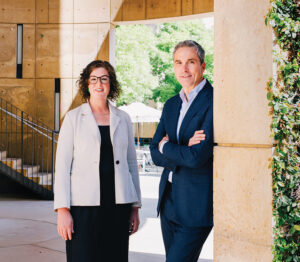
LASC has long been an innovative leader in improving access to justice—with services like Gina, its traffic-court chatbot, and community kiosks where residents can resolve disputes without entering a courthouse. Last year, it doubled down on efforts, partnering with Stanford Law School’s Deborah L. Rhode Center on the Legal Profession and the Legal Design Lab, to create tools to further modernize how LASC handles civil cases, enhances access, and settles disputes in more equitable, efficient ways.
“This is a first-of-its-kind partnership between a major court system and a major research university,” says Professor David Freeman Engstrom, JD ’02, Rhode Center co-director. “It’s critically important because many courts, especially the high-volume dockets we’re working in for this project, are overwhelmed and even in crisis.”
Through the collaboration, LASC granted Stanford unprecedented access to data, employees, and court users—allowing a team of Stanford faculty, staff, and students to evaluate how the court handles UD cases (“unlawful detainer” lawsuits filed by landlords to evict tenants), identify key challenges, and recommend improvements. Now, Stanford is working with LASC to develop pioneering, AI-based tools that make it easier for court users to find appropriate legal help and for court staff to more quickly verify that plaintiffs seeking default judgments against absent defendants have met all legal requirements.
“The Superior Court of Los Angeles County is committed to innovative transformation that enhances efficiency, accessibility, and fairness in the justice system for all residents of Los Angeles County,” says LASC Presiding Judge Sergio C. Tapia II. “We appreciate our partners at Stanford Law for identifying areas where we can improve, allowing the court to better fulfill our mission of providing fair and timely access to all that seek it, regardless of whether or not they have legal representation.”
A Blueprint for Better Courts
Law students in the Expanding Access to Justice in Eviction and Family Law policy lab—plus students from across the university, including undergraduates studying information technology—began by poring over case management data for 150,000 UD filings. They conducted hundreds of hours of interviews in LA courthouses, led focus groups, shadowed court users and staff, and met with community stakeholders, including Legal Aid.

For 2L Brian Xu, JD ’26, who was born and raised in LA County, participating in a project that could impact his neighbors and friends was rewarding. Xu participated first as a policy lab student, then as a Rhode Center fellow. He was surprised to find it wasn’t uncommon for a plaintiff seeking a default judgment against an absent defendant to fail to meet all legal requirements. “That’s something our project could help to remedy,” Xu says. He also found it “refreshing to think about ways to increase access to justice for people through a policy lens.”
“For most of these high-volume, high-stakes cases—an eviction or a debt collection challenge—you shouldn’t have to have a lawyer to understand how to respond,” he says. “Big picture, I hope that we get a court system that serves people without lawyers better.”
The first output from Stanford’s work was a 104-page blueprint for more modern, accessible courts. The team found that from 2019 to 2023 in LASC, eviction filings by corporate landlords rose, the gap between the number of landlords and tenants with legal representation widened, and the number of tenants who file answers fell.
Because a majority of defendants can’t find or afford legal representation, UD notices often go unanswered and cases end with a default judgment when defendants fail to appear in court, leading to garnished wages or eviction. In consumer debt collection cases, multiple jurisdictions around the U.S. report default-judgment rates as high as 90 to 95 percent. In eviction cases, the range is 20 to 40 percent—with LASC issuing a default judgment in 32 percent of eviction cases in 2023.
The problem with legal representation is in part financial, but it is also about transparency when defendants lack a clear understanding of their case and how to navigate the larger judicial system.
To help close information gaps—and foster more collaborative relationships with legal services providers and community groups throughout LA—the Stanford team’s report made numerous recommendations that include building high-quality digital tools geared toward transparency and equity.
“We believe this critical work will expand the court’s ability to enhance access to justice—not just by providing scaffolds for litigants, but by providing safeguards in their absence,” says Daniel Bernal, JD ’19, associate director of research at the Rhode Center.
It’s a strategy LASC and Stanford hope can ultimately translate to courts across the country.
Pilot Programs on the Horizon
“The amount of access and support and buy-in the court has given us for this project is amazing,” says Margaret Hagan, JD ’13, executive director of the Legal Design Lab and a lecturer at Stanford Law and the Stanford Institute of Design. “It’s not just to do one small thing in one courtroom; it’s a multipronged effort.”
Stanford and LASC have advanced three major initiatives—shaped by feedback from court users, court staff, and legal services providers—that will soon enter the court system for testing and evaluation.
First, the team looked at redesigning the informational notice the court sends to eviction defendants after a lawsuit has been filed—UD Notice, LASC CIV 002. Changes to encourage defendants to react and respond include simpler language highlighting the deadline and explaining next steps. The team will also test other variations, from text-messaging to language translations.
“What was in place before was text heavy and hard to understand for anyone who isn’t a lawyer,” Engstrom says. “We redesigned it using core principles of user-centered design.” The court will send redesigned notices to litigants starting this fall and then rigorously test the impact of the new designs, each attempting to overcome particular barriers. “It will be a randomized controlled trial—the gold standard for rigorous research,” adds Engstrom. “We want to see if our interventions improve outcomes. What we learn will benefit courts around the country by building the store of knowledge about what works and what doesn’t.”
And the team is fine-tuning a tool designed to help the court verify that plaintiffs seeking default judgments against absent defendants have satisfied all legal requirements. They aim to pilot an AI-based “default judgment assistant” tool by year-end. The goal is to streamline the default judgment review process by swiftly flagging compliance issues for judges and staff, improving overall efficiency without sacrificing accuracy.
“Right now, court clerks and research assistants have no option other than manual review. When our team scrutinized the documentation required by statute for debt-buyers seeking default judgment, it took us more than 30 minutes per case,” Bernal says. “Our default judgment assistant exemplifies how AI can transform court operations for the better by helping courts decide cases fairly and accurately.”
Finally, the team has created an interactive digital tool that makes it easier for court users to find legal help. Ultimately, the referral tool will be a chatbot on the court’s website, but it will be reachable through multiple avenues—from court forms, community kiosks, and court clerks and self-help staff. Users can enter details about their situation and preferences to generate a curated list of legal-help options, alleviating requests for referrals that are a pain point for court staff, says Hagan.
The project is ongoing. Future goals include helping LASC to consolidate its multiple websites into an AI-powered, one-stop hub where a court user can enter a plain-language description of a civil legal problem or task in a pending case and, in return, receive actionable information and access to the court’s full ecosystem of tools, information, and services. Ultimately, Bernal, Engstrom, and Hagan hope the collaboration helps guide the court as it incorporates new technologies into its operations in responsible and trustworthy ways.
“We really want the court to become an organization that has an ongoing ability to create and test interventions,” says Hagan. “LASC is a visionary for supporting this kind of multi-year R&D partnership. It should be a model for other universities and courts to collaborate as well.” SL