
Kirkwood Moot Court Tests Students on First Amendment Case
Final Round Featured Samuel Himmelfarb and Esther Lawrence for Petitioners, and Frances Wu and Dana Alpert for Respondents

After months of work and successive elimination rounds, two teams earned a spot in the final round of Stanford Law School’s 2026 Kirkwood Moot Court Competition: Samuel Himmelfarb, JD ’27, and Esther Lawrence, JD ’27, arguing for petitioners, and Frances Wu, JD ’26, and Dana Alpert, JD ’26, arguing for respondents. The final courtroom showdown in early February capped a competition that began with 20 two-person teams and challenged students to brief and argue a real Ninth Circuit case through multiple rounds of advocacy.
Himmelfarb and Lawrence won Best Team Overall and Himmelfarb also earned Best Individual Oralist. Wu and Alpert received the award for Best Brief.
Since 1952, Kirkwood Moot Court has been Stanford Law’s major moot court competition, named for Marion Rice Kirkwood, who served as an SLS faculty member from 1912 to 1922 and as dean of the law school from 1923 to 1945.
Himmelfarb, who will clerk for Judge Andrew Oldham of the U.S. Court of Appeals for the Fifth Circuit after graduation, says listening was the key to his and his team’s success.
“I listened to Supreme Court oral arguments, I listened to feedback from the friends and family who mooted us, and I listened—carefully—to judges’ questions. During the argument, I put the most effort into listening. When it came time to speak, the process took over.”
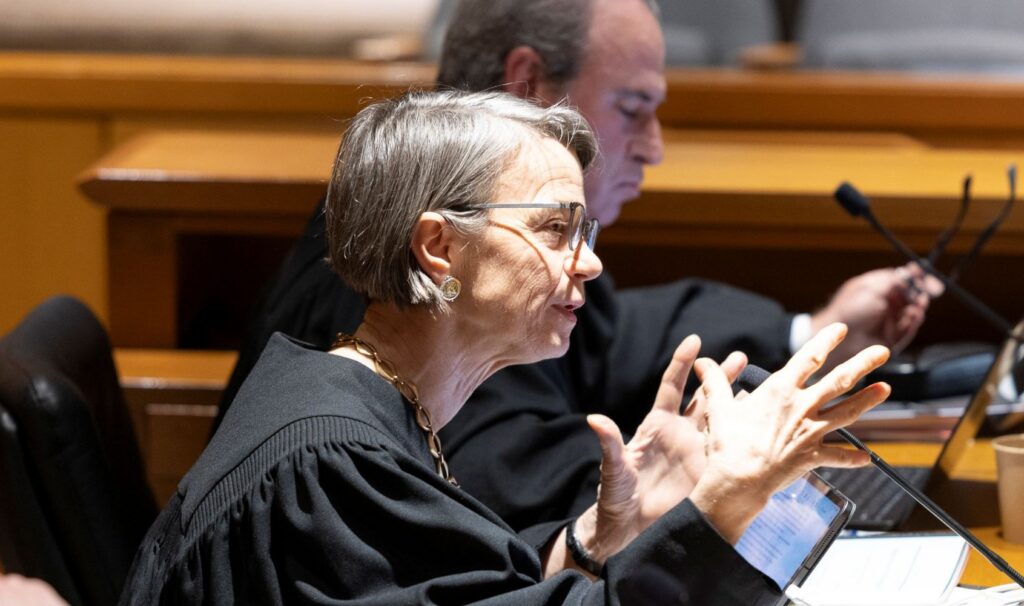
The judges for the final round were Justice Joshua Groban of the Supreme Court of California, Judge Stephanos Bibas of the U.S. Court of Appeals for the Third Circuit, and Judge Cornelia T. Pillard of the U.S. Court of Appeals for the D.C. Circuit.
The students were asked to brief and argue Project Veritas, et al. v. Nathan Vasquez, which concerned whether Oregon’s law prohibiting the unannounced recording of conversations violates the First Amendment. Specifically, the students addressed:
- Whether the First Amendment protects the right to record.
- Whether Oregon’s law prohibiting unannounced recordings is content-based and thus subject to strict scrutiny, which it fails.
- Even if Oregon’s law is content-neutral, whether it nonetheless is an invalid restriction on protected speech.
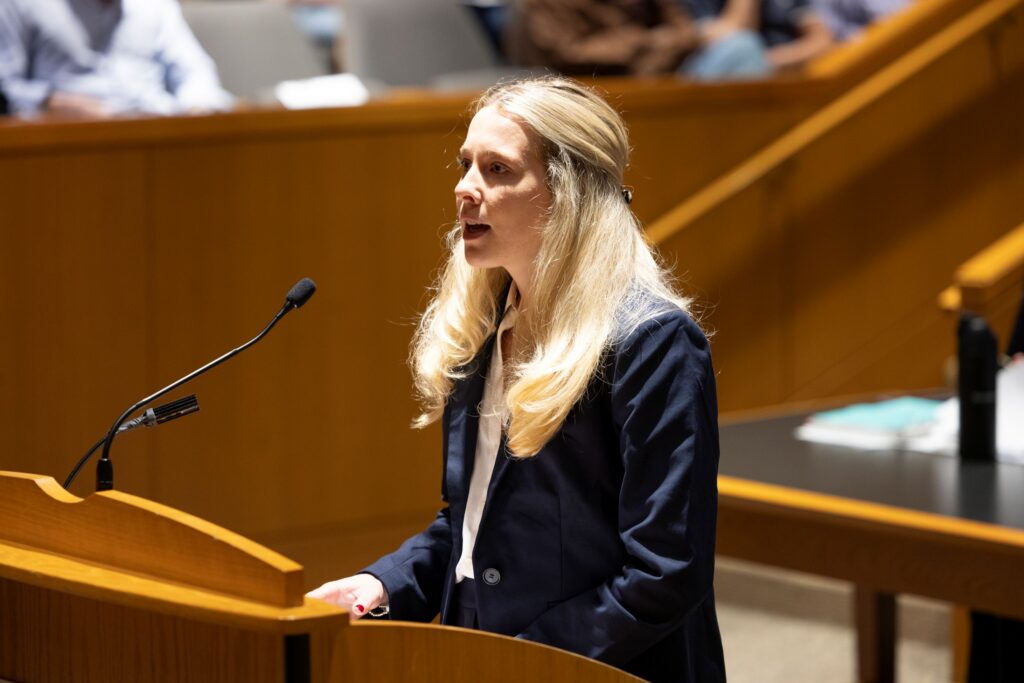
“It was tough to tackle an unfamiliar doctrinal area, but that was also what made it so fun,” says Lawrence, who will eventually clerk for Chief Judge Sutton of the U.S. Court of Appeals for the Sixth Circuit. “I enjoyed reading cases and articles, refining our argument structure, and thinking creatively together. The best advice we got was to be authentic. Sam and I have different speaking styles and ways of thinking. Leaning into those differences not only made for a good team balance, but freed us to really listen to the judges’ questions and concerns during argument.”
Wu, who argued for respondents, says moot court was “very unlike anything else I’ve done before—you have to juggle so many things at once, such as maintaining eye contact, speaking at a reasonable speed, and keeping your hands in control, all while making sure you’re being responsive content-wise to the hard questions that the judges are asking you. And you get only a split second to think about your answer before launching into it.”
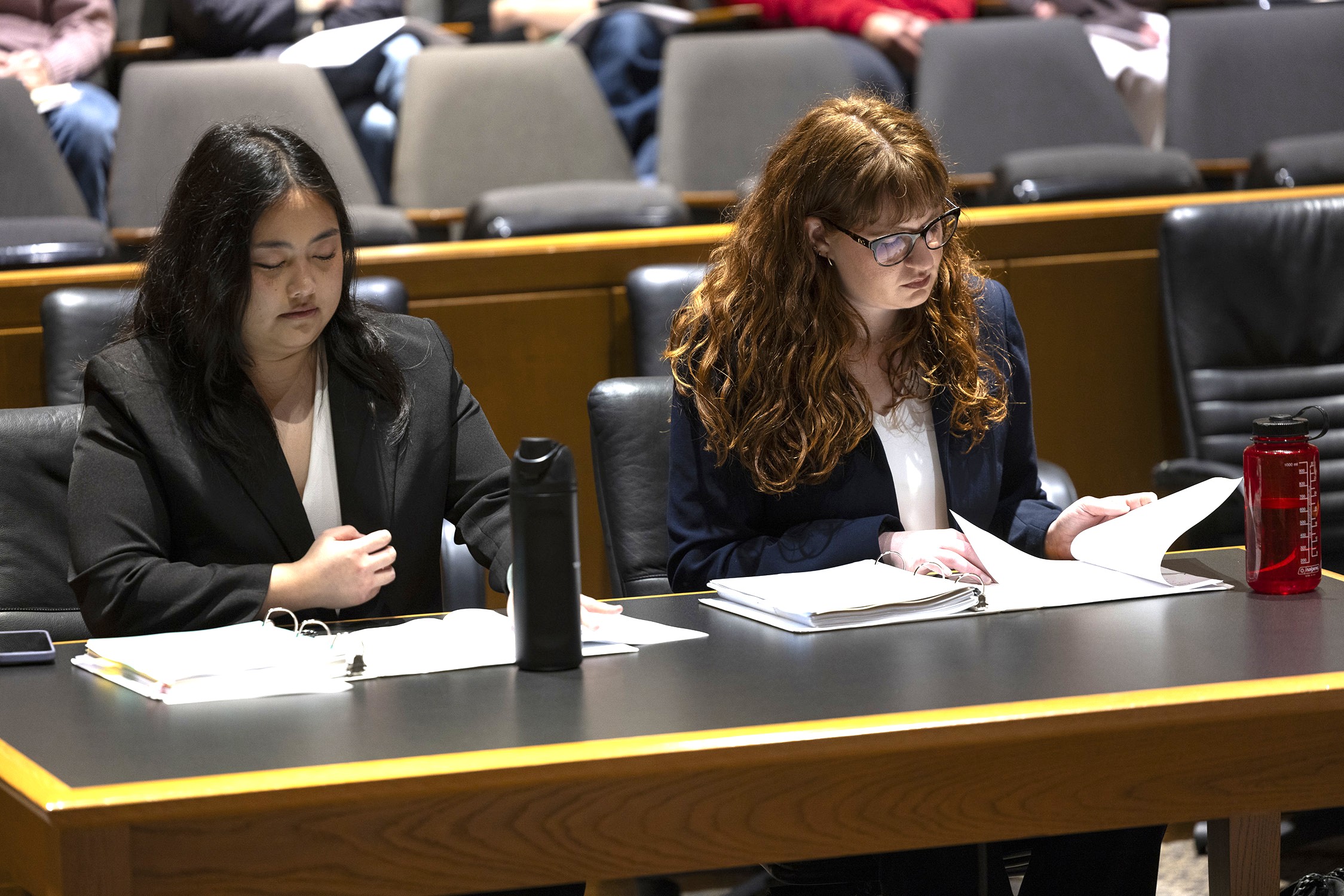
Wu plans to start her legal career at WilmerHale in D.C. before eventually clerking for Judge Karin J. Immergut of the U.S. District Court for the District of Oregon.
For Alpert, who will clerk for Judge Toby Heytens of the U.S. Court of Appeals for the Fourth Circuit after graduation, moot court was an opportunity to rethink what oral advocacy should be.
“I received great advice during the competition to treat oral argument less like an “argument” per se and more like a conversation—one where you’re trying to persuade thoughtful individuals who are engaging with you in real time,” Alpert says. “I tried to lean into that mindset in the later rounds, and it made a big difference. The questions and hypotheticals were still challenging, but I started to see them as opportunities to clarify my position and work through the issues collaboratively with the judges. By the end of the competition, I found that I was not only more comfortable at the podium but genuinely enjoying the process of oral argument.”
Students who received awards in the preliminary rounds:
- Hannah Repke, JD ’26, and Beatrix Bondor, JD ’26, Best Petitioners’ Brief
- Maya Rodriguez, JD ’26, and Sarah Ryan, JD ’26, Best Respondents’ Brief
- Shreeya Singh, JD ’27, Amanda Morrison, JD ’27, Best Team of Oralists