
Law, the Markets, and Governance with Megan Barbero
A discussion with Megan Barbero, JD ’05, former general counsel of the U.S. Securities and Exchange Commission
Americans can be forgiven for having a degree of complacency about the security of their investments.
Almost 100 years after the 1929 stock market crash and subsequent Great Depression spurred financial safeguards, including the establishment of the Securities and Exchange Commission (SEC) in 1934, about two-thirds of American adults have money in stocks, their investments navigating the typical ups and downs of a well-regulated market.
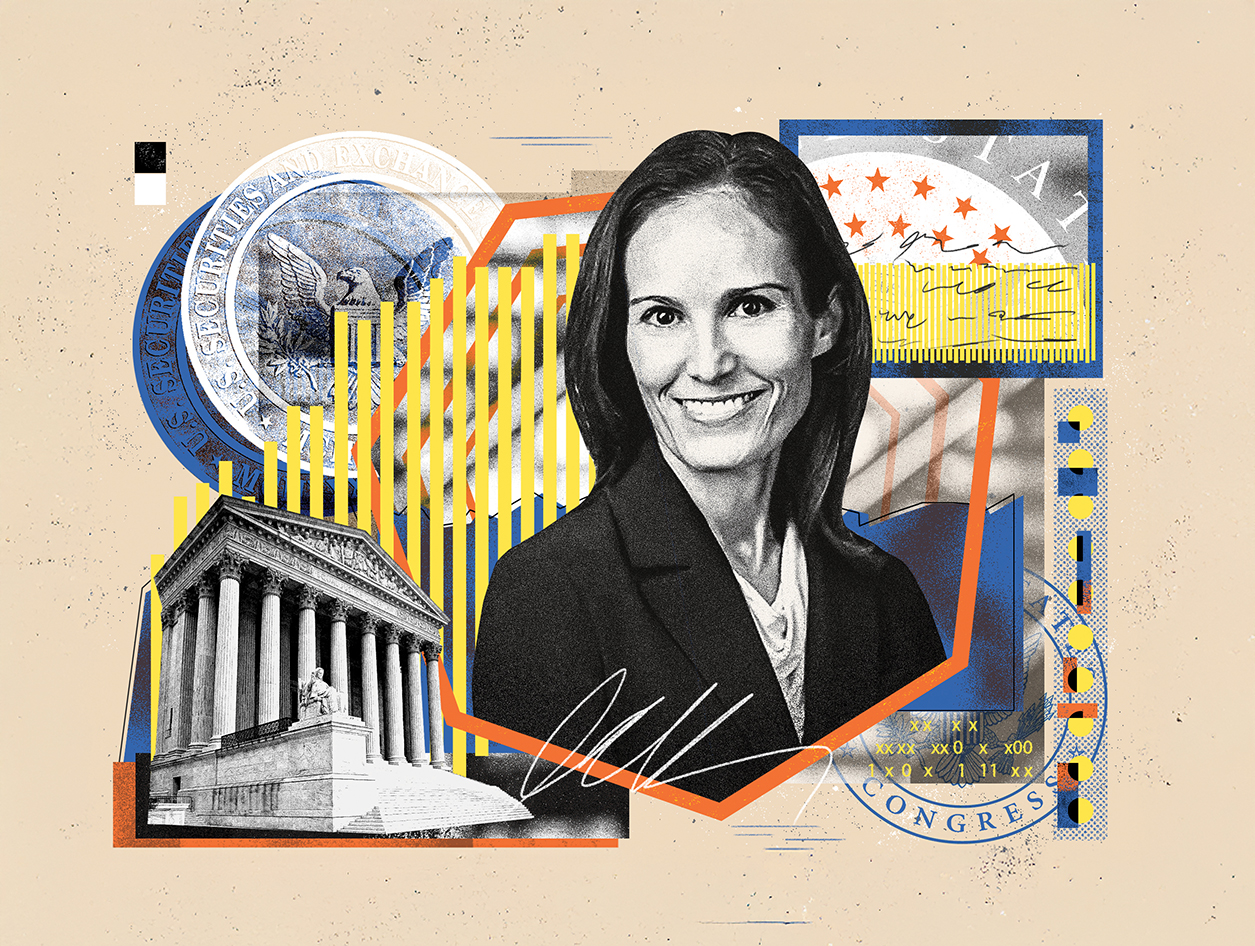
At the center of much of the work of the SEC is complex law—and a legal department, with a 160-strong team of attorneys who navigate a rapidly changing environment that now includes such issues as deepfake fraud and cybersecurity risks. At its helm was Megan Barbero, JD ’05, who served as the commission’s chief legal officer from February 2023 until January 20, 2025.
Barbero embraced her role, bringing the full weight of two decades of government and private-sector experience litigating across a wide range of issues, representing clients before every court of appeals and the U.S. Supreme Court.
“I came into that job with a broad litigation and appellate background, including a focus on administrative law. I’d represented the agency for several years when I was at the Department of Justice, working on cases that culminated in the Supreme Court’s decision in Lucia and also later the Cochran and Axon cases. So, I was familiar with the agency as a client,” she said before starting the interview that follows.
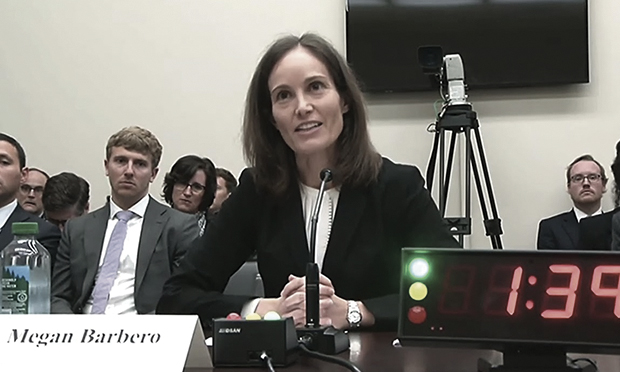
At the SEC, Barbero provided expert counsel on rulemakings and enforcement actions and guided the commission through recent developments in constitutional and administrative law. She testified before Congress, provided counsel on the full range of legal and policy issues before the SEC, and represented the agency in all of its high-profile defensive and appellate litigation.
Prior to joining the SEC, Barbero served as deputy general counsel for the U.S. House of Representatives and as an appellate attorney in the Civil Division of the U.S. Department of Justice. Like in so many areas of government where staff bring expertise from the private sector to the job, Barbero arrived with nearly a decade of private practice under her belt, primarily with WilmerHale. She joined Venable LLP in D.C. as a partner soon after she left the SEC.
Here, Barbero discusses her work with the SEC and her career leading up to it with Robert Bartlett, W. A. Franke Professor of Law and Business, faculty co-director of the Arthur and Toni Rembe Rock Center for Corporate Governance at Stanford Law School, and professor of finance (by courtesy) at the Stanford Graduate School of Business. Bartlett has written widely on law and finance, with a particular emphasis on venture capital finance, market structure, corporate governance, mandatory disclosure, and capital market regulation. Barbero is speaking in her personal capacity, and her views do not represent those of Venable or the SEC. —by Sharon Driscoll
ROBERT BARTLETT: You were at the SEC during an incredibly busy time. Can you talk about the environment when you arrived
at the SEC?
MEGAN BARBERO: When I was offered the position at the SEC, first as the deputy general counsel and then as GC, I knew it was going to be a very busy regulatory and enforcement period for the agency, and I felt that my background—my litigation experience, my appellate experience—would serve me well in guiding the agency through the anticipated rulemakings, as well as the court challenges and enforcement appeals.
So, it wasn’t necessarily a traditional path to becoming the general counsel of the SEC, but I had the right experience for the job at the time.
Can you say a few words about the portfolio you managed while you were the SEC’s general counsel?
It’s a wide portfolio. As the general counsel, the chief legal officer for the commission, you touch almost every aspect of the commission’s work. For example, on the enforcement side, my team would review enforcement recommendations before they went to the commission to be considered. I also had teams that worked closely with the three primary rulewriting divisions in the agency: Trading and Markets, Corporation Finance, and Investment Management. And we had OGC attorneys who were experts in each of those spaces and who worked closely with those rulewriting teams.
The OGC legal team also wrote draft adjudication opinions for the commission and handled internal investigations and congressional oversight responses. I also supervised an appellate staff and litigators who represented the commission in all of its defensive litigation, including challenges to rulemakings, and handled enforcement appeals. There’s work on general law and litigation issues, including FOIA [Freedom of Information Act] appeals, appropriations questions, intellectual property questions, and labor and employment law. And then, of course, we were tracking closely all of our own cases and developments in administrative law and other issues that directly affected the agency.
The scope of work in the office really does run the gamut. We had more than 160 people in the office, so it was a fairly large general counsel’s office.
Your time at the SEC was marked by tremendous innovation in the capital markets. How did you manage to stay current on emerging issues?
The office is staffed with incredible lawyers who are real experts in their fields. So, it’s a high baseline of a lot of expertise and a lot of institutional knowledge.
One of the benefits for me, having come from the DOJ with the experience of working across the government, was knowing that we were not alone in the sense that many other agencies were grappling with similar issues, especially with some of the changes in law coming from the Supreme Court. We had colleagues at the Department of Justice who were helping to come up with government-wide guidance, and we were able to work closely with them on all of those issues.
Well, there has certainly been a change in administrative law in recent years. And the judicial landscape is changing.
Megan Barbero, JD '05
Turning back to the point on rulemaking, as you know, a lot of the rules were subsequently challenged and vacated, particularly those that were challenged in the 5th Circuit. Previously, most of the challenges would have been heard by the D.C. Circuit. What factors do you think contributed to this evolution? And strategically, how do you think any agency—not just the SEC—should approach rulemaking in the current environment?
Great questions. John Coates at Harvard had a blog post a little over a year ago that really stuck with me. He looked at the challenges under SEC Chair Gensler and the prior three chairs, and I think about 80 percent of our rulemaking challenges were filed in the 5th Circuit. And what’s notable is that for the prior three chairs, 0 percent of the rules were challenged in the 5th Circuit. So, looking at that data, it was a significant shift. In terms of the factors that went into that change, some challengers probably felt they would have a more receptive audience for challenging agency rulemaking in the 5th Circuit. And that was probably driving some of the choice of forum.
What should agencies be thinking in terms of rulemaking?
Well, there has certainly been a change in administrative law in recent years. And the judicial landscape is changing. Litigation risk assessments are something that agencies need to think very carefully about. With all of that said, looking at this from the perspective of a policymaker, they may feel strongly that there’s an important policy change that is going to protect investors, that’s going to benefit the market, that it’s something they came into office to do. These are decisions the agency heads are making every day, and they’re doing so in consultation with their general counsels and understanding the litigation risk, but also with an understanding of the policy mandate.
One of the more high-profile examples of the rule challenge was the climate disclosure rule, which was pretty promptly challenged by several states. The case is currently pending in the 8th Circuit, but the commission recently voted to cease defending the rule. You were one of the authors of the brief defending it. What was your approach to the rule and what is the strongest justification for the rule?
As you noted, I was very involved not just in the drafting of the brief but also in the rulemaking itself. In terms of your question on statutory authority, first, as the brief makes clear, this wasn’t about regulating climate change or environmental issues. It really was about protecting investors and ensuring that investors had appropriate and necessary disclosures. And both the Securities Act of 1933 and the Securities Exchange Act of 1934 adopted a disclosure-based regime because Congress understood that investors needed to have full and fair disclosure of decision-useful information. That is the baseline. Then Congress, in addition to statutorily mandated disclosures, also delegated to the SEC the authority to require additional disclosures that the agency deems necessary or appropriate in the public interest or for the protection of investors. And, for the past 90 years, the agency has required various disclosures, exercising that statutory authority—including, since the 1970s, requiring the disclosure of certain environmental matters. The record before the agency really showed that those disclosures on climate-related matters were inconsistent. They were difficult for investors to compare. Some of them were boilerplate, which is problematic, given the importance that climate-related disclosures have in terms of the effect on the company’s business, its financial performance, and the potential for climate-related disasters to damage assets. You can also have regulatory transitions and lower carbon requirements. All of those things are important for investors to understand, and that really is the basis of the rule. That’s the authority that’s laid out both in the rulemaking release itself and in the brief.
We’ve also seen several important decisions related to the Chevron doctrine [that courts should defer to an agency’s interpretation of an ambiguous statute]. Did you think that these were game-changing decisions? Did these cases meaningfully change the way that you approached rulemaking? Or were you planning for the higher scrutiny that is being applied toward agency decision-making?
The overruling of Chevron was a long time in the making. If you look back through the SEC’s rulemakings, and certainly our litigation positions over the last many years, even predating my tenure at the agency, you’ll see very little reference to deference and few arguments that a statute is ambiguous, and the agency’s interpretation should get deference. It just wasn’t an argument that the agency had been running for quite some time. Because we had anticipated that Chevron might be overruled, and then of course it was, the impact was mitigated somewhat.
I’ll add this: The agency takes Supreme Court decisions very seriously. There’s a thorough process at the agency for analyzing decisions, figuring out the extent they need to be implemented, and determining how best to do that.
It sounds like the West Virginia v. EPA decision was perhaps more of a surprise.
Having the Court articulate the major questions doctrine in those terms in West Virginia v. EPA was certainly something that we at the SEC took seriously. It was an argument we saw in many cases that were brought against us, both on the enforcement side and in the rulemaking challenges.
I would say that prior administrations had gone to great lengths to respect the independence of the agency.
Megan Barbero, JD '05
I am curious to hear your thoughts on Moab Partners involving Item 303 of Regulation S-K. [In Moab Partners, all nine justices held that private 10b-5 lawsuits cannot be pursued solely because a company omitted “known trend” disclosures as required by Item 303 of Regulation S-K.] My take on that decision is that the Court wrote it to be narrowly about Item 303, but it’s been interpreted more broadly to ban all pure omission cases under 10b-5. But the courts haven’t yet grappled with the full implications of banning all pure omission cases under 10b-5 given that insider trading liability under 10b-5 is also predicated on a pure omission theory, as reflected in Chiarella. At some point it seems like there needs to be clarification of the scope of Moab Partners. I don’t think all nine justices could have intended to overturn Chiarella and all of insider trading precedent without expressly discussing it.
I did follow the decision. In fact, we worked with the Solicitor General’s office to file an amicus brief in the case. I agree that we’ll continue to see developments in this area as the courts hash out the contours of Moab Partners and half-truths versus pure omissions. And I agree that we’ll continue to see courts grappling with how to square Moab Partners with Chiarella and Zandford and the duty to disclose that may make an omission of material fact actionable, which we discussed in our amicus filing.
Going back to the enforcement side of the SEC, regulators have a lot of discretion in choosing whether to make policy through rulemaking or through filing a lawsuit, and the latter concept sometimes is referred to as “regulation by enforcement.” Is that concept acknowledged at the SEC, and is it actually a strategy? Or is it just a label people use when they see active enforcement in a domain that is not subject to new rulemaking?
It’s certainly a criticism that was levied against the agency, especially in the crypto enforcement cases. The regulation by enforcement term has been used to suggest that the agency is doing something it shouldn’t be doing by bringing its enforcement cases. But when the enforcement staff recommends a matter to the commission, it is basing the recommendation on the existing statutes, existing regulations, and a violation or potential violation that enforcement staff have identified. What they are not doing is saying to the commission we should create a new regulatory regime by bringing this set of enforcement actions. It is based on the existing law. The argument on the other side was that a new regulatory regime was needed for new crypto technology and the developing market. The agency now has a crypto task force that has been active in the last few months and that is starting to undertake some of that work. Reasonable minds can and do differ on what the right approach is here.
There’s a bill pending in the House that would implement a model similar to what some crypto companies have advanced as a valid legal strategy for using crypto tokens—that is, issue a token via a private placement, followed later by a public distribution once the token has become a true utility token so that it is regulated and traded as a commodity. Do you see momentum behind any proposals for a regulatory environment for crypto?
I do think there’s momentum at the agency now. There have also been statutory proposals for how to manage crypto and how to divide jurisdiction among various agencies. One of the challenges that needs to be solved is figuring out how to create a regulatory regime that has enough protections built in and has an agency that has the enforcement expertise and mechanisms to protect against fraud and violations of the regulations, but also works for the industry’s business models. That’s been a fundamental challenge for a long time. But there is obviously a lot of interest in charting that path forward.
It sounds like you wouldn’t expect a new regime anytime soon—that this is something that’s probably going to take a few iterations.
My understanding is that there’s a lot of information-gathering happening now. Rulemaking in general takes a long time. If you think about pulling together all of the information to come up with a regulatory proposal and to put it out for public comment, you can expect that if the SEC were to propose a regulatory regime for crypto, it would receive tens of thousands of comments that the agency would then need to digest and consider before finalizing the rule. So, that all takes time. Even in the ordinary course, a rulemaking can take a long time—that’s especially the case for an issue that’s high-profile and potentially going to attract a lot of attention.

Another topic that has been in the news is increasing legal and political pressure to assert stronger presidential authority over independent agencies, including efforts to limit their structural independence. How real is the institutional autonomy of the SEC? What benefits do you see arising from it?
To use your words, Bobby, I would say the institutional independence of the SEC and other financial regulatory agencies is “real.” These are agencies that are independent by a combination of congressional design and long understanding by the White House and the agencies, and that’s really a core feature of our financial regulatory system. In terms of benefits, there are many, but at the top of the list is the idea that certain expert agencies should have a measure of independence to regulate within their sphere of expertise without undue influence from the political actors and the political pressures of the day. Our financial markets thrive on consistency and predictability.
We were just talking about rulemaking and the long process for changes, but that long time frame gives notice to affected entities of what may be coming down the pike so they can prepare. Regulators can’t provide that kind of certainty if they’re beholden to the same, often changing, political pressures that drive the White House and the core executive branch agencies. For example, in recent weeks, the markets have been sending clear signals about how much they value the predictability and the independence of the Federal Reserve.
Can you talk a bit more about the importance of agency independence—particularly for the SEC?
The primary test of agency independence is the president’s removal power. If the president has the authority to remove an agency head, without cause, he can then direct the agency’s policymaking. He can direct the enforcement function. If the agency doesn’t comply, then the agency head or heads are at risk of removal by the White House, and the president can put somebody else into that job who will carry out his policy preferences. But limitations on the president’s removal authority have come under increasing judicial scrutiny in recent years, to put it mildly. I expect that this will continue to be a pressure point, including because the Solicitor General’s office has determined not to defend Humphrey’s Executor in the Supreme Court. And the president has removed several heads of independent agencies. Those cases are being litigated. And I expect the Supreme Court will be presented with the question whether to overrule Humphrey’s Executor, and that, of course, could give the White House more authority to exert removal power over independent agencies.
Another pressure on the rulemaking side is in setting agencies’ agendas. We are accustomed to the chair of the SEC directing the agency’s agenda. In order to promulgate a rule, you need a majority vote of the commission, but the commission’s rulemakings generally are not directed by the White House. That line is very carefully respected. There’s no substantive review process. We’ve seen some recent executive orders that have put pressure on that aspect of independence as well. So, I think there’s a move to further centralize the rulemaking function and have additional review by the White House, which could also undermine some of the agency’s independence.
Our financial markets thrive on consistency and predictability.
Megan Barbero, JD '05
As a functional matter, do you think the ability to re-designate the chair of an independent agency gives the president a lot of de facto authority over the agency?
The SEC has five commissioners by statute. I don’t know that designating the chair gives the White House nearly as much authority over the agency as the removal power because, for a multi-member agency to act, you need a majority vote of the commission. If you have, say, a chair who disagrees with the president and would therefore dissent from whatever the president is pushing the agency to do, moving that individual out of the chair spot means they are not directing the agenda anymore, but their vote is likely to still be needed to move something forward.
That makes a lot of sense then, where the main threat for overturning Humphrey’s Executor would be that you could change the votes at will, right?
Right.
Did you feel pressure from the Biden administration too? It seems like there’s extraordinary pressure right now. Is it a continuation of something that was happening, or is it new?
I would say that prior administrations had gone to great lengths to respect the independence of the agency. Many would say that there’s a reason Congress designed the agencies the way that it did, to establish a guardrail and maintain agencies like the SEC that are independent from that direct political control, protecting the economy from swinging back and forth as the political winds change, which adds a lot of value to our financial markets.
What do you see as the broadest implications of the Jarkesy decision [that prevents the SEC from seeking civil monetary penalties for securities fraud]?
We were talking before about cases where the Supreme Court left some questions open—and that they may have to take up down the road. Jarkesy is another one because, depending on the interpretation of the decision, it could have very broad implications or it could be interpreted more narrowly. That’s an issue that’s being litigated. Now, we don’t know what the outcome of those cases will be, but at a minimum, the Supreme Court said that the SEC cannot, consistent with the Seventh Amendment jury trial right, seek civil money penalties for fraud in an enforcement proceeding before the agency. That is significant given the authority that Congress had provided to the agency. And the fact that the agency is seeking civil money penalties for fraud is bread-and-butter core business of the SEC.
Many of my students are curious about the wide range of career paths that Stanford Law alums have taken. Can you walk us through your path to the SEC?
Can I start by offering some very general career advice for law students, which has helped me on my career path?
First, find work that you enjoy doing and do it well. And, second, don’t be afraid to take risks in your career. You won’t always be in a position to take risks, but when an opportunity presents itself and you’re able to, take the leap.
In terms of my own career path and service as the general counsel of the SEC, it helped to have experience in other government jobs, both in the House and at the Department of Justice, because a lot of the work that you do as an agency touches other parts of the government and relationships that you’ve built in prior positions can be incredibly helpful. And having worked in private practice gave me the additional perspective of what it means to be on the other side of the table. Because so much of the general counsel job is about exercising good judgment and providing advice on difficult legal and policy issues, a varied background and broad perspective positions you well for success.
Before we end, can you share what you’re most proud of from the time you spent at the SEC?
I’m proud of all the work that we did. But the thing I’m most proud of is my team in the Office of General Counsel. It was a very busy time and they really rose to every occasion and met and exceeded my, admittedly, very high expectations. I’m incredibly proud of the work that we did together and very grateful to everyone who works at the agency and everybody who’s in public service.
Thank you for being so generous with your time. We really appreciate it.
Thank you, Bobby. SL