
Marshall Goldberg’s Unscripted Path
A New Documentary is Next Step in Career Spanning Law and Hollywood
In the mid-seventies, Marshall Goldberg, JD ’71, was working in Washington, D.C., as lead counsel on the extension of the 1965 Voting Rights Act and then for the Civil Rights Division at the Department of Justice. The work suited him, but D.C. did not. “It was not a spiritually healthy place to work,” he recalls. The raw pursuit of power troubled him.
A friend, discussing possible career changes, asked Goldberg what he liked. Movies, he replied.
Goldberg went back to Palo Alto and struck a deal with the owners of the Festival Cinema, a revival movie theater. He would work there for six months, and if he liked the job, he would buy the theater. Day after day, he sold tickets, made popcorn, and swept the aisles. But he also sat in the darkened theater, watching films and taking notes on how they were pieced together.
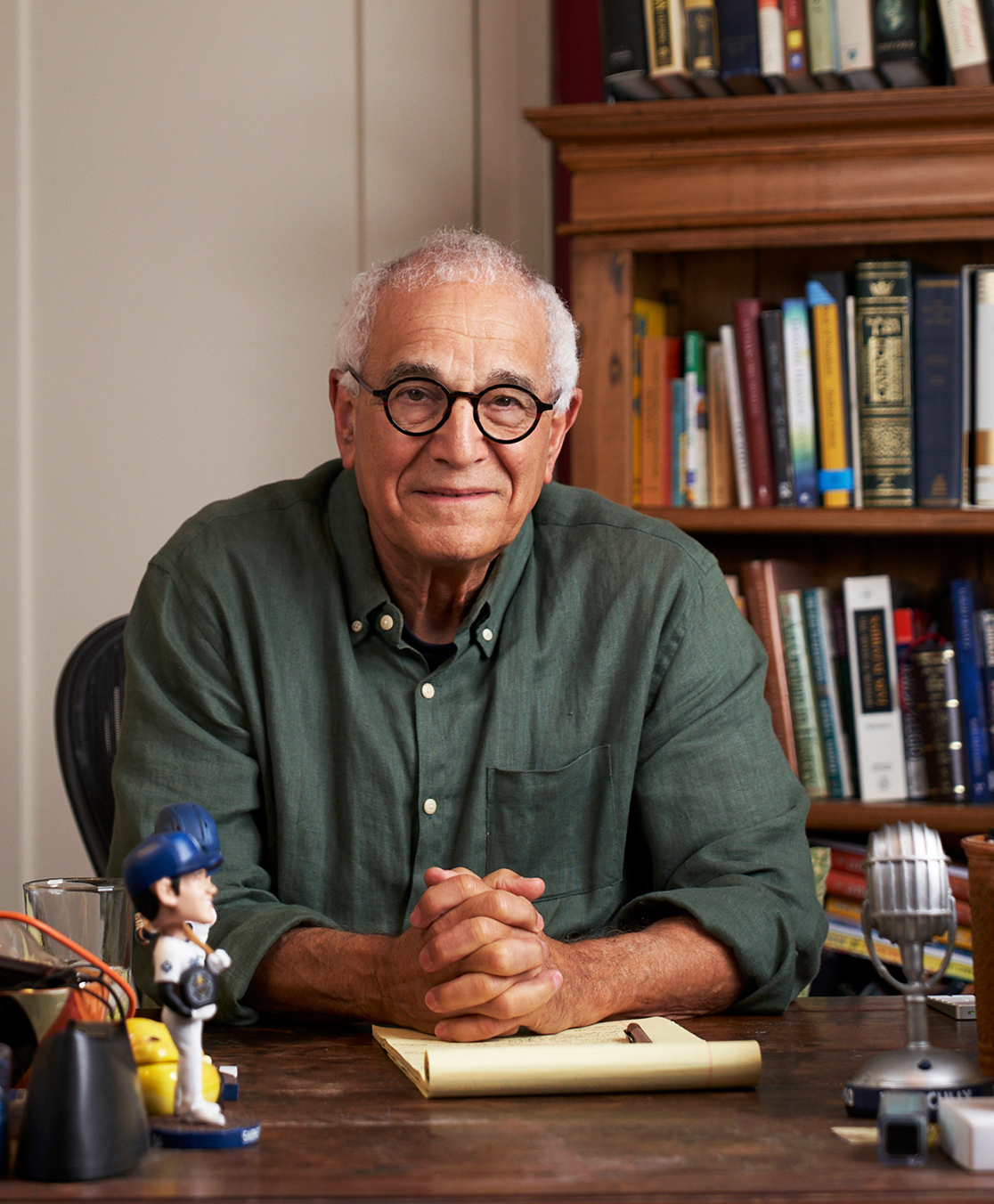
The experience inspired Goldberg to switch careers. He left the law for entertainment—but not by purchasing a movie theater. Instead, he tried his hand at screenwriting. Thanks to a friend who worked as a lobbyist for the ACLU, the script made its way to famed producer Norman Lear, a longtime supporter of the organization. Lear liked the work.
Not long after, Goldberg moved to Los Angeles and began writing for—and eventually producing—shows including Diff’rent Strokes, The Jeffersons, and L.A. Law, among others. He worked in Hollywood for 25 years before his next course change.
In 2003, the executive director of the Writers Guild of America asked Goldberg to serve as general counsel. He agreed, stayed for two years, and left to write a historical novel, The New Colossus, published in 2014.
Goldberg’s time in Hollywood—where he devoted thousands of hours to carefully constructing different narratives—had made him an expert on the harmonic resonance between story and emotion. This information, he believed, could benefit young lawyers. So he began teaching a class at Stanford Law School, and later at the University of Michigan Law School, on the strategic importance of storytelling. The first half of the class was a writing boot camp, he says, after which “we would come back to shore and I would give them cases” in which the law and the equities were on the other side. It’s common, Goldberg explains, for lawyers to find themselves in front of bad press, for instance. Thinking in narrative can help overcome these challenges.
“To me, there is a single person lurking behind every one of these endeavors,” says Rebecca Eisenberg, a law professor at the University of Michigan who had a hand in bringing Goldberg to Ann Arbor. She ticks off his unlikely mix of jobs, including the latest as documentary maker. “In all of these is a smart, creative, empathic person who wants to make a difference in the world. He has not only found a variety of ways to do that, but he has succeeded in doing it.”
Documenting justice
Goldberg was born and raised in Pittsburgh. He attended Harvard, majoring in government and economics. A dedication to civil rights brought him to law school; wanderlust drew him from the East Coast to the deserts and mountain peaks of California. During his 2L year, in response to Nixon’s invasion of Cambodia, Goldberg led the committee in charge of a student strike.
“I’ve always had strong political views,” he says, “but that was the first time I got involved in shutting down an institution.” It was also his first time being tear-gassed. After graduation, he clerked for Judge Robert F. Peckham of the U.S. District Court in San Francisco and then moved to D.C. to begin his work on the extension of the Voting Rights Act.
Goldberg’s most recent project, Justice USA, a six-part documentary that follows 12 indigent defendants, juveniles and adults, through seven months in the criminal justice system, pulls together the many threads of his career. The idea for the series, a decade in the making, grew from Goldberg’s observations that most people hold strong opinions about the American justice system despite a general ignorance of how it really works.
To properly tell the story, Goldberg insisted on finding a sheriff who would open the local jail to the entire crew. He wanted a public defender who would grant access to conversations with defendants. He needed a district attorney to agree, in writing, that nothing captured in the documentary would be sought as evidence. With those pieces in place, he believed he could tell the story honestly.
Leading with compassion
it took five years to find an amenable jurisdiction, which Goldberg did, in Nashville, Tennessee. Once he filmed the pilot, it took another three years to secure financing, which arrived after Oprah Winfrey agreed to back the project. The series was shot in 2021 and aired on HBO Max in March 2024.
The access granted to Goldberg and his crew makes for profound intimacy in settings typically walled from sight. One scene early in the first episode tracks a mother into her bond hearing where she is told by video monitor that she owes $2,500 for her release and that this release is “on hold” for 12 hours. The hearing takes place at 5:25 p.m.; if she can pay the bond, she’ll be let out at 5:25 a.m. The camera presses in tight. She bends down, face in her hands in a cinderblock room, and weeps.
“You see her life crumbling before your eyes,” says Mike Tollin, an executive producer on the project and a longtime friend of Goldberg’s. “And here is Marshall with a clipboard, boom mic overhead, two cameras pointing at this poor woman, and he’s asking in his most avuncular way if she would talk with him.” In a moment of such vulnerability she agrees, in large part, Tollin suggests, because Goldberg “leads with compassion and a big heart. These people were willing to trust him with their stories.”
The stories Goldberg is currently gathering are for a new project about ICE raids in Los Angeles. “I want to show the impact, the traumatizing, not only on the undocumented but on all immigrants,” he says. “But there are also powerful stories in what communities are doing in response to this.”
What comes after that is unclear, but Goldberg has become comfortable with these uncertainties. Reflecting on the many paths of his career, he returned to the first pitch meeting he’d ever had, for Diff’rent Strokes. He was presenting to a man behind a desk and two producers on a couch. Goldberg was going through his background—law school, work on a presidential campaign, aide in the Senate. The producers continued asking questions about all this; the man behind the desk was tapping his pencil, silent, until at last he cut in and said none of that meant anything out here.
It was, Goldberg says, great to hear. “It meant I don’t have to worry about my past. I don’t have to rely on that,” he says. “I don’t think people appreciate how resourceful they can be. You can figure it out.” SL