
Playing the Long Game
How Ed Policy’s Legal Training Is Shaping the Packers’ Future
When Ed Policy, JD ’96, started law school at Stanford, he had clearly defined football loyalties. His father, Carmen, was the president and CEO of the San Francisco 49ers, a team still in the midst of their dynasty with five Super Bowl championships. Ed had been named for 49ers team owner Eddie DeBartolo Jr. As a child growing up in Youngstown, Ohio, he was reprimanded for wearing a Cleveland Browns jersey: His father told him in no uncertain terms, “We’re a 49ers family now.”
But time passes and loyalties change. And while Ed Policy learned about the NFL from watching his father manage the 49ers, he brought those lessons to a different team. As president and CEO of Wisconsin’s Green Bay Packers, Policy holds a unique leadership position in American sports.
Although he carries the same title his father once did with the 49ers, and came to sports from a similar legal background, the younger Policy’s role is quite different. Most NFL teams are owned by wealthy individuals or investment groups. The Packers are owned by their fans, which means that while Policy may act as the voice of Packers’ ownership to the league, his actual boss is the guy in the ski hat and parka with season tickets.
Many team owners pay lip service to being custodians of a public trust. But in Green Bay, those words carry real weight.
“It’s very literal for us,” Policy says. “Owners of teams might consider themselves stewards of a community asset. But it’s true in Green Bay. The team is owned by the fans—about 539,000 shareholders. They are the true owners, and we represent them.”
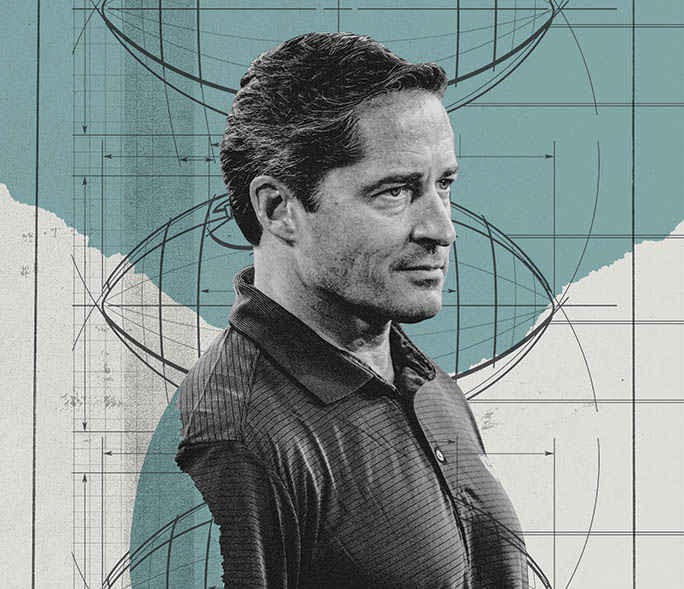
That makes Policy’s job unlike any other in sports.
“I think his job is more akin to running a public company than running an NFL franchise owned by an individual or a family,” says Carmen Policy, who didn’t predict such a path for his son.
“I pictured him as a managing partner in a large law firm. He never said to me, ‘I’d like a career in sports. I’d like to follow in your footsteps.’”
But Ed Policy learned a lot through osmosis. He enjoyed watching the Sunday football games, but he also asked a lot of questions about the action off the field.
“He was paying attention to what was happening at the league meetings and in the press and to things that would affect the franchise,” the elder Policy says.
While Ed Policy spent time at law firms after graduation, first at Heller Ehrman in San Francisco and later at Thompson Hine in Cleveland, he pivoted to sports early in his career. On the recommendation of Roger Goodell, who at the time worked under then-NFL commissioner Paul Tagliabue, he was hired by Arena Football League commissioner C. David Baker as general counsel. Policy learned all facets of the league, becoming the AFL’s chief operating officer and deputy commissioner before succeeding Baker as commissioner.
“Ed was the best listener that I’ve ever known,” Baker says. “And he is deeply committed to the game, to its history. He has a deep respect and reverence for the game of football.”
That deep respect was vital when Policy joined the Packers as general counsel in 2012, after working as a consultant in the NFL league offices. In the 14 years since, he has found his legal background indispensable to meeting the challenges Green Bay faces.
“I think a law background is the perfect entree into modern-day sports,” Policy says. “That was the advice my dad gave me—that law permeates everything we do in sports. And, as sports continue to get more complicated and more complex, a legal background becomes even more important. From labor relations to player relations, contracts, real estate, and venture capital, everything we do involves the law.”
From general counsel, Policy rose to COO and oversaw the development of Titletown, a mixed-use development outside famed Lambeau Field. When Packers team president Mark Murphy faced a mandatory retirement in 2025, Policy was the obvious choice to replace him. Policy was already familiar with the distinctive demands of the Packers job. And he, his wife Christina, and their two sons had become deeply ingrained in the Green Bay community.
“I think you really have to understand the community,” Policy says.
“I think a law background is the perfect entree into modern-day sports.”
Ed Policy, JD ’96, President and CEO, Green Bay Packers
Operating in a tiny market, the Packers embody the history of the NFL, the team’s lineage going back to its founding in 1919. They are the last of the small-town teams in football and their traditions are cherished by fans. Yet the team competes in the world’s richest sporting league.
That presents an unusual set of hurdles. All other NFL teams are allowed to sell private equity stakes, bringing in outside investors as minority rights holders, but the Packers cannot because the team is publicly owned by shareholders. No other team has that ownership structure. As a result, Policy must look for additional revenue streams.
“Now you have the other 31 teams with access to an enormous source of capital that we don’t have access to,” Policy says. “That does create a bit of a challenge for us going forward. We’ve got a corporate reserve fund of about $700 million that took us over 30 years to save. Another team could sell 5 to 7 percent of their team and raise more than that in three months.”
The Packers have stayed competitive, making the playoffs six times in the past seven seasons, but they haven’t won a Super Bowl since 2011. With new investment rules, ones the Packers can’t take advantage of, it will be even more of a challenge to keep pace in the high-octane league. “You have an absolute arms race, in terms of coaches’ compensation, the number of coaches on a staff, the facilities—everything from locker rooms, training rooms, and recovery rooms,” Policy says.
Policy must walk a tightrope between preserving the core values of his storied franchise and keeping the team competitive in the modern NFL.
“As with Lambeau Field, it’s the balance in keeping it iconic, yet state of the art,” Policy says. “The Green Bay Packers brand is so sacrosanct that you have to be careful with any changes or tweaks.”
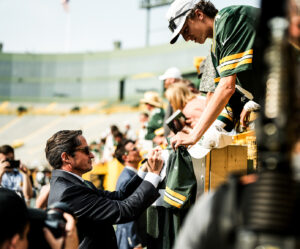
One option teams often choose to boost revenue is to sell naming rights to their stadium. In Green Bay, that would almost certainly cause an uproar.
“I don’t see selling naming rights for Lambeau Field, certainly not in my tenure,” Policy says. “But we will be a little more aggressive in other entitlement rights, probably our practice fields, in the coming years.”
Increased revenue streams are not the only test in today’s NFL. The league is being shaped by new forces, including legalized sports gambling, artificial intelligence, and the sweeping changes in college sports, such as NIL (name, image, and likeness) deals and the transfer portal that allows students to move from school to school, often to the highest bidder.
“I’m not a big fan of legalized sports gambling,” Policy says, but acknowledges it’s complicated. “There is a potential upside and growth due to increased viewership among people who have an economic stake in the game. And there are some direct revenue streams related to sponsorship.”
At the same time, however, it threatens the integrity of the game. “The NFL has a very thoughtful gambling policy and does a very good job educating players. But that’s another thing that keeps me up at night,” Policy says. “It’s just too easy for a player to make a mistake and run afoul of the gambling policy.”
When it comes to AI, Policy sees an upside to the technology being used in the league to promote health and safety by developing predictive models based on statistics and workload that could help avoid injuries and yield better health outcomes for players. Policy also sees a future in which AI could help with the data collected on players entering the draft, which could inform which players might be most successful in the NFL.
“That’s obviously a type of holy grail we’d all like to find,” he says.
Collegiate talent, acquired through the annual draft, remains the lifeblood of the NFL, but that pipeline has changed dramatically in recent years.
“You essentially have a pro model, with complete freedom of player movement and player compensation, but you don’t have any of the structure that the NFL has,” Policy says. “I hope they can get some structure around it.”
Policy believes that changes in the college game have created a different kind of player coming into the NFL.
“First of all, some are staying in college longer because they’re being compensated, so they’re coming in a little bit older,” he says. “They used to be a little more resilient, have the ability to solve conflict and think through challenges better.”
Policy explains that, for instance, if a player isn’t happy with his position coach or doesn’t feel he’s getting enough playing time, he can use the transfer portal to leave rather than work through the issue.
“They’ve had this escape hatch—they can just leave and go to another team and don’t develop those skills of how to deal with conflict and disappointment,” Policy says. “We’re finding, across the NFL, they have to develop those skills during their rookie year as opposed to in college.”
All of which makes strong leadership even more important in the current NFL landscape. After his first full season as president and CEO, Policy signed head coach Matt LaFleur and general manager Brian Gutekunst to multiyear contract extensions, despite the previous season ending in disappointment with a wild-card playoff loss to their rival, the Chicago Bears.
“I think you need continuity,” Policy says. “As young people develop, you need to surround them with continuity, and with really high-quality, high-character people.”
Policy has found his own sense of continuity. Several times a week, on his way home from his Green Bay office, he calls his father in California to talk about the job, its challenges, and how the world of professional sports has changed.
“It kind of blows his mind that, as I’m driving home from Lambeau Field, I’m talking about things like private equity, venture capital, real estate development,” Policy says. “But also building a winning culture, building a coaching staff, dealing with the media, and network deals. Much of it is still the same.”
Time passes and loyalties change. And these days, when Carmen Policy shows up for a game at Lambeau Field, with his grandkids, he wears green and gold Packers gear.
“Because blood trumps legacy,” Carmen says.
And his son is the caretaker of the NFL’s most iconic legacy. SL