
Reclaiming the Founders’ Frameworks
Jud Campbell, JD ’11, Reexamines Rights Through the Lens of History
The trail of early american ideas runs through dusty archives, across faded pamphlets, and into long-forgotten sources. Professor Jud Campbell, JD ’11, has followed that trail for much of his professional life, tracing the fading footprints of 18th-century constitutional thinking. His meticulous research looks into the past to animate current debates about rights, authority, and civic obligation. And his goal is to bring back into view an earlier world where rights were understood very differently than they are today.
By many accounts, he is reframing constitutional scholarship.
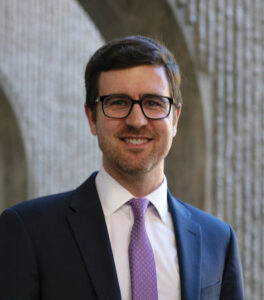
In early 2025, Campbell, Helen L. Crocker Faculty Scholar, was honored with the Federalist Society’s Joseph Story Award, given annually to one early-career scholar for contributions to research, teaching, and public engagement. The recognition drew attention from scholars across the academy. In a tribute video, Georgetown Law Professor Randy Barnett said, “It is very unusual for any scholar, much less a junior scholar, to fundamentally change the terms of the debate over the meaning of the Constitution, and Jud’s scholarship has done that.”
The award came roughly 18 months after Campbell joined the Stanford Law faculty, where he teaches Constitutional Law and Property, continues to expand a prolific research portfolio, and has already earned a reputation as a standout teacher. The 1L class selected him for Stanford Law School’s 2025 Barbara Allen Babcock Award for Excellence in Teaching.
His most recent article, “Determining Rights,” published in the Harvard Law Review (Vol. 138, 2025), explores how the nation’s founders understood the Bill of Rights as declaratory—affirming the existence of certain rights but leaving their specific content to be worked out not just by the courts but also through politics, custom, and civic practice. By recovering that framework, Campbell shows that the founders expected constitutional meaning to evolve through civic deliberation, not simply judicial decree.
It is a view that complicates modern notions of both originalism and progressive constitutionalism.
“I don’t see my work as necessarily pointing in a liberal or conservative direction,” says Campbell, a University of North Carolina graduate who majored in math and political science but wrote history papers on the side “just for fun.” “I’m not advocating for a particular outcome. I’m trying to understand how people thought in the past, how they understood rights, who got to enforce them, and how they limited governmental power,” he says. “I’m trying to show that the assumptions we bring to constitutional questions today are very different from those the founders had. Once we see that, it opens up new questions that we haven’t been asking.”
A landmark article
Campbell started asking those questions as a student at Stanford Law School, where he made a strong impression on Michael McConnell, Richard and Frances Mallery Professor of Law and director of the Constitutional Law Center. McConnell later tapped Campbell to lead the center, a role he held for three years before joining the University of Richmond faculty. In 2023, he returned to Stanford Law as a member of the faculty. “Jud is tackling some of the most fundamental questions of civil liberty in the United States and has already made major contributions to our understanding of rights,” McConnell says. McConnell is not alone in his admiration for his former student. In 2017, Harvard Law Professor Cass Sunstein called Campbell’s Yale Law Journal article “Natural Rights and the First Amendment,” which Campbell wrote in his early 30s, “the most illuminating work on the original understanding of free speech in a generation.”
In that article, Campbell showed how far removed the founders’ concept of free speech was from modern doctrine. In the 18th century, he argues, expression was seen as a natural right—an inherent liberty grounded in natural law rather than government decree, broad but bound by the public good. The government could restrict speech to preserve morality and order, for example, provided the restrictions stayed within proper limits.
“The founders’ understanding of rights would leave them completely confused by how we think about free speech today,” Campbell says. They thought about different kinds of rights in different ways, he explains, sometimes invoking natural rights, sometimes customary or common-law rights. And modern scholars can easily misinterpret their writings if they don’t distinguish which tradition the founders were invoking.
“Jud is tackling some of the most fundamental questions of civil liberty in the United States and has already made major contributions to our understanding of rights.”
Michael Mcconnell, Richard and Frances Mallery Professor and Faculty Director of the Constitutional Law Center
The common good
A theme running through Campbell’s scholarship is that the United States has lost the founders’ sense of constitutional responsibility. “Today we tend to think that the Constitution is something for judges alone to interpret and enforce,” Campbell says. “For the founders, political actors of all types were bound by the fundamental principle that public acts had to be directed toward the common good. We’ve lost touch with that idea.” Campbell points to the steady erosion of political norms as one symptom of constitutional drift. As part of his Story Award acceptance speech, he said that the founders envisioned a system in which “all citizens and all politicians, not just judges and lawyers, know and care about the Constitution and its underlying principles.” Relentless political hardball, he says, would have alarmed earlier generations. “The founders assumed ambition would be checked by structure, by norms, by institutions, and by a shared sense that everyone was bound by higher law.”
Constitutional collaborations
At Stanford law, Campbell has found a fertile setting for his approach to history and law. He collaborates closely with Professor Jonathan Gienapp, who holds appointments at the law school and the history department and whose research also examines how early Americans conceived of constitutional authority. The two are working on a forthcoming paper about the continuities between British and American constitutional thought in the late 18th century. “Jonathan and I are interested in how people at the founding understood where fundamental law came from and who got to enforce it,” Campbell says. “We’ve been reading each other’s papers for nearly a decade. It’s exciting f inally to bring those conversations into a joint project.” Gienapp says it is “hard to overstate the significance of Jud’s work for our understanding of early American constitutional thinking.”
“Few scholars have had the same level of impact on how I think about this subject, which is my core area of study,” he says. “I’ve learned and absorbed so much from Jud’s pathbreaking scholarship that it’s become hard to know where my own thinking begins and his ends. Whenever I’m unsure of how to approach a new question or am testing out a new interpretation, I turn to him for his reaction. It’s been incredible having him as a colleague here at Stanford.” Another of Campbell’s forthcoming papers revisits the little-discussed link between free speech and separation of powers. Founding-era thinkers, he notes, distinguished sharply between legislative and executive restrictions on expression, a nuance that vanished as modern doctrine came to treat all government limits the same. “Given the expansion of executive authority, it may be worth recovering that earlier perspective,” he says.
“Best part of the job”
Campbell brings to the classroom the same curiosity and historical perspective that define his scholarship. He eschews a traditional casebook in his Constitutional Law class, opting instead for his own curated materials. “The cases are the same ones everyone teaches,” he says, “but I want students to see the broad shifts in how Americans have understood constitutional law and the relationship between text, history, and other sources of fundamental law.” He calls teaching “the best part of the job.” “I love helping students think through different ways of approaching the law. I try to get them to step into the shoes of people they disagree with. Understanding competing perspectives is how real progress happens.” SL