
Reflections on a Global Quarter
Broadening Conceptions of Law During Asian Field Study

Translating is an under-appreciated aspect of lawyering. Lawyers are experts at deciphering clients’ concerns and communicating those issues to the court or other parties. They are masters at understanding the law and sharing that knowledge with clients to advise them. Lawyers are the conduit between laypeople and the legal system that governs them.
Halfway through law school, I still wasn’t sure how lawyers actually became translators. Each academic quarter exposed me to new legal concepts and jargon, and I began to feel as if I were moving away from my pre-law school self. I hoped that at some point in my early career as a lawyer, I would somehow naturally acquire the skill of communicating fluidly between parties. But I was skeptical.
Then I joined the W. A. Franke Global Law Program’s Global Quarter during my 2L year. The program began with six weeks of studying the legal landscape in other countries through classes including Global Corporate Governance, Transnational Litigation and Arbitration, and Law, Geopolitics and De-Globalization. We learned how laws developed in other countries and traced the ways those laws have shaped the culture and inform business relationships.
For the last three weeks of the quarter, we traveled to Tokyo, Singapore, Shanghai, Shenzhen, and Hong Kong, where we met with government officials, private practice attorneys, corporate general counsel, judges, and arbitrators. On our days off, we explored the cities, sampling new cuisines and enjoying the nightlife.
“Seeing varied models of legal systems was invaluable—and a critical reminder that many aspects of our legal environment that we may take for granted are not predetermined.”
Esther Lawrence, JD ’27
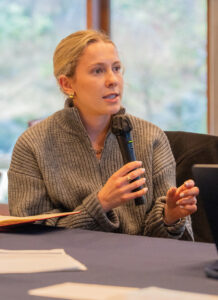
This was unlike any travel I’d experienced before. The meetings we participated in with legal and business professionals, as well as the more informal conversations we had in our free time, gave me the sense of peering behind the curtain of the countries we visited. Rather than simply observing cultural differences as I had done when traveling previously, we learned why those differences had manifested. For instance, at the Ministry of Economy, Trade and Industry in Tokyo, we learned that corporate governance in Japan is controlled primarily through informal rules and “soft law.” Social conformity in Japan is so robust that these rules substitute for the corporate laws we have in the U.S. In Shanghai, we spoke with an attorney who lived through China’s rapid privatization and economic growth. His insights about how significant that period was—by lifting nearly a billion people out of poverty and accelerating business development—explained why we noticed a near-constant display of national pride as we walked Shanghai’s streets.
But this repeated exposure to cultural differences was also a repeated lesson in translating. Seeing varied models of legal systems was invaluable—and a critical reminder that many aspects of our legal environment that we may take for granted are not predetermined. Instead, they are informed by social standards like the role of family, political and military history, natural resources, and national identity. Communicating effectively as lawyers, playing that essential translating role, requires more than just observing differences, as I had done in earlier travel. It demands full appreciation of where those differences originate so that common ground can be found.
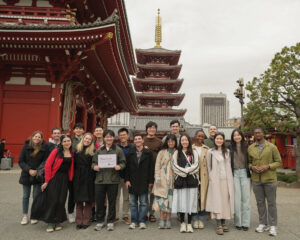
In our last on-campus class before we left for the Asia field study, Professor Curtis Milhaupt, the faculty director of the Franke Global Program who taught Global Corporate Governance, shared this Henry Miller quote about travel: “One’s destination is never a place, but a new way of looking at things.” As law students, our conception of the law and of our own career paths is still in formation. The way we view the world is not yet fixed, making an experience like the Franke Global Quarter extra impactful. The program delivered a substantive education that will be useful should I choose to work internationally or cross-culturally. Even more important, I learned to broaden and question my viewpoint, and I hope to nurture that malleable perspective throughout my career as a lawyer. SL