
Scholars Examine High Court Ruling on Sentencing
Many of the nation’s leading criminal justice experts gathered at Stanford Law School on October 8 and 9 to discuss the impact of the landmark U.S. Supreme Court ruling in Blakely v. Washington. The June ruling struck down as unconstitutional Washington State’s sentencing system, and, by implication, the federal system as well. Blakely set the stage for the Court’s January 12 ruling in United States v. Booker, which overturned the 17- year-old federal sentencing guidelines.
The two-day symposium, “The Future of American Sentencing: A National Roundtable on Blakely,” was organized by Robert Weisberg ’79, Edwin E. Huddleson, Jr. Professor of Law and director of the new Stanford Center for Criminal Justice. Weisberg used the symposium to launch the new center, which will integrate research, public events, and clinical education in the field of criminal law.
The symposium was held just days after the Supreme Court opened its new term with expedited hearings in Booker. The U.S. Justice Department had asked the Court to speed up its handling of this case to resolve the uncertainty over federal sentencing in the wake of the Blakely ruling. The timing of the symposium was opportune, allowing attendees to discuss not only what the implications of Blakely were for federal sentencing, but what possible remedies the Court and Congress might take to revise them. “Almost all the participants at our conference predicted that the Blakely decision would substantially invalidate the federal guidelines,” said Weisberg. “The decision in U.S. v. Booker simply confirms the foresight of the participants.” The federal sentencing guidelines were designed to constrain the discretion of federal judges in sentencing, and to ensure greater uniformity.
in sentencing practices across the country. But the guidelines were controversial from the start. Both criminal defendants and federal trial judges condemned the rigid formulas and mandatory terms they imposed. In Booker, the Justices ruled that if Congress wants mandatory sentencing factors, those factors may have to be decided by juries, not judges. The Court avoided the jury trial requirement by declaring that the guidelines are now merely advisory and not mandatory. “The result of Blakely and Booker is very ironic,” continued Weisberg. “We are back to the kind of discretionary system that the guidelines were supposed to alter. This is likely to be a very unstable compromise. Congress will now explore a wide range of options and is likely to end up constraining judicial discretion all over again.”
Among the symposium panelists were the two principal attorneys in the Blakely case: Jeffrey Fisher, counsel for defendant, and Michael Dreeben, a U.S. deputy solicitor general who has represented the government in the Blakely and post-Blakely litigation.
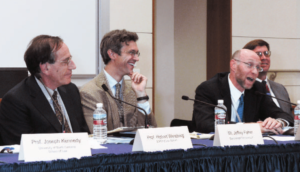
“On the surface, Blakely is about assigning determination of sentence to a judge, but it’s not about that at all,” said Dreeben. “It’s not aimed at protecting jury trial either. It’s about Justice Scalia’s view of judging as opposed to judges interpreting the Constitution. He’s saying ‘Stop me before I annihilate the jury and give my and Delinquency on juveniles and the criminal justice system. “Upcoming events will likely include a symposium on reassessing gun control, gun rights, and the Constitution, to be held in the late spring or summer,” said Weisberg. Additional plans for the center are still being finalized. Among the possible activities it will engage in are sponsoring and publishing original research, hosting visiting fellows, running clinical programs, and developing interdisciplinary courses and programs with other parts of the university. —Judith Romero