
Stanford Law Gathers to Celebrate Mark Kelman’s Extraordinary Career
“I was thinking about the many challenges we face in the legal academy, and I think we could solve a lot of them if we could just figure out a way to clone Mark,” Professor Amalia Kessler told a roomful of Professor Mark Kelman’s colleagues, former students, fellow scholars, and friends at Stanford Law School on May 15.
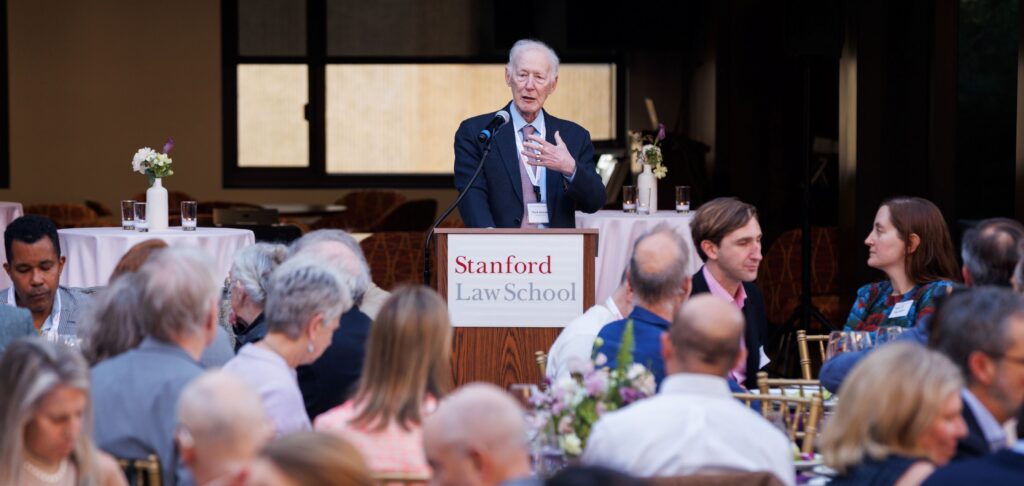
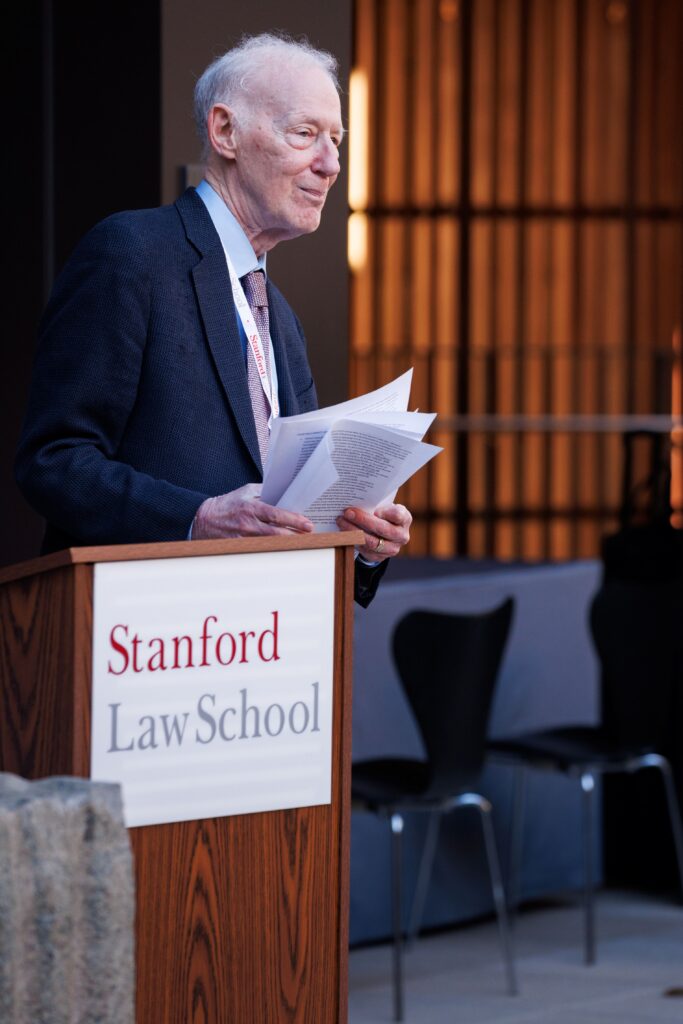
The line captured the spirit of the day-long festschrift honoring Kelman, the James C. Gaither Professor of Law, whose career has helped define the intellectual life of Stanford Law School for nearly five decades. A pioneering legal theorist and longtime vice dean, Kelman is known for interdisciplinary scholarship that has reshaped debates in critical legal studies, criminal law, taxation, antidiscrimination law, and the legal meanings of “harm,” “injury,” and “welfare.”
The festschrift included substantive discussions of Kelman’s wide-ranging contributions to law and legal theory, along with personal reflections on his mentorship, institutional leadership, and enduring influence on the Stanford Law community.
Bernie Meyler, JD ’03, the Carl and Sheila Spaeth Professor of Law, served as the principal organizer of the day. “There is something about the combination of Mark’s characteristics that have made him so transformational for the law school: his openness to interdisciplinary inquiry, his ability to synthesize as well as critique, and his willingness to engage in the practical minutiae needed to make sure the best version of legal education can be implemented,” Meyler said.

Moral Conviction and Intellectual Humility
Kelman joined the Stanford Law faculty in 1977, at age 26, after working on criminal justice and social policy projects in New York City. Over nearly five decades at Stanford Law, he has become one of the school’s most influential intellectual figures, known for integrating insights from economics, cognitive psychology, and political theory into his legal scholarship.
His most recent book, Understanding Harm: How the Law Should Assess Injury, invites critical thinking about legal approaches to injury and what it means to be well or badly off.

Kessler, Lewis Talbot and Nadine Hearn Shelton Professor of International Legal Studies, offered opening remarks for the first panel. She reflected on the breadth of Kelman’s scholarship, describing it as a rare combination of interdisciplinary reach, empirical grounding, respect for nuance and complexity, deep moral and political conviction, and a signature intellectual humility.
“Now more than ever, we need the qualities of mind and character that make Mark Mark,” she said. “Although his work has ranged very broadly from early critical legal studies to today, I see a set of qualities of mind and character and values that are consistent throughout his long career.”

A keynote panel in the afternoon brought together Kelman, Stanford Law School Dean George Triantis, and former Stanford Law Dean Larry Kramer, now president and vice chancellor of the London School of Economics and Political Science. Introducing the discussion, Triantis described Kelman as “an institutional pillar” of Stanford Law School for nearly half a century and noted his profound influence on generations of students, colleagues, and the broader university. Kelman’s teaching, Triantis said, has long centered on the “fundamentals of law, the legal system, and legal institutions.”
“Mark’s career project, at least part of it, might be described as mapping the genome of the legal system,” Triantis said. “Mark’s focus on fundamentals and the core values and principles that underlie the legal system and legal academia couldn’t be more timely than now.”
Kelman, in turn, used the keynote panel to reflect on the close connection between teaching and scholarship. Many of his books, he noted, began in the classroom, including A Guide to Critical Legal Studies, which grew out of a course he taught in the early 1980s, and Understanding Harm, which emerged from a discussion class on injuries.
“Pedagogy and scholarship bear quite a lot in common,” Kelman said. Many of his major projects, he explained, grew from “trying to teach an interesting problem and discuss it with a group of engaged students.”
Read More: Stanford Lawyer magazine feature about Professor Kelman