
Stronger Oversight of Health Care AI
A report published in October in the Journal of the American Medical Association outlines how the health care sector should responsibly seize the opportunities of AI, including what must change to ensure that AI adoption improves patient outcomes, not just efficiency. Among the key recommendations in “AI, Health, and Health Care Today and Tomorrow” are expanded oversight by the Food and Drug Administration and the development of evaluation tools to measure effectiveness in clinical settings.
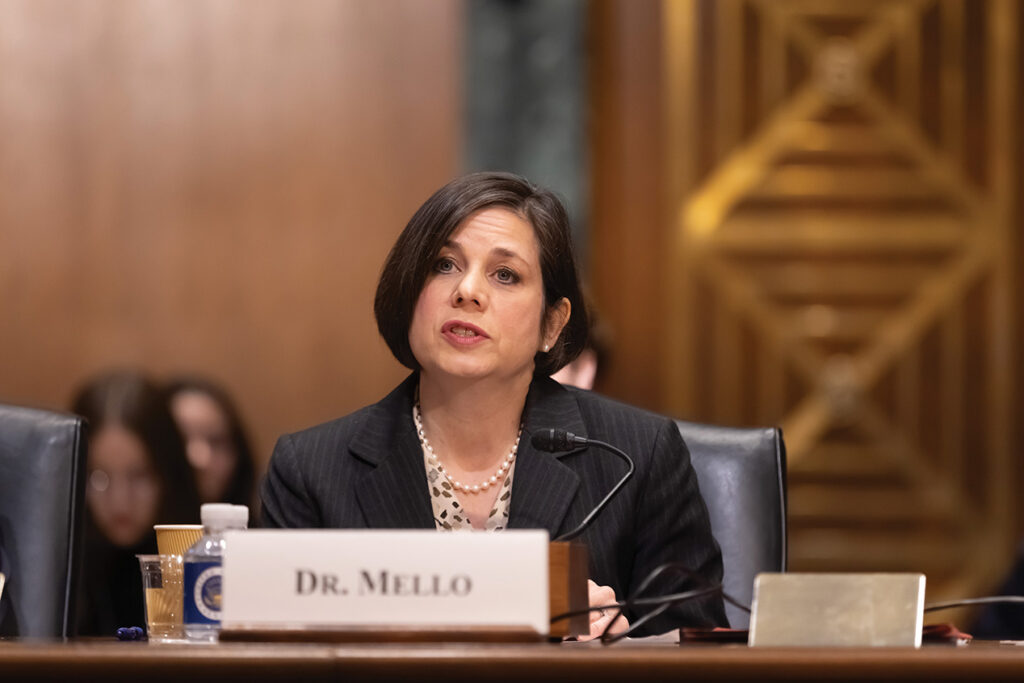
Policy Michelle Mello (BA ’93)
The report was co-authored by Michelle Mello (BA ’93), professor of law and health policy at Stanford Law School and Stanford University School of Medicine, along with Professors of Medicine Dr. Tina Hernandez-Boussard (MS ’13) and Dr. Nigam Shah. The report grew out of the 2024 JAMA Summit on Artificial Intelligence, an invitation-only convening that brought together more than 60 leaders in medicine, law, policy, and industry to examine the opportunities and risks of AI integration in clinical care. The summit was part of an ongoing JAMA series launched in 2023 to spark cross-sector dialogue and drive practical solutions to pressing health policy challenges.
“AI is being adopted at remarkable speed in the health care sector, but our systems for evaluating and regulating it haven’t kept pace,” says Mello, a member of the National Academy of Medicine whose empirical research is focused on understanding the effects of law and regulation on health care delivery and population health outcomes. “This report identifies concrete steps that can help make AI’s integration into health care more transparent, effective, and fair.” Mello and her co-authors emphasize that AI’s potential is vast for reducing administrative burdens, improving diagnostic accuracy, personalizing treatment, and extending care to underserved populations. But without better infrastructure, evaluation, and incentives, they write, that promise could be undercut by limited and inequitable deployment, unintended harms, and wasted resources. SL