
Studying Law and Democracy in South Africa
Reflections on a Transformative Field Study
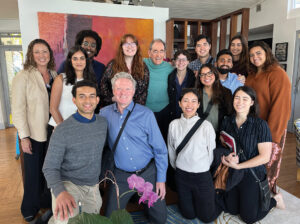
“Amandla awethu!” we chanted together on our first day in Cape Town. The words, Xhosa for “the power is ours,” have echoed through South Africa’s long history of resistance. Taught to us by the lawyers at the Equal Education Law Centre, the phrase is an invitation, a reminder that power does not live only in constitutions or courtrooms but also in people acting together. Beginning our study trip with these words was tuning in to a vision of law grounded in collective action and the belief that the seeds of change rest in our hands.
Our time in South Africa brought us into conversation with a nation openly reckoning with law’s failures and possibilities. Led by instructors Jamie O’Connell and Jory Steele (BA ’93), our group was part of the field study Law, Lawyers, and Transformation in Democratic South Africa and the third cohort of 12 students funded by Stanford Law’s W.A. Franke Global Law Program to travel to Cape Town to explore the role of law and public interest lawyers in advancing social transformation. During the 14-day course, we were asked to hold two truths at once: In a country where the law was used under apartheid to uproot communities and legitimize racial violence, it now supports some of the world’s most ambitious and creative public interest work. Encountering these realities in the same city made clear that law’s power can cut both ways—and as future lawyers, we bear great responsibility for how we choose to use it.
South Africa is often heralded for having one of the most progressive constitutions on the planet. Its text enshrines socioeconomic rights to housing, education, health care, a healthy environment, and more. Among the highlights of our trip was meeting Justice Albie Sachs, appointed by Nelson Mandela to the first Constitutional Court and a key drafter of the agreement that governed the transition from apartheid to democracy. Sitting in his home looking over the ocean, Justice Sachs shared stories of his exile in Mozambique, conversations with Mandela, and visits to the U.S. Supreme Court, returning repeatedly to a central lesson he urged us to carry home: Socioeconomic rights, though legally enforceable, were never meant to be self-executing. They are aspirations as much as guarantees—promises written into law that require sustained political will and imaginative lawyering to become real and lasting.
“As Justice Sachs reiterated, justice is not something the law delivers on its own. It is something lawyers can help bring into being …”
The tension between constitutional promise and lived reality became a defining theme of our time in Cape Town. More than three decades after apartheid’s formal end, South Africa continues to grapple with its enduring legacies. During our week of preparatory study on Stanford’s campus, we examined the legal architecture that created and enforced racial hierarchy. We traced how statutes, administrative systems, and courts were mobilized to dispossess, segregate, and control. But those harms, discussed abstractly on campus, took on new weight once we arrived.
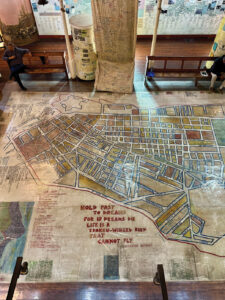
For many of us, our visit to the District Six Museum was one of the most impactful moments of the trip. Once a vibrant, multiracial neighborhood in the heart of Cape Town, District Six was a place of music, family, and shared lives, where homes were built close together and communities grew over generations. Under apartheid, District Six was declared a “whites only” area, and more than 60,000 residents were forcibly removed. Homes were bulldozed. Lives were decimated. The museum, lined with photographs and testimonies of former residents, revealed how laws had provided a veneer of legitimacy for the destruction, cloaking systemic displacement in the language of order, development, and progress. Law had not merely failed to prevent injustice—it had actively organized it.
Today, District Six represents not only the physical erasure of an entire neighborhood but also a collective wound that, despite ongoing efforts at restitution, has yet to fully heal. As we stood on land from which vibrant communities had been uprooted, the consequences of legal racism felt immediate and unsettling. This was not distant history. Many of the people whose words filled the museum walls are still alive, and many of the harms Black South Africans live with today remain unresolved. This proximity forced us to confront a difficult truth: The law’s capacity for violence is not confined to a distant past; it is an ever-present risk when legal systems, and the lawyers who serve them, fail to resist it.
A new vision for law
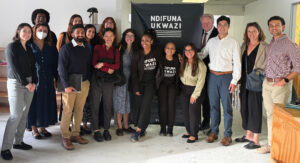
Against this backdrop, our meetings with public interest organizations across Cape Town showed us a different vision of what the law can be. If learning about apartheid revealed law at its most destructive, these conversations uncovered its most transformative potential. At organizations like Ndifuna Ukwazi, Equal Education, and the Legal Resources Centre, we encountered a version of lawyering that was bold, creative, and deeply rooted in community. The lawyers we met described their work as the careful task of making the law responsive to lived realities it too often overlooks. Transformative lawyering, we learned, grows out of humility, imagination, and an awareness that the constitution is not a finished achievement but an aspirational promise still being fought for.
In the end, our time in Cape Town revealed far more than the obvious contrast between law’s possibilities and its shortcomings: It emphasized the responsibility that sits between the two.

We traveled to South Africa at a moment of uncertainty, when many fellow students are questioning what it means to study law in a world where the language of “legality” continues to mask displacement, exclusion, and harm, both at home and abroad. We returned without easy answers, but with greater clarity about what our chosen profession asks of us.
As Justice Sachs reiterated, justice is not something the law delivers on its own. It is something lawyers can help bring into being, slowly, imperfectly, and in partnership with the people the law is designed to serve. It lives in listening before speaking, in imagination before certainty, and in the courage to choose, again and again, to resist the law’s capacity for harm and insist instead on its promise. Amandla awethu. The power for change is ours—if we commit to carrying it together. SL
Nicolas Lama is a second-year JD/MS candidate at Stanford Law School and the Doerr School of Sustainability. At Stanford, he is co-editor-in-chief of the Stanford Environmental Law Journal and financial officer of the Stanford Latinx Law Students Association. Last summer, he was a litigation intern at the Natural Resources Defense Council in Washington, D.C.