
Taking Clinical Education to the Next Level
It was in the fall of 1990, just before the Jewish Day of Atonement, that Rolando Cruz came into Lawrence C. Marshall’s life. Cruz had been sentenced to death for the 1983 rape and murder of a 10-year-old girl, and some lawyers were asking Marshall to take on his appeal.
At the time, Marshall was a young professor at Northwestern University School of Law. “I was not yet tenured and had a heavy publication schedule,” he says now. Larry Marshall, one of the nation’s top clinical law professors, recently joined the law school faculty — charged with turning the clinical program into one of the best and most innovative in the country. But as he listened to the well-known passage in the Yom Kippur liturgy—the part that asks, “Who shall live and who shall die” in the year to come?—Marshall remembered thinking, “How can I turn this guy down?” At the time, Marshall had developed certain views about capital punishment. He believed that it was applied in an arbitrary and racist manner and that the typical quality of trial counsel in death cases was dismal. But like many people, he tended to believe that people on death row almost certainly committed the crimes for which they were convicted. “The Cruz case just shocked me,” he said, “because it was clear to me that there was no way this man was guilty. The evidence was so paltry.”
As the appeal picked up steam, law students at Northwestern volunteered to help Marshall by interviewing witnesses, conducting research, and writing drafts. Cruz finally was freed—more than five years after Marshall became involved—after a sheriff’s deputy admitted that he was in Florida at a time when he had earlier testified he had heard incriminating evidence in Illinois. DNA evidence later showed another man committed the crime.
Marshall and his students soon took on the cases of other wrongly convicted Illinois death row inmates, freeing many over the next 14 years and creating one of the most successful clinics in legal education. Their efforts made national headlines and threw Marshall into a dizzying round of television appearances.
When then Illinois Governor George Ryan made his highly publicized speech commuting the sentences of all prisoners on the state’s death row in 2003, he cited Marshall as one of his chief sources of inspiration. “Larry,” he says now, “helped me see the light.”
Earlier this year, Marshall left Northwestern for Stanford Law School, bringing with him all the energy, passion, and commitment that was so evident in his death penalty work. Now, as professor of law and David and Stephanie Mills Director of Clinical Education, Marshall is on an ambitious mission: to make Stanford Law School’s growing clinical program the best in the United States.
Within the next two years, he hopes, Stanford will be able to provide a quality clinical experience for every law student who wants one. Ultimately, Marshall would like Stanford to be the first top university in the nation to require hands-on training for all its future lawyers.
Sitting in his office in the basement of Stanford Law School, Marshall, 46, is surrounded by souvenirs of his high-profile career, including an autographed photo of U.S. Supreme Court Justice John Paul Stevens, for whom he clerked, and a framed copy of the 1995 Chicago Tribune front page announcing Cruz’s exoneration. Marshall knows that building on that success at Stanford won’t be easy—the school’s clinical program doesn’t even yet rank in U.S. News & World Report’s top 30. He understands that supervising students on complex pro bono cases will demand greater resources and face time from Stanford faculty than traditional teaching requires. Yet as he sees it, law schools, like medical schools, have an obligation to provide students with opportunities to integrate what they have learned in the classroom into the realities of practice, under the intense guidance of clinical faculty.
As the genial, bearded scholar explained, “It’s a unique educational experience for a student to watch the progress of a case from the beginning to the end, and it’s a remarkable inspiration for students to recognize the power that they have as lawyers. I’m not going to say that the panacea for all the legal system’s problems is clinical education. But one commonality that all lawyers have is that they’ve been through law school. And that creates a real responsibility for us to find devices to inspire our students about how glorious a profession law can be.”
RELEVANT EDUCATION
American law schools began to launch clinics in significant numbers in the 1960s, as students demanded more relevant courses and the War on Poverty provided the first federally funded support of legal assistance to the poor. The idea, wrote Daphne Eviatar in the November/December 2002 issue of Legal Affairs, “was to teach law students the basics of legal practice by having them handle cases for low-income clients. Under a seasoned lawyer’s supervision, students would represent, say, a tenant fighting an eviction notice or a disabled person filing for Social Security benefits. The cases were about solving someone’s run-of-the mill legal problem, not making headlines.”
During the 1970s and 1980s, clinics mushroomed across the United States and became increasingly popular with students. “Yet they remained at the margins of the legal academy,” Eviatar wrote. Clinical professors—mostly longtime legal aid lawyers who had come to academia after decades in housing, family, or criminal court—were “suspect in the eyes of many academic professors, some of whom practiced little or no law themselves.” Said Wallace Mlyniec, associate dean of clinical legal studies at Georgetown University Law Center, in that same article: “The assumption was always that [clinicians] couldn’t compete with the academic rigor of the rest of the faculty.”
As law school applications dipped in the mid-1990s and rankings pressure mounted, some law schools began to rethink their attitudes toward clinical education. The movement got a boost with the publication of an American Bar Association paper known as the McCrate report. It concluded that much of American legal education was badly out of touch with the profession and that law schools weren’t teaching students essential skills and values. Today, Eviatar wrote, almost all of the 182 U.S. law schools offer in-house clinics, which are staffed by more than 1,400 instructors and generate around 3 million hours of volunteer student legal work each year.
Stanford first began offering clinical opportunities to complement its regular curriculum during the 1970s under the guidance of law professor Anthony G. Amsterdam. After Amsterdam left for New York University School of Law in 1981, Stanford students participated in a variety of clinics through the East Palo Alto Community Law Project, an independent nonprofit organization launched by Stanford law students that provided legal services to the poor of East Palo Alto and east Menlo Park.
More recently, under the direction of David Mills, senior lecturer in law and then director of clinical education, Stanford launched several in-house clinics taught by full-time faculty. As Kathleen M. Sullivan, Stanley Morrison Professor of Law and former dean, explained, “Previously, we relied on lecturers and adjuncts to give students handson clinical training. Launching a full-time clinical faculty consisting of great litigators who also shared deep intellectual interests and passions with the tenure-line faculty was a bold new step for Stanford.”
Currently, about 60 percent of Stanford law students participate in one of seven clinics during their three years at the law school. They include the Stanford Community Law Clinic—an in-house version of the original nonprofit Law Project that provides legal assistance to low-income Bay Area clients—and a criminal prosecution clinic in which students work under the guidance of a professor and experienced prosecutors from the Santa Clara County District Attorney’s Office.
Other clinics deal with cyberlaw, education, the environment, and Supreme Court litigation; earlier this year, the law school added an immigrants’ rights clinic to the list. (Each of the seven clinics is profiled at the end of this article.) Before long, Marshall hopes to develop a transactional law clinic that will give students practice helping small business entrepreneurs and nonprofit organizations, and an intellectual property clinic to take advantage of the law school’s Silicon Valley location and strong faculty presence in that field of the law.
Pamela S. Karlan, Kenneth and Harle Montgomery Professor of Public Interest Law and codirector of the Supreme Court Litigation Clinic, is one of many Stanford faculty and students who are thrilled by Marshall’s permanent appointment, which she calls “a real coup” for the law school. “Larry is not only an experienced and creative thinker about clinical teaching issues, but also a first-rate constitutional law scholar and Supreme Court watcher,” she said. “Everyone I’ve talked to—both within and outside Stanford, students and faculty alike—thinks he’s a great addition to the faculty.”
Larry Kramer, Richard E. Lang Professor of Law and Dean, agreed, calling Marshall “a highly respected traditional academic” who is also one of the nation’s leading clinical teachers. Under Marshall’s new leadership, Kramer said confidently, “we believe we can create a clinical program unlike any other in the country—a program whose quality and reputation matches that of the school generally.”
Soon, the clinics will have renovated office space to facilitate their functions. One of the first things Marshall did after taking over the program was to sit down with an architect. Most of the school’s clinics are hidden behind office doors along an antiseptic white hallway in the law school basement, and the student workspace is furnished with mismatched hand-me-downs.
Marshall envisioned something better—a high-tech, professionally furnished “mini-law firm” where Stanford law students could greet and interview their clients, discuss strategy with their professors and peers, and write up case briefs and court petitions.
The resulting basement renovation, to be completed this fall, will be more than an exercise in tasteful office decor. “We want to make the statement, both symbolically and actually, that clinics are not some collateral sideshow, but are an integral part of what Stanford Law School is,” Marshall said. “And if we’re going to build world-class clinics, we need world-class space.”
MENTOR AND TEACHER
Unlike many of his clinical colleagues, Marshall didn’t start off his career as an attorney working in the legal trenches. The Boston native spent his undergraduate years in Israel at a small yeshiva. Then he returned to Boston and worked for a nonprofit agency that brought foreign patients to the city for specialized health care. After graduating first in Northwestern’s law class of 1985, he went straight into clerkships for Patricia Wald of the United States Court of Appeals for the District of Columbia Circuit, and for Justice Stevens.
Recruited back to Northwestern in 1987, Marshall started out as a “completely conventional stand-up teacher” offering popular courses in civil and criminal procedure, constitutional law, federal jurisdiction, legal ethics, and appellate practice. “I was producing law review articles and writing and teaching, and enjoying that greatly,” he recalled, “but at the same time, I felt it was really important to have at least a finger, if not a hand, in practice, so I could teach my students the realities of what it means to be a lawyer. Being involved in practice also allowed me to show them I embrace the practice of law, and believe it to be an area in which great satisfaction can be had.”
By 1990, Marshall had begun working on cases with the Chicago law firm of Mayer, Brown & Platt, then the premiere Supreme Court and appellate group in the country. That’s when he got involved in the Rolando Cruz case. Later, another Illinois death row inmate named Gary Gauger wrote asking if Marshall and his students could help with his case, too.
Gauger, a laid-back organic farmer, had been convicted of murdering his parents in 1993 on the family farm in Richmond, Illinois. After the crime, police questioned Gauger for 18 hours without a lawyer, until he blurted out that it was possible he might have committed the murders during a mental blackout. Again, Marshall and his clinical students agreed to take the case, and again their client was exonerated. Federal agents ultimately caught the real killers: two members of a motorcycle gang who killed the couple during a botched robbery.
Today, Gauger is happily married and back on the farm, breeding heirloom tomatoes. He speaks for many when he calls Marshall “a great example of what a human being should do with their life.” Before Marshall took his case, Gauger said in a telephone interview from Illinois, “I was really burned out and turned off by lawyers. I’d had two bad attorneys who were just in it for the money. Larry taught me that not all lawyers are shysters.”
Students are still chipping away at the death penalty, one case at a time, at Northwestern’s Center on Wrongful Convictions, the clinic Marshall founded in 1999. One of his former students, Alais Griffin, called Marshall “an incredible mentor and teacher” who provided her with a model of what a lawyer should be in any specialty. “He told us that as we read cases in our textbooks to learn various propositions of law, we should always remember that these were cases that involved real people who cared deeply about the outcomes,” said Griffin, now a fourth-year associate in the Chicago law firm of Goldberg Kohn Bell Black Rosenbloom & Moritz, Ltd. Northwestern law dean David Van Zandt echoed the sentiment. “He’s an excellent classroom teacher and Stanford’s lucky to get him,” Van Zandt said.
CONSTANT MOTION
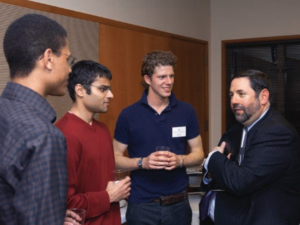
Since moving to Stanford as a visiting professor last year with his family—Marshall’s wife, Michelle Oberman, who teaches at Santa Clara University School of Law, and two of his five children (three are grown)—Marshall has been in a constant state of motion. During a recent informational dinner in the law school student lounge, he worked the crowd relentlessly, spreading the word about clinical education to a curious, standing-room-only audience of law students. Even though few are aiming at careers in public service, he told them, “We want you to be exposed to what you can do with your law license and your immense talents, because the world and community need you, and because we’re convinced that involving yourself in the needs of the underserved is going to make you happier, better lawyers.”
Marshall is often asked why law students should enroll in clinics if they’re going to be practicing their whole lives. “The answer,” he said, “is that if clinics were simply giving students a fast-forward preview of what they will be doing for 50 years in practice, then we’d have no right to be part of an educational institution. But what our clinics are doing is creating an essential bridge between the class room—where you have a lot of theory but necessarily not a lot of real world context—and the world of practice, where you won’t have the time or opportunity to reflect, to dissect, and to think about the theoretical implications of what you’re doing.”
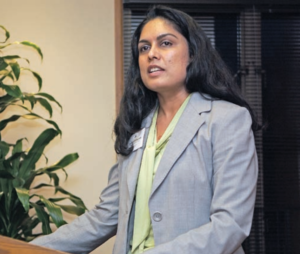
Stanford’s Youth and Education Law Clinic is a case in point. Founded in 2001, it gives as many as 14 students each semester the chance to work for academic credit on a variety of educational rights and reform cases, including direct representation of youth and families in special education and school discipline matters, community outreach and education, school reform litigation, and policy research and advocacy.
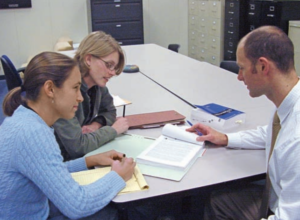
Students are assigned their own cases and work in teams of two, meeting frequently with clinic director William Koski (PhD ’03), associate professor of law (teaching), for guidance. Once a week, the whole class meets to review the cases, reflect on the experiences of the past week, and discuss the finer points of education law.
At one late afternoon session, students in the clinic gather around a conference table to talk about their young clients. Gabriel Soledad ’05 and his partner Kamali Willett ’06 are trying to help an emotionally disabled local high school student who has been disciplined for an incident involving use of the Internet, but they aren’t sure what to say in their demand letter to the school district.
Koski suggests some wording and puts some sample letters up on the overhead. But Soledad, a law student from El Paso, Texas, is troubled by a deeper question: Sure, they may eventually get this low-income Latino student back into school with the help he needs. But doesn’t a lawyer also have an obligation to make sure the kid actually learns something from the experience?
The question sparks a thoughtful exchange. One student insists that behavioral counseling is not the best use of a lawyer’s time. Another says she would focus on warning the young person about the legal consequences of future misbehavior. “I’ve struggled with this, too,” Koski says. Once, he even asked a kid to sign a contract promising that he’d check back with him at regular intervals after the case ended. “It was a miserable failure,” he says, to laughter. “A year later I saw him riding his bike in East Palo Alto. He just waved.”
Later, in his office, Koski reflected on the lively classroom discussion. “In my mind, that’s exactly what clinics are supposed to do—to give students the space to be reflective and think about their lawyering and really meld those bigger, broader ideas into practice. These students are the cream of the crop, so there’s always a very insightful conversation.”
Many alumni say working in the Stanford clinics was the capstone of their legal education. David Gonzalez ’99 was enrolled in the Criminal Prosecution Clinic during his third year of law school. Today he and his wife run their own small criminal defense firm in Austin, Texas. He finds that job candidates who come to his office with clinical experience have a 6- to 12-month advantage over those who don’t. Looking back, he said, “The best part of the clinical experience was working with a group of students and a professor to process fact scenarios, legal arguments, and ethical quandaries. I have never been a big fan of group projects or collaborative learning, but it wasn’t until I was out on my own that I realized how important it is to have someone to bounce ideas off of or discuss case strategy with.”
Marshall confesses that when he first came to Stanford last year as a visiting professor, he didn’t think he would stay. “I was so entrenched in Illinois,” he explained, “with a community and friends I loved, that in order for me to stay it was going to take an extraordinary sense that this was a once-in-a-lifetime opportunity to be part of something very substantial.” But the energy he’s felt since then—from the dean, faculty, and students—has persuaded him that “the stars are aligned, and Stanford is on the cusp of becoming a true leader in clinical education.”
He smiles and props his feet up on the desk. “I remember one day, maybe a week into my arrival, I made a phone call to someone in the law school asking for a clinic phone number, and the person said, ‘I think you have the wrong number. Don’t you want the Stanford Medical School?’ My dream is that 20 years from now, someone will call up the medical school looking for a clinic. And the person on the other end will ask, ‘Don’t you want Stanford Law School?”