
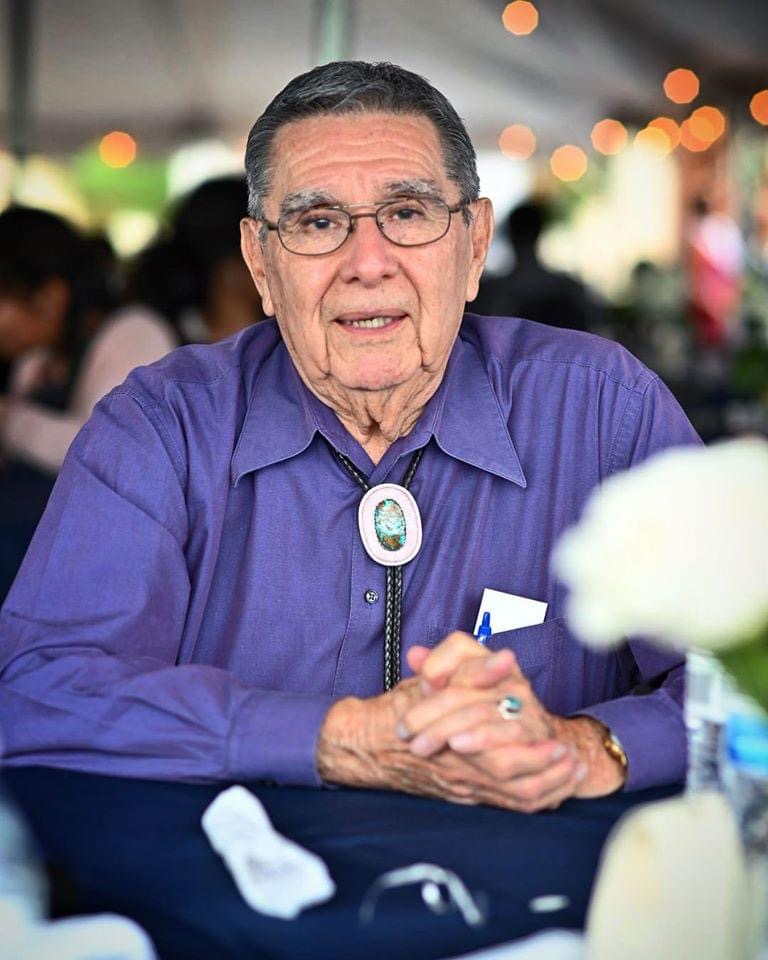
The Honorable Robert H. Piestewa Ames
On September 17, 1963, a makeshift bus carrying migrant workers participating in the federal government’s Bracero Program that brought agricultural workers from Mexico into the United States collided with a train in Chualar in California’s Salinas Valley. It was the worst transportation accident in the country at the time, with 32 people dead and 25 injured. The bus driver, Francisco Espinosa, who claimed he could not see or hear the train coming, was charged with manslaughter.
“There were no public defenders in those days,” Robert “Bob” H. Piestewa Ames, JD ’54 (BA ’51), said in a Monterey Herald article about the incident. “Of course, everybody knew about the accident, it was all over the newspapers, everybody was aware of it. It never occurred to me I was going to end up involved in it at all. The phone rang … the judge said, ‘I want to appoint you to represent the bus driver in the train accident.’ I took a deep breath and I said, ‘OK, I’ll do it.’”
Ames put together a strong defense, his investigation uncovering evidence of overgrown vegetation and wobbly telegraph poles lining the tracks that obstructed the view and a challenging geography that made it hard to hear a train approaching. He also took Espinosa for a thorough eye exam that revealed serious vision issues. He won the case and Espinosa was acquitted of all charges.
It was a landmark case that helped to reshape farm labor bus laws and end the Bracero Program. For Ames, it was what he loved about the law—the work that happened out of the limelight—asking questions and digging for the evidence that a case might turn on.
Ames, the first Native American Stanford Law School graduate, chief judge of the Hopi Tribal Trial Court, tireless advocate for Native American culture and education, passionate Stanford sports fan, and much more, passed away on December 5, 2023, at the age of 94 at his home in Salinas, California.
Ames grew up during the Great Depression just outside of the Hopi reservation, between Route 66 and the railroad tracks in Winslow, Arizona. His family was poor, like everyone in the area at the time. His father was a Hopi Tribe member and his mother white. They divorced when he was young, and he took his stepfather’s name, “Ames.” He excelled at sports and in academics, and a teacher encouraged him to apply to Stanford. Never having been to Palo Alto, he arrived on campus in 1947 to study economics. He lived in Encina Hall, using Navajo rugs brought from home as blankets. He walked on to the baseball team and settled into a place that was at first very foreign.
“I don’t think anybody on the baseball team thought of me as an Indian person,” he recalled in the 2010 Stanford Oral History. “The baseball team was my support group at the university, together with my fraternity. At that time, there were no theme houses and no minority counselors and no scholarships.”
The first in his family to go to college, he decided to pursue a law degree and perhaps make a difference. He described missing out on things he didn’t know to ask about—like the regular dinners honors students had with faculty and even Law Review.
“That was totally foreign to me. And I wish I’d been a little more aware. Even to the extent the first year of law school, I believe I was tenth in the class, and I was invited to join Law Review. And I said, ‘What’s Law Review?’ And they said, well, you’ve got to come back and do a lot of reading and studying and research and all that. I said that doesn’t sound like a lot of fun. I got to go back home and work in the service station.”
After law school, he looked for a small firm to join, in a town with a strong sense of community. He found what he was looking for when a Stanford friend introduced him to the founders of Stave and Bryan in Salinas. He joined the firm in 1955, focusing on labor law and other areas—and stayed until he retired in 2022.
One of his daughters, Lauren Ames, traces her father’s love of labor law to his early experiences. “He said it’s important to know what it means to do hard labor.” And he did: working construction at Stanford where he helped to build Crothers Hall, at church where he cleaned up after Sunday services, and in gas stations on the old Route 66. It was the Depression, and people migrating to California would pass through. “In those days, full service meant you did everything, and to check the water and the oil, you had to reach into the cab of the car. And he said the rotting fruit smell was powerful, people carrying with them what they could scrounge up,” Lauren recalls. “Anytime he smelled rotting food, it would take him back to that.”
Ames was active in Salinas and in Native American issues, serving as chief judge of the Hopi Tribal Trial Court and as a member of the board of the Institute of American Indian Arts (IAIA), among other activities. In 1991, he was appointed by President George W. Bush to the board of IAIA, a four-year college and research center in Santa Fe, New Mexico, primarily for Native American students. Because it was a presidential appointment, he was sworn in by a federal judge—fellow Stanford Law alum and U.S. Supreme Court Justice Sandra Day O’Connor, LLB ’52 (BA ’50).
“I think that was the first American Indian ceremony in the U.S. Supreme Court building,” he recalled.
A beloved member of the Stanford community, Ames was an unofficial recruiter to the university—encouraging young people with promise to apply and even writing recommendations for a few. And word got out.
“I have calls from people all over the place. I just recently received a message from a lady who was on the board of trustees at the Heard Museum in Phoenix while I was there, and she gave me the name of a young Navajo boy who is going to school and he wants to go to Stanford, and she wanted me to come and talk to him,” Ames recalled in the oral history. “There are two young women in New Mexico that I recently talked to, and I try to do that as often as I can. When I become aware of anyone, especially Indian students, I do that.”
Ames clocked more than 60 years of volunteer service to his alma mater, including serving on the Stanford Athletic board, the Stanford Alumni Association’s Board of Directors, and the Stanford Associates Board of Governors. As a supporter of Stanford’s Native American Cultural Center, he was inducted into the Multicultural Hall of Fame in 2004. He was recognized in 2011 with the “Stanford Medal” in recognition of his service to the university.
Still, his influence on Stanford is perhaps equal to the effect it had on him.
“As an Indian person, the impact of Stanford on me is incredible. But I think I made a difference at Stanford, and that is that I’ve helped Stanford people understand a little bit about Indians and learn about how Indian people live and what they can do,” said Ames. “I know that there are Stanford people now on the campus who have a better knowledge and understanding of Indians than they did before I was there.”
The old courthouse for the Hopi Tribe was in Keams Canyon, northeast of Winslow, Arizona, next to a trading post, in a double-wide.
In the late 1960s, after some 15 years practicing law in Salinas, Ames was asked by Hopi elders to become the chief judge of the Hopi Tribal Trial Court. For more than 20 years, he commuted from California to Arizona each month to hear cases and help organize and strengthen the Hopi judicial system—while continuing to practice law in Salinas.
“The Hopi courts are in much the same situation that I am—halfway,” Ames wrote in his contribution to Hopi Nation: Essays on Indigenous Art, Culture, History, and Law. “The courts are trying to recognize custom, tradition, and history in the rendering of decisions and judgments, but the Hopis are living in a contemporary world, and they have laws that are not the same as those with which Hopis have traditionally learned to live. The Hopi courts, as with all courts, should be predictable. How can a Hopi predict what the result of his conduct will be unless he can look to the court to support in some way his customs and tradition?”
The first known member of the Hopi Tribe to earn a law degree, he brought his Stanford education to the job—particularly the lessons of John Hurlbut, his favorite law professor, who would ask students questions but rarely provided the answers. Ames recalled that as chief judge, he often assumed the role of teacher with his associate judge, for instance, who hadn’t gone to law school.
“He would take a recess and he’d call me. And I would ask him: ‘Tell me about the case, who are the two lawyers? … Have they discussed this theory or that theory?’ And then I’d say, ‘What are the possibilities? How does that fit into what you’re seeing and what you’re learning about this, and about the case,’” he recalled in the oral history. “I never told him the answers. But by the end of our discussion, he would have a lot of it figured out.”
Lauren recalls her father talking about his work for the Hopi. “He would say, ‘Maybe you need to take this back to the village.’ He was always pushing to make sure that they didn’t give up the things that are crucial to their sovereignty.”
Toward the end of his life, Ames would tell his daughter that he left everything on the field, that he was at peace.
“He said he was always the peacemaker. The Hopi are known as the peaceful ones. That really was him.” SL