
Tom Dannenbaum (BA ’03)
Investigating the Moral and Legal Principles That Shape Modern Conflict
In early 2003, as the united states prepared to invade Iraq, Tom Dannenbaum (BA ’03) was helping to organize the anti-war movement on Stanford’s campus. “My view was, and still is, that the decision to go to war was legally and morally indefensible,” he says, recalling his time as an undergraduate studying philosophy, public policy, and ethics. “What became clear to me subsequently is that the scale of human suffering it unleashed demanded a deeper account than most explanations of the law were offering.”
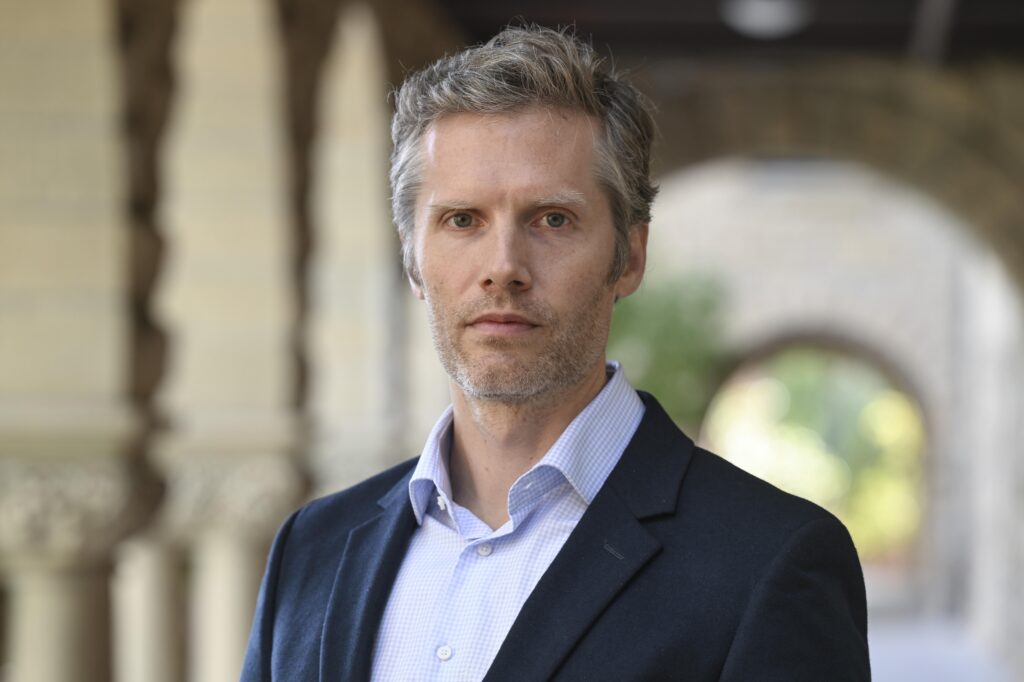
That search for a deeper account has shaped Dannenbaum’s work ever since. As a scholar, teacher, and frequent public commentator, he gravitates toward the difficult questions that emerge where international law, the law of war, human rights, and moral philosophy meet. And it is a focus that has taken his scholarship across a wide terrain: aggressive war, siege and blockade, starvation as a method of warfare, targeting and intent in urban conflict, civilian redress, the duty to end war, and the law governing nuclear installations in conflict zones, among other areas.
Previously a professor at the Fletcher School at Tufts University, Dannenbaum joined the Stanford Law faculty and Stanford University’s Freeman Spogli Institute for International Studies (FSI) in mid-2025. He serves as the Frank Stanton Professor of Nuclear Security at the Center for International Security and Cooperation and is a senior fellow at FSI while also holding a courtesy appointment in the Department of Political Science.
“Until I came to do my job talk, I hadn’t been back on the Stanford campus for two decades,” says Dannenbaum, who earned his JD from Yale Law School and a PhD from Princeton. “It is good to be back.”
A global perspective
Raised in the United Kingdom in a family with roots in multiple countries, Dannenbaum grew up with a natural orientation toward global rather than national frames of reference. During law school, he spent summers working at criminal tribunals for the former Yugoslavia and Sierra Leone.
“From an early age, I found myself drawn to what was happening internationally as much as to domestic politics,” he says. “In grappling with normative questions, I’ve always been inclined toward a more cosmopolitan ethical framework.”
One of his most significant contributions has been rethinking the crime of aggression, the illegal act of resorting to war. Most scholars treat aggression primarily as a violation of sovereignty. For Dannenbaum, the crux of its criminality is the human cost. If going to war is unlawful, he argues, then every death it causes is legally unjustified (at the level of deciding to fight) even though the laws of war allow soldiers to target one another. “Without the crime of aggression,” he says, “that kind of unjustified killing would end up being outside the criminal framework altogether.” Understanding the crime in this way has implications for reparations, disobedience, immunities, and the meaning of pursuing accountability—points that Dannenbaum has emphasized in his work on Russia’s invasion of Ukraine.
“The disconnect between what humanitarians were seeing
and what lawyers were writing was striking.”Professor Tom Dannenbaum (BA ’03)
Starvation, perpetual war, and nuclear security
As he was preparing a legal overview for a 2018 conference on the return of famine in conflict zones, Dannenbaum discovered that the legal analysis on starvation crimes, despite active starvation operations in Syria, Yemen, and elsewhere, was remarkably thin. “The disconnect between what humanitarians were seeing and what lawyers were writing was striking,” he says. He went on to produce work articulating both the legal thresholds for liability and the deeper normative wrong of starvation, which he describes as “societal torture,” a slow and profoundly destructive unraveling of community that is not reflected exclusively, or even primarily, in elevated mortality. These insights have shaped legal debates, twice brought Dannenbaum to testify before Congress, and informed his analysis of starvation tactics in Gaza, Sudan, Tigray, and elsewhere.
Another strand of his scholarship poses a question international law seems to have sidestepped: If the law regulates when states may go to war and how they fight, why does it appear to be almost silent on when they must stop? Dannenbaum’s answer: It is not. There are, in fact, existing legal rules and principles on this issue, but there has been a failure to articulate and develop them in a way that facilitates their operationalization in practice. Remedying that failure, he argues, ought to be a project of no less urgency than resolving long-standing debates about the initiation and conduct of war. Dannenbaum has written a forthcoming book chapter, “Forever War and the Jus Ex Bello,” that examines this issue against the backdrop of the United States’ decades-long armed-conflict posture vis-à-vis al-Qaeda and “associated forces.”
In addition, he is co-editing, with Professor Eliav Lieblich of Tel Aviv University, the forthcoming Research Handbook on International Legal Theory and War, which includes contributions from more than 30 authors who share their perspectives on international law and war.
Increasingly, Dannenbaum is also focused on international law relating to nuclear risk. “The scale of potential harm is extraordinary and unfortunately far from hypothetical,” he says. “Despite that, the topic receives relatively little legal attention, and numerous critical questions remain unanswered.”
In each of these areas, the stakes associated with work on international law feel especially high today, he says. Dannenbaum worries about the most powerful states engaging in severe and brazen violations, while simultaneously undermining the international institutions responsible for oversight and accountability and degrading domestic mechanisms for the internalization of international obligations. “If not met with clear-eyed and broad-based resistance,” he says, “that combination poses an existential threat to the international legal system.” SL