
The Law Must Be King
Judge J. Michael Luttig on the Rule of Law in an Era of Executive Overreach
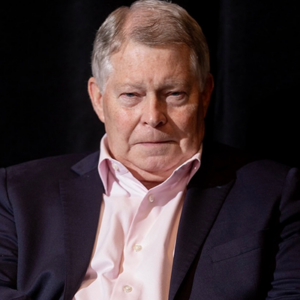
In this special episode, recorded at the Neukom Center’s Rule of Law Speaker Series, Judge J. Michael Luttig, former Fourth Circuit judge and ex-General Counsel of Boeing, discusses a looming constitutional crises facing the United States. Drawing on Lincoln, Paine, and Churchill, Judge Luttig argues that the Trump administration’s actions represent not the exploitation of constitutional vulnerabilities, but unconstitutional conduct that federal courts have repeatedly struck down. He expresses particular alarm over the Supreme Court’s use of the shadow docket to stay lower court decisions without briefing, argument, or written reasoning—a practice he characterizes as a crisis within the Court itself. Judge Luttig also addresses the DOJ’s institutional corruption, Congress’s abdication of war powers and tariff authority, and the Supreme Court’s sweeping immunity ruling in Trump v. United States. Throughout, he challenges law students to treat their professional oath as a solemn civic obligation in a moment of national testing.
This episode originally aired on May 28, 2026.
Transcript
Honorable J. Michael Luttig: It’s not the role of the Supreme Court of the United States to step in when Congress abdicates its job. It hasn’t been in the past, it’s not today, and today especially, it must not do because today, the president has forced a collapse of the separation of powers in the United States of America by brute force. There is no separation of powers in our country at the moment.
Diego Zambrano: This is Stanford Legal, where we look at the cases, questions, conflicts, and legal stories that affect us all every day. I’m Diego Zambrano, a professor at Stanford Law School. Please subscribe or follow this feed on your favorite podcast app. That way you have access to all new episodes.
All right, hello. Welcome to the Neukom Center’s Rule of Law Speaker Series. We are so pleased to welcome Judge Michael Luttig to Stanford today. We’d like to thank the Rhode Center for the Legal Profession and the Stanford Constitutional Law Center for co-sponsoring this event.
Judge Luttig is a widely respected jurist and influential voice in American constitutional thought. He served on the U.S. Court of Appeals for the Fourth Circuit for 15 years, from 1991 to 2006. After retiring, Judge Luttig entered the corporate world, providing his advisory and legal services for both Boeing and Coca-Cola. At Boeing, he served as general counsel from 2006 to 2020. And prior to his judicial service, he also served in the Department of Justice in various capacities, including in the Office of Legal Counsel. We’re very excited to welcome him today.
Honorable J. Michael Luttig: Thank you. Thank you, Diego. I appreciate it. Thank you. It is a special privilege for me to join you today at this Neukom Center for the Rule of Law, and to honor and salute my dear friend, Bill Neukom. Bill was a national treasure for the rule of law in America. He was a world treasure for the rule of law around the globe. America is celebrating the 250th anniversary of its founding this year. Thomas Jefferson authored the Declaration of Independence for the American colonists, which is dated July 4th, 1776. In September of 1787, after the Revolutionary War to secure our independence from the tyrannical King George III and the British Crown, we, the people of the United States ordained and established the Constitution of the United States, in order to form a more perfect union. And on July 4th, 2026, we will celebrate the birth of the greatest nation on Earth, the greatest experiment in self-government in the history of the world. For the 250 years since its founding, America has been the envy of the world and the beacon of freedom and liberty because of the shining light of its democracy, constitution, and rule by law, not by men.
But as we all know, today America is not the same beacon of freedom or the same envy of the world that it has been for a quarter of a millennium, nor, I fear, will it ever again be the very same beacon and envy. The question for we, the people of America, in this, the 250th anniversary of our nation’s founding, is whether we are willing to do the sacred work necessary to return our country to its deserved place as the beacon of freedom and envy of the world.
As we struggle to decide what we ourselves want for America and what we want our America to be and not to be, the entire world is anxiously awaiting our answer. The time of America’s testing has finally come. The founders of this great nation feared these times in America. In this 250 years since its founding, America’s institutions of government and governance and its institutions of democracy and of law are under vicious, unsustainable, and unendurable attack from within.
Speaking in a time of not dissimilar tumult in America nearly two centuries ago, Abraham Lincoln urged a revival to the Constitution and to the rule of law, a renewed reverence for that great charter of our governance and guarantor of our liberty and our freedoms. “Let reverence for the laws,” the 29-year-old Abraham Lincoln implored, “be breathed by every American mother to the lisping babe that prattles on her lap. Let it be taught in schools, in seminaries, and in colleges. Let it be written in Primers, spelling books, and in Almanacs. Let it be preached from the pulpit, proclaimed in legislative halls, and enforced in the courts of justice.” In short, Lincoln sermonized with the reverence he urged, let the Constitution and the rule of the law become the political religion of the nation.
Today, America is in desperate need of such a revival to our Constitution and rule of law, as our 16th President of the United States urged for the nation in 1838. A reawakening and quickening to the reverential imperatives of the Constitution from which we have strayed so very far. Winston Churchill said that Congress is, that courage is rightly esteemed the first of human qualities because courage is the quality which guarantees all others.
We Americans must finally summon the courage that has eluded us in our all-consuming fear over the past decade of years. We must summon from deep within the courage that was once our founders’ courage when, with a firm reliance on the protection of divine providence, they mutually pledged to each other their lives, their fortunes, and their sacred honor to secure their freedom.
With the united support of a hopeful world, we Americans must overcome our fear. We must find our voices again. We must finally stand up, raise our voices, and speak out against what we are witnessing in America today. After all, ours is a nation founded upon dissent and protest. America’s protest against the British Empire 250 years ago is the single greatest protest in all of history. A revolutionary dissent from the tyranny and oppression of King George III.
Until now, we Americans have never hesitated to defend, preserve, and protect our cherished liberties, our freedoms, and our fundamental constitutional rights from governmental tyranny, whether it be from abroad or from at home. If we but find the courage to speak our truth to our government’s power now, today, not tomorrow, as did the founders and our ancestors when their time of testing came, the United States of America will soon again be the envy of the world, and it will endure forever as the beacon of freedom and liberty to the world.
It’s going to take the courage of the convictions of the American citizenry and young patriots like yourselves to defend, support, and protect our imperiled Constitution and rule of law on this, America’s 250th anniversary. Then, once we have finished this task at hand, we must finish the great task that yet lies ahead of us, 250 years since our founding.
We must refound America again. We must rediscover the truths that we once believed to be self-evident. We must discover and reexamine, if need be, the ideals, the truths, the values, and the principles on which our country was founded and has flourished for two and a half centuries. We must reawaken ourselves to the visions, truths, beliefs, hopes, and dreams upon which the country was founded, which have bound our nation together into the more perfect union that we, the people, ordained and established, and that has made America the greatest nation on Earth.
We must “turn this government back into the channel in which the framers of the Constitution originally placed it,” said Abraham Lincoln. We need to shore up and reinforce the bulwark of our faltering democracy and law and refortify the institutions of our law and democracy. “Preserving virtuous institutions is its own noble purpose,” David French put so well.
And as we refortify and restrengthen our sacred institutions of law and democracy, we need to inspire among our citizenry a reverential revival to the Constitution and to the rule of law. Above all else, America is a government of laws and not of men. We are desperately in need of such a revival. We simply have no other choice, than to pass with flying colors the test laid down for us by our ancestors, to ensure that this nation, so conceived in liberty and dedicated to the proposition that all men are created equal, will long endure.
Many of you here today are soon to be members of the profession of law. We in the law belong to one of the most honorable and honored, the most noble and nobilified, and the most venerable and venerated of professions. Of our Founding Fathers, 35 of the 55 delegates to the Constitutional Convention in 1787 were lawyers or had legal training. Of the Framers of our Constitution, 32 of the 55 were lawyers. Of the Committee of Five tasked by the Continental Congress with writing the Declaration of Independence, four were lawyers. We in the legal profession are the guardians and stewards of the Constitution and rule of law, the foundations of our democratic nation, and the guarantors of our liberty.
We lawyers take an oath to support and defend the Constitution of the United States. We are uniquely qualified, positioned, and obligated to defend our Constitution, our rule of law, and our democracy. And we must do so today, tomorrow, and the next day, and until the present existential threat is no longer.
If this all sounds as if the lawyer holds a special place in the constitutional order that is our democracy and that we are weighted by an almost sacred responsibility, it is because we do, and we are. We have a high appointment and a high charge. There comes a time in every single one of our lives, whether that life be private and personal or public, when we are summoned to attest to our beliefs and convictions, when we are summoned to stand, bear witness, and affirm what we believe and what we do not believe.
This moment of truth and decision is our moment of calling, and the decision that we must make in that moment always comes at personal cost. When our call comes, if we answer with the courage of our convictions, we are heroes—whether we be heroes to our families, to our friends, our loved ones, our communities, or heroes to our country.
We call those in public life and in public service heroes who, when summoned, stand affirm and act to preserve and protect all that we cherish and hold dear in America. We honor these men and women as heroes because when their time comes and they are summoned, they rise, they speak, and they act without having to decide whether to do for them, there is no decision to be made, for they made their decision long before. When their time comes, these heroes stare down fear, often profound fear, already knowing what they must do and what their sacrifice may be. We bear witness to, and we affirm the heroism of these heroes, in order that heroism will be forever encouraged in a world in which there are vanishingly few with the strength, the courage, and the will to speak and act when they are called upon. That is, in a world where there are fewer and fewer heroes.
Students of Stanford University Law School, one of your moments of calling has come. Perhaps it is the first, but if it is, it almost certainly will not be the last. You are being summoned, as are all of us Americans, to stand, bear witness, and affirm that you believe in America, and that you believe in our Constitution and our rule of law, and that you believe in our democracy.
You and we, as members of the noble profession of law, are being summoned to stand and affirm that we will honor the oath that we took to preserve, protect, and defend the Constitution of the United States. I challenge and entreat you today to commit and recommit yourselves to the Constitution and to the rule of law, to pledge yourself to these and to their protection and preservation.
I challenge you today to vow that it will be the law that triumphs over politics and not politics that triumphs over the rule of law. If you do this, you will have risen to what is your high calling to ensure that America remains a nation of laws, not of men. I leave you with the reminder of these inspiring prophetic words from Thomas Paine, writing in his revolutionary pamphlet, Common Sense, in 1776. “But where, say some, is the king of America? I’ll tell you, friend, he reigns above, and doth not make havoc of mankind like the Royal Brute of Great Britain. Let a crown be placed thereon, by which the world may know that so far as we approve of monarchy in America, the law is king. For as in absolute governments the King is law, so in free countries the law ought to be king, and there ought to be no other. But lest any ill use should afterwards arise, let the Crown at the conclusion of the ceremony be demolished and scattered among the people whose right it is.” Our task is great and noble and the hour’s late. Godspeed, students of Stanford Law. Thank you.
Q1: First of all, Judge Luttig, I just want to thank you for coming here today. It’s wonderful to have you here at Stanford. I’m sorry we couldn’t give you California weather. I want to almost go back to where you started and one of the themes in your talk, which is a sort of reclamation of the Constitution.
And I just want to get your sense as to almost whether that is enough at this point. And by that, is—are most of the threats to our democracy that we’ve seen over the last however many years how much of them are necessarily a violation of say the Constitution or the law or just norms that we’ve been taking for granted for generations?
So, I’ll just give you an example. Use of the pardon power or prosecuting political enemies or some other things that, that have happened… in a sense has this become, that, that what we’re seeing out of the administration is finding vulnerabilities in the constitutional system and that it’s not what did the mechanism look like for us to regain back some of the norms that constrained the behavior of previous presidents and previous administrations on these kinds of rule of law questions?
Honorable J. Michael Luttig: Thank you for that question, as broad as it is and all-encompassing as it is. But let me state this, unequivocally—this is not an instance of President Trump finding vulnerabilities in the Constitution. It is anything but that. As we can take judicial notice at this point that virtually every single initiative of this president since he returned to the White House in January last year, has been facially unconstitutional or otherwise in violation of the laws of the United States.
And now, sixteen months thence, the federal courts of the United States have struck down, I think, almost every single one of them as being unconstitutional. And of course, my friend Michael McConnell was the driving figure behind the Supreme Court’s invalidation of Donald Trump’s unilateral and unconstitutional tariffs that he wrought upon the entire world.
In fact, I guess I owe everything that I know to Mike McConnell, but The Atlantic asked me to write a piece on the hundred days, first hundred days of Trump’s, term of office last year. And I chronicled all of the signature initiatives of his administration, at that point, which essentially were all of them to date.
And I and I said in that article that his entire administration was really built on two primary initiatives. That was the deportations and the tariffs. I have come to say recently that he had to prevail on the tariffs or he had to force Jay Powell out of the chairmanship of the Federal Reserve Board, if he were ever going to succeed in his presidency—it having been defined as the tariffs, the reckless tariffs, and the deportations.
It turns out that the Supreme Court of the United States acquiesced in, and has acquiesced in to this day, almost every one of those unlawful initiatives with the exception of the tariffs case and at least a sliver of the deportations to foreign lands piece through its use of the shadow docket, which is unprecedented in all of American history.
And hopefully, in light of the revelations about that shadow docket in the New York Times a few days ago, we will see the end of that shadow docket disposition of what has been two dozen of the most fundamental constitutional questions that could ever be decided. Decided by this Supreme Court on an emergency basis without argument, without briefing, and upon written order, unexplained and unreasoned.
Hopefully, we’ve seen the end of that.
Q2: Myself and probably other law students in this room aspire to work in the federal government and may have the opportunity to work in it at a time when it’s rebuilding a lot of institutions from the harm that the second Trump administration has caused to them.
So I’m wondering what sort of advice you might have for a young lawyer who’s working, maybe at the DOJ, maybe in another part of the federal government, for how you can be a good institutionalist in your day-to-day job when you’re, thinking about how these places might be rebuilt post the second Trump administration.
Honorable J. Michael Luttig: I was hoping no one would ask me that. But we judges, we only tell the truth—that’s our Achilles’ heel. Look, you know as much about the Department of Justice today as I do and America does. It has been corrupted from top to bottom. We could example after example that you’re familiar with, but the several that were most poignant at this point are, in a couple of case…
First off, the Department of Justice lawyers have gone into the federal courts of the land over the past sixteen months dripping with contempt for, not just the law, but perhaps even more importantly, dripping with contempt for the United States courts and even the particular judges, the Department of Justice lawyers, with the Attorney General of the United States flying air cover for them and supporting them and justifying every contemptuous word spoken.
That’s the state of our Department of Justice as it were. The sacred Department of Justice, especially for all of you and all of us. And until this Department of Justice, it—every person who’s gone into the, to the department, that I know, has literally viewed it as a sacred institution of law, to, of which they were part trustee for the time that they were there, and they held that trust every single day, especially when they were arguing in front of the courts of the United States.
I had the greatest law clerks in the world, but apparently, I had some that were not so great. John Eastman, the architect of the of Trump’s effort to overturn the 2020 presidential election, was a law clerk of mine. I don’t think I’ve ever said this publicly, but after I advised Mike Pence on January 5th that he had no such power under the Constitution it was a week later that John called me and said Judge, I understand that you advised the vice president differently than I had. Would you mind sending me your written opinion of law?” I said, “Written opinion of law, John? Nobody needs a written opinion of law to advise the President of the United States. That it would be the gravest constitutional crime to attempt to overturn this election that he lost fair and square.” And he expressed surprise.
When I testified before the January 6th committee a year or two later, I heard a voice that I recognized, and I turned to the podium, hundreds of cameras in your face, and this voice said Mr. Luttig, I have this question for you. On the screen are Mr. Eastman’s analysis for the president overturning the election. On this screen, is your statement that Mr. Eastman was wrong every single turn of his analysis.” And this booming voice said could you explain to the American people what you meant by your statement?” And I turned to my law clerk, John Wood, and I said, “Mr. Wood, I meant exactly what I said.” And Mr. Wood said, “I don’t have any more questions for you, Judge Luttig.” He called me immediately after, and I had something to say to him about asking such an asinine question in front of the world.
But my other clerk is currently the solicitor general of the United States. The New York Times called me about a month ago and said, “Judge, would you ever have a comment? We’re doing a profile on, on your clerk, John Sauer.” And I said, “You better believe I will.” I said, “Do you have your pen and paper down right now?” And they said you have some time to think about it.” I said, “I don’t need any time to think about it. Take this down. John Sauer’s arguments to the Supreme Court are embarrassing for the Supreme Court, and they are embarrassing to John Sauer.” I hope you don’t know this, but apparently, I didn’t know it, but apparently the solicitor general of the United States begins his briefs before the Supreme Court with a monologue of social, Truth Social posts from the president and other statements from the president, as to what the law is.
Really? Before the Supreme Court of the United States. So that’s to say that and I’m not being short at all. No one wants to work at the Department of Justice in this administration. No one. Every lawyer who’s there today, no matter, their thoughts, but especially if they oppose all of this corruption, they should walk out the door. And that’s unfortunately, that is the case in much of the government today. Tomorrow’s another day. We must pray. Yes, sir.
Q3: My question for you is about Congress’s role in all of this, in this question that we’re pondering. It seems to me that over the course of the last half-century, the judiciary’s developed all sorts of doctrines to punt questions to the politically accountable branches, like the executive and to Congress. But now it seems that with Congress being absent in a lot of these major discussions and questions about the executive role, that the judiciary has to step into another role that it previously didn’t consider. So, I’m wondering what your thoughts are about that, if the role of the judiciary in handling actions by the executive should grow in an absent Congress, and what just generally what you see the balance between the judiciary and Congress should be in this climate?
Honorable J. Michael Luttig: It didn’t, it doesn’t now, and it shouldn’t. It’s not the role of the Supreme Court of the United States to step in when Congress abdicates its job. It hasn’t been in the past. It’s not today. And today especially, it must not do so because today the president has forced a collapse of the separation of powers in the United States of America by brute force.
There is no separation of powers in our country at the moment. And I would remind you what you learned in first year law school. The separation of the powers is really the genius of the Constitution, right? Constitution’s all about power—power of the government. What was the genius of the American experiment?
We separated the three powers, effectively creating the third power. Then we separated those powers into a [inaudible] so that each would be checked and balanced by the others. Today, the argument that Congress has been abdicating its responsibility for decades now is indisputably true, but never like today.
In the past, the argument has been primarily that Congress was legislating but not legislating in a way that would provide substantive guidance to the courts, and that was true. It will always be true. That’s not what’s going on today. Under the Constitution of the United States, the president has no power whatsoever to impose tariffs, let alone global tariffs. Let alone global tariffs of usurious portions that change with the day.
He has no power at all. That’s why the Supreme Court struck down what he’s done. The only and very limited power that the president has to impose tariffs is in an emergency situation. Think an invasion by a foreign country, an attack on a foreign country. And then by statute, that power is very limited in scope, kind, degree, and duration.
The President of the United States knew that when he ordered the imposition of the tariffs. War Michael and I have been on the inside of, in, in many of the discussions of war and the war powers over the past fifty years. And the Constitution contemplates really a continuous tension because it supposes that no president would ever actually go to war, commit the United States to a full-fledged war without Congress. That supposition was good for two hundred and fifty years, and then Donald Trump, who we now know had no earthly idea what he was doing, he couldn’t articulate any objectives, much less the objectives. He thought he would, that we’d be at war in the Middle East for a couple of days. He thought he could, whatever, send a bomber or two, and make a strike or two. We’re out, there’s “peace in the Middle East.” We’re in… after two months, I read this morning, like you did, that, that the peace talks have now broken down for the umpteenth time and the vice president has delayed his trip to for further negotiations.
And the world is on fire. And the Congress of the United States—I’ll tell you what, when I first went on television, someone Linda Greenhouse’s, husband wanted me to write a piece on the war power and so we did. And I got Senator Danforth and Dick Gephardt to join us, saying that this war’s unconstitutional. Then I had to go on TV and the first thing I said, “Look, this, this is a war under any definition of war.” I said to the audience though, “But don’t take my word for it. The President of the United States is out there saying every day, ‘This is a war.’ The only people that are saying that just, that it’s not a war, it’s a mere skirmish, is the Congress of the United States of America.”
Now we’re facing a full-fledged war in the Middle East, and the Republican Congress has refused to take a vote on that war. That’s unforgivable under the Constitution of the United States. Yes, sir.
Q4: Just reading the news, there appears to be so much illegality happening that’s going unpunished, from corruption to abuse by federal law enforcement. I’m curious if we ever have a future Justice Department that’s committed to the rule of law—how do we balance concerns about cycles of retribution with the demand of the rule of law that like cases be treated alike and that illegal conduct not go permanently unpunished?
Honorable J. Michael Luttig: I’ll start this way. The Supreme Court’s abhorrent decision in Trump vs. United States, in which the Supreme Court gave Donald Trump absolute immunity, deciding every single issue possible for all time, except the one issue the court was presented with, which was whether Donald Trump could be criminally charged for trying to overturn the 2020 presidential election.
There was… and, I was head of the Office of Legal Counsel. It was one of my dreams in life because Chief Justice Rehnquist and Antonin Scalia had headed the office before me, and I got to head that office for two years. I am confident that for 250 years before that decision, there was not one single word written or spoken in the law by courts, by judges, by scholars of the law, by constitutional scholars. Nowhere, not one word had even suggested that the President of the United States would be immune from prosecution for a constitutional crime. And by the way, the Supreme Court of the United States didn’t find anything. Remember the previous, the only authority in the Supreme Court of the United States up until Trump vs. United States was Nixon.
Nixon was a landmark case because it said the president is not above the law, and if the president commits a crime, he can be prosecuted for it. Nothing else between Nixon and Trump against United States and its holding. But the reason I raise that is because much of the Supreme Court justices, quote, “arguments or responses to questions,” and I think included in the opinion, though I’m less sure of that, is this idea that they were concerned about this endless cycle of retaliation—president to president. In the inelegant words of the law, that’s total BS.
What on earth is our Supreme Court making a decision on that basis for? And if they were, look what they got. Guess where the retaliation came from? The very man that they said was immune from prosecution.
So what do we do in the future? If we can ever get back to the place in America where our officials, presidents, and the like are just decent people, good people, we won’t have to worry about this. But we have to flush out of the system everything and everyone that’s there now. And I’ll go so far as to say, but there—it’s never crossed my mind to this day that a Democrat would do the same thing.
That’s why I’m heartbroken over this corruption of the Republican Party. My whole life I’ve thought of Democrats as just, friends and neighbors and fellow citizens who saw things a little bit different from me. I was never certain that I was right and they were wrong. In everyday living, I thought I was right and they were wrong, but that’s all though. That’s all.
Justice Thomas gave a speech last week at the University of Texas. I’m sure you read about it. He literally said that progressives worldwide, but also in America, for the past century and a half, have sought to undermine the Declaration of Independence and the Constitution of the United States. “Progressives and progressivism,” he said, “cannot much longer coexist with the Declaration of Independence.”
Really? I just couldn’t not respond to that. That was a rallying cry for the battle for America that lies ahead. And so, I went on Ali Velshi’s Sunday morning from the airport hotel over here, and then yesterday I post, or day before, no, yesterday, posted on Substack a fuller explanation of the, the historical, ahistorical analysis that, that Justice Thomas had just… this was an hour-long speech. This was the of his lifetime.
Q4: Whenever you have this kind of sweeping immunity and elevated power as interpreted by the Constitution, it’s like a loaded gun laying around. I am actually a Democrat with a capital D, as well. I don’t want to leave this laying around for the next president of whatever party.
And I believed for a long time that we couldn’t get any constitutional amendment at all. It’s virtually unimaginable. But I’m beginning to wonder now if the next president, actually of whatever party, asks the country and the Congress to restrain his or her own power with a certain very circumscribed set of constitutional amendments. For example, requiring that any presidential pardon be approved by the Congress, maybe even by a special majority in order to take effect. And secondly for example, overturning the Supreme Court ruling on presidential immunity and explicitly stating in the Constitution that the president can be held criminally accountable.
What do you think about a limited set of constitutional amendments to fix, if I can put it this way, the mess that the Supreme Court has given us?
Honorable J. Michael Luttig: Yeah, great question. Love it. I don’t favor a limited set of anything like that. President Biden, as proposed a constitutional amendment to overturn Trump vs. United States and I publicly supported it.
Among the many problems with a limited set, of course, is that you could never get any of them, ratified into the Constitution with the current Republican regime, which is going to last for the rest of my lifetime time at least. But even if you did, this Supreme Court wouldn’t have any, it wouldn’t have anything of it. They made short shrift of the “law of the land,” which is that no man is above the law, especially the President of the United States. They made short shrift of that. These people, it’d be no, no challenge at all if they were confronted with a limited restriction on presidential immunity.
First thing they would do is argue that they would hold that limited immunity doesn’t Trump vs. United States immunity. Back at the time when it was believed that Donald Trump had pardoned himself before he left office, the Washington Post asked me to do a piece on the pardon power and self-pardon.
I had never looked into the issue, but I agreed to. And I ended up writing an essay for the Washington Post saying that there is no such thing as a “self-pardon power” resident in the President of the United States. But I’m like you and everyone else, it’s everything. If you said, “Okay, let’s attack the pardon power today,” I’d say, “Are you kidding?” That’s like number 25 on the list. He’s going to pardon all these people. There’s no question at all.
Q5: It’s great to see you. I can understand actually why it is that the Congress may be fearful and subservient given the nature of the electoral process right now. I can understand why John Sauer might have a form of Anders brief in reading all the Truth Social quotes. But what I don’t understand is why the Supreme Court has, to use your word, acquiesced in this, and I wondered if you’d share some thoughts on what you think is going on with the court right now and whether that’s likely to change with the current composition of the court.
Honorable J. Michael Luttig: And at first, I kind of… I would say to audiences, “Look, I don’t know. It’s either out of fear or favor.”
It’s almost impossible for the reasonable mind to believe today that it’s out of fear and not favor. I’ve been gravely concerned about this shadow docket, and I’ve heard from hundreds of retired judges and an undisclosed number of sitting federal judges who have just asked me to do something about it because, this is the stuff of law school study right this moment.
The lower courts will invalidate an action of the Trump administration with a 30-, 40-, 50-page unassailable opinion of constitutional law. Trump immediately appeals it and says that there’s an emergency. Listen to this. There’s not been one single emergency. Not one, not even arguable.
Supreme Court stops the lower court decision from being implemented, and then takes that “emergency,” appeal into the bosom of the court and it comes forth within a week or two weeks with a very fancy order. It says on their order, “Supreme Court of the United States—the decision below is hereby stayed. It is so ordered.” I just ask you to think how you would feel if you were the lower federal court judges. And not that this should matter, but Donald Trump and his attorney general then crucify the lower federal court judge for having written the decision. The Honorable James Boasberg is a case in point, and the Supreme Court lets Judge Boasberg and all the other judges hang out to dry.
But it’s worse than that. One of our Supreme Court justices, joined by another, has contemptuously addressed the lower court judges, listen to this, for not “following the Supreme Court’s order.” The order as to which there is not one single word of reasoning or explanation. The lower federal courts in the United States have honored their oath to the letter for the past 16 months, but they’ve done so not just without the support of the Supreme Court, but in the face of Supreme Court affirmative action against, against them.
Go back and study. If you study nothing else for an hour or two, study this shadow docket disposition. That this, I have called, is a crisis within the Supreme Court of the United States. At the very moment when the country needs the Supreme Court more than ever, the Supreme Court is not just AWOL, it’s affirmatively aiding this lawless president through things like the shadow docket.
Diego Zambrano: This is Stanford Legal. If you’re enjoying the show, please tell a friend and leave us a rating or review on your favorite podcast app. Your feedback improves the show and helps new listeners to discover us. I’m Diego Zambrano. See you next time.