
Congress’s Power of the Purse and the Trump Administration
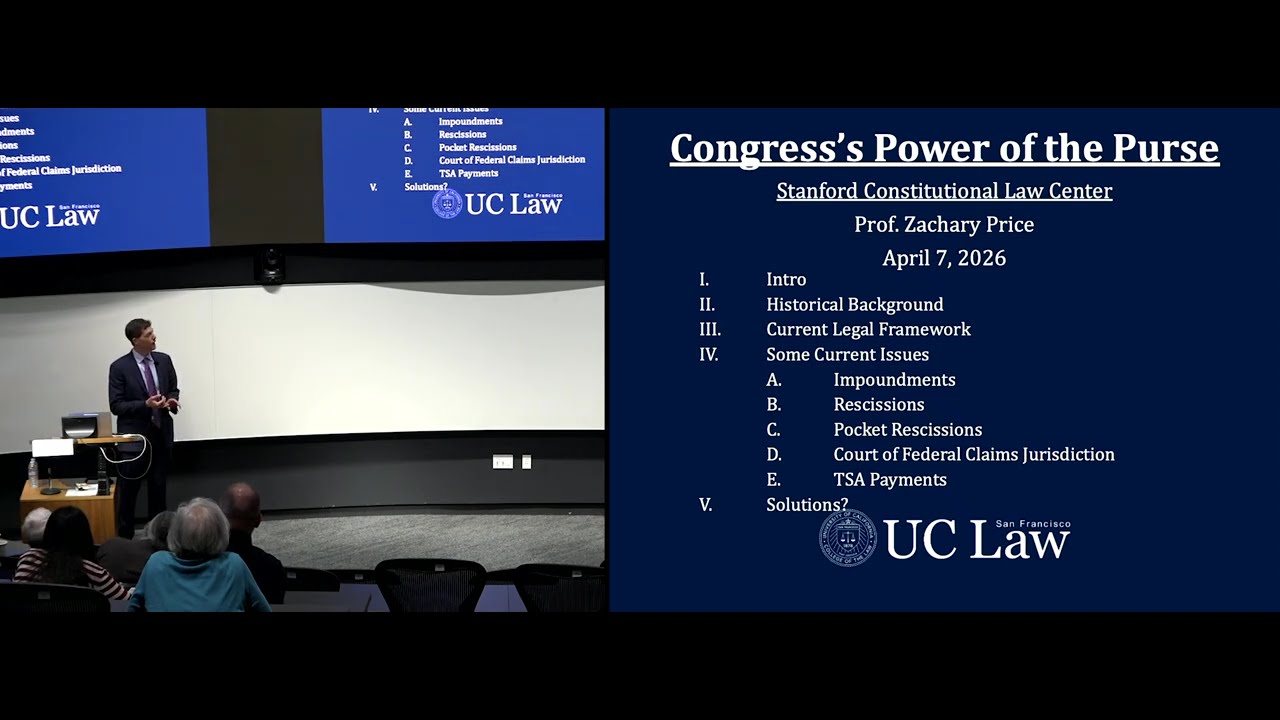
April 7, 2026
Stanford Law School
Sponsored by Stanford Constitutional Law Center
Welcome everyone to tonight’s constitutional conversation. It’s my very great pleasure to welcome back Professor Zach Price. I say welcome back because he was a fellow in the Constitutional Law Center how long ago? 12 years perhaps, and then he has gone on to teach at the school once known as Hastings.
And I always forget, what is the new name of Hastings Law School? UC Law San Francisco. UC Law San Francisco. Zach has had an absolutely stellar career teaching constitutional law at UC Law San Francisco. He has written for… His most recent book I think is marvelous. If you haven’t seen it and read it, I highly recommend it.
It’s called Symmetrical Constitutionalism. It presents a- an argument that constitutional doctrine is most legitimate when it delivers for both sides of the political spectrum that it’s least legitimate when particular doctrines like, give the left or the right or some particular substantive point of view the victory.
And he illustrates this with a number of different I think very compelling examples. Great book. But he’s also I think emerged as one of the most important separation of powers scholars in America. His work on prosecutorial discretion and its relation to the idea that presidents can simply not enforce laws passed by Congress is…
It’s really the best work that’s been done on that issue, which, l- so many separation of powers issues, has become exceptionally important in i- in recent years. And I invited him to speak here tonight because of his he’s now working a good bit on the power of the purse. And again, I try in these constitutional conversations to have a mix between issues that are ripped off of the front pages and those that are, like, more theoretical or historical.
This one’s ripped off of the headlines because I bet… I haven’t done the question. Maybe I should ask ChatGPT or something. But I bet there have been more cases filed against the Trump administration based upon spending clause issues, refusals to spend money, spending money on something for which it wasn’t really appropriated, possibly than any other single topic.
And Zach has been doing, I think, the most cutting edge explanatory, insightful work on that important question. With that, just thanks for coming back and I look forward to hearing what you have to say
All right, Thanks very much to Michael for the overly generous introduction. Really had a great time in my fellowship here, which was a really formative experience, and it’s great to be back. Thanks to all of you for coming. I’m gonna talk about Congress’s power of the purse which as you probably know if you’re here, is Congress’s power over government spending, government money.
And as you probably also know if you’re here, it’s been an area of a lot of controversy recently. So I wanna build up to talk about some of the current disputes but actually mainly wanna kinda give a broader perspective on the issue, g- give you a bit of a framework for understanding why it’s important and how we got where we are.
So I think I really wanna get across three key points. One is that the power of the purse is really central legislative authority, and particularly so under modern conditions. These days, the president is quite powerful. We have very powerful federal agencies, a lot of statutory and constitutional authority vested in the executive branch.
And so in that context, presidents can often do what they want to take strong actions unilaterally but they’re subject to an ongoing political constraint from Congress due to their dependence on resources. And so that’s what makes the power of the purse important. If you care about checks and balances in this context, you should care about the power of the purse.
So that’s the first point. Second point, though, is that it’s not self-executing. It really depends on a strong expectation of executive compliance with spending directions from Congress. And we’ve had that sort of expectation for seventy-five, a hundred years now, but as I’ll talk about it wasn’t always quite as strong, or at least things worked somewhat differently.
So it could be somewhat fragile, and that might be what we’re seeing now. So it’s important but not self-executing potentially fragile. And then the third point that’s somewhat bleak, perhaps, is that if it is degrading a bit there’s not a good sort of silver bullet solution because it’s a power that really depends a lot on Congress’s enforcement.
Depends on Congress defending its institutional interests, which is something that because of the degree of partisanship in the country, is not something Congress is very good at these days. So I’ll come back to some other possible remedies, but that’s really the core problem. Okay, so just to set things up I say it’s in the news lately, what am I talking about?
So you probably know this stuff, but the Trump administration came in and froze a lot of funding, canceled lots of grants, took control over spending in a lot of ways. It also dismantled the agency that dispenses foreign aid. It cut off money for universities as a way of getting leverage to get certain settlements.
And then we’ve also had two prolonged shutdowns now where the Congress and the president couldn’t agree on new funding so the government shut down. We’ve had this keep coming up in the news, and I think something that’s important to appreciate is this is, w- well, o- one thing you might ask is is this actually new?
Is this just Trump, or is it something other presidents have done? We have had other spending related controversies with recent presidents, and we have a general kind of pattern of recent presidents asserting powers broadly and getting weak pushback from Congress. But I think it is new that with Trump to take that trend into the spending area to really assert control in the executive branch over spending to this degree.
So I wrote an essay last summer with some co-authors where we called this Appropriations Presidentialism. Said, the administration is part of that larger trend toward broad assertions of executive power. This administration was doing a number of things to try and assert stronger executive control over spending, tip the balance a bit in terms of Congress and the executive branch in terms of who controls spending.
And that’s also been it’s across the spectrum of dimensions of spending from whether the money gets spent at all to sometimes spending money without authorization from Congress or clear authorization to also imposing conditions and requirements on money that’s going out. So it’s really a broad spectrum dimension of this administration.
It’s also a sort of a philosophical commitment. I think this president asserts power in all sorts of ways, but at least some people in the administration have a kind of philosophical view that president should control spending more strictly. So this is Russell Vogt, who’s the director of the Office of Management and Budget the agency in the White House that controls executive spending.
He’s incredibly sophisticated about how the government works, what the laws are, how spending operates. He served as OMB director for part of the first Trump administration as well. Trump at one point- Had this Truth Social post with this weird AI video where he called Russell Vought the Reaper which I think was meant as a compliment.
The idea is he’s killing off u- unnecessary spending. But Russell Vought, before the second administration he gave a lecture where he s- he, he said it’s a problem that agencies are too responsive to Congress.” You’ve got a corrupt system where agencies and congressional committees get together and engage in a lot of spending that’s not necessarily broadly supported by the public.
So it, it reflects the values and the leader of a permanent ruling class in a capital city. So Vought, thinks that w- we wanna get spending… The way to assert popular control over all this government spending is to have stronger presidential authority over it. There’s some truth to that perspective.
I think there’s certainly wasteful spending, certainly things that don’t have broad popular support. There’s special interest giveaways in a lot of congressional appropriations. But I think that’s ultimately the wrong frame for looking at the issue. I think the right frame is that first point I tried to highlight earlier.
I think y- we ha- the, We have a world in which presidents have broad authority. Congress is given a lot of authority to ex- the executive branch, to agencies. And they can often use that to assert policy initiative even create things with the force of law in the form of regulations.
And Congress’s power of the purse then is what guarantees a kind of back end constraint, a check on how that’s exercised. So the way I put this in an article a while back is I said, “If you’ve got a world of broad delegations, expansive executive authority, then Congress’s power of the purse is really the single feature of our system that guarantees an ongoing political constraint on what the executive branch is doing.”
And I think recent events really highlight that. So one example you might think about the immigration crackdown Minneapolis and so forth. There you see the president… we’ve got this agency ICE- A lot of authorities, a lot of resources, but nonetheless, the president has a lot of control over how actually that’s exercised, what that’s gonna mean on the ground.
Chose to exercise it in this way to go into cities like Minneapolis and be very aggressive. Led to some tragic deaths, a lot of controversy. And so the president has the power to take this sort of initiative, but then he needs on, new money from Congress on an ongoing basis to f- to fund the agency, the Department of Homeland Security.
So right now, Department of Homeland Security is shut down because Congress is trying to use that leverage to get kind of new limits and constraints on on this agency. So that’s a good example in the domestic context. I think the war in Iran illustrates this even more dramatically.
Some people think the right way to understand the constitutional design is that the president has authority to use military force unilaterally. Most people think the original design is Congress is supposed to authorize use of military force. But regardless, at this point, we’ve got a pretty strong bipartisan practice of presidents taking action unilaterally, asserting a power of initiative.
And in that context, it’s really important that Congress can have some say in the long run by ultimately needing to fund ongoing military operations, can use that power to impose limits and constraints if it wants. So to sum up, I think, the vote perspective would be spending as this monster that’s out of control, needs to be brought under presidential authority.
I think the better constitutional perspective is, in some ways, the executive branch as a sort of maybe not quite a monster, but a bit out of control has a lot of power needs to be kept under congressional control or at least subject to some congressional constraint through, through funding.
Okay, so that’s the kind of general why the issue matters why I think you should care about the power of the purse in the current context. Let me say now a little bit about the constitutional and historical background for this power, how it ended up being a legislative authority, how the framers thought about it, and how we got to Where we are.
So when we say the Constitution gives the power of the purse to Congress, what are we talking about? I think there are really two key provisions. There’s the appropriations clause, which says directly you can’t take money out of the treasury, but in consequence of appropriations made by law. So appropriation is just a term of art for a particular type of statute.
So basically, if the federal government’s gonna spend money, it needs to get specific authority to do that from legislation. So that’s sp- you can’t spend money without specific authorization from Congress. On the flip side, what if Congress mandates spending for some purpose? I think there the key clause is the take care clause, which just generally says the president is has a duty to take care that the laws are faithfully executed.
So president is supposed to carry out laws that Congress enacts. So I think that’s what means… It says if Congress is gonna require spending or require the government to take some action, generally the president is gonna have a constitutional obligation to follow that. There’s also a clause that limits appropriations for the army to two years.
So you can’t appropriate funds for more than two years for the army. In general, it’s up to Congress whether to impose that sort of time limit, as I’ll talk about in a minute, often does. And the reason why is reflected in this clause. It’s a it’s a way of ensuring that the president always needs to come back to Congress to get authority.
That was a particular concern with the army, so it’s in the Constitution there but it’s a practice followed in other areas as well. So that’s what the Constitution says and it it grows out of a kinda deep historical background. For the framers, it would have been completely obvious that this should be a legislative authority.
So here’s James Madison in the Federalist Papers said, “Congress’s power of the purse was the most complete and effectual weapon with which any constitution can arm the immediate representatives of the people for obtaining a redress of every grievance and for carrying into effect every just and salutary measure.”
So it’s a strong statement of thinking of this power as a kinda essential legislative authority, a kinda key bedrock of responsive, accountable Republican government. And the Framers thought of that way because th- that grew out of this ba- English background, English constitutional development.
As you might know, English had this period of religious and political tumult, civil war in the 17th century, and the key issues had to do with government finance. Parliament came into conflict with the Crown over the Crown trying to raise revenue, spend money without authorization from Parliament when they felt they should have to authorize it, didn’t like what the king was doing.
This all culminated in this constitutional settlement called the Glorious Revolution in 1688, where a key piece is it’s established that Parliament has authority over the government’s revenue and can dictate, for the most part, how money is spent. So in that context, it functions as a really key direct check on monarchical authority.
And Parliament also develops this practice of providing funds only for a year at a time or some limited period, and it does that to ensure it has ongoing leverage over what the monarch is doing and can impose checks if it doesn’t, if it doesn’t like it. So then with that background, it’s not at all surprising that the framers just…
For them, it’s uncontroversial, not a matter of a lot of debate. There’s a central legislative authority. They put it in the Constitution. They also pick up that practice of annual appropriation right from the beginning. So here’s the very first appropriation statute from the first Congress, and it provides money only for one year, and that practice carries forward for the, same reasons it did in England.
It’s a way of ensuring a kind of ongoing authority over what the government is doing. Okay, so we’ve got this important power. It’s got this… It’s pretty strongly reflected in the original Constitution, the history that led up to it. So one might think that we’ve got this pristine structure at the outset.
James Madison gave us a constitutional garden. Now we’ve got an orange snake undermining the whole thing. And, there’s some truth to that but it actually turns out that this structure… I think the history is a lot more complicated because it turns out it’s actually pretty hard to run the government this way, particularly under early conditions of administration.
So for a lot of the early history of the country, we get the executive branch often doing things that, that stretch legal bounds, even exceed them, and then Congress having to come in after the fact and approve what the executive branch did. A k- a key example is actually in George Washington’s administration, the first presidency.
There’s this violent tax revolt in Western Pennsylvania called the Whiskey Rebellion. And Washington views this as a really important threat to federal authority, wants to back up the force of the federal government, establish the legitimacy of the new constitutional system. Say, we had our revolution, but now it’s over.
Now everyone has to follow the law.” So he raises this gigantic militia force to go and suppress this rebellion. And it works. But the trouble is he did not have any appropriation to do this. Congress was not in session, so he moved money from accounts. So the regular military used it to fund this militia, and then afterwards, he came to Congress and explained what he’d done in detail and asked them to to ratify it.
So here’s his exact quote. He said “Having thus fulfilled the engagement which I took when I entered office to the best of my ability to preserve, protect, and defend the Constitution of the United States on you gentlemen and the people by whom you are deputed, I rely for support.” So he’s saying, “I did what I felt was necessary, what I felt the responsibilities of my job required and now I’m putting myself before you, counting on you to approve of what I did.”
So Gerhard Casper, a constitutional historian who actually ended up as president of Stanford University a while back, he had a book addressing this episode, and he called it the– he called it Fiscal Heroism. It said it is the heroic approach to spending. And what he meant was that Washington is taking action that he feels is necessary but then staking his honor on Congress’s retrospective approval of it.
So he’s exceeding his legal authority, but- Not doing it in a totally lawless way, recognizing that only Congress can ultimately provide the funds, approve of his actions. And in, in this episode, that’s what Congress in fact did. But the trouble is that in some ways became a pretty common pattern in 19th century administration.
There’s this practice that came to be called the coercive deficiency. Agencies quite often would spend more money than they had commit funds they didn’t have and then go to Congress afterwards and ask it to make up the shortfall. So they create a deficiency and again, they’re respecting Congress’s ultimate authority over the money, but it’s coercive.
Congress often feels like it can’t… it doesn’t really have a choice about it. So there’s a classic eh, people in Congress get mad about this, they debate it. There’s a great quote from this guy back in the early 19th century. This John Randolph, who was a kind of acerbic Jeffersonian member of Congress.
And so he said in Congress that, “Those who disperse the money in the executive branch are like a saucy boy who knows his grandfather will gratify him and overruns the sums allowed him at pleasure.” So in other words, it’s like perhaps some law students here, right? Executive officials run up a big bar tab and then go to mom and dad and say Gosh, if you want me to buy my books I’m gonna need some more money.
So the this kind of forgiveness rather than permission model i- is a is a way a lot of kind of accountability for administration works, works in the 19th century. And again it’s not completely lawless. It respects Congress’s ultimate authority, but also involves the executive branch taking a lot of independent initiative.
So this goes away though and I can talk more about this later. It’s a kind of complicated story, but it takes a process of legal and institutional development. Congress enacts some laws. I’ll talk about some of them later on. But it also particularly in 1921 undertakes a really big reform of the budget process, makes the president responsible for putting together a budget that then gets proposed to Congress, also creates a congressional agency led by the Comptroller General to police spending compliance and gives itself unified committees to oversee spending.
So it does a lot of things that ultimately end up establishing a stronger expectation of compliance with the letter of appropriations laws, ends this practice of deficiency spending. I think the point is we do kind of transition to a world in which there’s a strong expectation of executive compliance, and I think we should see it as part of the process of building up a more powerful modern state.
So at the same time that Congress is developing executive agencies, creating the sort of executive branch we’re used to, and in some ways enhancing presidential power, it’s also making this legislative check through the power of the purse more effective or at least more controlling i- in terms of compliance with the strict letter of what Congress is doing.
So that leads to an, a- an era, kinda mid 20th century. We’ve got a very s- Powerful control over spending appropriations committees exercise a lot of authority. That comes under stress again with the kind of imperial presidents of Lyndon Johnson and Richard Nixon. Particularly Nixon claims the constitutional power to impound funds, to not spend money that Congress wanted him to spend.
But again, Congress asserts itself. He lost some court cases, backed off, and Congress enacted new budget reforms, including a statute I’ll talk about in a second, that tries to control impoundments. So basic story here is we’re building up a powerful federal administrative state, and in that context, Congress is pretty effective at establishing and maintaining a norm of close compliance with spending directions.
It’s not perfect, right? We do get recurrent controversies, but I think this is the background against which the new controversies are arising Okay, so to, explain why the power of the purse is important I think this history suggests that it’s not entirely self-executing, but we’ve been through a process that, that gives it strong force.
I wanna turn to some of the current controversies, but to do that, let me just talk a little bit about some of the current framework statutes that, that come out of this historical development that are the sort of backdrop for how things work now. And this stuff can get really technical very quickly which is part of what makes it fun.
But I’ll try to kind of not get too deep in the weeds. But I think– So to go back to what I was saying earlier, in the constitutional framework, we’ve got paired constraints that both prevent spending without authorization and prevent non-spending when it’s required. And there are key statutes now that reinforce both of those constitutional requirements.
So on the side of ensuring we don’t have spending without authorization, the key statute is this law called the Antideficiency Act. And it’s really addressed that problem that John Randolph was complaining about be- the problem of coercive deficiencies. ‘Cause what this law says is that government officials can’t even obligate, can’t commit funds, let alone spend them, unless they have an existing appropriation that it supports the expenditure.
So you can’t enter a contract, you can’t commit money in various ways unless you ha- it, it’s consistent with the appropriation you have at that time. You also can’t ask employees to work voluntarily for the government. And that’s understood not to mean that… you can sometimes have pure volunteers, people who have disclaimed any right of compensation.
This provision is understood to address a kind of related problem to the coercive deficiency of agencies having people work overtime or work extra and then kinda creating a moral obligation on Congress’s part to, to pay them afterwards. So this is actually the reason why the government shuts down when annual appropriations run out.
It’s because if people went to work, the government would be incurring an obligation to pay them. And because of the voluntary services prohibition, it can’t ask them to work without an expectation of payment. So that voluntary services provision then has an exception for emergencies involving the safety of human life or the protection of property, so that’s why some functions keep going like TSA the Transportation Security Administration, the folks who do airport security.
They can work voluntarily. The government can accept voluntary services from them, so they, they keep working because they’re protecting the safety of human life. But they still don’t get paid whi- which of course m- makes them a bit unenthusiastic about, about working. But that’s how shutdowns work.
It’s because of the Antideficiency Act and then the reason some functions keep going is because of that exception. Okay, and this is a penal statute. It imposes penalties on individual government officers who violate its provisions. If they do so willfully it’s a criminal offense. Okay, so that’s the spending without authority side.
On the flip side, the non-spending the key statute is this Impoundment Control Act, and so this is part of those 1974 reforms. And it’s a little complicated what it does, but it basically says you can’t even delay spending unless it’s for reasons consistent with the underlying Policies reflected in the statutes, and if you wanna cancel spending altogether, you have to go to Congress.
You can propose what it calls a rescission and you can pause the spending for forty-five days while Congress considers that proposal under fast track rules. But ultimately, Congress has to… Only Congress can rescind the money. It c- it has to pass new legislation that cancels the budget authority you wanna get rid of.
So it doesn’t quite directly ban impoundments the way the Anti-Deficiency Act does for spending, but it reflects an assumption that spending is generally going to… the executive branch is supposed to spend money in the way Congress has provided. If it wants to change, it has to go back to Congress.
Okay. Let me finally turn to some current issues to give you a flavor for what the administration has been doing against that backdrop. There are a lot of controversies here and I’m happy to talk about others, but I just wanna highlight a few.
One thing to say I’ll skip over this, but the administration has not claimed a general constitutional power to just spend or not spend however it wants. It made some noises about doing that, but instead what it’s normally done is kinda look for ways to bend and twist statutes to get flexibility that maybe helps get it to the same place.
So I wanna highlight a couple there. I wanna talk a little bit about rescissions, what it’s done with that authority, and then about the current shutdown and the TSA issues, and then try and connect it back up with the broader themes. So it’s really done two things with that rescission authority from the Impoundment Control Act.
And the first is at least legally uncontroversial, which is it’s actually used it. It’s made some rescissions. It got Congress to approve a rescission of about nine billion fund- nine billion dollars in funds for foreign aid and for public broadcasting. And it did that by, it made a rescission proposal.
Congress made some changes, but approved it. And that was controversial because appropriation statutes are subject to the filibuster rule. They generally need sixty votes in the Senate, so they generally have to be bipartisan. A rescission proposal under those fast track rules just requires a simple majority vote.
So you can get bipartisan spending package, but then go back and rescind o- on a party line vote the things you don’t like. It, it made some people in Congress angry for that reason, but it’s perfectly legal. It’s provided for in the statute. You know- Kudos to the Trump administration on that one.
No legal problem. Okay, but they’ve also done something that I think is unlawful based on the same authority, which is they’ve done what they call a pocket rescission. So the way this works is, remember the Impoundment Control Act says you can propose to rescind money and then there’s a forty-five day period where Congress considers the proposal and you can pause the spending during that period.
So you can pause it to see if Congress w- ultimately agrees and takes it away. If not, you have to spend it. What they’ve done is they with respect to some foreign aid funding, they paused the mo- they proposed the rescission within forty-five days of the end of the fiscal year. So they said, “We can, we propose the rescission, we can pause it,” and then the fiscal year ends, the money goes poof, it’s gone.
And now even though Congress didn’t approve the rescission, the money’s gone. The statute is a little bit ambiguous, but I think that’s at odds with the overall design. First of all it emphasizes making the money, ensuring money gets spent unless Congress approves a rescission and the whole idea of this device is to get to cancel it without Congress taking any action.
You can also only do it if you defer the spending to the end of the fiscal year in ways that the deferral provision probably should be understood to, to prohibit. It’s a way of creatively reading a statute meant to control impoundments to create a kind of impoundment, a unilateral impoundment authority.
I don’t think it should be lawful but they did it. People tried to litigate it but the Supreme Court said basically that the only person who could sue to challenge it would be the Comptroller General. And in that case it was a private party. So they didn’t address the merits but allowed it to go forward.
So I think you can expect this administration, possibly future ones, to use that same technique. So it’s a good example of a kind of tendentious statutory interpretation, whittling away Congress’s privacy. The… I’m gonna skip over this one the current controversy with the TSA I think has the same sort of structure.
So here again, as I mentioned before, the Department of Homeland Security is shut down right now because some people in Congress Democrats in Congress wanna add restrictions to ICE’s enforcement activities as a condition of new money. They actually can’t shut down ICE itself, not only because it would be within that emergency exception, but also because Congress in the tax bill earlier this year, it provided extensive funding for ICE on a four-year basis.
So there’s money for ICE, but not for the rest of the Department of Homeland Security including the TSA. So the Antideficiency Act, again, prevents those people from being paid, requires those who aren’t performing those emergency functions to stop working. S- TSA has to keep going because its functions are excepted, but becoming an increasing problem that they’re not getting paid.
The two sides in Congress couldn’t agree. The president issued a memorandum directing the Department of Homeland Security to use funds that have a reasonal- reasonable and logical nexus to TSA operations to f- to pay TSA employees anyway. So look for ways to use DHS money to pay TSA.
It’s– they have not been very clear about what they’re actually interpreting now to pay TSA although they seem to be paying TSA. Based on some reporting, they’re using this provision from the tax bill that provided $10 billion for costs incurred in undertaking activities in support of the Department of Homeland Security’s mission to safeguard the borders of the United States.
So it, it seems to be that their view is to find a provision, this provision or a provision like it, and squeeze TSA into that category to say, “Look they’re related to safeguarding the borders. At least some of what they do maybe fits that, that description,” but then use that money, transfer it over, use it to pay TSA.
So this is the kind of thing that they’ve also done in previous shutdowns in various ways, which is to bend, transfer authorities to give themselves more flexi- flexibility, avoid politically inconvenient- Spending limitations. And it’s the kind of thing that if it accumulates as examples, as precedents would really chip away at that expectation of strict compliance with what appropriations laws say.
Okay, so to just try and sum up got this important power of the purse, particularly important in a world where presidents, executive agencies have a lot of authority. It took a lot of effort historically, a process of institutional legal development to make it a really robust check on what executive agencies are doing.
But now maybe it’s a bit under stress. So what can we, what could we do? Is there any solution? And as I said at the outset, I think unfortunately, there’s not any kind of silver bullet. And the really central problem is that Congress has tended to be weak in recent decades in defending its own institutional prerogatives.
Congress tends to operate these days on a very partisan basis. People in Congress tend to wanna support authorities claimed by presidents from their party, oppose actions by presidents from the other party. Here’s a graph that illustrates that. This is a measure of Congress’s internal polarization. You can see it was quite low during that mid-twentieth century period when I was describing a really effective appropriations process controlling executive agencies.
It’s very high right now, and that’s exactly the dynamic with Trump’s actions. He’ll take unilateral action. He’ll do the sorts of things I was describing earlier. In some sense, they’re a challenge to Congress’s institutional authority. But be– for partisan reasons the president’s co-partisans aren’t willing to push back effectively or may like the policy outcomes, may not wanna embarrass the president, so they haven’t made a strong response.
If Congress were to assert itself more aggressively, there are lots of things it could do. The main thing would be to actually use the power of the purse to defend its institutional authority. It could do things like condition spending for presidential priorities on compliance with other spending laws or even condition official salaries for government officials on compliance with various measures.
It does things like this to some degree has done it. It’s not completely passive, but we don’t see a really strong response along those lines. Other things that might help it could do things to clarify or enhance certain judicial remedies that could help courts police some of these problems and courts do have an important role.
The trouble there is that because this is a matter of controlling ongoing administration, ongoing operation of the government, it works a lot better when it’s functioning as a kind of political constraint rather than a just a legal one. Cour- courts often have trouble coming to grips with these issues within the sort of timeframe required to deal with annual appropriations and funds that are expiring and that sort of thing.
So could help there but again, a kind of incomplete solution. Could also do things like making more spending automatic, limit some of the discretion the executive branch has kinda cut off some of those statutory theories I was talking about although you could there end up with a problem of whack-a-mole of eliminating certain theories, but not solving the broader problem.
Another… A last possibility is as I mentioned earlier, the Anti-Deficiency Act has penal provisions. So you could actually retroactively enforce those in a future administration. And that, could be useful in maintaining a deterrent effect from the law, but could also be putting government personnel in a difficult situation and lead to a kind of spiral of retributive action in other administrations of the sort we see in other areas.
So I think the central problem here is we’ve got a Congress that is not very good at defending its institutional prerogatives in this area, as in others, that gives the president a lot of running room to take unilateral action and get away with it and set precedents that then shape future administration.
But given the centrality of this power I think we should hope that Congress does push back e-eventually and maintain this important check on what the executive branch is doing. I know I was covering a lot but thanks for your patience and I look forward to any questions you might have
Please line up in either aisle if you have any questions
Thank you very much. So in 1789, James Madison proposed 17 amendments, 12 passed Congress, 10 got ratified. One that didn’t make the congre- con- congressional gate was one that said that the, each branch of the government could not delegate to the other branches of government its enumerated powers such as tariffs, appropriations.
Would it be useful at this time to reintroduce that or, yeah, reintroduce it to Congress? And would that be part of the solution, not the whole solution? Could that be part of the solution? It’s a good question. This gets into the broader debate about delegation. Y- I… congress has given away a lot of its authority over spending, but also over affirmative policy-setting, and it’s done that for good and bad reasons.
I think, a problem with a really strict non-delegation rule of that sort might be that in a modern complex society, it’s hard for legislatures to keep up with changes have the sort of flexible administration we want in a lot of areas. So I don’t think it’s… it, it could be too much of a straitjacket if you say you can’t delegate at all with the sort of separation of power system we have.
But I do think it’s important that if you’re gonna have broad delegation it’s important to have some guarantee of a check from another branch, and that’s what the power of the purse most centrally provides in that environment of broad delegation
I have lots of questions, but, Is this on? Yes, here we go. Lot of questions, but wanna begin with standing, and especially in the area of impoundments, refusals to spend money appropriated. And the com- the statute gives the Comptroller General authority to go to court in the case of impoundments. And no one else. The statute doesn’t mention anyone else.
On the other hand, back in the Nixon years when he was doing the impoundments, I think there were about 180 different lawsuits brought by the would-be recipients of money, and they all seemed to have standing. And in the Bill Clinton case about line item veto recipients had standing to challenge a refusal to spend money.
What is the current status of the law, including that s- you referred briefly to the or to the recent decision about that. And it’s all become more important because when the Impoundment Control Act was passed, the Comptroller General had some independence from the president, but I think not anymore that the Comptroller General can be fired by the president.
So what is the current st- status of who can actually sue? Yeah. So I think it’s a, it’s somewhat clouded by the Supreme Court litigation I was mentioning earlier. But so what the Impoundment Control Act says is that… here’s the language. “If under the Impoundment Control Act budget authority is required to be made available for obligation, and such budget authority is not made available for obligation, the Comptroller General is hereby expressly empowered to bring a civil action.”
So the question is, what’s the… First of all, is that exclusive? And secondly, what’s the scope of it if, i- you know, if it is exclusive? So in the litigation over the pocket rescission- The DC Circuit initially said that it, covered any kind of challenge to an impoundment and dismissed the case that way.
Then the en banc court forced them to narrow that down, and then the Supreme Court affirmed somewhat cryptically. So I think the right way to read it is that if it’s exclusive, it should only apply to the specific situation in the pocket rescission case, which is that the Impoundment Control Act itself is requiring that the money be made available for obligation.
At least that’s the argument, is that you’re th-the Impoundment Co– that provision in the Impoundment Control Act that requires obligations of funds unless there’s an appropriation as what was what was at issue, and therefore something that the Comptroller General can enforce. And that makes sense because the Impoundment Control Act is setting up a kind of political process for resolving these rescissions, and maybe it makes sense in that context to have this congressional official be the one who can sue.
But in most impoundment-related cases like the Nixon cases, the spending obligation is not actually coming directly from the Impoundment Control Act. It comes from the underlying appropriations. And the theory there is that people can sue under the Administrative Procedure Act to challenge non-spending in the same way that they can challenge any other unlawful agency action.
So I think that’s the better way to read the statute. The Supreme Court, as I recall, was a bit ambiguous about it, but can be understood to only be approving that theory as well. That was what the DC Circuit en banc thought, and that would preserve the ability of other litigants, private parties who are adversely affected, to challenge non-spending when it’s just a matter of not spending mon-money provided in some underlying appropriation outside of this context where the Impoundment Control Act is directly at issue Oh, yeah.
Thank you so much. I learned a lot from the talk. I’m a little over my head here, so for- Sure … apologize if I get a little abstract. But I was really taken by this idea of coercive deficiency. It was a new- Yeah … term that I learned. And it’s interesting because money flows faster than the discourse or disputes that come up in politics.
And we see that there’s a currency now to have, being able to have a political dispute over lots of things. And I was wondering what the history of coercive deficiency in these sort of spending battles can teach us about a potential looming crisis about something like default or a debt ceiling or something like that.
‘Cause you can see that there’s a sort of parallel issue here of running the tab high and then having to account for it later. Is there anything we can learn from this context in that other context? Yeah, it’s a good question. So I think that, you could see a lot of these actions of this administration and some others as going back to that sort of model of executive accountability where you take action and then- W- look for forgiveness rather than ratification.
Or sorry, th- r- rather than permission in advance. I- my worry about it is I think it, in the 19th century, it’s embedded in a different sort of political culture and office-holding culture where people, people care about their honor and their… It matters to them.
The… They’re also– The accountability structure is quite different in other ways. Government officers in general, they can be sued and held personally liable if they exceed their authority, but then go to Congress and would ask Congress to indemnify them for the liability they’ve suffered.
So there’s a model not just in spending, but in other areas where you’re taking action you feel is necessary and trying to anticipate whether Congress will approve that. But we also… It’s an environment where the government does a lot less, it’s a lot weaker, and I’d worry about r- going back to that sort of model of executive behavior in an environment where people may f- you know, partisanship may give them motivations to act in, in really aggressive ways without a lot of constraints and also where the government just has a lot more capacity than it did in the past.
So it’s the kind of thing where there… Everyone can imagine like really extreme emergency situations where you want the government to take action, where law isn’t necessarily the most important thing but you want them maybe in that context at least to, to need to depend on after-the-fact ratification but still take the action.
There are certain things people did during the financial crisis that had that sort of character, but I think it would be really bad if that became a kind of routine aspect of the way the government operates. Thank you. Thank you, Zach. This was great. Much of the discourse around the power of the purse seems to be mediated by hyper-partisanship with the ideological valence of some of these arguments shifting based on short-term political conditions.
I wanted to go to the end of your presentation when you’re talking about potential solutions- Yeah … and propose two to you that have been put forward that exist in a way to get around some of this hyper-partisanship, and I’m drawing from Shalanda Young, who was OMB director. But she’s talked about the urgency of both changing the membership of who serves on appropriation committees, both expanding and broadening in Congress, so institutional reforms to who is involved in appropriations in Congress, and the second would be dramatically expanding the congressional staff that’s involved in appropriations.
It’s a common knowledge that there are two million Article Two related executive connected employees, but only ten thousand in similar capacities who work for Congress. So do you… What do you think of those two proposals, and how do they relate to how we can think of this outside our hyper-partisan perspective?
Yeah, great. So I’m inclined to think things like that would be helpful. I think in particular Congress has… is definitely a staff mismatch, in some ways prestige mismatch with the executive branch. The executive branch is institutionally better able to assert a view of its power and then defend it, articulate a rationale for it.
Congress is a collective body. It has inherent difficulty doing that. It could be helpful to develop stronger institutions or staff within Congress who can do that sort of thing. That’s to some degree what the Comptroller General was and is an effort to give Congress that sort of capacity with respect to spending.
So I think it would be helpful. I think it could help Congress defend its institutional interests better. But I do worry there’s still the underlying problem of partisanship if at the end of the day people are voting along party lines and more interested in the fortunes of their party than the interests of their branch, then they’re not, even if they have a lot more staff, they may not ultimately be effective in pushing back at executive abuses.
I thank you very much for the presentation. It’s really interesting. I was wondering if you could address and it’s really just, I think, my ignorance, but other sort of suite of controversies that have come up under this administration which seem to involve the executive branch enforcing conditions on spending- Yeah
That maybe Congress hasn’t actually put in the statute. So even, I think, this last weekend having to do with the administration of collegiate athletics. And I, I guess part of what I’m trying to understand is in, in that order, that executive order regarding collegiate athletics, part of the order seemed to say be a directive to lawyers within the executive branch to f- see whether the failure to comply would be a grounds for withdrawing spending from universities that, that allow, say, some athlete who transfers twice to play for them.
So I guess w- i- one question is a process related one which is are lawyers not looking at this before the executive branch is taking action? And which is, somewhat problematic. And I guess the second question is am I understanding this correctly, that the executive branch is trying to articulate a whole bunch of conditions on spending that Congress itself hasn’t placed in those spending statutes, the appropriations?
Yeah, so I- that certainly has been an aspect of that appropriations presidentialism, is it this administration has claimed very broad authority to put conditions on money it’s giving out it’s a little bit complicated. I think you always have to look at the particular spending program to figure out whether conditions are valid.
There are cross-cutting requirements like often civil rights laws apply to people receiving government funding, particularly universities, so they may have some room to reinterpret those. So sometimes what they’re doing may be lawful. It’s also the case that we have a structure in the case law for thinking about conditions imposed by Congress on grants, particularly grants to state institutions.
There’s less case law about this problem of executive conditions, so it’s something that may need to get worked out in litigation. The way I would think about it is along the lines of what you were suggesting. I think the executive branch should have the authority to impose conditions that relate closely to the underlying purposes of the appropriation or the program pursuant to which the government is providing the money.
That’s part of executing the law. But it shouldn’t be treating a kind of discretionary authority to give out money as just a source of leverage to achieve other sorts of policy goals. So I think it can c- impose conditions that advance the goals of the underlying spending or the program that’s operating but it shouldn’t be able to impose conditions that are unrelated and just reflect administrative or presidential policy priorities.
And they, they often say things like, “Everything’s dependent on the administration’s priorities,” but if that’s not consistent with the, what the statutes say, it’s not faithful execution of the law
I’m gonna take ano- I’m gonna sneak in another question All right you didn’t mention one other Set of issues which has to do with use of private donations- Yeah … to fund things that Congress hasn’t appropriated. Back in the first funding shutdown the president said that he would– he was going to get very large contributions to pay members of the armed services.
I don’t know, I just don’t remember whether anything ever came of that, did it just disappear because the funding shutdown s-ceased. But that struck me as a really dangerous thing if it actually took place. And then more recently we have the ballroom, and it’s being funded supposedly, I think it is being funded through private contributions.
But my understanding under the An-Anti-Deficiency Act is that the executive branch can’t fund government activities through contributions ex… unless Congress has a specific statute permitting it. And I was a little surprised when I read Judge Leon’s District Court opinion enjoining the further work on the ballroom that it didn’t mention that.
Which made me wonder, am I just imagining a spending clause problem there that hasn’t been litigated or isn’t real? No I think that’s exactly right. I think the way to think about it is, and I think this is reflected in, in, in practice and in the way courts, the executive branch, and the Comptroller General have understood the applicable law.
Which is that the Treasury is not just a particular bank account when you’re thinking about the Anti-Deficiency Act or the Appropriations Clause. It’s money under, under government control. So under the, the general legal architecture the Supreme Court has said the government can accept gifts.
Anyone can give a gift to the government. But unless the agency has specific gift authority to take funds and use them for its own purposes, they have to go to the general treasury, and then are subject to appropriations limits like any other money. So some agencies have specific statutory authority to use donations to carry out certain functions.
But if they don’t have that, if they take the money, then it’s what the Comptroller General calls an augmentation of their appropriation. They’ve given themselves more money than Congress wanted them to have. And that’s important in this kind of power of the purse dynamic I’m describing, which is what Congress is doing with the power of the purse is often as– determining the level of activity for different government functions or putting legal limits on how things are carried out or whether they’re carried out at all, and it would really upend that whole structure if you could just get donations from outside the government to circumvent tho- those sorts of limits.
So I think that’s exactly right. It has been a theme with this administration. Another aspect of this kind of unilateral executive authority is to try to use private funding as a workaround. I think it should not it, it should not work. The… My favorite opinion in this regard there are a bunch of controversies.
This is a feature of the Iran-Contra scandal and the Reagan administration other things. But there’s a there’s some Comptroller General and Attorney General opinions about whether undercover government officers can use the proceeds of their activities for the law enforcement operations, and the Justice Department’s actually said they, they can’t.
They’re, they have to go to the general treasury. Under… There’s a statute called the Miscellaneous Receipts Act that reflects this principle. If you get money, it’s supposed to go into the general treasury. So you can’t even play a, in a gambling game and then use the winnings to, to engage in other anti-gambling operations unless there’s a specific statute allowing you to do that.
So I think that’s the right constitutional view, and I hope it gets vindicated in some of these examples. Do you know about the ballroom? I I read the opinion also. I don’t know why he didn’t… it’s… Most of what he said seemed consistent with that outlook, but he seemed to focus more on just the problem of, That the government appropriations were subject to certain legal limits that were not followed.
But I think the same analysis should apply if they’re, whether they’re private contributions or government funds, they would still be treasury funds for constitutional purposes and therefore subject to those same legal limits. I see our time is now up.
Please join me in thanking Professor Price for a most illuminating presentation. Thank you, Zach. Our next constitutional conversation is a week from tonight, and it’s a little unusual. We’re inviting two we’re we’re ha- hosting two retired Canadian Supreme Court justices to come and talk about various aspects of of cons- of comparative constitutional law and and basically, from a, from the perspective of the frozen North.
So I’m assuming they’ll still be a separate country by a week from now because the president has other things on his plate at the moment. Please plan to hear from them. So thank you again.