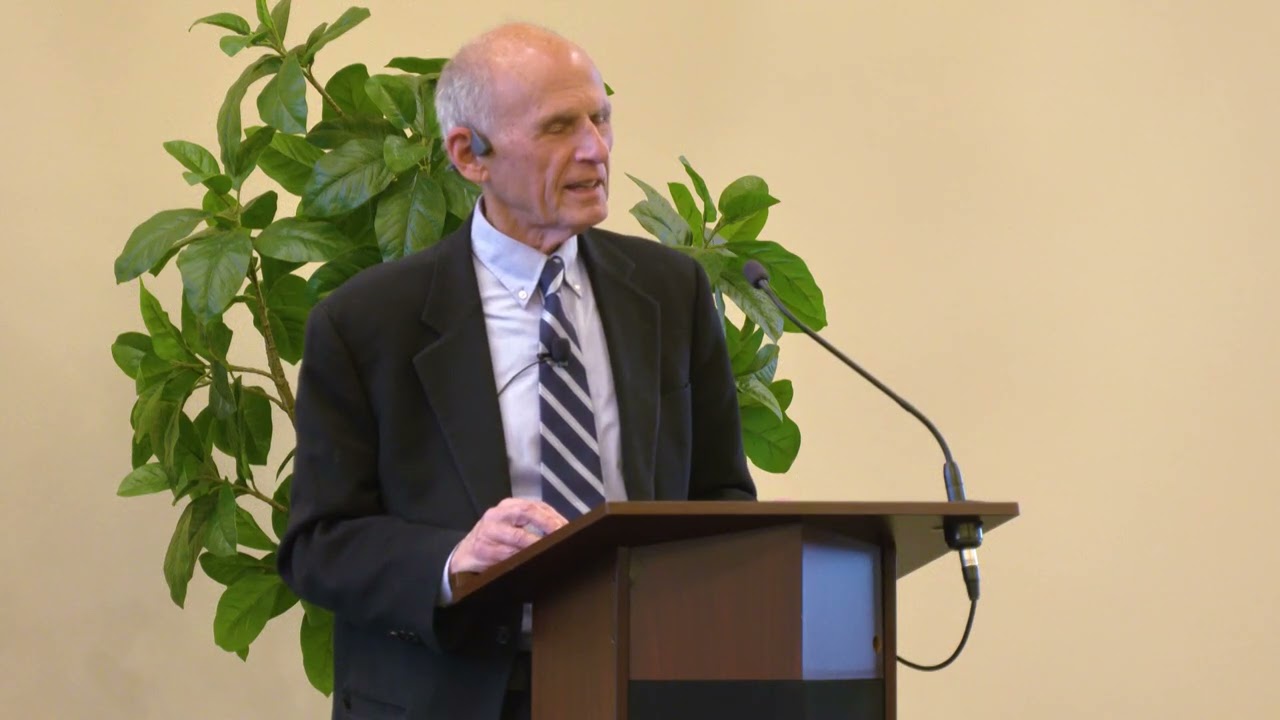
Publius Symposium with Judge David Tatel: Vision: A Memoir of Blindness and Justice
The New York Times calls Vision: A Memoir of Blindness and Justice “a winning memoir that recounts the remarkable career of a civil rights lawyer who succeeded Ruth Bader Ginsburg on the nation’s second most powerful court.” Inspired to attend law school by the idealism of the 1960s, Judge Tatel spent the first chapter of his career pursuing voting rights, school desegregation, and other critical issues both in and out of government, and then three decades deciding cases and legal issues that define our generation—all while completely blind.
Losing his sight gradually, Judge Tatel writes about how he spent decades denying the implications of his blindness. He walked into many walls and stumbled over countless curbs before finally getting a white mobility cane, and he waited until age 77 before getting a guide dog, a German shepherd named Vixen, who “changed my life.” All along the way, Judge Tatel broke barriers—in the courtroom, on the ski slopes, and just about everywhere else.
Vision braids together both threads of Judge Tatel’s story. It explores his commitment to civil rights, fairness, and equal access to justice. It gives readers a behind-the-scenes look at the work of federal judges—what they do, how they work, and how his blindness affected his judging. It explores the art of judging through fascinating and important cases, and defines judicial restraint in our constitutional system and the critical role it plays in both judges’ decision-making and the public’s perception of justice. In chapters focusing on the environment and voting rights, Vision levels serious critique at the current Supreme Court and the threat it poses to our democracy.
Finally, Vision is a love story about the Tatel’s sixty-year marriage to Edie and how blindness affects their lives together.
Listen to a conversation with Judge Tatel about his important book. Professors Zachary Price (UC Law SF) and Rabia Belt (SLS) offer commentary, with Professor Michael McConnell (SLS) moderating.
So welcome everyone to tonight’s event. This is a special event that we do each year. The Constitutional Law Center sponsors the Publius Symposium. This is dedicated to a book that has been published, usually in, in the immediate preceding year, that is in some way important to law and the, and especially constitutional law, named obviously for of the Publius, the authors of the great Federalist Papers that are, still the most important book ever written in the field.
And it is my pleasure and honor to welcome tonight’s speaker and Introduced to you the Publius winner, if that’s the right word for it for this year their speaker, Judge David Tatel, and his wonderful book called Vision: A Memoir of Blindness and Justice. Now usually when I introduce speakers, I give a lot of information about their past, where do they go to law school, who do they clerk for, what do they teach, what, things of that sort.
But since this is a memoir, and I am guessing that Judge Tatel is going to be telling us quite a lot about his life in the course of it, I’m going to leave that to him. But just to say this that Judge Tatel has been a judge on the D. C. circuit for, I don’t know, how many years now? Thirty. Thirty years.
And he is, truly an ornament of the judiciary, whether you’re left or right, no matter where you may be, you may disagree from time to time, but this man has been a giant in the law, a person who shows how judging really can be done as an enterprise of integrity. And so it’s just so much my pleasure and honor to welcome him.
To speak with us tonight. And as soon as he is done, we’re going to have responses. So the other aspect of the Publius program is we always invite two or three informed speakers to offer reflections on the book. And so I will be more fully introducing my colleague, Rabia Belt, and my A good friend Zach Price afterwards, I’ll tell you a little bit about them.
And please everyone, you’re invited at the conclusion of the proceedings to a reception where there will also be a book signing. So please join me in welcoming.
Thank you Michael. What a pleasure it is to be here and to have my book honored, especially given the books that were honored in earlier years. It’s Quite a club to be part of so thank you. A special thanks to Michael for those of you who have seen the actual book. He has a blurb on it, and I was flattered that he offered a blurb, but Michael, I haven’t told you this, but my publisher thinks that your blurb, and especially Your statement that you don’t need to agree with Tatel’s politics to read the book sold a lot of books.
You’ll be receiving a bill. Morgan Weiland, thank you to you too for making this all so smooth for me and getting it all arranged. I want to say something about how special it is for me to talk here today in the Paul Brest Hall. Paul and Iris are here. In 1991, Edie and I And our then 10th grade Emily had a sabbatical here at Stanford.
And it was Paul who greeted us and welcomed us and made it possible for me to teach a seminar in the law school, which was quite a wonderful experience. And also during that year, Mike Smith, who was the late Mike Smith, I’m sorry, Dean of the Ed School Gave Edie where are you?
This is my wife Edie, right there, gave Edie an office in Coverley and a title, Visiting Scholar, and it’s in that office that Dr. Tatel finished her, almost finished her PhD. And finally you may not be able to see her, the other member of my family is my guide dog, Vixen, who’s right down there.
So on to the book, I’ve put together a few brief passages along with a little commentary. Think Reader’s Digest version of the book, which I hope will give you a sense of vision of its several main threads. My years as a civil rights lawyer, both in and out of government, my three decades on the DC circuit and my growing concerns about our Supreme Court.
My struggle with declining sight, ultimate blindness. And how they all relate to each other. I’ll conclude with a few thoughts about what’s not in the book. The deeply profound experience of writing a memoir. The first passage I want to read comes from the prologue. I’ve lived a rich and varied life. As a civil rights lawyer, as a federal judge, as a husband of 60 years.
As a father of four, as a grandfather of eight, and now as a great grandfather. I spent my professional career in the pursuit of justice, and I could have written a memoir entirely about that pursuit. But unlike most lawyers and judges, I’ve been blind for over half my life due to a rare inherited eye disease called retinitis pigmentosa.
Throughout my 30 years on the nation’s second highest court, the United States Court of Appeals for the District of Columbia Circuit, I could neither read a word of the thousands of legal briefs submitted to my court, nor see the faces of the hundreds of lawyers who argued before me. A blind judge sounds like a cliché, I know.
Like the statue of Lady Justice, wearing a blind judge and holding her scales. But it’s no cliché to me. I can’t see, but I can listen closely. I didn’t need to see the lawyers to hear their arguments, and I absorbed all the written materials by having it read to me. Or later by using audio digital devices.
For decades, I fooled myself into thinking that my blindness was irrelevant to my work and my worth. Only now in my eighties and in writing this memoir, have I finally come to accept my blindness as an essential part of who I am. This memoir is about my life in the law. and my journey into blindness.
It’s also about the Supreme Court and my grave concerns about the state of our judiciary. Beginning with blindness, I was first diagnosed with RP in 1957. I was only 15 years old. The symptoms then were minor. Difficulty seeing in the dark, slightly narrowed peripheral vision. I otherwise functioned as a sighted person.
Doctors knew very little about RP. After all, it was only five years after the discovery of the double helix. Eat lots of carrots, doctors told me. I did, but it did no good, though I still really love carrots. For years, I told no one about my RP and developed lots of tricks to cover up my declining sight.
For example, going to the movies with friends was really tricky. I could get to my seat just fine when the lights were on, but if I went for popcorn after the lights dimmed, I had to count the seats sideways, then the rows up and down, to have any chance of getting it back to the right spot. Somehow I feared my friend’s, somehow feared my friend’s judgment about my declining vision more than the decline itself.
Like most kids, I just wanted to be normal, and I thought my friends would think less of me if they knew what was going on. So I began building a repertoire of cover up strategies. Instead of saying to my friends, I can’t see the ball, I made up excuses. Can’t believe I missed that one. As if being a lousy ball player was better than being a poorly sighted one.
And on. And on. I kept up that ruse for years. Not until I met and fell in love with Edie did I disclose my RP to another person. I was 23, she was 22. But even then, I kept my declining site a secret. At the University of Chicago Law School, as an associate at Sidley and Austin, And as director of both the National and Lawyers, Chicago and National Lawyers Committees.
But by then, my deceptions had become far more sophisticated. One of my favorites was following a woman in high heels going in my direction. It worked like a charm, and no senator ever asked about it at my confirmation hearing. The first time I told someone in my work life about the possibility I might become completely blind, was in 1975.
I was 35, during my job interview at Hogan Hartson. By that time, my sight had declined significantly. Here’s a story from Chapter 8, Turning Points. Edie and I had discussed how I should handle the issue, and we both agreed that for the first time in my life, I’d try just being open and honest. By that point, it felt like I didn’t have much choice, but I’d carried the secret for so long.
And rehearse the words so many times in my head that it felt like a relief to just say them. I have retinitis pigmentosa and I don’t know how longer how much longer I will be able to see. I explained to the partner Bob Cap. I remember the conversation very well because it was so difficult personally and professionally.
I remember the exact words Bob said in response. He didn’t ask whether I could do the work. He didn’t pry. He didn’t even feel sorry for me. He asked just one question. What help will you need? Those five simple words changed everything. The defenses I’d hidden behind for so many years, the worry that my declining vision would prevent me from getting a good job, all gone in an instant.
I think that passage is one of the most important in the book. I hope every single person hiring at law firms, corporations, government agencies, and everywhere else reads and understands it. I eventually took the difficult step of getting a mobility cane, which I had resisted for years. But instead of learning the official way, Like going to the lighthouse for the blind.
Edie introduced me to the blind tap dancing teacher at our community center. In her living room, she taught me how to tap and swing the cane. And I got pretty good at it. And although it was wonderfully liberating, I still never talked about my blindness. Not when I was director of the Office for Civil Rights during the Carter administration.
Not when I was a partner at Hogan. Not when I was on sabbatical here at Stanford. And not even during my three decades on the D. C. Circuit. I was not a blind judge. I was a judge who happened to be blind. Only in the process of writing Vision, and only after learning to work with Vixen, my wonderfully talented guide dog, have I finally come to terms with blindness.
You’ll read all this in the last chapter, The Dog That Changed My Life, and that, I guarantee you, is no overstatement. Before I go into the law, I thought maybe you might be wondering about this device I’m using. It’s a laptop computer, except that it has only seven keys, all you need to type braille.
Instead of a screen, it speaks, and I hear it through this headset. I’m using it now as what might be called an audible teleprompter. This and other amazing technologies. All described in the book have made an enormous difference in my life. Vision also focuses on the art of judging, the principles of judicial restraint that distinguish the life tenured judiciary from the two elected branches of government.
Using the cases I know best, environmental and in voting, and voting cases, I explain how the current Supreme Court has largely abandoned these principles. And the threat that poses to the threatened, and the threat that poses to the separation of powers enshrined in our Constitution. Every time the Supreme Court strikes down or reinterprets the law that Congress passes, it effectively accumulates more power for itself.
A perfect example is 4 decision in Shelby County against Holder. Where, disregarding four of its own precedents, and reversing my opinion for the D. C. Circuit, it declared unconstitutional the key provision of the Voting Rights Act of 1965, one of the most effective civil rights laws ever passed. Section 5 forbade any voting district with a proven history of racial discrimination in voting to change its procedures.
including redistricting, ID requirements, and even moving a polling place without first proving to the Attorney General of the United States that the change would not be discriminatory. Here’s a passage from Chapter 18, The Future of Democracy. The court began by emphasizing that the founders had intended the states to keep for themselves the power to regulate elections, neglecting to note that the drafters of the 15th Amendment, which came later, most certainly did not.
Next, the court gestured to the tradition of equal sovereignty, privileging the equal treatment of the states, guaranteed nowhere in the Constitution, over equal treatment of minority voters, guaranteed by the 15th Amendment. Finally, the court declared that Section 5 That was no longer necessary in light of the nation’s progress with respect to racial discrimination in voting.
According to whom, exactly? Certainly not Congress, which had found that pre clearance remained necessary when it last reauthorized the Voting Rights Act. What we see in Shelby County, a court disregarding the Constitution’s plain text. It’s own precedent and the findings of Congress characterizes many of this court’s 5 4, now 6 3 decisions.
Since this is the Publius Symposium, I’d like to invoke Federalist 78. Quoting Montesquieu, it says this, There is no liberty if the power of judging Be not separated from the legislative and executive powers. I suspect that Zach and Rabia will have some thoughts about this. But before turning it over to them, I’d like to say a few words about a critical feature of judging that is rarely alluded to in law school and that I only came to understand in my years as a federal appeals court judge, judicial collegiality.
Here’s a short passage about that. Appellate judging is a team sport. Not a solo endeavor. That’s a great strength of our judicial system. Three judge panels reduce the effects of personal ideology. And working together improves the quality of decision making. I thoroughly enjoy discussing cases with my colleagues and trying to reach consensus.
Or, if we couldn’t, to disagree in principled ways. When we do it well, the atmosphere that supports that process is called judicial collegiality. Judicial collegiality has nothing to do with singing holiday songs together, having lunch, or attending basketball games together. It has everything to do with respecting each other, listening to each other, and sometimes even changing your minds.
It is through honest, open debate that judges with very different policy views can decide cases neutrally and, almost as important, narrowly, setting aside more divisive issues for another day. As the Chief Justice has put it, if it is not necessary to decide more to dispose of a case, then it is necessary not to decide more.
Resolving cases narrowly is one way life tenure judges avoid meddling in the work of policymakers elected by the people. and protect the separation of powers. In Vision, I give several examples of how I work with other D. C. Circuit judges, including judges whose policy views were very different from mine, to reach consensus even in difficult, highly charged cases.
Our opinions were always better for having been so carefully tested. One example involves a disagreement That I had with my colleague, Steve Williams, over an extraordinarily technical issue that only federal judges and law professors could possibly love. You would be hard pressed. to find two judges whose political and policy views were more different.
We wor Here’s the quote from the book. We worked as hard to Steve and I worked as hard to achieve consensus on the little cases as we did on the big ones. This time, though, Steve and I couldn’t reach agreement. I wound up writing the majority opinion, and Steve wrote a dissent. As we wrote, we exchanged 16 drafts, far more than in many high profile cases.
Each time I read Steve’s dissent, I better understood his point of view and revised my opinion for the better. He did the same with his dissent. By our 16th go around, we had narrowed our differences dramatically, but still couldn’t agree on the bottom line. Our law clerks were sure we finally stopped out of mercy to them.
Steve and I were proud of our opinions, but even prouder of the memos we had exchanged throughout the drafting process. We wished we could have published them so the public could see how serious judging gets done. So I want to finish up with a couple of observations that are not in the book. One is the profound effect of writing this memoir.
When I started, now almost four years ago, I thought when you wrote a memoir you just started at the beginning, went to the middle, wrote to the end, and you were done. Turns out that’s not true. I was gifted. with a superb editor at Little Brown who pushed me to deal with difficult personal issues as I wrote.
People won’t read your book, he told me, if you don’t. And if I’ve asked too many questions, just consider it the cheapest therapy you ever had. But most important, at this point, Edie, my wife, got involved in the writing process. She’s not only a superb writer, but she’s part of this story. It’s my memoir, but it’s really our memoir.
And my blindness affected both of us. And we used the three years we wrote this book, while we wrote, to debate and discuss many issues that although we had briefly thought about during our many years of marriage, by the way. We will be married 60 years this August. We focused on some really difficult questions together.
Why did I decline why did I hide my declining sight as long as I did? How did it affect Edie and our marriage? How did it affect our four children? We now have four adult children. And speaking of the children, here’s an example of how the writing process and the thinking process Changed my views.
When I first wrote a couple of pages about the children and the effect of my blindness on them, the paragraph essentially said blindness was as challenging for my children as it was for me. That it was a major challenge in their lives. But Edie and I had drafted a ten question, a ten part questionnaire for them, called Growing Up with a Blind Dad, and we sent it to them.
And they all took it seriously. And they all responded in writing. These answers, by the way, are just total treasures. And when you see quotes from the children in the book, they’re from these questionnaires. But what we learned was totally different than I thought. Very different story once we read what the kids said.
Here’s one story they told. I went back, Stephanie and I, she’s our second daughter, went backpacking in Montana together. She was totally in charge of the route, our meals, and me. She wrote that she hadn’t been at all worried about my blindness. But the repeated lightning strikes up in the mountain had sure given her fright.
Rebecca, our oldest daughter, told us that until she rode in carpools, quote, she didn’t know that dads drove cars.
I had to rewrite that part of the book. And here’s what it now says. So my disability was not mine alone. We shared it. Edie, our children. and eventually their spouses and our grandchildren. We were all in it together. It touched all of our lives. It was simultaneously a challenge and completely normal. The writing of this book was a profound and meaningful experience for ED& E, but it doesn’t work for everyone.
A friend of mine, a publisher in New York, gave Jimmy and Rosalind Carter a very large advance. to write a joint memoir. He told me that three months later, they returned the check with a note. Our marriage will not survive this.
The three years we spent talking about our marriage and blindness also gave me the opportunity to think more deeply about the courts. As a busy appeals court judge, you move from case to case. And yes, you’re aware of the trends, you think about them. But during these three years, I had the luxury of being able to reread many of my opinions and, most important, Supreme Court opinions.
And during those three years, I refined my own views about the judicial system, about the art of judging, and about our current Supreme Court. And the result are the two substantive chapters. One is called The Future of the Planet. And the other is called The Future of Democracy. Last point. Just as profound as writing this book has been its aftermath.
The book came out last June. And I have had hundreds of emails and letters and conversations. with people who say, and they almost always say it in these words, I read Vision and it tells my story too.
People who were losing their sight hid it, just as I did. But not just people headed for blindness, people losing their hearing told me the same stories, how they hid their loss of hearing. People with other forms of hidden disabilities, diabetes, depression. I have Edie and I have so many stories now of people who have told us that they too, as long as they could, hid their growing disability.
This is completely news to me. If I had not written this book, I wouldn’t have known this. When I was a little kid, counting seats in the theater, or a grown up following women with high heels, I thought I was the only one. I didn’t have anybody. to talk to about it. Now I realize that my reaction, my behavior was human.
That’s what humans do. And I can understand that’s why we do it. It’s very reassuring to me to have learned this from writing the book. But it’s also, I wrote this book for many reasons. It’s given me another reason for being pleased that I wrote the book and that is that I hope people who are going through what I went through as a young man, whether it’s a hidden visual disability or deaf hearing disability, whatever it is, I hope they’ll read my book.
And realize from it what I didn’t understand, which is that disclosure and acknowledgement is best for the person and for our society. So thank you. Thank you very much Judge Tatel for that inspiring talk. And thank you, Vixen, for keeping me company during during that time. Is your head on your foot? Yep. Okay. And and I’d now like to introduce the respondents, or the commentators, on the on this book. On my immediate right Rabia Belt, a colleague of mine here, a professor at Stanford Law School, whose academic specialty is disability.
I’m not going to say disability law because I think that’s just part. of what she’s a specialist and she’s an, a specialist not just in the law but also in the experience and culture of disability. And I think what we’ve just heard indicates, what a common ground she has with Judge Tatel in, in that respect.
And on the end here is Professor Zach Price. From I’m from University of Cal, what do you call it? Now? What used to be called Hastings University? University of California College of Law, San Francisco. Okay, University Coll you heard it. I’m not Zach teaches constitutional law, administrative law, and other things.
So he might have some comments on those aspects of the book. But the real reason that we invited him here is that he was a law clerk to Judge Tatel some some years ago. And so he has a long standing experience with the judge. And I don’t know which of you wants to speak first.
We’re both good at it. Yeah. I can do it. Even though we call on our students all the time. Should I go? Sure. Okay. First of all, thanks to Michael and Morgan and the Stanford Constitutional Law Center for inviting me. It’s a real honor to participate in this event. As you heard, I had the Privilege of corking for Judge Tatel.
This was exactly 20 years ago, which is hard to believe. But I have to say it was one of the great experiences of my life. I’ve been lucky to have a number of other great jobs, including an invaluable year here at Stanford as a fellow in Michael’s Center, but the Tatel corkship was probably the single most formative experience for me in my professional development.
So what I want to do in the remarks is to offer some reflections on the corkship experience that connect with some themes in the book. And I should say, first of all, the book is really extraordinary if you haven’t read it. It answers lots of questions that clerks like me might have had but wouldn’t have asked about.
But far beyond that, it has this extraordinary novelistic quality. It offers a compelling personal narrative not only about the judge’s struggles with his disability, but also a beautiful love story about his marriage with Edie stuff about his family life. But then it connects all that with much larger themes in the life of the nation, like the grand drama of civil rights, questions about law in the courts.
So you should all buy the book and read it take the opportunity to get it signed. I think the limited value I can add here, as I said, is just to offer a few personal reflections that connect with the theme. So I thought I’d say a few words, first of all, about the judge’s blindness and about his approach to judging, both from the perspective of a law clerk.
And at the end, I’ll say a few words about When I think Ailes, the federal judiciary, another theme in the book and offer I think a slightly different, but compatible account to his. So anyway, to start with the blindness the judge’s disability is obviously a salient feature of the clerkship.
And I’d say at first, a source of some anxiety in the chambers, we would each have to beat the judge. The Metro or Jim one morning to score him in the courthouse. He didn’t have Vixen then, so he needed someone to Help him get to the courthouse. And at first, it was a bit terrifying. This be awkward?
Will I cause an important public official to get hit by a bus? Seems like there was a lot to worry about. But it turned out that was all misplaced because actually the judge was quite at ease with himself, at ease with the need to be helped around and beyond that, turned out to be a completely fascinating person and excellent conversationalist.
So far from being a source of stress these walks were actually cherished opportunist opportunities to spend time one on one with an extraordinary person. So that said though, there were some other things to worry about in connection with these walks, but they were quite different. And they go to the judge’s extraordinary character.
So this would have been about 8. 30 in the morning. And by this time, the judge would seemingly have read every major newspaper in the country. So the conversation would sometimes begin with a question like, Zach, did you see the fascinating story this morning in the business section of the Washington Post?
And I would say something like no, I didn’t know the Washington Post had a business section. Then later in the year, you’d start to get questions like, Zach. What do you make of the affidavit on page 87 of the joint appendix? I’ll have to look at that one again. Anyway, so I’m exaggerating, but just a tiny bit.
But the bottom line is that the judge’s disability gave us the time, chance to spend this kind of special time with them and really be humbled and inspired by his curiosity, his hardworking character, and extraordinary capability. So that brings me to another aspect of the disability, which is the way we worked on cases.
And a lot of the process was pretty conventional, we did, of course, did we have cases, write bench memos, help him prepare for oral arguments then if you’re, he ended up writing an opinion, you’d have to write a first draft. He wrote a draft within a week, which is a little hardcore, but not out of the ordinary.
And then you get some comments and revise and all that. But so all that was pretty conventional, but then things would take a sort of different turn because at a certain point you would actually sit down with the judge, often for hours and hours over many days, and go through the opinion paragraph by paragraph, reading it out loud, talking through the arguments, double checking points.
It’s recrafting sentences and paragraphs. I was just an extraordinary experience. I really can’t imagine a better form of training for a young lawyer than to get so clo to work so closely and intensively with someone so accomplished and capable. So it’s an extraordinary experience. I have to say I always felt a little guilty about it because it was obviously mainly a function of the judge’s disability.
So it seemed to be like I was getting an extraordinary opportunity due to the judge’s personal misfortune. So it was an extraordinary experience, but a bit tinged with guilt. And from that point of view, I was happy to see what Judge Tatel writes about it in the book. Because while acknowledging he says at one point quote, my reliance on others during the editing process was frustrating sometimes.
He also seems to put it in what he calls, at one point in the book, the Department of Silver Linings. He says, quote, I’ve come to believe that reading aloud has real advantages. Goes on to suggest that the need to work through his opinions orally in this way with another person may have actually helped him to craft the exceptionally well written and precise opinions for which he’s so well known.
So that’s the, some thoughts about the disability from the perspective of a law clerk. But I also want to say a few things about the judge as a judge because as he said just now, it was very clear at the time. He wanted to be known as a judge who happened to be blind rather than a blind judge.
So what sort of judge was Judge Tatel? The way he modeled the judicial role made a big impression on me at that stage. I think one key feature of judging for him maybe the key feature was that law was not the same as politics. And this came across partly because Judge Tatel it was quite apparent was actually not an apolitical person.
So in the fall of my courtship year, George W. Bush was running for re election against John Kerry and Judge Tatel had, shall we say, opinions about which outcome would have been better for the country. Later that year, someone in the courthouse set up an internal NCAA March Madness competition. And Judge Tatel, not knowing much about basketball, actually adopted the rubric for his brackets of always picking blue state teams over red state teams.
This approach worked about as well for him as it did for John Kerry.
But it highlighted the, his political commitments. But the thing was, that side of him would just go out the window when you started working on a case. As you work through the issues or draft an opinion, the relentless focus was always on what the facts and law supported not what result he would have wanted as a voter.
I think related to that, it was also apparent that the judge was not playing for the crowd. He certainly cared a lot about how people perceived his opinions, but what he cared about was whether serious people thought they were sound and well reasoned, not whether they liked the outcomes or whether they advanced his name on a Supreme Court shortlist.
I actually vividly recall moments when the judge described with a sort of hushed reverence how his Republican appointed colleague, Judge Silberman, had written what he called a brilliant opinion supporting the reversal of Oliver North’s criminal conviction. And what really impressed the judge about the opinion was not just its brilliance, as he put it, but the fact that Judge Silberman knew full well that putting his name on this opinion would eliminate any chance of ending up on the Supreme Court.
What I took away from all this was that as a lawyer or judge but also in other roles, you have to do the job you have. Judges have this very powerful role in our society, but it depends on them accepting a certain set of ethical constraints, people sometimes call it role morality. about what the job entails.
And I found myself thinking about this a lot recently because I think the same is true for lots of roles that are important for how our liberal society functions. But it seems to me that in the past 20 years it’s gotten harder for people to accept these sorts of constraints. We certainly have lots of judges these days auditioning for the Supreme Court.
or playing to their base and their opinions which creates particular problems. But I think there are lots of other areas of life where people seem to be finding harder to suspend their personal and political commitments and play a more impersonal role. So to that extent, I think lots of people could learn from Judge Tatel’s book.
So that brings me to the last point I wanted to address, which is to offer a few thoughts about the judiciary at present. As a judge Suggested the concluding portion of the book is quite critical of the Supreme Court. He faults the justices for abandoning precedent and judicial restraints and embracing a set of conservative preferences in their decisions.
I don’t disagree at all, but I think the problem is actually even worse because it seems to be that we’d have much the same issue. If political alignments on the court were reversed, we’d just have different people happy with the outcomes and others upset by them. The fact is American society has become highly polarized, particularly at the elite level, and that politicization has infected the judicial selection process.
Judge Tatel encourages his readers to vote for presidents and legislators who appoint judges, quote, who have principles, not agendas, and who are beholden to the Constitution, not the political party that appointed them. Again, I couldn’t agree more but these days I often feel I search in vain for such politicians.
Some are better than others, but the two parties are both organized around pushing distinct legal and constitutional visions and finding judges who will advance the same outlook. I think it’s a bit bleak, even worse than Judge Tatel lets on what can we do? I think there is something here in the Department of Silver Linings as he puts it which is I think even today that judicial role morality that Judge Tatel so exemplified still has a powerful pull on people who end up putting on black robes.
Despite the politics of judicial selection process. people who become judges and justices still do not wanna be remembered as result driven partisans. They want to be remembered the way Judge Tatel is as superb craftsmen who approached the most challenging cases with rigor, integrity, and a far sighted devotion to the law.
So for that reason among others, I hope very much that They read Judge Tatel’s book. I actually have not had the opportunity to meet Judge Tatel until today in person. I’ve heard about him as a legendary judge for people who have been former clerks, like my colleague Nate Persily. I have read accounts and opinions from him, and this panel gave me an opportunity to read the book, but then also meet the man, and I’m very fortunate, and thank you so much for inviting me to be part of this panel.
Thank you, Morgan, Michael, Gisele, and others for organizing it. And thank you to Annika Ariel for conversations about the book and the experience of navigating this law school as a blind student. Oh, I am not getting paid for this, to say this, but this is a great book that it is searching and engaging and it’s a witty tour of a really distinctively impressive life and career.
And he ranges from his childhood with a brilliantly curious scientist father to politically engaged and entrepreneurial mother. to his education at the University of Michigan, go blue, and the University of Chicago Law School, which is a wide ranging career as a law school instructor, firm lawyer, civil rights litigator, government administrator, and judge on the D.C. Circuit. He makes clear his love for his family, his devotion to the principles of sound legal reasoning, and his commitment to justice. When he started his legal career, the Americans with Disabilities Act was decades away, and as he worked to protect the civil rights of black Americans, women, and other vulnerable communities, Civil rights for disabled people was growing from the spark of an idea into law.
Disability law and justice seeks to recognize and protect, in the words of disability activist and founder of the National Federation of the Blind, Jacobus Tenbrook, the right of disabled people to live in the world. This means the restructuring of our built environment, such as curb cuts and accessible parking, treating disabled people in public places like everyone else, providing a free and public education to disabled kids, but also dismantling the system of stereotyping and stigma towards people with disabilities.
We’re in a raucous, chaotic community, consisting of a lot of different people with many different types of bodies and minds. But one of the things that really does connect a lot of folks within the disability community is dealing with these negative assumptions of what disabled people can do and how can they flourish.
Navigating what that means, though, even as a disabled person, is pretty hard. When I was a law student, I didn’t take a disability law class, even though I now teach disability law, because there wasn’t one. Many of those questions of what can we do, So the answers to them were improvised on the fly, learning as we go as we’re thinking through the inclusion of folks with disabilities in places that had never had them before and assumed that disabled people would not fit within them.
And Judge Tatel’s memoir encompasses this multi faceted aspect of life as a disabled American. So he discusses the challenges of skiing while blind and the accommodations designed to get him back on the slope. So I can see and I do not ski, so the idea of skiing on the slopes. that you can’t see seems even more daunting.
I have some of my criminal law students here, and I told them that my job is terrifying enough that I don’t do it for entertainment purposes. But it is something that the story of thinking through how to get back on the slopes and what kinds of accommodations would work in order for that to happen took a lot for both.
Thinking as Judge Tatel talks about, that this is, seems like an impossible problem to one that became a solution that not just brought skiing back, but then also gave it as an example to other people that would not have thought that it was possible for blind people to ski either. He also talks about the people and equipment that facilitated his career as a lawyer and a judge.
He recounts the incidents where people disregarded his agency and talked to his wife and other sighted people instead of him. And he forthrightly discusses the long arc of grappling with his identity as a disabled person, as a disabled lawyer, as a disabled judge, and what this means. And he tells us about challenging his own internalized feeling of stigma as he masked his visual impairment to his colleagues and loved ones, although he also says They often do anyway grappling with whether or not to use a cane and the saga of acquiring and connecting to his guard dog, Vixen, which Michael is blocking my access to right now.
Just saying. So when Judge Tatel took the bench, he was the first blind federal judge and the law is still a profession with a vanishingly small number of disabled lawyers and judges. How small is actually not clear because the Federal Judicial Center doesn’t keep track of disability with respect to judges and we also don’t have robust data on the state level either.
Judge Tatel was a pioneer in many respects. One of the things that he was a big pioneer about It is about grappling with how to be a disabled lawyer and judge, both asked, trying to figure out how to ask the question, what do you need? Are you disabled? But then providing answers for other people that had never had the question asked to them either.
And he’s been from reluctance to speaking about his blindness to writing a memoir where the front cover of it has this picture of him with his guard dog. It’s called Vision, where it is foregrounded. I would love to hear more. So this is my opportunity now, because I don’t just have the book. Now I can ask you some questions.
So one thing is, see this is what happens when you’re on a panel. Not only do you read the book, but you also read all the blurbs. So that, there is a quote here by Nina Totenberg, that’s under Michael’s quote. That David Tatel has written the book that his friends and admirers Always hoped he would write, but expected he would not.
All capital letters. One that deals candidly with his vision, his blindness, and his years of treating it as an asterisk, all while becoming one of the most prominent and thoughtful judges in the country. So there’s a lot to unpack there. Nina’s not here, but I would love to hear more about The expectations or assumptions that you had with the other people in your life, did they want you to talk more about being a blind lawyer and judge?
How did they make those expectations if they had them known to you? And how did you react? And there are so many people that have been in your life in which you’ve been such a big influence. You had colleagues, you had clients, you had clerks. I’d love to hear more about what they took away, do you think, about having you as someone in their life who was their boss?
Who was their colleague? Who was their lawyer? Probably for the first time for many of them, they had never interacted as much with a blind jurist or blind lawyer. So what assumptions and challenges do you think that they changed as a result of that experience? And then we also have sorry, I know lots of questions.
So just the last thing. So one thing that, because I see many of my students here is that in my disability law class, we talk about this challenge and paradox of the successful disabled person, someone who works really hard. It does a lot of things of self accommodating to try to clear away those ableist barriers they’re faced in their way.
The tough thing is, though, is if they’re successful at it, that it might be really hard to then also illustrate how much work and effort it took to do that self accommodation and to make it clear to the people that Yeah. Yeah. Yeah. didn’t see the hurdles that they may have placed inadvertently in their way that had been a challenge.
Also thinking this person was able to succeed. Why can’t other people? You are a very successful person, but I see so much effort in here. that you had to do. Do you feel as if this idea of being a successful disabled person has changed over time, gotten better or not? Finally, oatmeal raisin cookies for lunch every day.
Why? Chocolate chip was right there. Thank you.
Should I answer? Oh, yes. First of all, to both of you, thank you. I loved everything both of you said. One of the wonderful things about being a federal judge, maybe the best is your law clerks. And Zach your comments were so meaningful and thoughtful. Thank you. And I want all of you out there to know that I’m especially proud of Zach, because he, too, has a new book out.
called Constitutional Symmetry. It’s worth reading. I’ve thought a lot about it in, as I read through it. And he and I could have an interesting debate about his theory and mine. They’re a little different. But thank you, sir. And Robbie, thank you also for that. I’m going to try to answer your questions, if I can remember them in reverse order.
Okay. Last point about how hard it is to to be blind. , it is true. It is difficult. You, the planning, the effort is sometimes exhausting. And this relates to the final point I made in my remarks. I think looking back, that it would have been less difficult for me if I had been more honest.
about my disability. I think instead of me having to invent everything that I use to be successful I think it would have been much better for the people around me to have a better idea of what I was going through and that story I told. about Hogan and my interview, I think proves the point.
Because once I disclosed to the firm my growing and probably permanent disability in the end I no longer had to figure out how to accomplish things in the firm. I just asked and what I needed came. I said I needed, most lawyers had half time secretaries. I said I need a full time one to do reading.
And that’s why, Rabia, I said at the end that I hope young people who read the book will instead of struggling to keep it secret, will disclose it because I think it will help a whole lot. Your other question is, what did clerks take away from it? I think Zach answered that question better than I could.
And I thought his answer was was really lovely, and meant a lot to me. I think all of my clerks, one of my clerks wrote in a letter after she read the book, she said, I love the book because it answers every question I was afraid to ask during the clerkship. I think, I don’t have any doubt that all of my clerks are better citizens.
For having worked with someone with a disability for a year and realizing what a large part of the public doesn’t realize. And that is that people with disabilities can function at the highest level. And your first question what was your first question? Oh, Nina’s. Yeah. Okay. That’s a really, I loved Nina’s blurb.
Nina’s a really old friend of mine. I’ve known her forever. And it’s not surprising that Nina wrote what she wrote. And the answer to your question is when I wrote, one of the things I did when I wrote the book is I started, I interviewed a whole bunch of people who, friends to find out. When did they first realize that I had a visual disability?
And I learned from those conversations two things. One, my roost wasn’t as good as I thought, because they all were on to me much earlier than I was. But the answer to your question is that they understood that it wasn’t something I wanted to talk about and they respected it. Now, I’ve wondered, and I can think of very few exceptions of people who during all those years, even the closest friends who actually wanted to raise the blindness issue and wanted to talk about it.
Some of them did, but most didn’t. And as I, and I don’t know the answer to what I’m about to say, Robbie, I just don’t know. I wonder whether it would have been better for me and them if they had been a little more aggressive. I just, but I do not know the answer to that question. Be curious to know what my wife thinks about that.
Maybe she’ll think about that also. I think that’s a really good question. And probably a question every person like me, who’s hiding a disability is going through. We all went through the same thing.
Judge Tatel, I, we have found out, though that you are not willing just to reveal Every intimate matter, because you failed to answer the question about why you eat the oatmeal raisin cookie every day when perfectly good chocolate chips are so easily available. There’s an easy answer to that, Michael.
The answer is, I actually love both. But for whatever reason, the cafeteria in the courthouse made a better oatmeal raisin cookie than a chocolate chip cookie. That’s all. It’s not more complicated than that. And you and I could go out sometime and test it.
There you go. So now we have actually first I’d let’s give all three speakers a round of applause.
And now it’s your opportunity to try to Rabia. If that were possible there are microphones in the aisles if we would like you to speak into the microphones because that’ll enable everybody to hear and also for the that, that’s the only way it’ll get on the tape. Floor is open.
You’ll have to ask Morgan about that.
Judge Tatel, did you ever have to recuse yourself because of your disability? Ah, where’s my Wait, is it right here? I think it’s right here. Oh yes, he has a lap. Oh yeah, I have a lap, I have a thing on. Okay yes. And there, there’s a I deal with this whole issue in the book. In fact, this was one of the questions.
My editor, he asked me the same question you asked. I had written most of this without dealing with that question. And my editor said, did you ever recuse yourself? Don’t you think you should write about it? So the answer is, yes. There was one case I recused myself in. And looking back, there are two that I now wish I had.
I’ll just tell you about the one I did. And you can read the book about the other two. The case involved it was a lawsuit. Brought against the Treasury Department to enforce, to force it to comply with a long standing federal law requiring that paper currency be accessible to the blind. And the Treasury had done nothing about this for years.
And so people went to court and the case, I ended up being assigned randomly, all judges are assigned to panels on courts of appeals randomly to this case.
I thought about it. I felt extremely strongly about this issue. When I go to Mexico, I can tell the difference between a 10 peso note and a 20 peso note because they’re different sizes. Same thing in Europe. Euros. Here, I have to sort out my money in the morning or get Yi or the kids to help me.
And the worst part is that if they’re out of order and say I’m in a taxi, I have to ask the cab driver, is this a 10? I find that demeaning. And I resent my government pointing that out. A, I thought real strongly about it and wondered whether I should recuse myself. But I also thought, look, I can read this statute.
It’s not, this is not a hard case. I can read this statute. I can set aside my strong feelings and I can and I can I can decide the case. But I ended up recusing myself. And the reason was that I worried that notwithstanding my confidence, that the public might perceive the D. C.
Circuit’s decision as driven by a judge who was affected by that case. The public’s understanding of blindness is complicated and unsophisticated, and I worried that if I stayed on the panel, it would undermine the integrity of the court’s decision. I asked my two colleagues what they thought. They encouraged me.
to stay on, but I recuse myself, and I applied what I call in the book, Tatel’s five minute rule, which is that if I had to think about a recusal issue for more than five minutes, I recuse myself, because I wanted to err on the side of the integrity of the institution. And and then as I said, there are two cases that I wish I had recused myself in, and I hope you’ll read those also, but that’s the one I recuse myself in.
The appearance of impropriety, that’s the critical factor a judge has to consider when he or she is deciding whether to hear a case. It’s not your own confidence in your ability to do it, it’s whether or not the public, a reasonable public would have confidence in the integrity of the institution.
That’s so critical to the courts. Judge Tatel, thank you so much. I’m a second year law student and I’m dyslexic, so I’ve also always done my readings on audio. And you talk in the book about how that process affected your writing style and you give advice for folks to write. And I was wondering if you could expound on that, how you think listening to words change your writing style.
Yeah. Actually this is something I learned from Edie. Edie taught writing, college writing, high school writing, and she always had her students read everything out loud. I was aware of what she was doing in her teaching and I understood, she explained why she did it. So when I came to the court I actually also did that in law practice, but when I came to the court I continued it, not just because it’s a extremely helpful part of writing, but I really had no choice.
And I think Zach, your point, I’m so glad you put it the way you did about the question as to whether, you were somehow benefiting from my disability. I thought that was very thoughtful and I’m glad you said that. But here’s the thing about reading out loud. When you read out loud what you’ve written, you will hear things that you will not notice if you just read it yourself.
You’ll notice words that shouldn’t be there. You’ll notice too many annoying little words. You’ll notice things out of order. I can’t tell you how many times. I don’t know whether this happened to Zach. Maybe it did. We’re sitting there across the desk. The clerk on one side, me on the other side. The clerk’s reading.
The clerk is reading something the clerk wrote. And the law clerk finishes a paragraph and says, Wait, that doesn’t make any sense. Happens all the time. Or the clerk says, I don’t think the second and third sentences in that paragraph are in the right order. Or, I want to go back and take out some of these words.
My point is that you hear you hear things that you don’t see. And there are many great writers who see perfectly well who read everything they write out loud. I highly recommend it. Take it from a college writing teacher. Not me.
Anika. Hi. Hi Judge Tatel. Thank you so much for being here. I wanted to ask about guide dog refusals. I used to you have a question for Vixen or you want to ask about her? If Vixen wants to answer, that’s also great. Okay. But I was wondering, I read, I believe it was the Washington Post article where you talked about the guide dog refusals you faced.
I just wanted to hear if you have any ideas about how that could be fixed and what it says about our society more generally and also more personally. How does it feel to have made it to the highest level of the federal judiciary and still be denied access because of your disability? And still be what?
Sorry, can you say that again? Yeah, I couldn’t hear the whole thing. What was the Post article? The Washington Post article about guide dog refusals that you’ve encountered with Vixen. About guide dog what? Guide dog refusals. Oh, the Uber problem. Yes, yeah. Ah, yes. Yeah. I was wondering just, how does it feel to have reached the highest level of the federal judiciary?
And when I had a guide dog, Uber refusals happen all the time it’s just a fact of life. How does that feel, that even almost 30 years after the passage of the ADA, that guide dog refusals are just such a huge part of lifestyle? It is, it’s demeaning, it’s insulting, it’s I felt, I tell the story in the book, I actually there’s a great irony to this, because Edie, it happened on a day Edie and I had gone to a synagogue in Washington to talk to the rabbi about how the Old Testament dealt with blindness.
I really want to understand what the Old Testament says. The Old Testament’s pretty good about blindness. It says, Sighted shall not put a stumbling block in the way of the blind. And that’s meant not just physically, but metaphorically. So we had done these readings in the morning with Rabbi Holtzblatt, and then when we leave, we call a lift.
The lift wasn’t, not only wasn’t aware of the law, but, hadn’t read the Bible. Because he wouldn’t let me in his When you open up the door, Vixen hops in. She loves cars. And the driver went nuts. And, yelled and screamed. It was insulting. I felt small. I felt how dare you do this to me.
Now, it hasn’t happened to me as much as it has to many other blind people. I know that. I but I have had drivers who have shown up and refused. to take us, and Edie has, Edie has put on her teaching hat and explained to them that it’s their obligation and some of these people changed their mind and took us.
Which was fine. But here’s the answer to our problem. I just found it last weekend in San Francisco. Waymo. Laughter That’s our answer. That’s our future. Okay, they don’t reject guide dogs. Laughter
In fact, we have a great picture of Vixen. I think it probably went viral because When we got in the Waymo, Vixen, when Vixen gets in a car and no one’s there, she sits in the front seat, the driver’s seat. So this Waymo is sitting there. We’re in it. Vixen’s in the driver’s seat. There’s tourists all around taking pictures.
I thought it would have gone viral by now. Maybe some of you have seen it. Hi,
my question is not about the dog, so I apologize. I work at the Center for Biomedical Ethics, and first I just wanted to thank you, Judge, and the whole panel. This is really fantastic. So I guess my question is, for people who are, living in secret with various kinds of disabilities, as you, what would be your advice as people are thinking about disclosing, but also weighing very big risks?
To the extent that sometimes the moments of disclosure can go terribly wrong, how, to what extent can you turn those moments and periods into educational opportunities, if that makes sense? I think that’s a very hard question. And I don’t pretend to know the answer.
I’ll bet anything that, Rabia, you’ve thought more about that than I have. And probably even written about it, and I know it’s a big issue in the disability community. Yes, it’s better to disclose, but disclosure can also bring adverse consequences, right? And I just think it has to be done on a almost case by case basis.
And I don’t think there’s a clear rule for how to do it. It would be nice if our society it becomes so advanced that we don’t have to face questions like that anymore. But we’re very far from it. I know I, law students have called, have asked me the question of, should I, what should I put on my application for collection about my disability?
And it’s hard to know how to handle that question. I don’t have a simple answer.
This relates to something you’ve touched on a couple of times and that Zach talked about a good bit more. I’d like to get your take on the use of political ideology as a criterion for selecting federal judges in the first place where, never mind an appearance of impartiality, where that’s the whole reason they got their job.
And how about and do you see that changing over the years that you’ve been on the court? Zach may, Zach pointed out that, both Democratic and Republican presidents do this. I do. I, he read that sentence from the book where I say vote for presidents who won’t do that.
The fact is Presidents do that. It didn’t used to be that way. It wasn’t that way until, I don’t know, 30 or 40 years ago. Judges judges were picked because of their quality, because of their reputation and and because of their, of our confidence that they’d be good judges. And and we know that because there are so many stories of judges who join a court with one set of personal views and end up being very different once they’re a judge.
And I don’t know how we get back to that. The system is really broken. Every confirmation hearing at the Supreme Court and now at the appellate level, it’s a battle over policy. And the system is really seriously broken and I don’t know how we fix it.
If anyone wants to ask a question, but would prefer not to stand or come to the mic, just raise your hand and I’ll gladly bring the microphone to you. Otherwise, we can, we still have plenty of time for a few more questions.
Did you have a question?
I think you were on the court for the ruling for the Environmental Health Trust. A case, I’m a physician and I really want to say I really appreciate, wait. The Environmental Health Trust? Yeah. There was a case where the FCC has not read 11, 000 pages and it was your report.
Had what? Had not, the FCC, they were sued by scientists and physicians, I’m a physician, and and they went to your Court of Appeals the FCC where their assignment as appointees is to read The science, and I don’t know if you could comment on that case, that they still haven’t read their 11, 000 pages that showed health harm and they’ve been allowed to have, it’s not a political thing, but they just have not done what their appointment is regarded.
And that actually was in the federal court four years ago in Washington, D. C. I don’t know if you remember that case. Do you remember the name of the case? It was Environmental Health Trust et al. versus the Federal Communications Commission. And it was the 2021 judgment in your court in Washington, D.
C. Did I write the opinion? I don’t know whether you did, but it was your court. I was really grateful because you were talking about disability and a lot of the people that are disabled. Yeah, I’m sorry. I don’t remember. I’ve written a lot of opinions. I usually remember them. I don’t remember that one. Oh, okay.
I just wanted to say if you could I’m not sure if I can expand on that because they’re still not, they’re still getting to, even under the a lot of different areas they’ve been allowed to have their authority without, doing what their job is as appointees. Okay.
Thank you.
It appears that we have come to the end of our questions, even if not to the end of our, oh, I see there’s a hand over here.
You’ve talked about how you think the Supreme Court. is broken. It seems the problem is larger than that. I’d like you to comment on the presidents. Each president we get seems to make their own law through executive order. Yep, you got it. And that seems that each president comes in there and undoes what the previous president has done.
Congress, they take a lot of money from private groups, which seems to potentially affect their decisions when voting on bills. And then we have a lot of people who are unelected with an awful lot of power running things like medical or whatever. And I’m just curious what you think about all of the issue, not just the Supreme Court and the judge issues that you brought up.
The issue, it’s not it’s, what we’re facing isn’t new, it’s just more extensive than we’re used to. I spent, all 30 of my years on the court addressing situations where You know, a president had issued an executive order that turned out to be illegal. Or an agency had adopted a rule that was unlawful.
That’s what the courts do. Right now the situation is the same but more extreme. We have An administration that’s testing the limits of the law with its executive orders and its its termination of employees. And all of the other things you’re having. This is, they are testing the legal system.
And the question now is how will the courts respond? First question is how much of this is illegal? We won’t know that until these cases are litigated. And then the second question is what, what will the courts do? How will they defend the rule of law or won’t they? So that, it’s, what we’re facing now is more of what we’ve had in the past.
Judge, I read today in the paper, this is a follow up question to what you just spoke to, that a law office is working on support for overturning Marbury versus Madison. I know you can laugh, but they say they had their arguments and how that would give the president unlimited power. And do you have any thoughts on, I know how you would rule.
But do you have any thoughts on how the court system currently exists would consider that? Yeah, I worry about a lot of things. That’s not one of them. I don’t think you have to worry. I can give you a long list of things to really worry about if you’d like. I don’t think the the safety of Marbury v.
Madison is one of them.
Hi. Hopefully a softball question. This is not political at all. I’m just wondering in terms of values, right? It seems like when you, when your way of absorbing info is primarily through audio, it seems like when you can’t really, when you can’t read, right? Your primary way of Yeah. Taking in information is primarily through listening to audio.
That fundamentally places a constraint in terms of how fast you can absorb information, the amount of information you can take in. And like, how do you prioritize? Maybe outside of work in terms of when you’re listening to audio books what are the type of information that you prior, prioritize in terms of letting into your mind?
And then also informing you in terms of the things that are happening in the world that are not directly relevant to your work as a judge, but that you feel is important to you, right? That you should know about. It is true. It is true that it, even though I have been dealing with this for decades, it is true that listening is slower than reading.
I know that because, Edie and I are often reading the same book together and she’s done in two days and I’m done a week later. It’s just the nature of the beast. It’s slower. It isn’t any different in terms of quality. You get your information through your eyes. I get it through my ears.
It all ends up in the brain. That’s where the reading occurs, but you’re absolutely right. That it is slower. Now, one thing that’s helped enormously is technology. I can read so much faster now that when I was dependent 30 years ago, totally on human readers. Things were really much slower. I can absorb far more material now because of technology.
Cause I don’t have to have a human intermediary. The text to speech is instantaneous. And, when I’m using when I’m listening to like this afternoon, I was catching up on a couple of cases that I was looking at. I was. listening to them on my iPhone.
And, I was I don’t know what the speed was, maybe three X, I’m not sure, but I was absorbing that three times faster than I would have 30 years ago. So that’s been a huge improvement. I don’t know the answer to your question though. I haven’t felt the need myself to not read something because it’s going to take me too long or read something else because.
In other words, I don’t really think I’ve had to sacrifice stuff because I read, because it takes a little longer. But maybe I have, I just I just, it’s an interesting question, but I don’t think I’ve done that. But it’s even with this technology, even with reading three times or four times, listening three, four times I cannot read as fast as a good sighted reader can because, and you know why?
Because. When a sighted reader is reading fast, you’re skimming. You’re doing a whole lot of skimming, and you can’t do that when you’re listening. One last question.
I can project, oh, thank you. My question, and thank you, Judge for talking to us. I really appreciate your mentioning on the importance of disclosure. My question is coming with a great appreciation to your wife as a teacher. I am a former teacher, and I formerly taught students with disabilities.
I myself am a student with disabilities, and I am wondering if you could Phrase a call to action to the adults in the room or adults in the universe to how to empower Children with disabilities and how to, recognize and urge that internal empowerment and ability to disclose in our community in an effective way that does not alienate, but rather helps and supports.
That’s a really good question. I I hope my book helps in that effort. I hope people who read sighted people or people without any disability, although there probably aren’t any such people, by the way, right? There aren’t any such people. But people with fewer disabilities and others are less serious.
I hope people read this book and understand. that people with disabilities can function at the highest level. I hope that’s the message they take away. And that, whether they’re a elementary school dealing with a blind child, or a college professor with a blind student, or a hiring person in a law firm, that that they operate on the assumption that they’re dealing with someone who, with a little additional help, Can function just as well as anybody else.
That’s all I have to offer. I hope it’s helpful. With that, I’d like to ask everyone to join me in thanking Judge Patel for sharing his vision with us. Michael. Invitation the next Constitutional Law Center event will be next Tuesday. Which is going to be a tribute to one of Stanford Law School’s two Supreme Court Justices, Sandra Day O’Connor.
So that, I think it’s at 5. 30. It’s not at the, your usual event time is 5, but this for some reason that I’ve forgotten is at it will be at at 5. 30. And you’re also invited to a reception out in the courtyard here and Judge Tatel will be Signing books. So he won’t get to enjoy the reception.
Thank you for coming. Michael. Thank you.